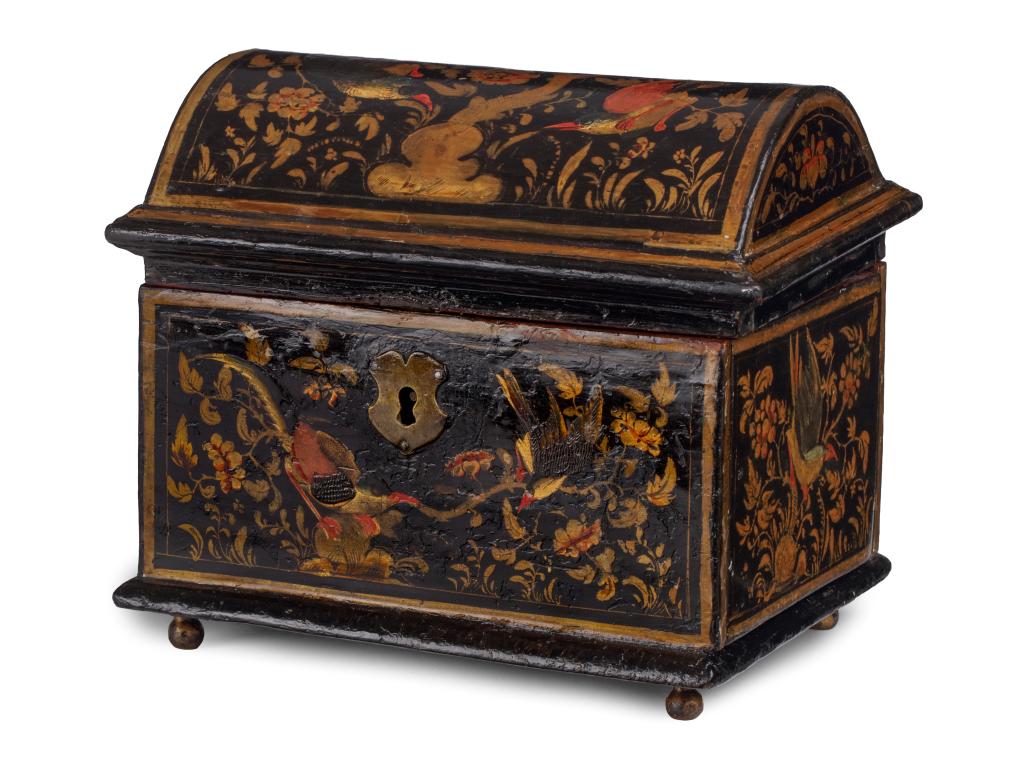
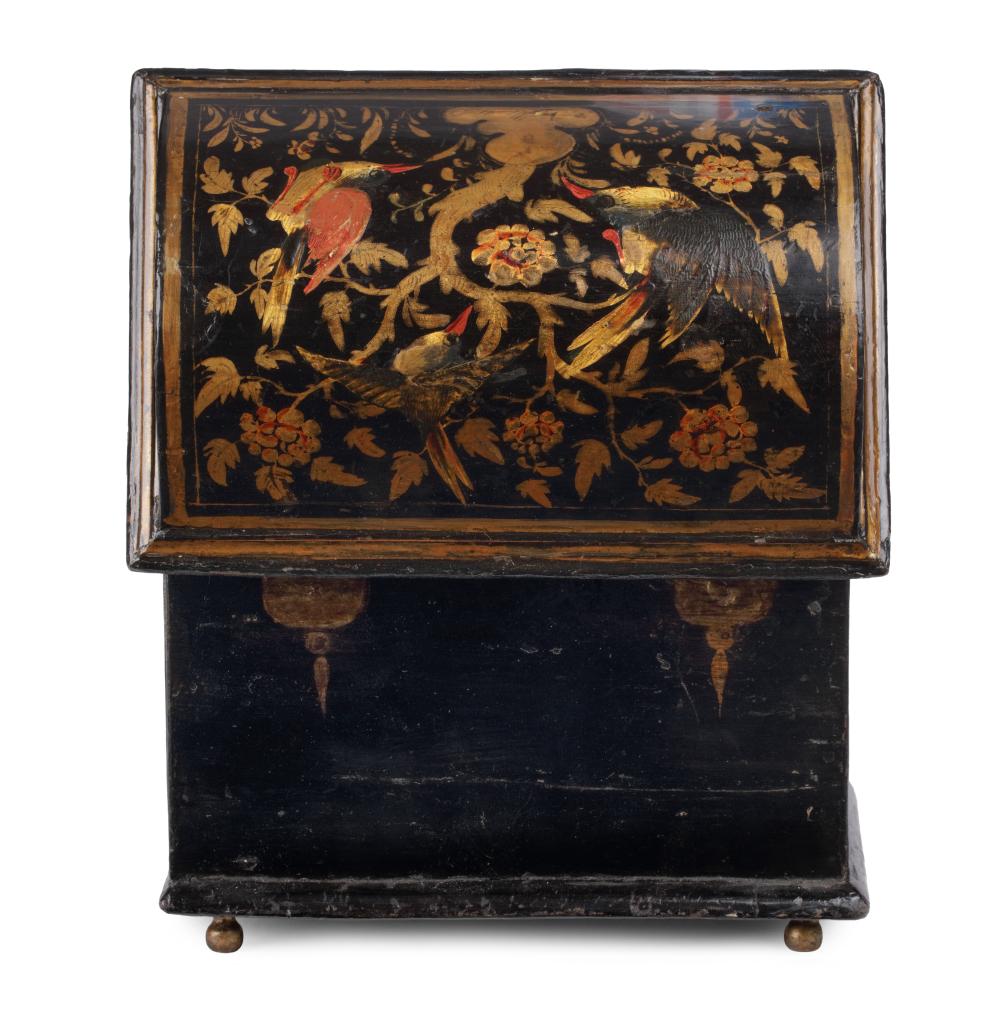
A Dutch chinoiserie lacquer casket by Willem Kick (1579-1647)
Amsterdam, circa 1620-1625
H. 16 x W. 18.9 x D. 13 cm
Provenance:
Private collection, Portugal (since at least the late 19th century)
Willem Kick: The Introduction of Lacquer Work in the Dutch Republic
Willem Kick (1579–1647) is recognized as a significant figure in the early 17th-century Dutch Republic, notably in the development and production of lacquered objects inspired by East Asian craftsmanship. His workshop in Amsterdam stands as one of the earliest establishments in Northern Europe to undertake the imitation of Japanese and Chinese lacquer, thereby paving the way for an independent European lacquer tradition. Recent scholarly research has provided a clearer understanding of his contributions based on archival documents and material analyses of attributed works.
Early life and first lacquer
Born in Breda, Kick subsequently moved to Delft before establishing himself in Amsterdam by 1609. In that year, he, along with his associates Balthasar van der Veecke and Jelis Jansen Beth, received a patent granting them the exclusive right to produce "all kinds of lacquer works" akin to those imported from East Asia (1). This patent conferred upon them a monopoly on the production of European lacquerware, thereby establishing Kick as the first documented professional lacquer craftsman in the region.
Kick’s workshop quickly gained recognition, securing high-profile commissions. Among the earliest known references to his work is the production of a large lacquered and gilded chest, delivered as a diplomatic gift from the Dutch States General to Sultan Ahmed I of the Ottoman Empire in 1612 (3). His signature on the accompanying invoice confirms his direct involvement in this transaction.
Innovation and metalware
In 1619, Kick obtained an additional patent for the application of lacquer on metal, marking a significant technological advancement in European lacquer techniques. The patent's text emphasized the durability of his lacquer, asserting its capacity to withstand impact without chipping and featuring an enhanced glossy finish resistant to abrasion. This technique presaged the Japanese methods that would become widely adopted in Europe in subsequent centuries.
A lacquered plate attributed to his workshop, preserved at the Museum für Lackkunst in Münster, remains the sole existing example of his innovation in this medium. It substantiates Kick’s engagement with metal lacquerwork. The plate’s decorative motifs reveal distinct influences from contemporary Chinese Kraak porcelain, suggesting a deliberate effort to cater to the European market's fascination with imported luxury goods (3).
Attribution and stylistic analysis
Kick's most recognizable products are the lacquered caskets attributed to his workshop, of which some are currently housed in the Rijksmuseum and other institutions. These caskets, dating from approximately 1618 to 1625, are characterized by a black lacquer ground adorned with gold-painted designs, enhanced by polychrome glazes in red, green, and blue. The motifs—depicting birds among flowering shrubs, heraldic symbols, and drapery—combine East Asian aesthetic elements with European decorative traditions, particularly Dutch ornamental prints from the early 17th century.
Notably, a casket dated 1618 features a painted coat of arms and a heart pierced by an arrow, indicating its commission as a marriage gift. Its structural design, which includes a hidden compartment accessible through a sliding panel, aligns with Japanese export lacquerware of the period but has been adapted to suit European preferences. (3)
Business and legacy
Kick's enterprise extended beyond decorative objects to functional lacquered furnishings. Archival records document his production of lacquered cabinets, tables, and even bedsteads. His clientele encompassed the Dutch elite and foreign dignitaries, underscoring his commercial success. In 1613, he supplied a lacquered tableware set as a wedding gift for Princess Elisabeth Stuart. (2)
By the 1630s, Kick gradually shifted his focus to the production of gilt leather, a trade closely associated with lacquerwork due to its similar decorative techniques. His death certificate from 1647 specifies him as a maker of gilt leather, suggesting a decline in his lacquer production in the later years of his life. Nevertheless, his contributions had lasting effects on the European lacquer industry, particularly in the (Northern and Southern) Netherlands and Germany, where lacquer production continued to evolve throughout the 17th and 18th centuries.
Willem Kick played an instrumental role in introducing lacquerwork as a viable craft in the Dutch Republic, effectively bridging East Asian and European artistic traditions. His technical experimentation, particularly with metal lacquering, established a precedent for subsequent developments in European japanning. The recent identification of lacquered objects attributable to his workshop, such as the present casket and unique fall-front cabinet, has advanced our understanding of early European attempts to replicate and innovate upon imported luxury goods.
Sources:
(1) Reinier Baarsen, "Kistjes van Kick? Hollands lakwerk uit de vroege 17de eeuw" in: Bulletin van het Rijksmuseum 56, 2008, pp. 12–27
(2) G. Doorman, Octrooien voor uitvindingen in de Nederlanden uit de 16e-18e eeuw, Nijhoff, Den Haag, 1940, pp. 141-142
(3) Monika Kopplin, "Gelact ende verguld: New Discoveries from Willem Kick’s Workshop in Amsterdam" in: Studies in Conservation 64, 2019, pp. S4–S13
H. 16 x W. 18.9 x D. 13 cm
Provenance:
Private collection, Portugal (since at least the late 19th century)
Willem Kick: The Introduction of Lacquer Work in the Dutch Republic
Willem Kick (1579–1647) is recognized as a significant figure in the early 17th-century Dutch Republic, notably in the development and production of lacquered objects inspired by East Asian craftsmanship. His workshop in Amsterdam stands as one of the earliest establishments in Northern Europe to undertake the imitation of Japanese and Chinese lacquer, thereby paving the way for an independent European lacquer tradition. Recent scholarly research has provided a clearer understanding of his contributions based on archival documents and material analyses of attributed works.
Early life and first lacquer
Born in Breda, Kick subsequently moved to Delft before establishing himself in Amsterdam by 1609. In that year, he, along with his associates Balthasar van der Veecke and Jelis Jansen Beth, received a patent granting them the exclusive right to produce "all kinds of lacquer works" akin to those imported from East Asia (1). This patent conferred upon them a monopoly on the production of European lacquerware, thereby establishing Kick as the first documented professional lacquer craftsman in the region.
Kick’s workshop quickly gained recognition, securing high-profile commissions. Among the earliest known references to his work is the production of a large lacquered and gilded chest, delivered as a diplomatic gift from the Dutch States General to Sultan Ahmed I of the Ottoman Empire in 1612 (3). His signature on the accompanying invoice confirms his direct involvement in this transaction.
Innovation and metalware
In 1619, Kick obtained an additional patent for the application of lacquer on metal, marking a significant technological advancement in European lacquer techniques. The patent's text emphasized the durability of his lacquer, asserting its capacity to withstand impact without chipping and featuring an enhanced glossy finish resistant to abrasion. This technique presaged the Japanese methods that would become widely adopted in Europe in subsequent centuries.
A lacquered plate attributed to his workshop, preserved at the Museum für Lackkunst in Münster, remains the sole existing example of his innovation in this medium. It substantiates Kick’s engagement with metal lacquerwork. The plate’s decorative motifs reveal distinct influences from contemporary Chinese Kraak porcelain, suggesting a deliberate effort to cater to the European market's fascination with imported luxury goods (3).
Attribution and stylistic analysis
Kick's most recognizable products are the lacquered caskets attributed to his workshop, of which some are currently housed in the Rijksmuseum and other institutions. These caskets, dating from approximately 1618 to 1625, are characterized by a black lacquer ground adorned with gold-painted designs, enhanced by polychrome glazes in red, green, and blue. The motifs—depicting birds among flowering shrubs, heraldic symbols, and drapery—combine East Asian aesthetic elements with European decorative traditions, particularly Dutch ornamental prints from the early 17th century.
Notably, a casket dated 1618 features a painted coat of arms and a heart pierced by an arrow, indicating its commission as a marriage gift. Its structural design, which includes a hidden compartment accessible through a sliding panel, aligns with Japanese export lacquerware of the period but has been adapted to suit European preferences. (3)
Business and legacy
Kick's enterprise extended beyond decorative objects to functional lacquered furnishings. Archival records document his production of lacquered cabinets, tables, and even bedsteads. His clientele encompassed the Dutch elite and foreign dignitaries, underscoring his commercial success. In 1613, he supplied a lacquered tableware set as a wedding gift for Princess Elisabeth Stuart. (2)
By the 1630s, Kick gradually shifted his focus to the production of gilt leather, a trade closely associated with lacquerwork due to its similar decorative techniques. His death certificate from 1647 specifies him as a maker of gilt leather, suggesting a decline in his lacquer production in the later years of his life. Nevertheless, his contributions had lasting effects on the European lacquer industry, particularly in the (Northern and Southern) Netherlands and Germany, where lacquer production continued to evolve throughout the 17th and 18th centuries.
Willem Kick played an instrumental role in introducing lacquerwork as a viable craft in the Dutch Republic, effectively bridging East Asian and European artistic traditions. His technical experimentation, particularly with metal lacquering, established a precedent for subsequent developments in European japanning. The recent identification of lacquered objects attributable to his workshop, such as the present casket and unique fall-front cabinet, has advanced our understanding of early European attempts to replicate and innovate upon imported luxury goods.
Sources:
(1) Reinier Baarsen, "Kistjes van Kick? Hollands lakwerk uit de vroege 17de eeuw" in: Bulletin van het Rijksmuseum 56, 2008, pp. 12–27
(2) G. Doorman, Octrooien voor uitvindingen in de Nederlanden uit de 16e-18e eeuw, Nijhoff, Den Haag, 1940, pp. 141-142
(3) Monika Kopplin, "Gelact ende verguld: New Discoveries from Willem Kick’s Workshop in Amsterdam" in: Studies in Conservation 64, 2019, pp. S4–S13
Part of the Europe collection.