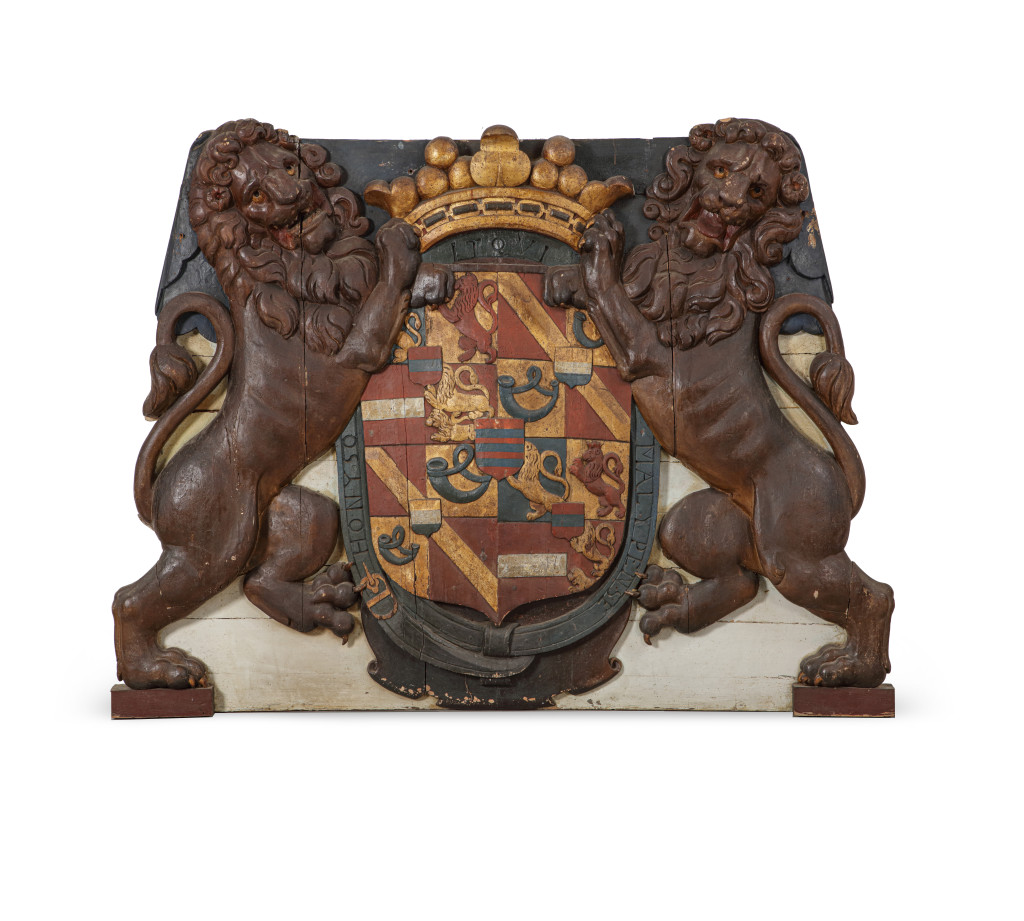
The tafferel stern decoration of the 17th century Dutch man-o-war "’T Prinssen Wapen"
Holland, probably Amsterdam, circa 1672
Probably from the ship ’T Prinssen Wapen (1672), snauwschip Adm. of Amsterdam under captain Hendrick Walop part of De Ruyter’s last campaign to the Mediterranean in 1675, involved in the battles of the Etna and Stromboli.
Carved and polychromed wood, featuring the coat-of-arms of the Prince of Orange, Stadtholder of the Dutch Republic, flanked by two rampant lions. The shield is quartered with diagonal bands, lions, and hunting horns, with a central escutcheon featuring a smaller shield with horizontal red and blue bands. The lions, with detailed manes and expressive faces, support the crest surmounted by a carved, gilded crown. The shield bears the motto “Honi soit qui mal y pense” along a ribbon. The backing panel is shaped, painted in muted tones, and shows signs of age, with cracks and wear. The lions rest on a slightly curved base, confirming this was originally mounted on a ship’s stern.
H. 147 x W. 193 cm
Provenance:
Archeologist, historian and economist Armand René du Chatellier (1797-1885), Chateau de Kernuz; thence by descent to his son
Archeologist and historian Paul Maufras de Chatellier (1833-1911), Chateau de Kernuz; thence by descent
Kept in the Maufras de Chatellier family, Chateau de Kernuz
Private collector, Europe (purchased from the above in 2019)
Original examples of seventeenth-century stern ornamentations are usually the domain of maritime archaeology. They are to be found as a component of shipwrecks on the bottom of the seas, where they are protected by heritage legislation: in the Netherlands by the Wrecks Act of 1934, and in the United Kingdom by the Protection of Wrecks Act of 1973. These laws ensure that maritime heritage is preserved on site. An exception to this practice is the wreck of the Vasa, a three-master built in the 1620s on the orders of the King of Sweden, Gustavus Adolphus. The ship sank immediately upon its launch in 1627 due to a lack of stability, partly caused by the lavish decoration. The wreck was salvaged in the port of Stockholm in 1959 and has since been displayed in the Vasa Museum.
The collection of the Rijksmuseum in Amsterdam also preserves an original seventeenth-century stern decoration. During the expedition on the Medway in June 1667, under the command of Michiel de Ruyter and Witte de With, the ship Royal Charles was captured from the English. The ship was built during the Commonwealth period in 1654 and had been delivered under the name Naseby. After the Restoration, in May 1660, the ship was renamed Royal Charles by decree of King Charles II and his brother James, Duke of York. The original tafferel was then covered with new carvings representing the royal arms. After the capture, the ship was brought to the Netherlands and exhibited to the public in Hellevoetsluis until 1673, when the parts were sold for scrap. The stern decoration could be removed relatively easily during dismantling and was kept as a trophy in the storehouses of the Admiralty of Rotterdam until it was transferred to the Ministry of the Navy in 1855.
The carving on the stern of a ship often relates to its name and, in addition to its ornamental function, serves as a feature of recognition. In English, ‘tafferel’ is still a common term for the carving on top of a ship’s stern, whereas in Dutch, the word ‘tafereel’ has fallen into disuse. The framing of the woodcarving by a tabernacle with curtains was a common feature of stern decoration in the seventeenth century, comparable to how a ‘tafereel’ or ‘tonneel’ was presented within the frame of an open curtain on frontispieces in printed books.
Indeed, the planked support tapers at the top of the present tafferel follow the shape of a vessel. On the top side, it would have been crowned by naiads of reclining dolphins, lions, or mermaids. Just below the naiads and along the sides were the draperies of a curtain with a caryatid as a quarter piece on the outer corners on either side of the ship. In larger ships, the construction required a slight curvature of the tafferel to ensure stability.
The woodcarving shows the coat-of-arms of Prince Maurice of Orange (1567-1625) adorned with the order of the garter and the motto ‘honi soit qui mal y pense’. The shield is carried on either side by a lion. The limited plasticity of the relief suggests that the stern does not date from Maurits’ lifetime but rather from the second half of the seventeenth century, when the decorations on Dutch ships showed less exuberance in comparison to the first decades of that century.
To identify the associated ship, the lists of Dutch warships from the unpublished inventory by A. Vreugdenhil and J. van Sluijs have been examined. A copy of the manuscript of this six-part documentation can be found in the Amsterdam Maritime Museum. The following names qualified: ‘T Wapen van Nassau (c. 1650), Admiralty of Friesland; Prins Maurits (built before 1652), Admiralty of the Noorderkwartier; ‘t Prince Wapen (built before 1656), Admiralty of Friesland; Prins Maurits, mentioned in 1656 in Dantzig; ’T Prinssen Wapen (built in 1672), Admiralty of Amsterdam.
From the modest size of our tafferel it can be derived that only a ship of small dimensions may be considered. ’T Prinssen Wapen from 1672 is the only vessel that meets this requirement. The ship is described in logs as being a ‘snow’ with 8 guns and a length of 36 meters. The seventeenth-century snow is not to be confused with the small men-o-war and merchant ships that sailed brig-rigged with a snowmast from the second half of the eighteenth century. The seventeenth-century designation refers to a small open-sailing vessel of two masts that was widely in use by Flemish privateers during the early modern period. The Admiralty of Amsterdam started to outfit snows as part of their fleet during the 1670s, and as such, they appear on fleet lists.
<br>
Despite its small dimensions, ’T Prinssen Wapen holds an important service record. On 16 August 1675, it sailed under the command of the Gouda lieutenant Hendrick Walop towards the Mediterranean to assist Lieutenant-Admiral De Ruyter in his campaign against the fleet of Louis XIV. Walop was the son-in-law of Rear Admiral Pieter van Middelant, who kept command of the ship ‘Steenbergen’. The snow was subsequently involved in the three important sea battles of 1676, subsequently the Battle of Stromboli on 8 January, the Battle of Agosta on 22 April and the Battle of Palermo on 2 June. Michiel de Ruyter died from wounds sustained during the Battle of Agosta on April 29th. Three days later, Walop’s father-in-law perished during the Battle of Stromboli. After this incident, nothing more is heard of ’T Prinssen Wapen. It is likely that Walop was assigned to command one of the larger men-o-war and that the snow was left for scrap in the waters near Stromboli.
’T Prinssen Wapen was launched in 1672 during the so-called disaster year (‘Rampjaar’), when the Republic was attacked from all sides by foreign powers. It is also the year in which the First Stadtholderless Period came to an end with Prince William III being appointed as supreme commander of both the army and fleet. It is conceivable that the tafferel, similar to the stern decoration of the British Royal Charles, was loosely added shortly before the launch of ’T Prinssen Wapen as an honorary token from the Amsterdam Admiralty to the Prince of Orange. The remarkable fact that the present tafferel has been preserved above water over the centuries could possibly also be explained by its demountability. As the ship was abandoned in Mediterranean waters, the tafferel could thus have easily been dismantled and collected as a trophy by the French.
Since the nineteenth century, the tafferel can be traced back to the collection of the Maufras de Chatellier family in Brittany. The historian Paul Chatellier established a museum in his family home of Chateau Kernuz, showcasing archaeological finds and objects of historical importance. The museum was dismantled in 1927, and the collection was transferred to the Musée National de Saint-Germain-en-Laye. The objects that were deemed too large or too heavy were left in the castle, where the stern decoration remained until 2019.
We are grateful to Mr. Ab Hoving, former head curator of the Marinemodellenkamer, Rijksmuseum, for his assistance in writing this catalogue entry.
Literature:
- Armand du Chatellier, Archives de la famille Maufras du Chatellier (Chateau de Kernuz, près Pont-l’Abbé)., Orléans 1881
- Henri Bourde de La Rogerie and Jean-Marie Abgrall, ‘Paul du Chatellier’, in: Bulletin de la Société archéologique de Finistère, Vol. XXXVIII (1911), pp. 167-78 and XII-XVI
- Yves Coativy [ed.], Paul de Chatellier. Collectionneur finistérien (1833-1911), Brest, 2006
Probably from the ship ’T Prinssen Wapen (1672), snauwschip Adm. of Amsterdam under captain Hendrick Walop part of De Ruyter’s last campaign to the Mediterranean in 1675, involved in the battles of the Etna and Stromboli.
Carved and polychromed wood, featuring the coat-of-arms of the Prince of Orange, Stadtholder of the Dutch Republic, flanked by two rampant lions. The shield is quartered with diagonal bands, lions, and hunting horns, with a central escutcheon featuring a smaller shield with horizontal red and blue bands. The lions, with detailed manes and expressive faces, support the crest surmounted by a carved, gilded crown. The shield bears the motto “Honi soit qui mal y pense” along a ribbon. The backing panel is shaped, painted in muted tones, and shows signs of age, with cracks and wear. The lions rest on a slightly curved base, confirming this was originally mounted on a ship’s stern.
H. 147 x W. 193 cm
Provenance:
Archeologist, historian and economist Armand René du Chatellier (1797-1885), Chateau de Kernuz; thence by descent to his son
Archeologist and historian Paul Maufras de Chatellier (1833-1911), Chateau de Kernuz; thence by descent
Kept in the Maufras de Chatellier family, Chateau de Kernuz
Private collector, Europe (purchased from the above in 2019)
Original examples of seventeenth-century stern ornamentations are usually the domain of maritime archaeology. They are to be found as a component of shipwrecks on the bottom of the seas, where they are protected by heritage legislation: in the Netherlands by the Wrecks Act of 1934, and in the United Kingdom by the Protection of Wrecks Act of 1973. These laws ensure that maritime heritage is preserved on site. An exception to this practice is the wreck of the Vasa, a three-master built in the 1620s on the orders of the King of Sweden, Gustavus Adolphus. The ship sank immediately upon its launch in 1627 due to a lack of stability, partly caused by the lavish decoration. The wreck was salvaged in the port of Stockholm in 1959 and has since been displayed in the Vasa Museum.
The collection of the Rijksmuseum in Amsterdam also preserves an original seventeenth-century stern decoration. During the expedition on the Medway in June 1667, under the command of Michiel de Ruyter and Witte de With, the ship Royal Charles was captured from the English. The ship was built during the Commonwealth period in 1654 and had been delivered under the name Naseby. After the Restoration, in May 1660, the ship was renamed Royal Charles by decree of King Charles II and his brother James, Duke of York. The original tafferel was then covered with new carvings representing the royal arms. After the capture, the ship was brought to the Netherlands and exhibited to the public in Hellevoetsluis until 1673, when the parts were sold for scrap. The stern decoration could be removed relatively easily during dismantling and was kept as a trophy in the storehouses of the Admiralty of Rotterdam until it was transferred to the Ministry of the Navy in 1855.
The carving on the stern of a ship often relates to its name and, in addition to its ornamental function, serves as a feature of recognition. In English, ‘tafferel’ is still a common term for the carving on top of a ship’s stern, whereas in Dutch, the word ‘tafereel’ has fallen into disuse. The framing of the woodcarving by a tabernacle with curtains was a common feature of stern decoration in the seventeenth century, comparable to how a ‘tafereel’ or ‘tonneel’ was presented within the frame of an open curtain on frontispieces in printed books.
Indeed, the planked support tapers at the top of the present tafferel follow the shape of a vessel. On the top side, it would have been crowned by naiads of reclining dolphins, lions, or mermaids. Just below the naiads and along the sides were the draperies of a curtain with a caryatid as a quarter piece on the outer corners on either side of the ship. In larger ships, the construction required a slight curvature of the tafferel to ensure stability.
The woodcarving shows the coat-of-arms of Prince Maurice of Orange (1567-1625) adorned with the order of the garter and the motto ‘honi soit qui mal y pense’. The shield is carried on either side by a lion. The limited plasticity of the relief suggests that the stern does not date from Maurits’ lifetime but rather from the second half of the seventeenth century, when the decorations on Dutch ships showed less exuberance in comparison to the first decades of that century.
To identify the associated ship, the lists of Dutch warships from the unpublished inventory by A. Vreugdenhil and J. van Sluijs have been examined. A copy of the manuscript of this six-part documentation can be found in the Amsterdam Maritime Museum. The following names qualified: ‘T Wapen van Nassau (c. 1650), Admiralty of Friesland; Prins Maurits (built before 1652), Admiralty of the Noorderkwartier; ‘t Prince Wapen (built before 1656), Admiralty of Friesland; Prins Maurits, mentioned in 1656 in Dantzig; ’T Prinssen Wapen (built in 1672), Admiralty of Amsterdam.
From the modest size of our tafferel it can be derived that only a ship of small dimensions may be considered. ’T Prinssen Wapen from 1672 is the only vessel that meets this requirement. The ship is described in logs as being a ‘snow’ with 8 guns and a length of 36 meters. The seventeenth-century snow is not to be confused with the small men-o-war and merchant ships that sailed brig-rigged with a snowmast from the second half of the eighteenth century. The seventeenth-century designation refers to a small open-sailing vessel of two masts that was widely in use by Flemish privateers during the early modern period. The Admiralty of Amsterdam started to outfit snows as part of their fleet during the 1670s, and as such, they appear on fleet lists.
<br>
Despite its small dimensions, ’T Prinssen Wapen holds an important service record. On 16 August 1675, it sailed under the command of the Gouda lieutenant Hendrick Walop towards the Mediterranean to assist Lieutenant-Admiral De Ruyter in his campaign against the fleet of Louis XIV. Walop was the son-in-law of Rear Admiral Pieter van Middelant, who kept command of the ship ‘Steenbergen’. The snow was subsequently involved in the three important sea battles of 1676, subsequently the Battle of Stromboli on 8 January, the Battle of Agosta on 22 April and the Battle of Palermo on 2 June. Michiel de Ruyter died from wounds sustained during the Battle of Agosta on April 29th. Three days later, Walop’s father-in-law perished during the Battle of Stromboli. After this incident, nothing more is heard of ’T Prinssen Wapen. It is likely that Walop was assigned to command one of the larger men-o-war and that the snow was left for scrap in the waters near Stromboli.
’T Prinssen Wapen was launched in 1672 during the so-called disaster year (‘Rampjaar’), when the Republic was attacked from all sides by foreign powers. It is also the year in which the First Stadtholderless Period came to an end with Prince William III being appointed as supreme commander of both the army and fleet. It is conceivable that the tafferel, similar to the stern decoration of the British Royal Charles, was loosely added shortly before the launch of ’T Prinssen Wapen as an honorary token from the Amsterdam Admiralty to the Prince of Orange. The remarkable fact that the present tafferel has been preserved above water over the centuries could possibly also be explained by its demountability. As the ship was abandoned in Mediterranean waters, the tafferel could thus have easily been dismantled and collected as a trophy by the French.
Since the nineteenth century, the tafferel can be traced back to the collection of the Maufras de Chatellier family in Brittany. The historian Paul Chatellier established a museum in his family home of Chateau Kernuz, showcasing archaeological finds and objects of historical importance. The museum was dismantled in 1927, and the collection was transferred to the Musée National de Saint-Germain-en-Laye. The objects that were deemed too large or too heavy were left in the castle, where the stern decoration remained until 2019.
We are grateful to Mr. Ab Hoving, former head curator of the Marinemodellenkamer, Rijksmuseum, for his assistance in writing this catalogue entry.
Literature:
- Armand du Chatellier, Archives de la famille Maufras du Chatellier (Chateau de Kernuz, près Pont-l’Abbé)., Orléans 1881
- Henri Bourde de La Rogerie and Jean-Marie Abgrall, ‘Paul du Chatellier’, in: Bulletin de la Société archéologique de Finistère, Vol. XXXVIII (1911), pp. 167-78 and XII-XVI
- Yves Coativy [ed.], Paul de Chatellier. Collectionneur finistérien (1833-1911), Brest, 2006
Part of the Europe collection.
Related objects
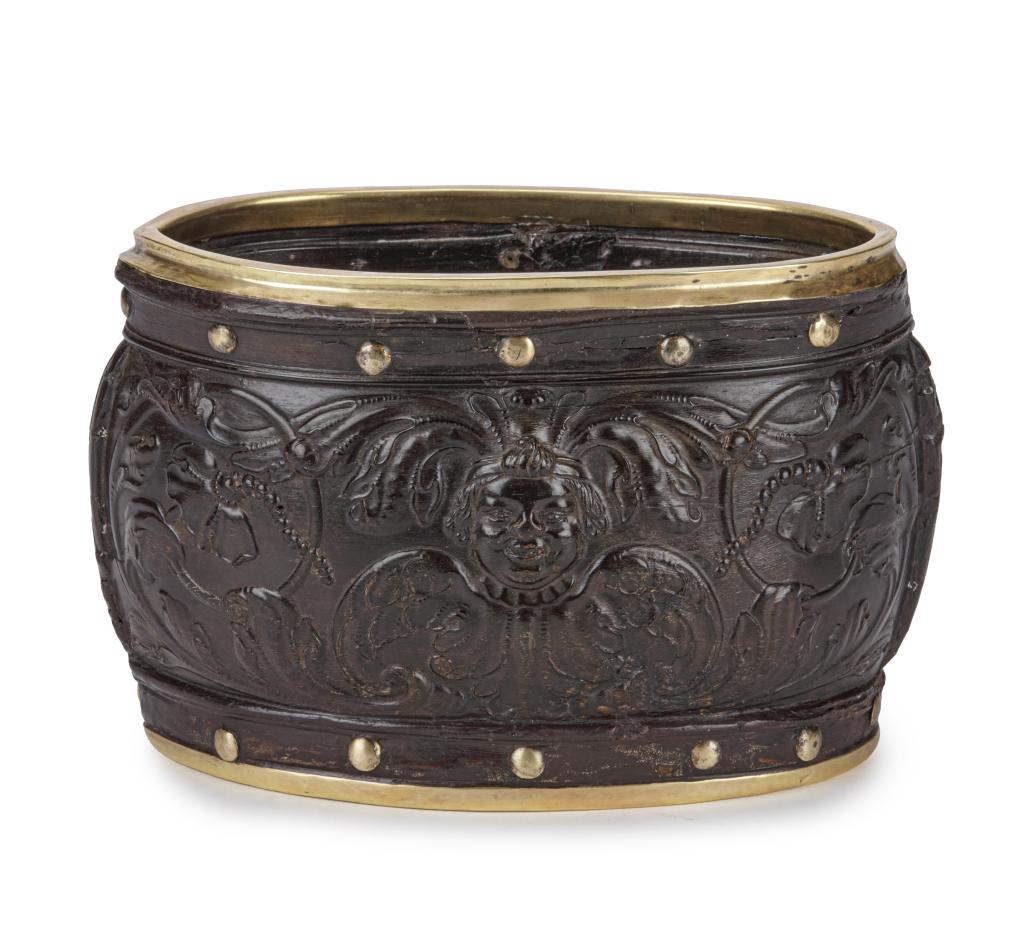
A Dutch brass-mounted pressed baleen casket by Herman Doomer (1595–1650)
_Amsterdam, circa 1640_ _L. 20.7 x W. 13 x H. 14.3 cm_
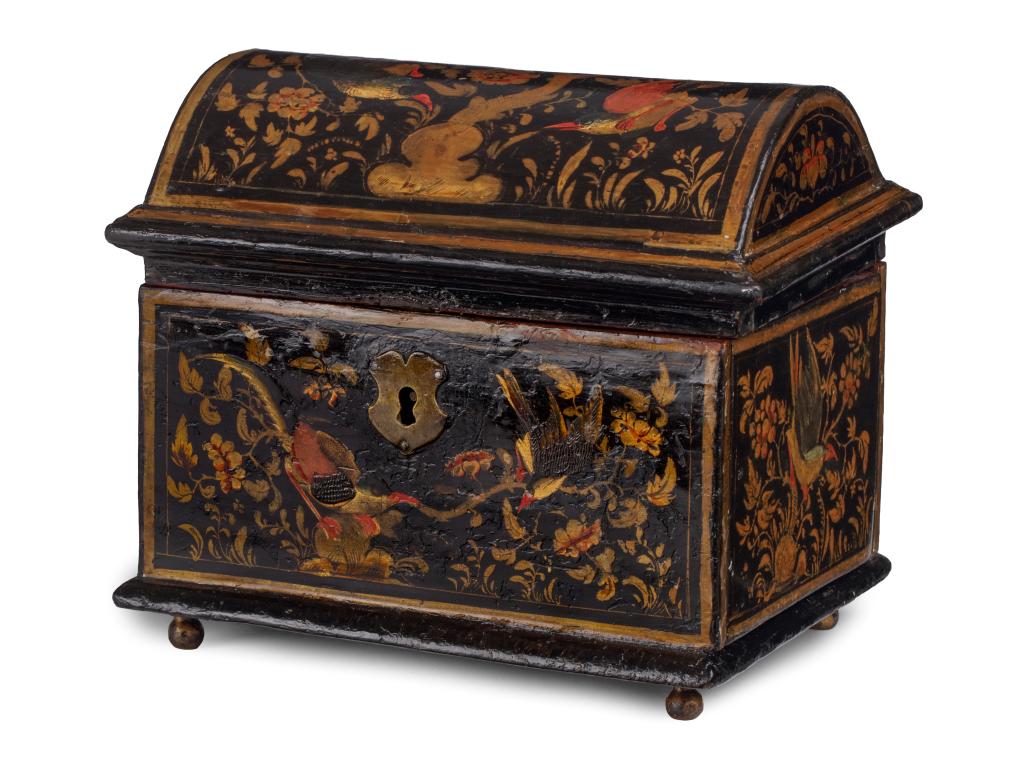
A Dutch chinoiserie lacquer casket by Willem Kick (1579-1647)
_Amsterdam, circa 1620-1625_ _H. 16 x W. 18.9 x D. 13 cm_ Provenance: Private collection, Portugal (since at least the late 19th century)
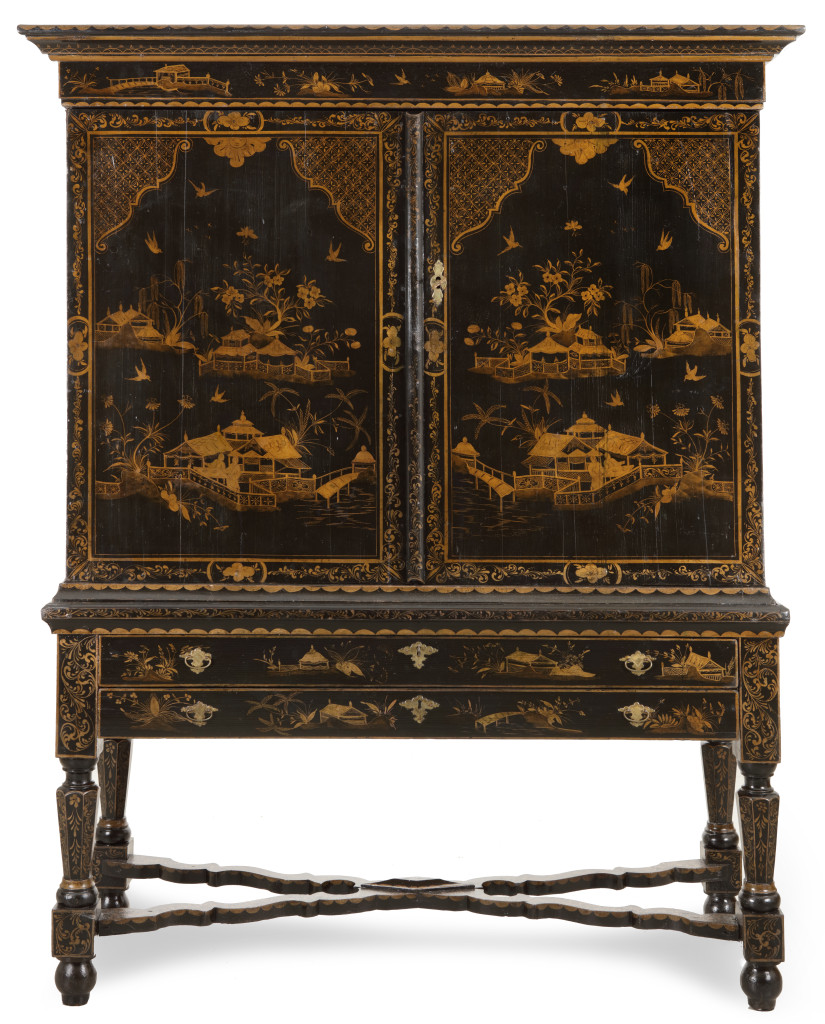
A Dutch lacquered cabinet on stand with chinoiserie decoration
Holland, late 17th century