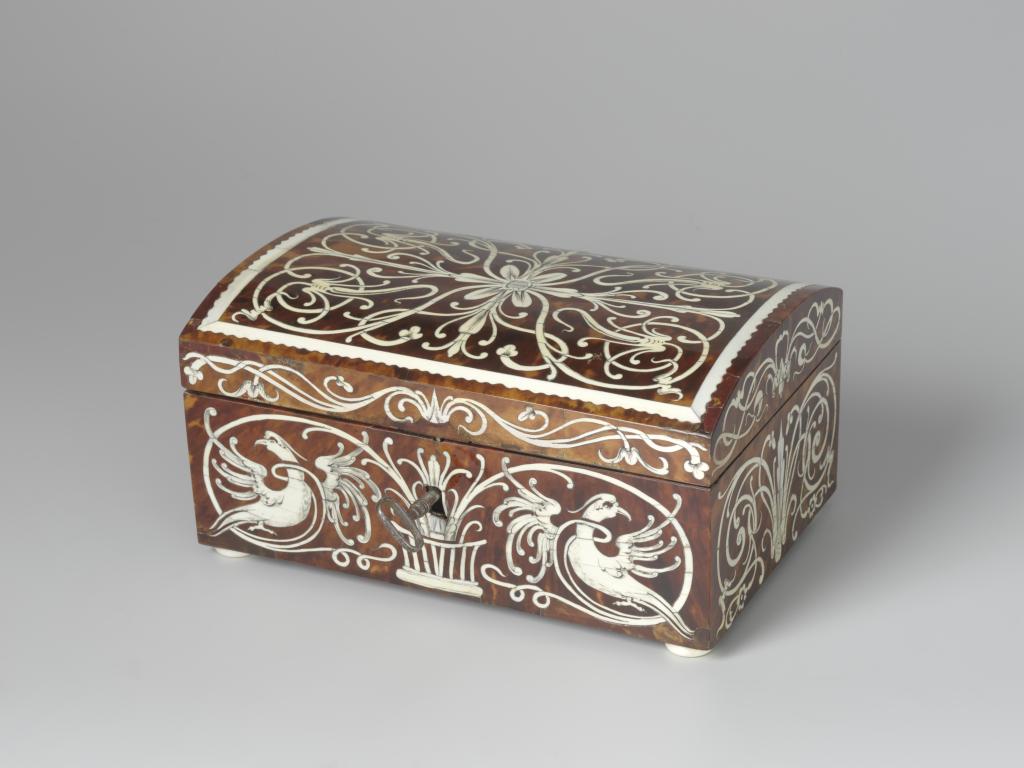
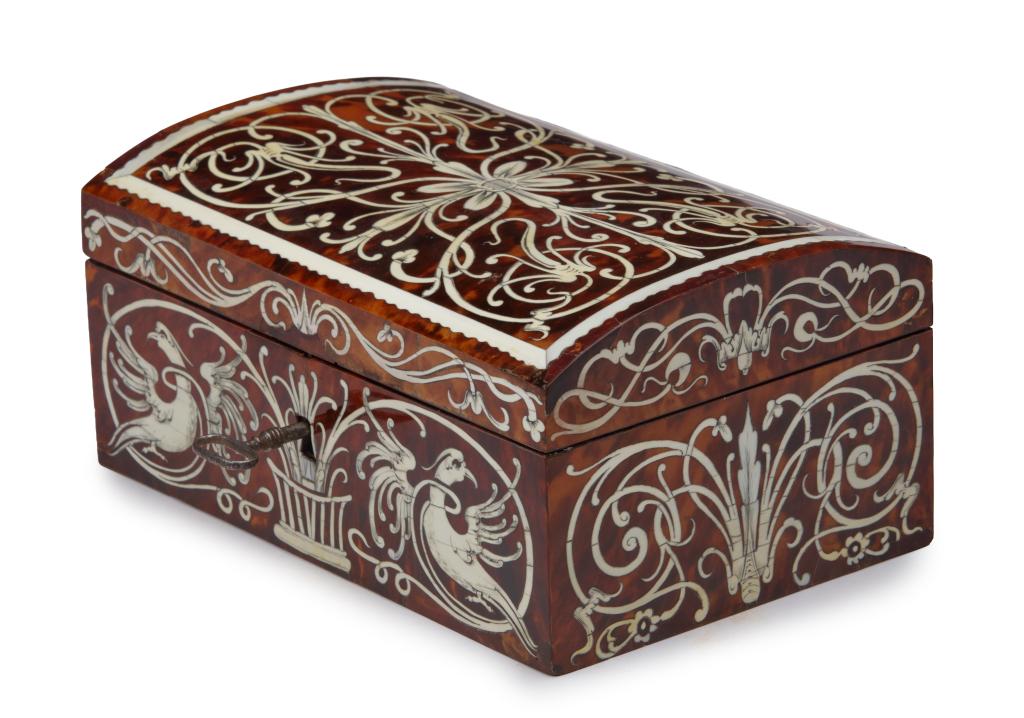
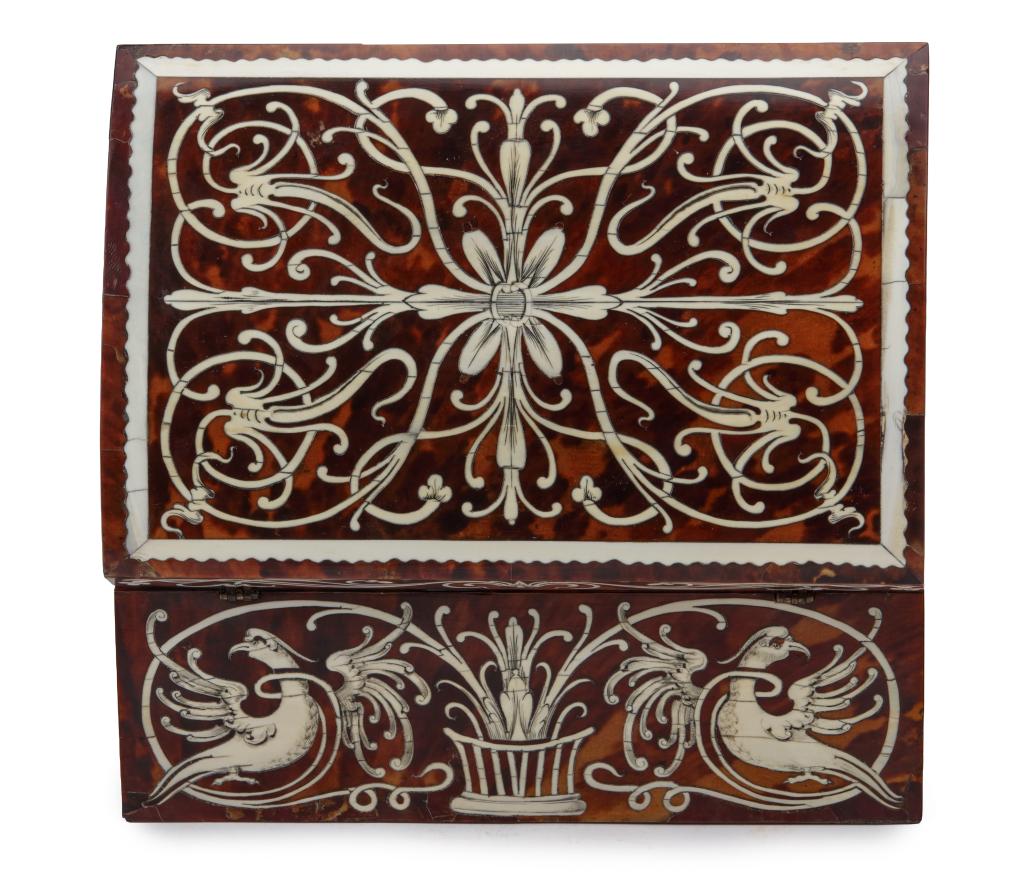
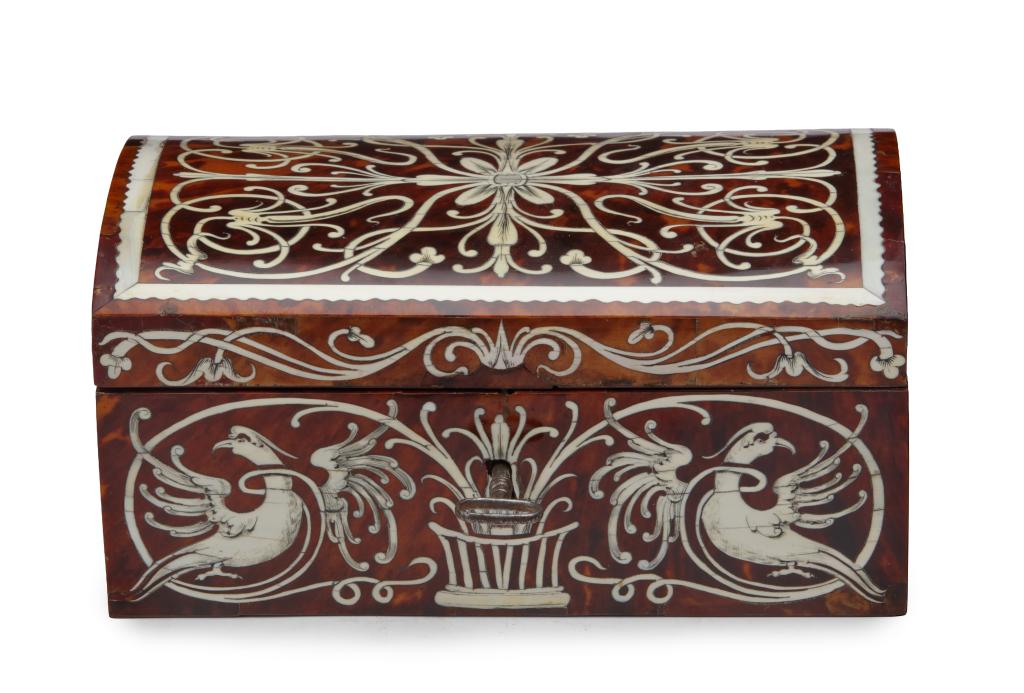
An ivory and tortoiseshell marquetry box attributed to Willem de Rots (act. 1640-1660)
The Hague, mid-17th century
H. 10.5 x W. 21.6 x D. 14.3 cm
Provenance:
Noble collection, Paris (the box came by repute from the German branch of the family)
Attributed to Willem de Rots, cabinet-maker and concierge at the court of Amalia van Solms in the Hague, on the basis of comparison with the cabinet (Rijksmuseum, BK-2005-19) and a box (Victoria&Albert Museum, 2422- 1856) made in circa 1650-60. The Hague was noted for its fashionable and sophisticated court taste with a strong Parisian accent, set by the Stadholders from the 1630s. Furniture was ordered from Paris, but the wealthy inhabitants of the city also supported artists and craftsmen.
The use of ivory and turtle-shell marquetry was influenced by furniture made in Paris and possibly northern Germany from the 1640s. The technique of two-material marquetry, sawn from clamped sheets at the same time later came to be known as 'Boulle marquetry', after its famous proponent André-Charles Boulle.
Willem, also known as Wilhelm Rots, was Princess Amalia’s concierge or kastelein, responsible for the moveable goods in her palaces, from at least the early 1650s and is recorded in the Hague from 1649 when he associated with ebony workers. He may have been of German origin. Another box with ivory and turtle-shell marquetry, with the HAVO monogram and therefore probably made for Amalia survives in the collection of the Landgrave of Hesse at Schloss Fasanerie. Baarsen suggests that Rots probably worked exclusively for the court. If this box is by Rots, it represents a simpler type of work from his documented and extremely elaborate cabinet for Amalia, and might have been a modest commission from a visitor to court.
Source:
Reinier Baarsen, Furniture in Holland’s Golden Age, Amsterdam, Rijksmuseum, 2007, pp. 111-123
H. 10.5 x W. 21.6 x D. 14.3 cm
Provenance:
Noble collection, Paris (the box came by repute from the German branch of the family)
Attributed to Willem de Rots, cabinet-maker and concierge at the court of Amalia van Solms in the Hague, on the basis of comparison with the cabinet (Rijksmuseum, BK-2005-19) and a box (Victoria&Albert Museum, 2422- 1856) made in circa 1650-60. The Hague was noted for its fashionable and sophisticated court taste with a strong Parisian accent, set by the Stadholders from the 1630s. Furniture was ordered from Paris, but the wealthy inhabitants of the city also supported artists and craftsmen.
The use of ivory and turtle-shell marquetry was influenced by furniture made in Paris and possibly northern Germany from the 1640s. The technique of two-material marquetry, sawn from clamped sheets at the same time later came to be known as 'Boulle marquetry', after its famous proponent André-Charles Boulle.
Willem, also known as Wilhelm Rots, was Princess Amalia’s concierge or kastelein, responsible for the moveable goods in her palaces, from at least the early 1650s and is recorded in the Hague from 1649 when he associated with ebony workers. He may have been of German origin. Another box with ivory and turtle-shell marquetry, with the HAVO monogram and therefore probably made for Amalia survives in the collection of the Landgrave of Hesse at Schloss Fasanerie. Baarsen suggests that Rots probably worked exclusively for the court. If this box is by Rots, it represents a simpler type of work from his documented and extremely elaborate cabinet for Amalia, and might have been a modest commission from a visitor to court.
Source:
Reinier Baarsen, Furniture in Holland’s Golden Age, Amsterdam, Rijksmuseum, 2007, pp. 111-123
Related objects
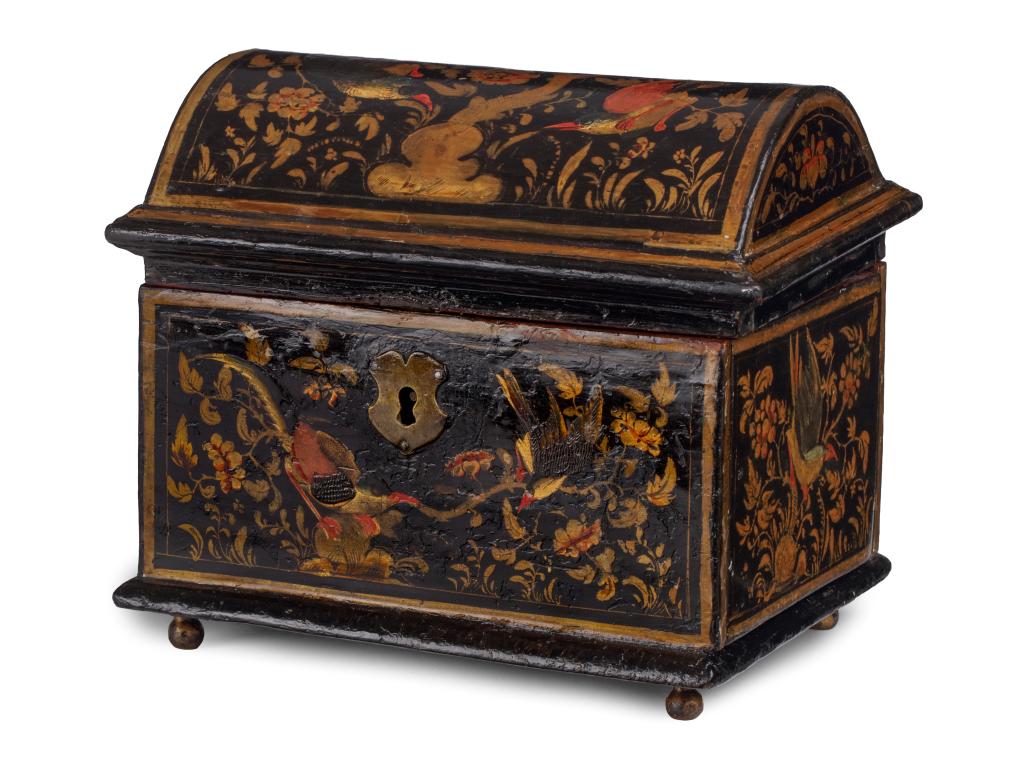
A Dutch chinoiserie lacquer casket by Willem Kick (1579-1647)
_Amsterdam, circa 1620-1625_ _H. 16 x W. 18.9 x D. 13 cm_ Provenance: Private collection, Portugal (since at least the late 19th century)
No image
A set of four German turned ivory pricket candlesticks
_Probably Augsburg, Southern Germany, circa 1650_ _H. 18.5 cm (each)_ _Diam. 10 cm_ Provenance: - Private collection, the Netherlands
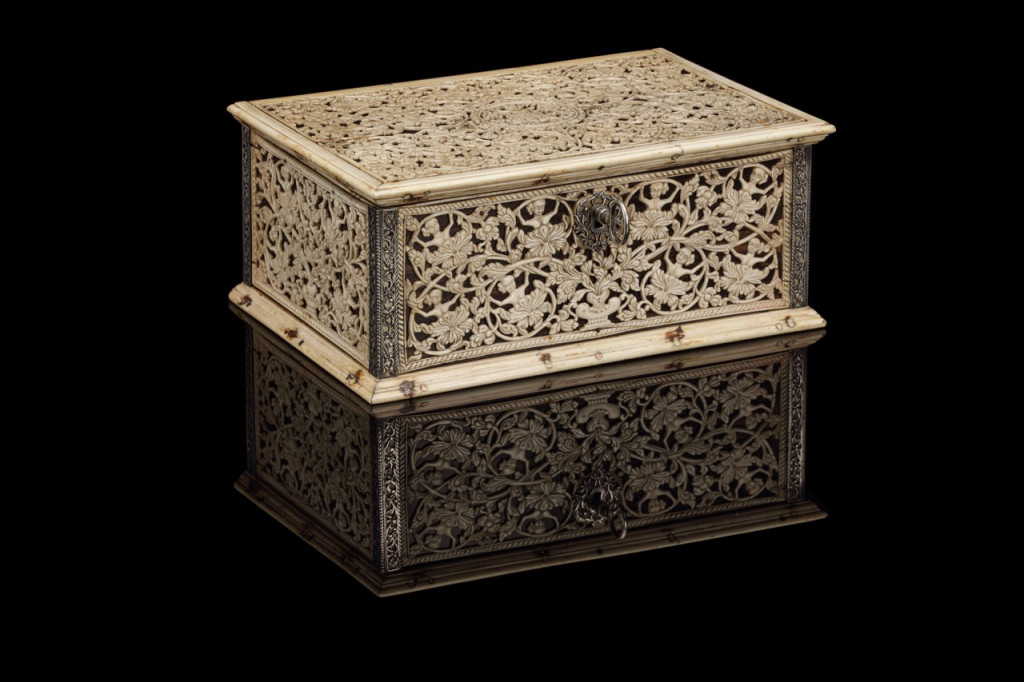
A rare Portuguese-Sinhalese openwork ivory and ebony casket with silver mounts
_Sri Lanka, 1st half 17th century_ _H. 10 x W. 23.2 x D. 16 cm_ A similar box in the collection of the National Museum of Colombo is illustrated in Portugal e Ceilão, Pedro Dias, Lisboa 2006, p.179.