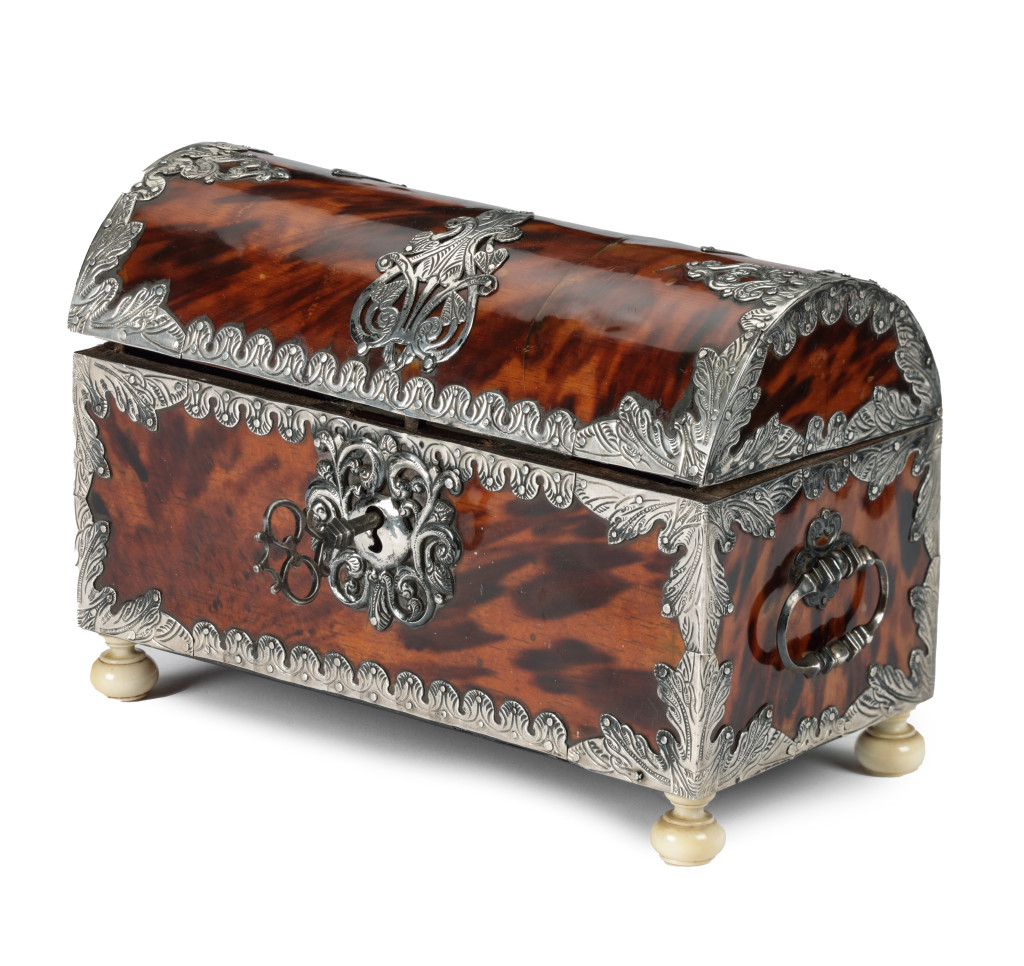
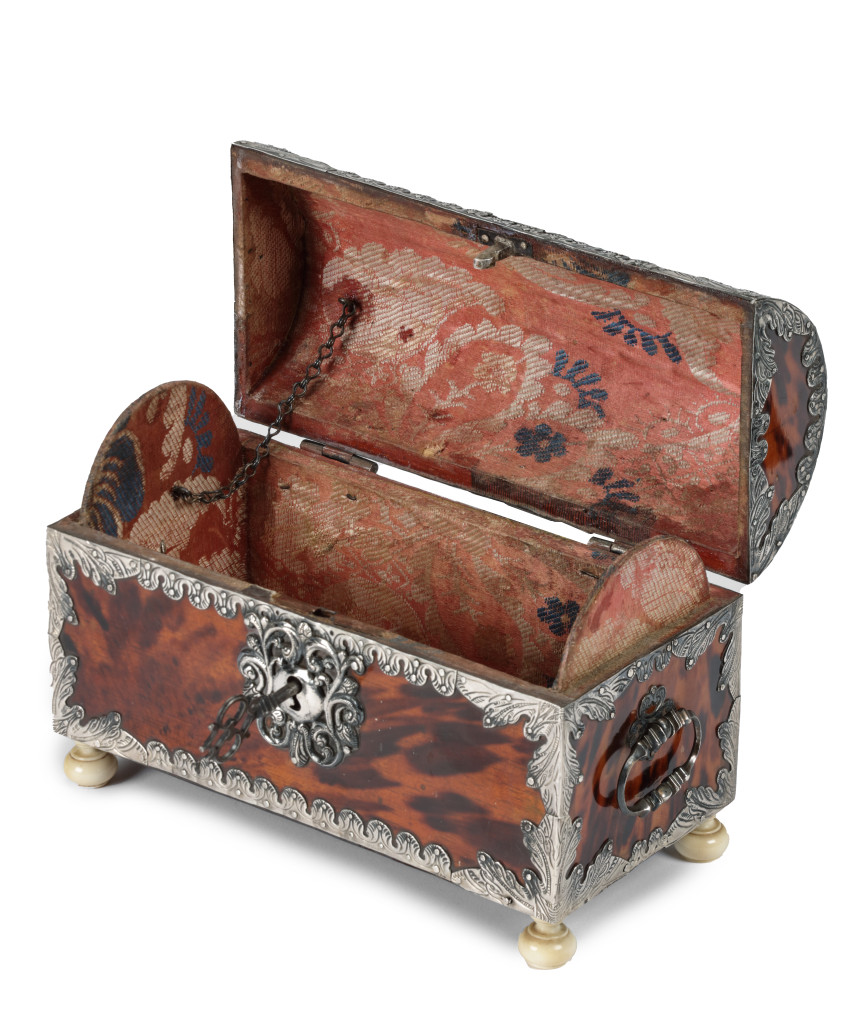
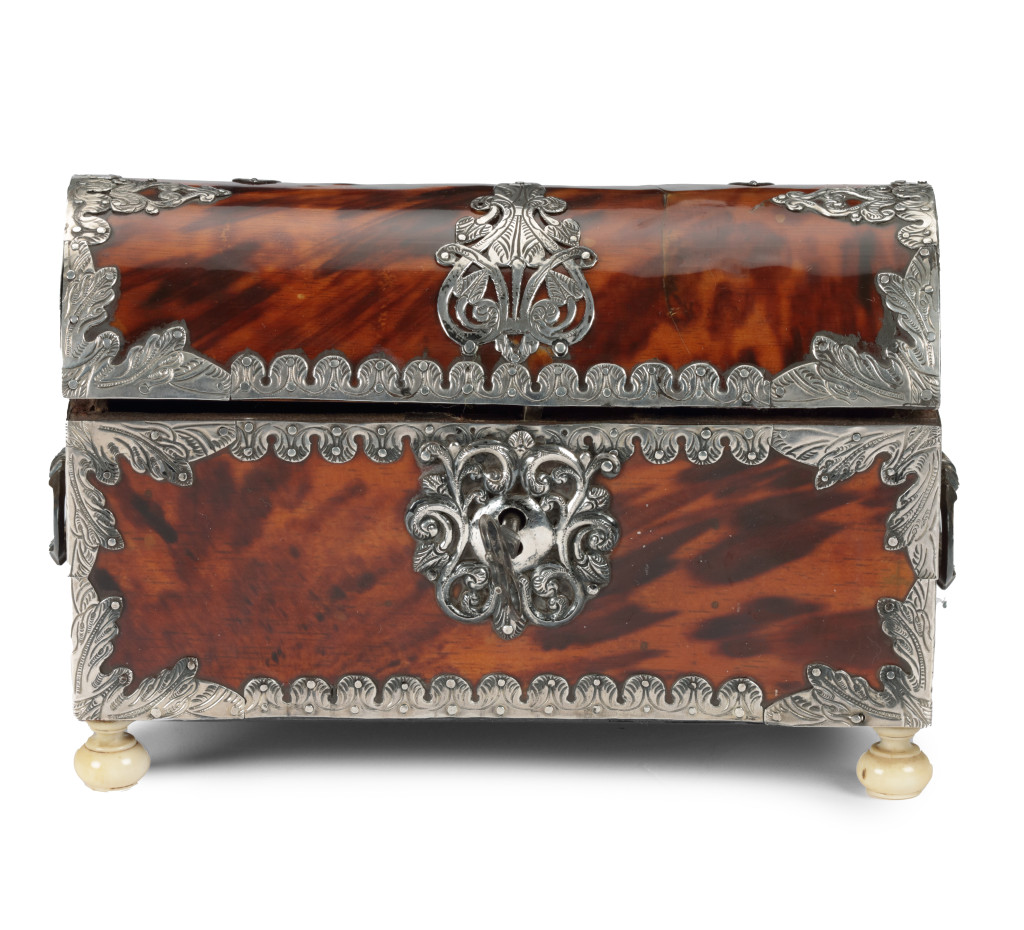
A colonial tortoiseshell veneered casket with silver mounts
Possibly Spanish colonial, 17th century
H. 15.2 x W. 25.1 x D. 12 cm
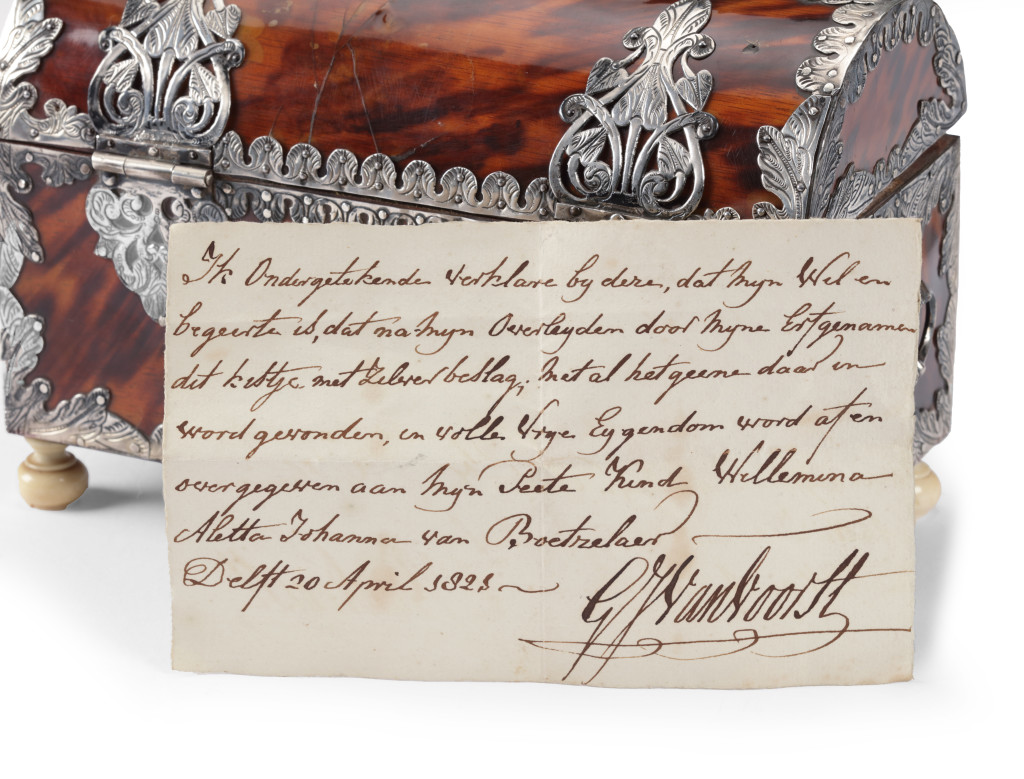
Included is a hand-written letter, reading:
Ik Ondergetekenden verklare bij dezen, dat mijn Wel en Begeerte is, dat na Mijn verleyden door Mijne Erfgenamen dit kistjhe met Zilver beslag, met al het geene daar in word gevonden, in vollen Eygendom word af en overgegeven aan Mijn Peete Kind Willemina Aletta Johanna van Boetzelaer.
Delft 20 April 1825
G.J. van Voorst
Which translates to:
I, the undersigned, hereby declare that it is my will and desire that, after my passing, this box with silver mounts, along with everything found within it, shall be transferred in full ownership to my godchild, Willemina Aletta Johanna van Boetzelaer.
Delft, 20 April 1825
G.J. van Voorst
Until recently these caskets were often classified as Spanish or Portuguese but it has become clear that they were produced over a very wide geographic area under European patronage in workshops in India, Sri Lanka, Batavia, China, the Caribbean, Central and South America in the seventeenth and eighteenth centuries. Distinguishing regional characteristics are generally only found in the type of decoration of the mounts.
Tortoiseshell used in luxury works of art and in furniture veneers is derived from the outer layer of the sea turtle's shell, primarily the giant Green (Chelonia mydas) and Hawksbill (Eretmochelys imbricata) turtles.
H. 15.2 x W. 25.1 x D. 12 cm
Included is a hand-written letter, reading:
Ik Ondergetekenden verklare bij dezen, dat mijn Wel en Begeerte is, dat na Mijn verleyden door Mijne Erfgenamen dit kistjhe met Zilver beslag, met al het geene daar in word gevonden, in vollen Eygendom word af en overgegeven aan Mijn Peete Kind Willemina Aletta Johanna van Boetzelaer.
Delft 20 April 1825
G.J. van Voorst
Which translates to:
I, the undersigned, hereby declare that it is my will and desire that, after my passing, this box with silver mounts, along with everything found within it, shall be transferred in full ownership to my godchild, Willemina Aletta Johanna van Boetzelaer.
Delft, 20 April 1825
G.J. van Voorst
Until recently these caskets were often classified as Spanish or Portuguese but it has become clear that they were produced over a very wide geographic area under European patronage in workshops in India, Sri Lanka, Batavia, China, the Caribbean, Central and South America in the seventeenth and eighteenth centuries. Distinguishing regional characteristics are generally only found in the type of decoration of the mounts.
Tortoiseshell used in luxury works of art and in furniture veneers is derived from the outer layer of the sea turtle's shell, primarily the giant Green (Chelonia mydas) and Hawksbill (Eretmochelys imbricata) turtles.
Related objects
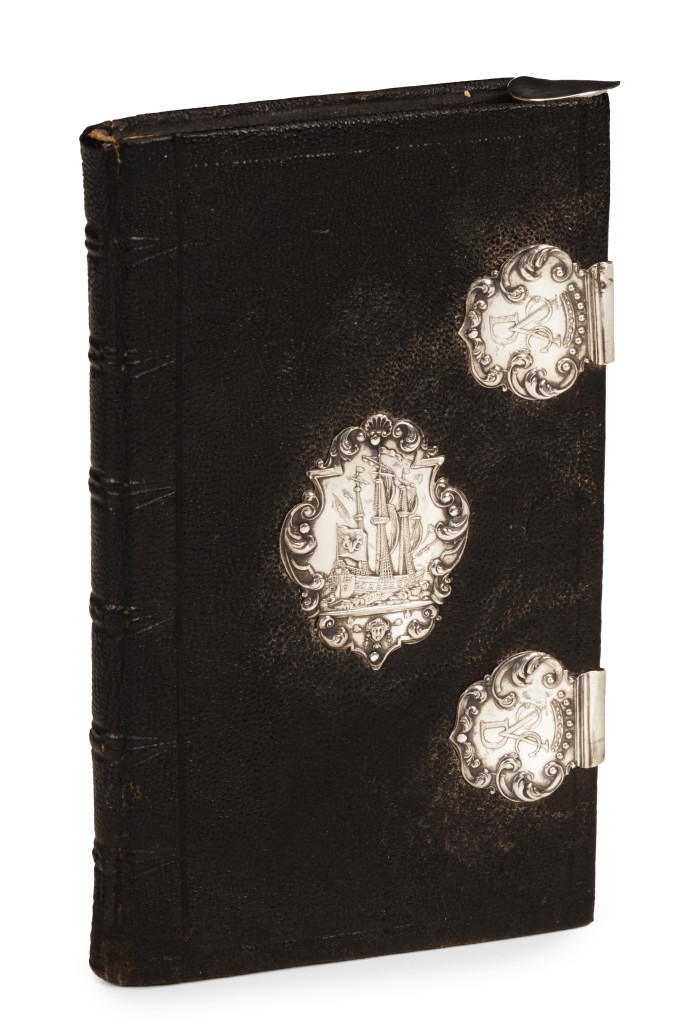
A shagreen bound VOC Delft notebook with silver mounts and pen
_Probably Amsterdam, circa 1780_ _H. 13.9 x H. 8.1 x D. 1.5 cm_ Provenance: Private collection, the Netherlands
No image
Three silver V.O.C. ingots
Circa 1738, with VOC monogram and the assay mark of the Amsterdam Grill family
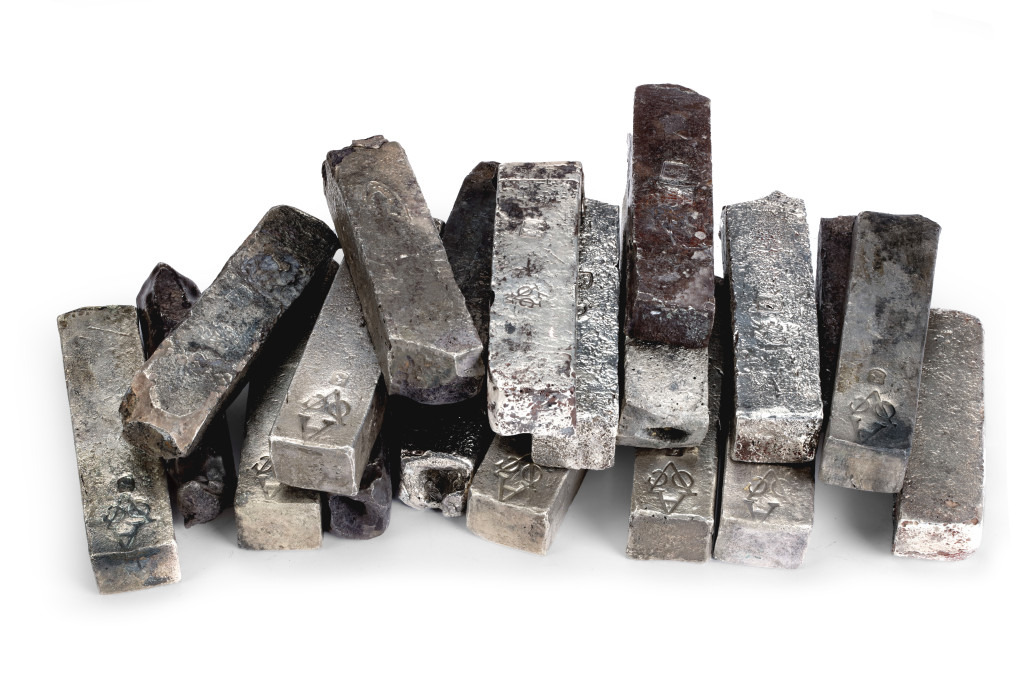
A collection of VOC silver ingots
_Amsterdam, circa 1738_ _Weight approx. 1960 grams_ _All bars are 98.7% pure silver_ Stamped with VOC Amsterdam monogram, and with the Amsterdam assayer’s hallmark of the Grill family, silver assayers in Amsterdam _Middelburg, circa 1738_ _Weight approx. 1700 grams_ _All bars are 98.7% pure silver_ Stamped with the VOC Zeeland/Middelburg monogram, with the Middelburg assayer’s hallmark of François Engelsen or with the assayer’s hallmark of Gerrit van Driel