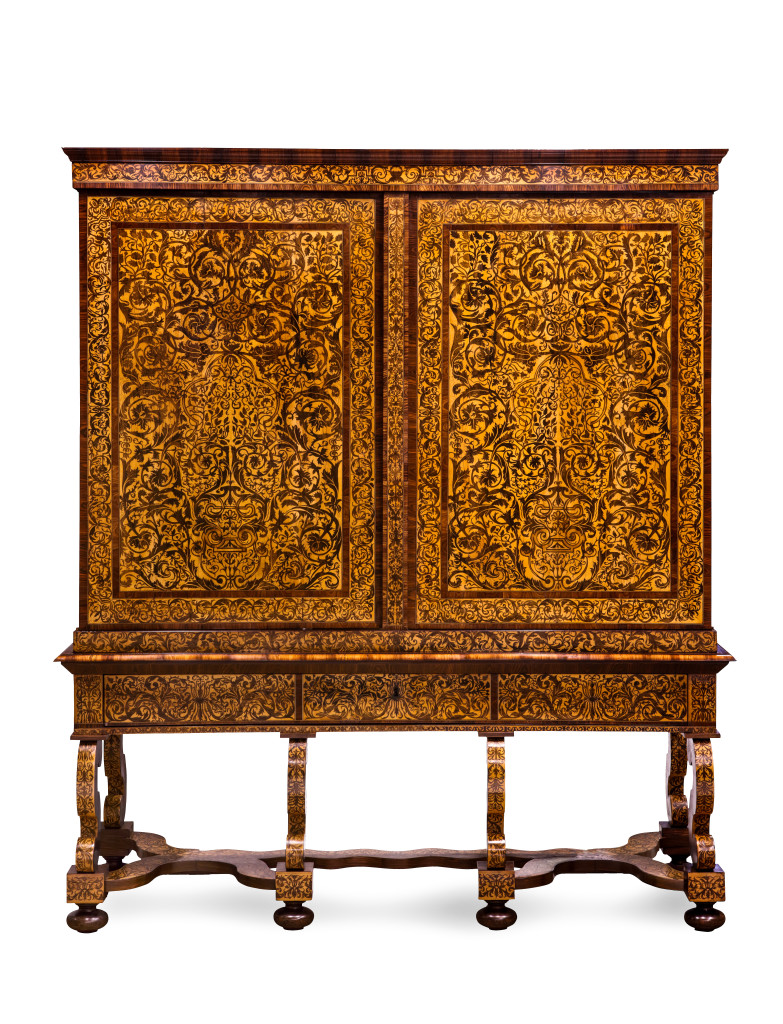
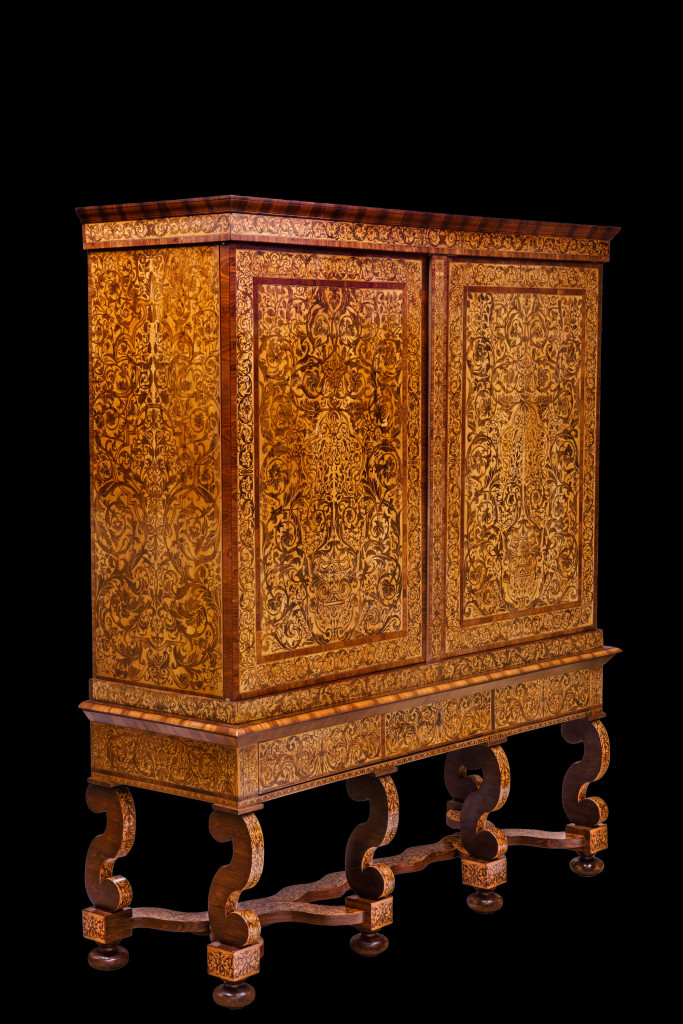
A magnificent Dutch marquetry cabinet on stand, by Jan van Mekeren (1658-1733) possibly made for William III and Mary of England
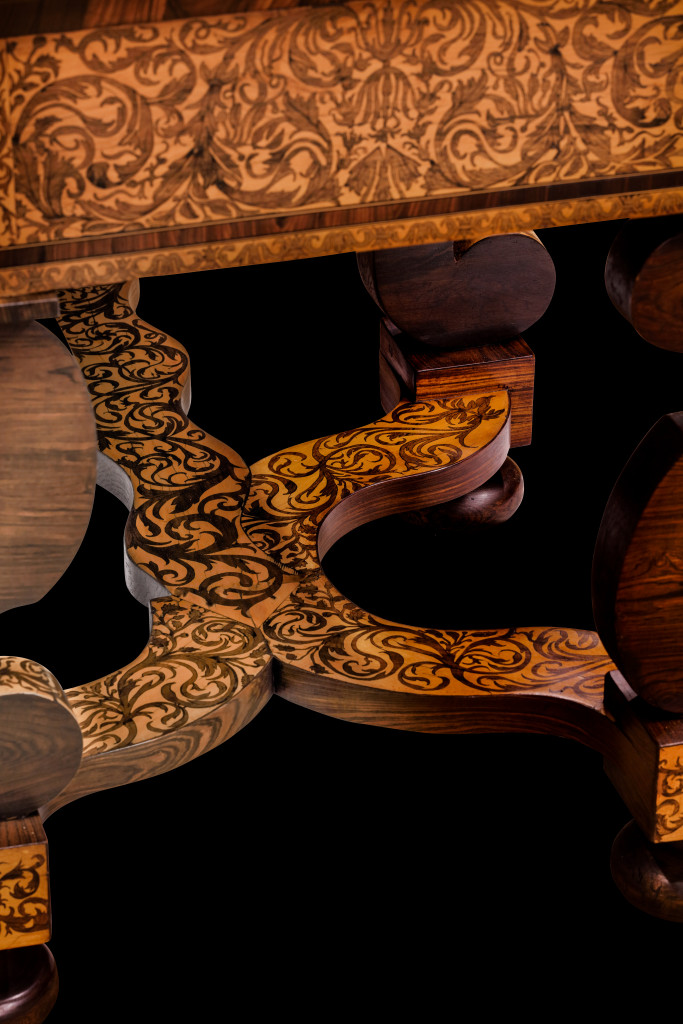
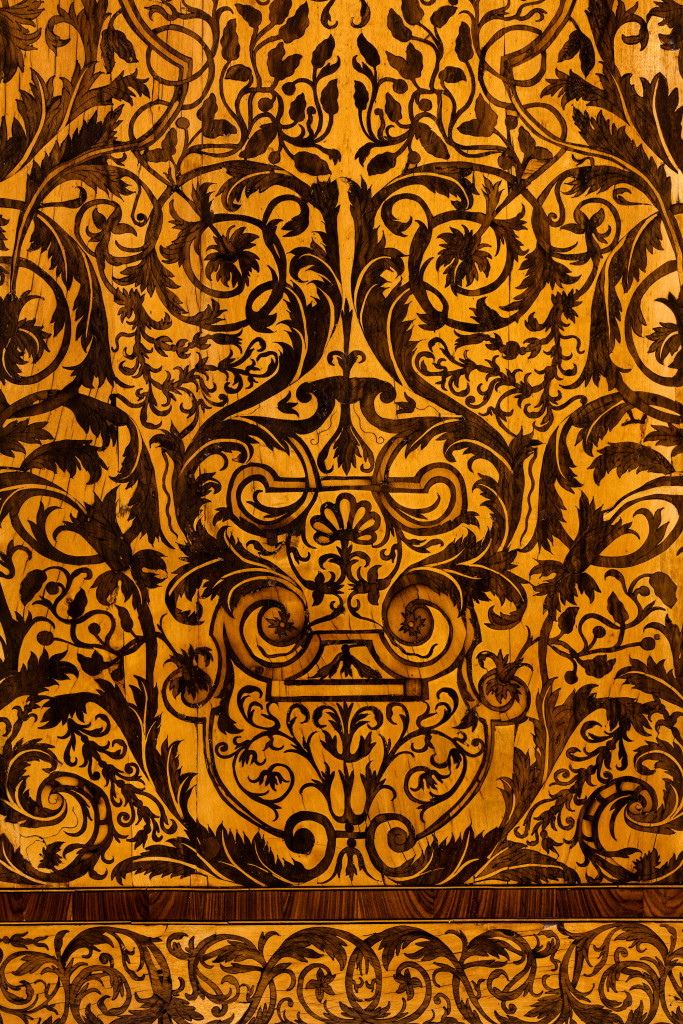
The oak cabinet is decorated with 'arabesque' or 'seaweed' marquetry in Turkish walnut (Juglans regia) on a holly (Ilex aquifolium) font, surrounded by a kingwood (Dalbergia cearensis) border. The top has a modest rectangular cornice of a frieze over two doors revealing the interior fitted with four shelves and five drawers. The inside of the doors and the drawer fronts are veneered with plain cedar (probably Cedrus atlantica). The stand has a frieze drawer and is raised on six S-shaped legs, joined by shaped stretchers and raised on turned ball feet. The entire cabinet, from the cornice to the stretchers, is covered in marquetry.
H. 209 x W. 178 x D. 67 cm
Provenance:
King William & Queen Mary of England or their very close circle, thence by descent (possibly)
Noble collection, England
Literature:
Monique Riccardi-Cubitt, Art of the Cabinet, Thames & Hudson, London, 1992, ill. p. 96 (as English, c. 1695)
The stellar feature of this cabinet is the fine marquetry, which shows scrolling vines, plants, and fruits, clearly recognisable but abstract. The latter’s design was not chosen randomly, for it is filled with symbolism specific to the marriage between William of Orange and Mary Stuart. The letters M and W can be found above each other on each side of the cabinet, with vines and leaves forming a heart in between, praised on each side by a narcissus (a spring flower symbol of new beginnings), placed within a giant thistle. W is in the centre of the cartouche, but M is not. When the M is noticed, one will also see the thistle.
Further, the well-known symbols for the House of Orange, recognisable by many in the Netherlands, have prominent places on the cabinet, such as the Appeltjes van Oranje, which are oranges and their blossom (recognisable because it is the only plant bearing fruit and blossom at the same time); roses for England, olive branches, a symbol of peace and stability (a result of the alliance between England and Holland); thistles (the symbol of the House of - Mary - Stuart, and Scotland); mistletoe, growing in pairs of branches and leaves (stands for being a couple) and is evergreen (for eternity); hazelnuts for fertility; and sunflowers for the transitoriness of/ and kinship.
Today we can’t comprehend that 17th-century people would immediately understand the symbolism. However, sources prove that myths and symbolism were part of education and shared knowledge, at least amongst the literate and educated upper class. With the intricate decoration, a cabinet like this would be a good enough conversation piece for William’s and Mary’s status. After all, a generic one with just a geometric motif was for ordinary people. On the other hand, a cabinet with custom-made iconography would be most entertaining to guests in a candle-lit drawing room. You can imagine a company chatting about the different flowers and their meanings. Another argument for the symbolism being not hidden is a bureau in the Royal Collection Trust, which Gerrit Jensen delivered (in whose studio Van Mekeren worked) in 1690 to William and Mary. The decoration holds the same flora and symbolism as this cabinet, the only difference being a clear monogram with a crown above. The symbolic plants and flowers are just as present on the cabinet, but with a monogram, showing that they were not hidden on both pieces. There is also a gueridon known, not documented, but by repute in the United Kingdom, with the same decoration.
All these symbols, together with the lion and eagles, are seen on the portrait of the young William III by Jan Davidsz de Heem and Jan Vermeer van Utrecht and on an engraving by Pieter van Gunst after Jean Henri Brandon and the designer seems to have used this image for the decoration of this cabinet.
Even more plants with meanings can be identified and combinations intended to be made, which could reveal even more spectator-specific intentions. Unfortunately, much of the meaning of the 17th century and earlier symbols has been lost or has yet to be studied.
Jan van Mekeren had six children with his wife, Maria. He had intended for his first son Fikko, born in 1693, to succeed him as a cabinetmaker, but unfortunately, Fikko died in 1731. After Jan’s death in 1733, the wood trade was continued by his daughter-in-law, but there was no one able to continue his cabinet-making business. Despite a 1624 regulation stipulating members of the Amsterdam cabinetmaker’s guild who offered their wares for sale in the guildís shop, furniture makers in 17th and 18th century Holland hardly marked their work. However, thanks to the inventory after Jan’s death, there is a good list of his workpieces with thorough descriptions, prices, and the names of his clientele.
The estate included many finished and unfinished pieces of furniture, an extensive collection of cabinet woods, and, most interesting, a long list of claims with names of the debtors and the amounts due. Most debtors were well-known Amsterdam patricians.
This cabinet is officially the eighth documented cabinet entirely attributed to, and thus by, Jan van Mekeren. The cabinet’s construction is nearly identical to that of the Van Mekeren Cabinet already in our collection, but also to that of the cabinet in the Rijksmuseum. The construction of the doors is still original and identical to that of the Rijksmuseum. Furthermore, some parts of the marquetry design on the doors and the central marquetry at the front and sides of the frieze are the same as the design on other cabinets by Van Mekeren.
Remarkably, the other two cabinets mentioned earlier have the same stand but differ in marquetry. The Fabergé cabinet shows a more 'seaweed’ marquetry closely related to the Jensen workshop manner, and the Kingston Lacy cabinet bolder marquetry closer to Dutch fashion. The cabinet presented here is right in between and therefore shows a certain tranquillity in the composition. Arguably, these cabinets were made shortly after one another after his arrival around 1686-87 and show Van Mekeren losing the influence of Jensen. The Fabergé cabinet was probably made right after Van Mekeren's return to the Netherlands, possibly even with Jensenís marquetry brought with him as a head start. Because of this 'Jensen’ style marquetry, we can assume it was made in 1687, just after he returned to Amsterdam and was registered with the cabinetmaker’s guild.
Van Mekeren struggled with some difficulties he encountered while making this cabinet. However, that would be most strange for a master kistemaker who could create such complex furniture. The marquetry sometimes does not fit the design properly, and the S-shaped legs can be perceived as slightly awkward, leaving a small space between the cabinet and the wall behind it. Furthermore, the marquetry on the legs ends on plain veneer at the stretcher at some points. The possibility of the legs having been turned later has been ruled out by inspecting the construction and (lack of) traces of restoration and the lack of plain veneer at the backs of the legs that are out of sight.
The most noteworthy of all faults can be seen on the sides of the cabinet. On the side of the doors, the marquetry is cut off by the plain veneer border, which makes it asymmetrical. The reason is that the door breaking the frame when opened was not considered while designing the side. This points out the possibility of Van Mekeren using a design. Recently, when looking for a design, one can consult the Decorative Art Fund collection of the Rijksmuseum. Unfortunately, a specific design for this cabinet is not present, but they all point towards Daniël Marot (1660/1661-1752), the personal designer to Mary and her close circle. Could it be that he granted her wish and designed a cabinet? It would point out that Van Mekeren - who didn't solve the problem - did not struggle in designing but rather struggled with the cabinet designer.
Therefore, Marot and Mary would be aware of the symbolism, which can be found in the famous Amalia Cabinet by Willem de Rots dating from 1652-1657, ordered by Amalia van Solms and now in the Rijksmuseum (BK-2005-19). Perhaps Mary was inspired by this cabinet when she saw it in the Netherlands. We can for sure say that Marot knew the cabinet since he was a nephew of Willem de Rots.
Sources:
- Adam Bowett & Laurie Lindey, “Looking for Gerrit Jensen” in: Furniture History, Vol. LIII (2017), pp. 27–50
- Lunsingh Scheurleer, Jan van Mekeren, een Amsterdamsche meubelmaker uit het einde der 17de en begin der 18de eeuw’ in: Oud-Holland 58, 1941, p. 178
- Wichers Hoeth, 'Jan van Mekeren’s gesticht “De Eendracht”’ in: Jaarboek Amstelodamum 39, 1942, p. 109-129
- Turpin, 'Floral Marquetry in late seventeenth-century England and Holland’ in: Leids Kunsthistorisch Jaarboek 13 (2003), p. 207-230
- Jongh, Portretten van echt en trouw: huwelijk en gezin in de Nederlandse kunst van de zeventiende eeuw, Frans Hals Museum, Haarlem, 1986, no. 33, 38, 39 & 56
- Yvette Bruijnen, 'Sophia Anna van Pipenpoy geschilderd door Wybrand de Geest’ in: Rijksmuseum Bulletin(2006), 54, no. 4, pp. 358-369
- James Hall, Dictionary of Subjects and Symbols in Art, Routledge, Oxfordshire, 2014
Part of the Europe collection.
Related objects
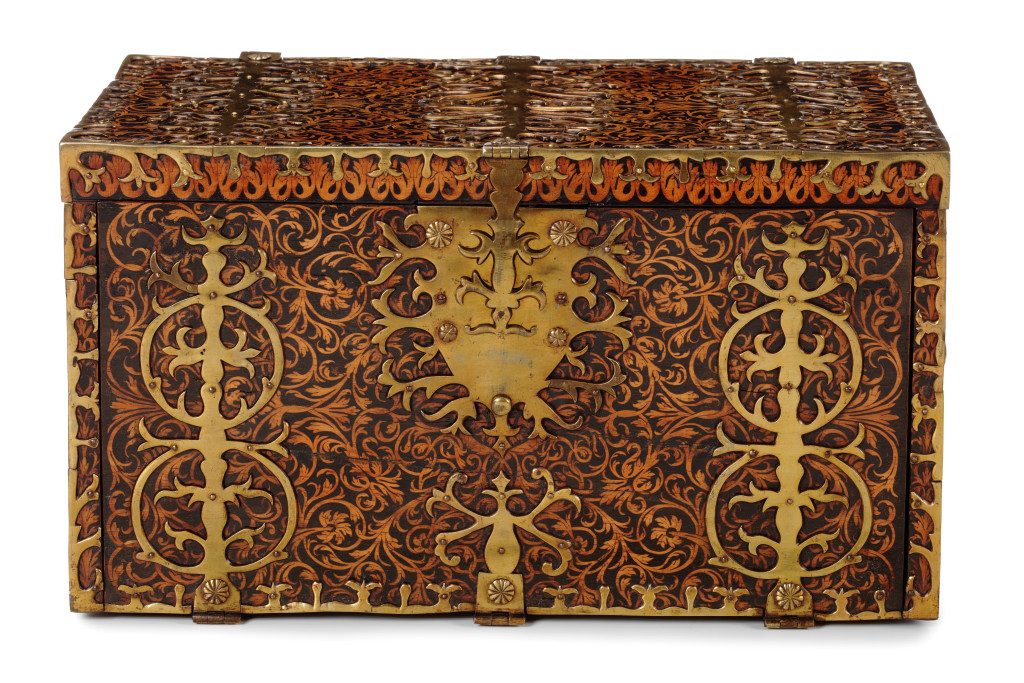
A seaweed marquetry veneered strongbox or 'captain's chest' by Royal Cabinetmaker Gerrit Jensen (1635-1715)
This is one of only three thus far known examples of strongboxes with seaweed or arabesque marquetry by Gerrit Jensen, one of which is in the Duke of Devonshire Collection at Chatsworth House and the other at Ham House. Jensen (act. 1680 - d.1715) was of Dutch or Flemish origin and was known to be working in London from premises in St. Martin’s Lane by 1680. He was the only cabinetmaker in England during this period known to have used metal inlays and elaborate 'seaweed’ or ‘arabesque’ marquetry.
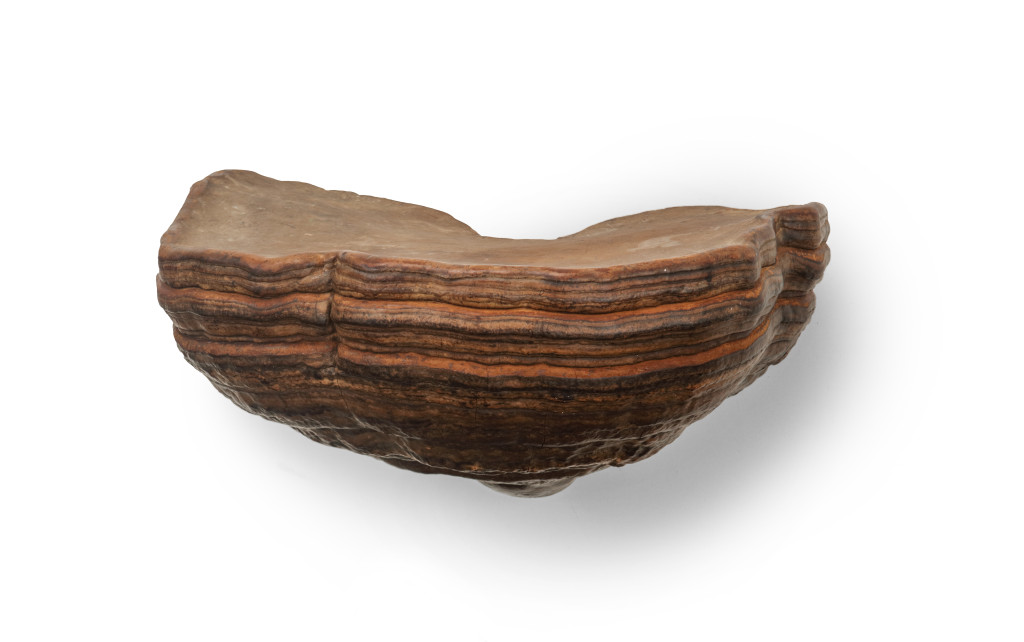
A wall console made from a real tinder hoof bracket fungus (Fomes fomentarius)
The bracket hoof fungus (Fomes fomentarius), also known as tinder fungus or false tinder fungus, has a rich history of use across various cultures, dating back thousands of years. Recognisable by its hoof-like shape and woody texture, this perennial polypore has been employed in medicine, craftsmanship, and even the kitchen. One of the most famous applications of Fomes fomentarius is as a fire starter. Its inner layers, particularly the spongy amadou, were traditionally processed to create tinder. When dried and treated, the amadou is highly flammable, making it a crucial tool for early human survival. This is evidenced by the fact that Ötzi the Iceman, a well-preserved mummy from around 3300 BCE, carried pieces of this fungus for fire-making during his Alpine journey. It was also valued for its antimicrobial properties in traditional medicine. Folk remedies across Europe and Asia used it to treat wounds, stop bleeding, and even manage inflammation. The fungus was often boiled into teas or applied directly to affected areas. Recent studies have identified compounds within Fomes fomentarius with potential anti-cancer and antioxidant properties, though such uses remain primarily within natural medicine. Despite its tough and woody nature, the bracket hoof fungus has found less common but intriguing culinary uses. When properly processed, the amadou layer can be softened and used to create a fabric-like material. This unique feature has been utilized by artisans in regions like Transylvania to fashion hats, bags, and even clothing. The versatility of Fomes fomentarius even extends to the decorative arts – as proven by the present wall bracket. Quite possibly, the use of a piece from nature indoors as a shelve to place something on is an invention from Romanticism. After all, during industrialisation, many people longed to return to idyllic farming, nature and fairytales.