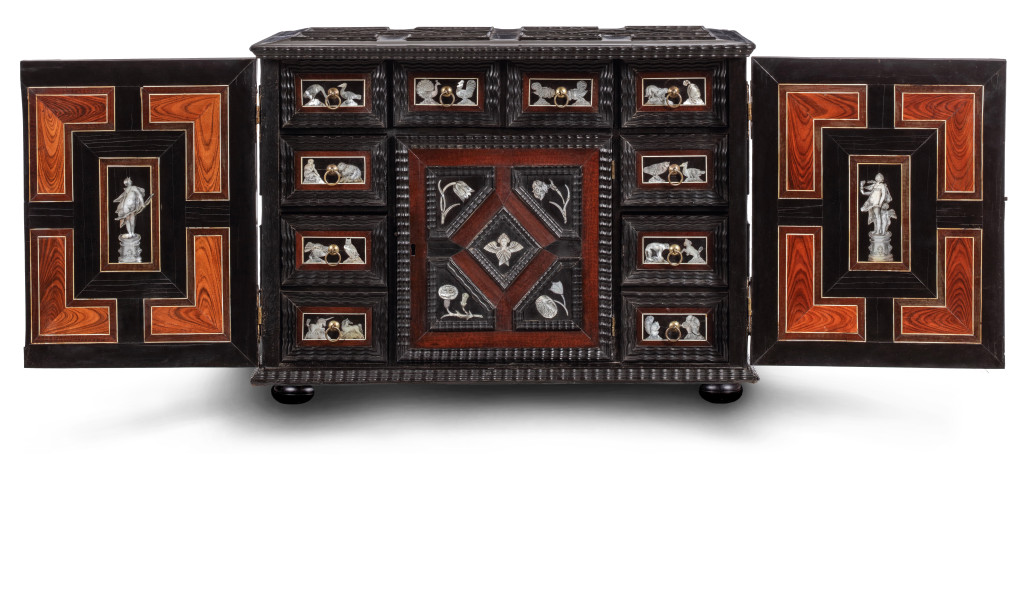
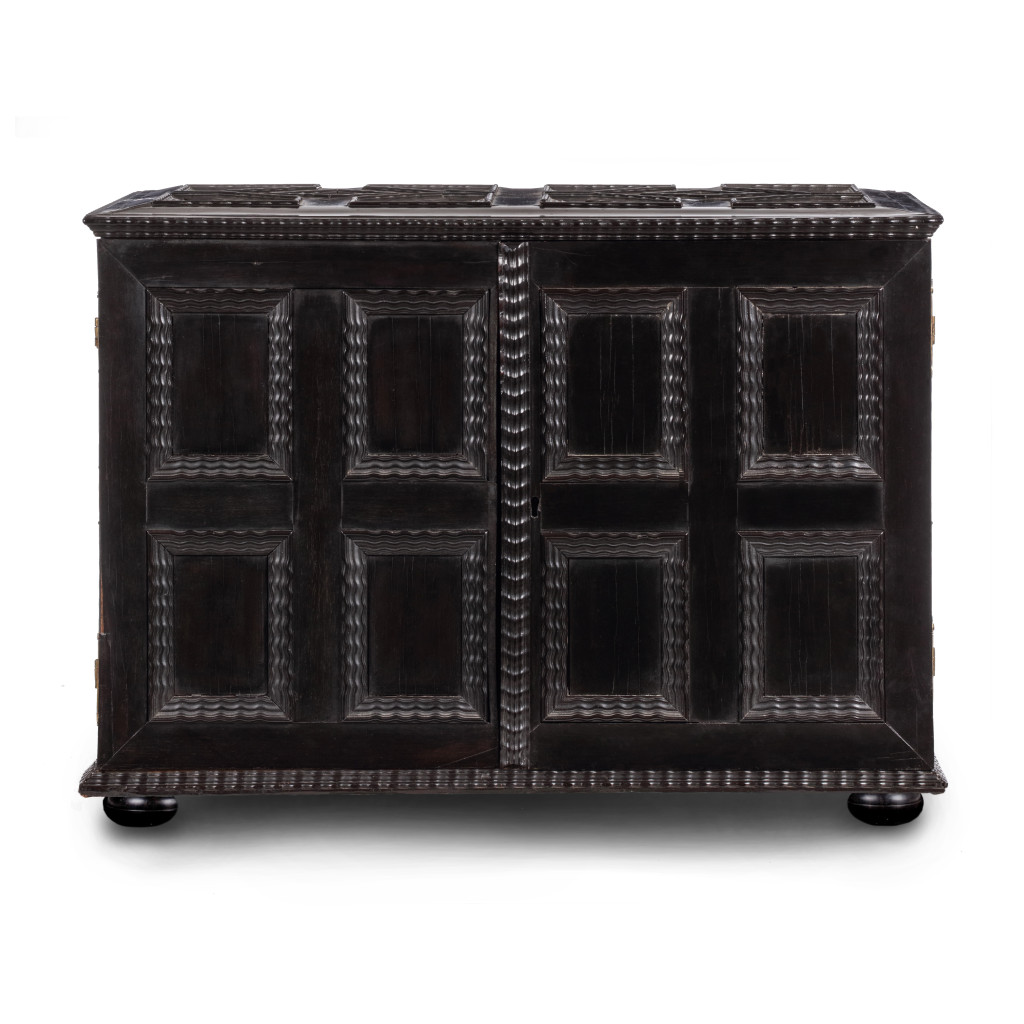
An engraved mother-of-pearl inlaid collector's cabinet by Herman Doomer (ca. 1595–1650)
H. 43 x W. 78.7 x D. 38 cm
Provenance:
Private collection, United States (since the early 20th century); thence by descent to a private collection, the Netherlands (since the 1970s)
This cabinet was attributed to Herman Doomer by observing the high-quality ripple mouldings and comparing the different works of art attributed to Doomer in museums and literature. Several small cabinets and a few large armoires by Herman Doomer are known, among which are the famous cabinets in the Rijksmuseum Amsterdam. One of which was recently acquired by the Rijksmuseum. Prof. dr. Reinier Baarsen, now Curator Emeritus Decorative Arts and Furniture of that same museum, has argued in his article "Herman Doomer, Ebony Worker in Amsterdam" in: The Burlington Magazine (November 1996), that Doomer had a very successful career, as can be concluded from the portraits by Rembrandt Doomer and his wife commissioned. However, Baarsen attributes only four cabinets and one picture frame to Doomer. Baarsen, in little more than one sentence, later eliminates a substantial group of high-quality ebony furniture with engraved mother-of-pearl.
An important change in the view of works by Doomer was a collector’s cabinet purchased by the Metropolitan Museum in New York (access.no. 2011.181), which was acquired in 2011 and not known to Baarsen when he wrote his article in 1996. It is the first argument that Doomer created a more significant number of these and probably other furniture forms. The finely engraved mother-of-pearl figures, animals and flowers on this cabinet are very similar - if not identical - to those on the Metropolitan and Rijksmuseum cabinets. The veneer on the inside is undoubtedly the final argument to attribute it to Doomer. Another cabinet, near identical to ours, privately restored by Iskander Breebaart (senior restorer at the Rijksmuseum), can also almost certainly be attributed to the master himself for the same reasons the Metropolitan cabinet was attributed. However, he completely renewed the ripple mouldings since they were replaced by plain veneer when (probably) a few fell off and got lost over time (leaving only four originals).
Doomer’s ripple mouldings on cabinets are recognised by the wave ending in a straight line in the corners. This implies that these mouldings were made with the frame’s dimensions in mind, as seen in the Metropolitan cabinet and the Rijksmuseum. Nevertheless, this is not an argument to not attribute other works to the master since the first Rijksmuseum cabinet shows neat ripple mouldings to the bottom of the cabinet but not ending in a straight line in the corners. When one considers Doomer making custom mouldings as an argument, the cabinet with perfect corner solutions should be by him. Similar corner solutions, but not ending in a straight line, can be found in one of the two cabinets by Doomer in the Boijmans-Van Beuningen Museum in Rotterdam (Div. M 90 b & M 17 a-d). Remarkably, when studying 17th-century cabinets from the Northern Netherlands, Germany, and Antwerp (since they are often misattributed), Doomer is the only cabinetmaker who ever thought of an eye-pleasing solution for the corners.
For a small ebony and pressed baleen table cabinet by Doomer from our collection, see inv.no. [ 24.20.11.13.23](https://zebregsroell.com/product/doomer-table-cabinet), and for a larger cabinet attributed to the workshop of Doomer, previously sold by us, see inv.no. [2023.11.4.15.57](https://zebregsroell.com/product/herman-doomer-cabinet).
Part of the Europe collection.
Related objects
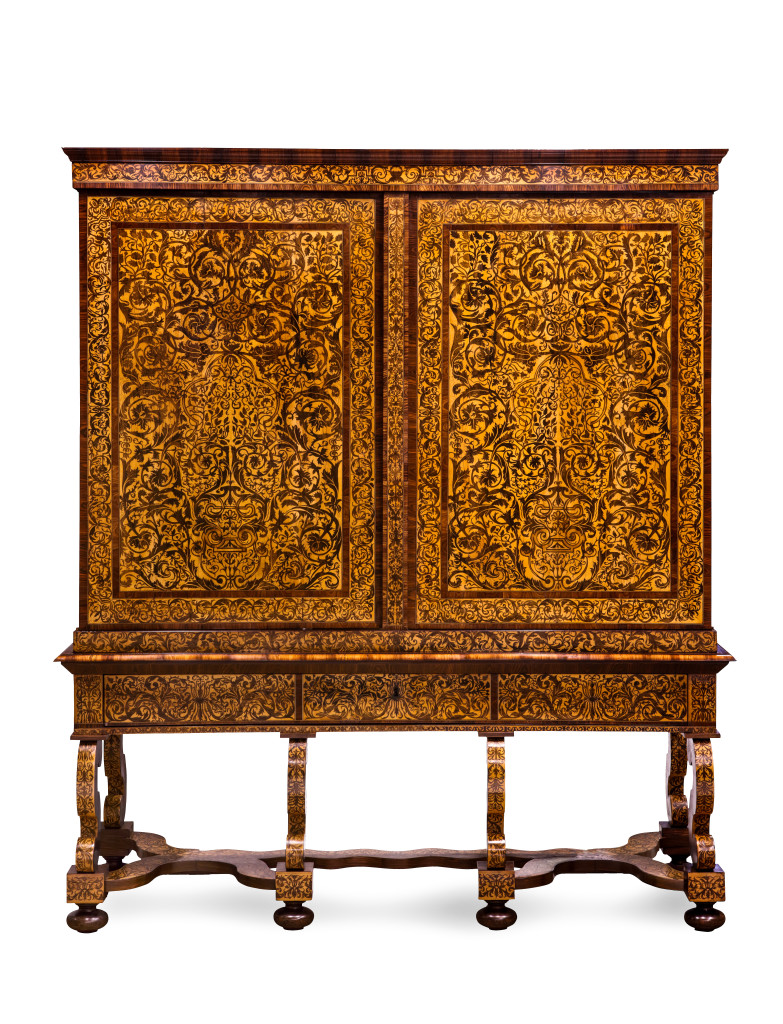
A magnificent Dutch marquetry cabinet on stand, by Jan van Mekeren (1658-1733) possibly made for William III and Mary of England
A magnificent Dutch marquetry cabinet on stand, by Jan van Mekeren (1658-1733) possibly made for William III and Mary of England. The oak cabinet is decorated with 'arabesque' or 'seaweed' marquetry in Turkish walnut (Juglans regia) on a holly (Ilex aquifolium) font, surrounded by a kingwood (Dalbergia cearensis) border. The top has a modest rectangular cornice of a frieze over two doors revealing the interior fitted with four shelves and five drawers. The inside of the doors and the drawer fronts are veneered with plain cedar (probably Cedrus atlantica). The stand has a frieze drawer and is raised on six S-shaped legs, joined by shaped stretchers and raised on turned ball feet. The entire cabinet, from the cornice to the stretchers, is covered in marquetry.
A large Dutch ebony cabinet on stand