Nagasaki-e and Yokohama-e: Foreigners in Print
Nagasaki-e prints were made starting from 1720, until the end of Sakoku, the isolation policy of Japan, which also marked the end of the Edo period. The Nagasaki-e print is a genre within the Ukiyo-e, woodblock prints and were souvenirs on paper, mostly produced and sold in Nagasaki. Earlier images of Portuguese or Dutch are known but weren’t created en masse on an industrial scale. Later, after the end of Japanese isolation, the focal point of printing became the mundane port-city Yokohama, resulting in Yokohama-e prints. We have an extensive collection of Ukiyo-e, Nagasaki-e and Yokohama-e prints for sale. In this EXPLAINED, we focus on the depicting of foreigners in Japanese woodblock print art.
Souvenir or pity prize
Nagasaki prints were often of inferior quality, as opposed to most refined Ukiyo-e prints. The, then, cheap pictures were sold to domestic tourists visiting Nagasaki who came to try and get a glimpse of a foreign ship or even, when very lucky, a Barbarian. Unfortunately, these Barbarians, or Dutch as the world calls them today, were even more isolated than the Japanese themselves. Secluded to the vicinity of a small fan-shaped island in Nagasaki Bay: Deshima. So, a print of an exotic foreigner had to do. And it did, for there is a wide range of subjects known within Nagasaki-e, amongst which foreign couples, children, families, pets, exotic birds and animals, foreign female beauties, courtesans from another world, unknown landscapes, frightening black ships, maps and, closer to the end of Sakoku: military events.
Real or Fake news?
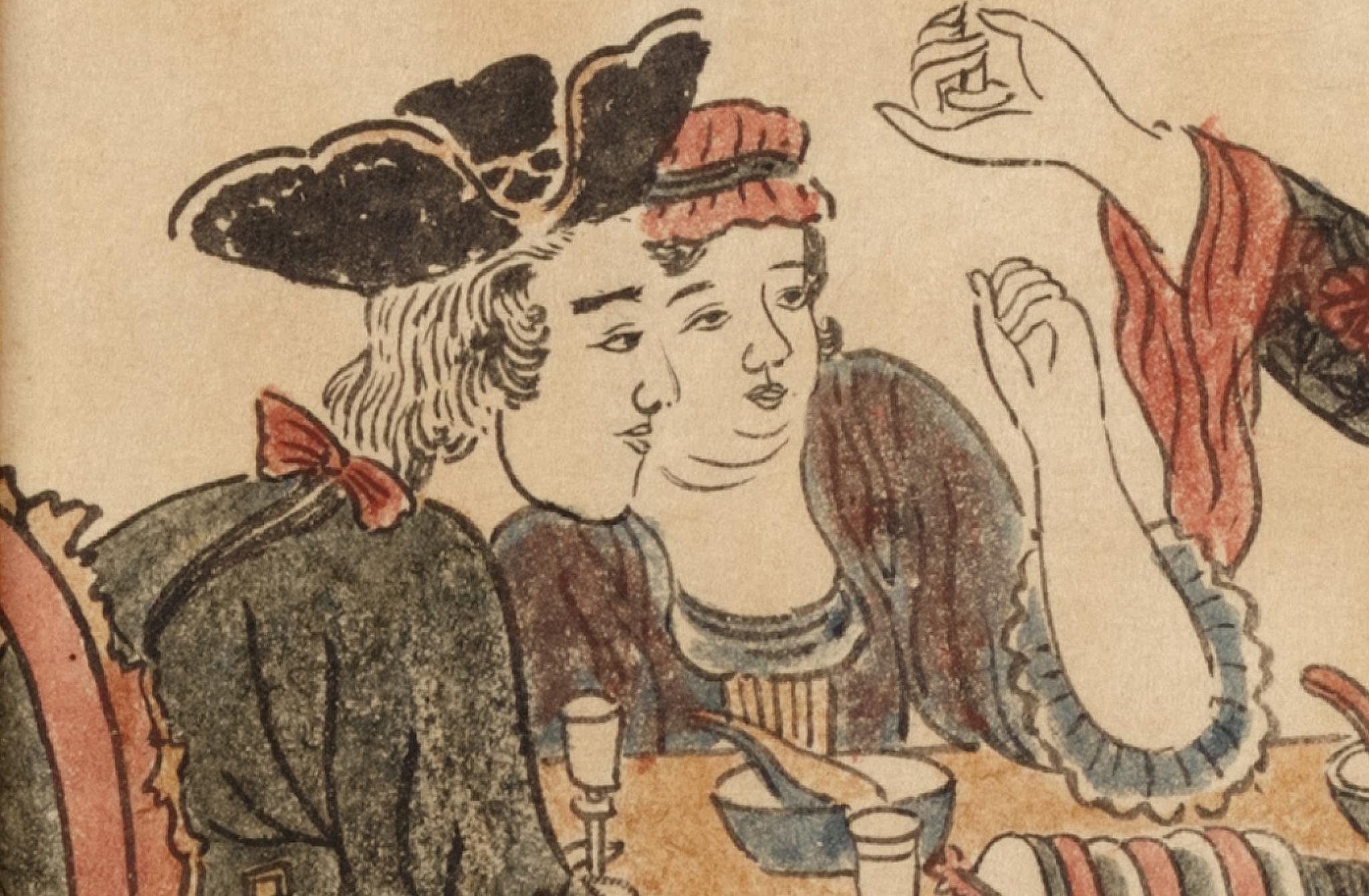
The prints from Nagasaki are of great historical importance, for they are one of the few media which the Japanese used to learn about the rest of the world, and especially Europe. Although often depictions on the prints weren’t right at all. The Dutch for instance, would have been depicted in mid 17th-century fashion throughout the three hundred years of isolation, with minor changes in appearance, or at least some variations in wide-brimmed hat or a Napoleon’s hat. Many of the artists involved in making the prints even never saw a Dutchman, let alone a European in real life and therefore relied on stories of courtesans entertaining the Dutch on Deshima, translators, or merchants. You could name it ‘fake news’ nowadays because the Dutch were never depicted favourable.
When the first white woman set foot ashore in Japan, the painters and printers in Japan exploded in enthusiasm and the story spread like wildfire. Titia Bergsma the wife of Opperhoofd Jan Cock Blomhoff, their child, her wet-nurse Petronella Munts, and the enslaved Javanese girl Maranty as servant, were of great inspiration and they became the subject of many (best-selling) Nagasaki-e prints. No (documented) non-Japanese woman had set foot ashore in Japan since the country isolated itself from the world in 1636, out of fright of too much influence by other countries. Cock Blomhoff had some nerves, for even centuries later it was still forbidden. In the year after their arrival, the women and child had to leave the country. He would never see his beloved wife again, for she died in 1821 by repute from missing her husband.
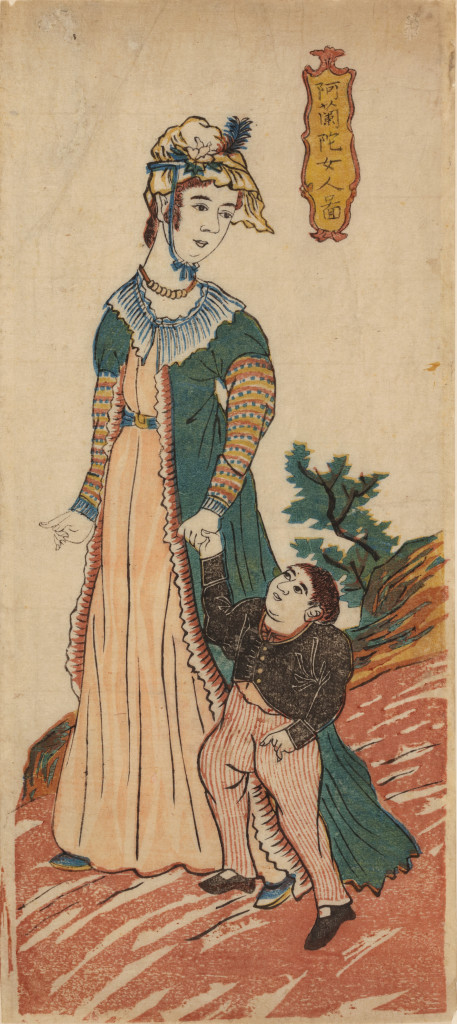 A Japanese colour woodblock print, Nagasaki-e, titled 'oranda nyonin zu' or 'Dutch woman walking with a child (for sale)
The end of a Land in Chains
About twenty-five years later, a big black ship bulging out smoke, with a thousand sails and a big wheel in the centre would appear at the coast of Japan. The Americans arrived, and with their Commodore Perry and his fleet, they would force Japan its ports to the world and trade. In 1854, officially, the era of Sakoku was ended as the Daimyo fell for the aggressive policy of the USA. With the signing of the Treaty of Kanagawa, the focus changed from Nagasaki as a ‘port’ for foreign (Dutch and Chinese) ships, to Yokohama.
A New Destination
Swiftly, like the domestic tourists changed route, the Nagasaki-e printers focused on the new bustling port city. Not only the subject, but also the style changed. Subjects on Yokohama-e prints are groups of sailors, merchants, and marines from different (European) nations, ships, detailed maps, trains, and many events related to the arrival of new nations and their peoples. Not always as accurate, but often more accurate than the Nagasaki prints, which were based on repute and legend. Now, the artists themselves could marvel at the drunk, loud, and hairy Europeans and Americans in uniform, strolling or marching by, afoot, in a carriage or on horseback, and depict them in a way closer to real-life. A change in style is also noticeable in this period, as more European images and pictures came to the country. The artists started working in a more ‘Western’ style, letting go (only a bit) of their traditional Japanese style. Perhaps, to make their work more attractive to a new group of customers, who just were allowed to set foot ashore.
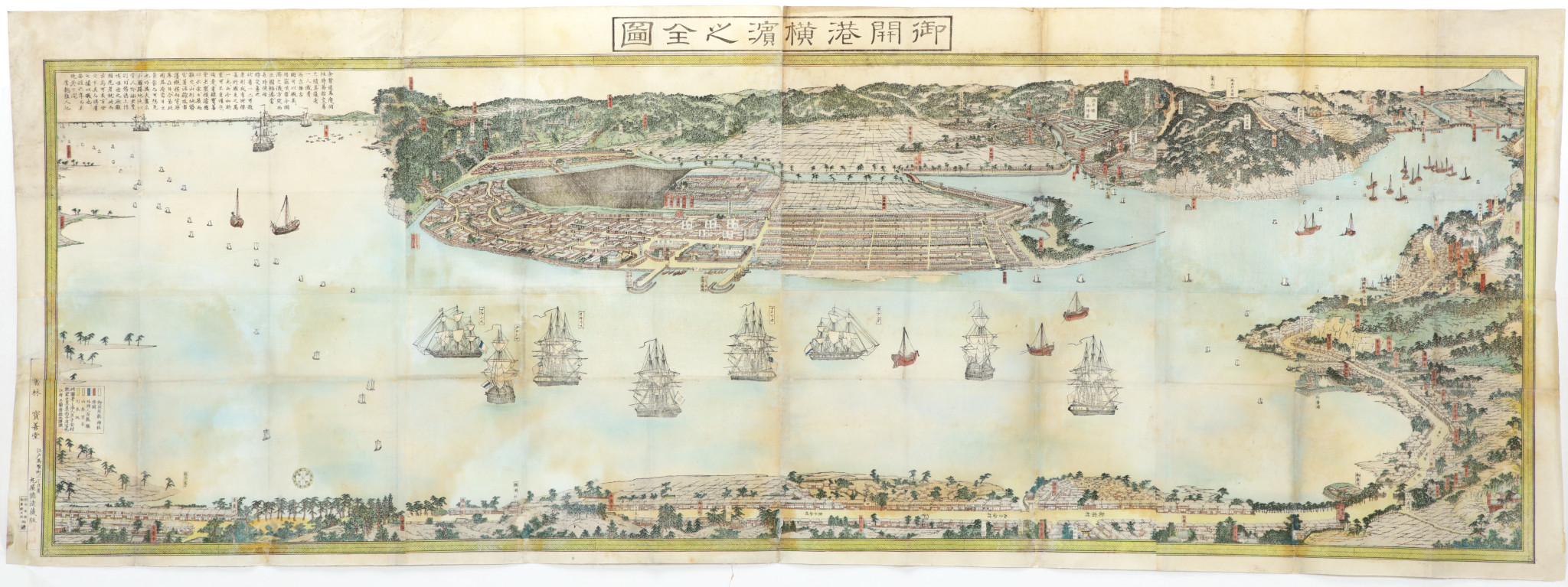 Hashimoto Gyokuransai, artist’ name Utagawa Sadahide (1807-1878/79) Gokaikõ Yokohama õezu: kan (Large illustration of the Opening of the Port of Yokohama: complete) (for sale)
Yokohama: from Dormant village to Mundane port-city
It had to be a magnificent, but impressive sight for the Japanese, especially in Yokohama. After the signing of the Treaty, the harbour of Yokohama was pointed out by Commodore Perry and the Americans as the most favourable. Hence, steam-powered ships, small boats, large sailing vessels and anything in-between entered the bay and harbour of the small fishing village. Americans, French, British, Russians, Chinese, and of course the Dutch, quickly found their way to the village, which developed rapidly into a mayor port-city. Within a significantly short period of time, the entire coast of Yokohama was bustling, and docks filled with European architectural style houses, warehouses, and other buildings were developed, wiping the old dormant fishing village off the map. This city became the main domestic tourist destination in Japan, and souvenirs to bring back to family members in the inlands were most wanted.
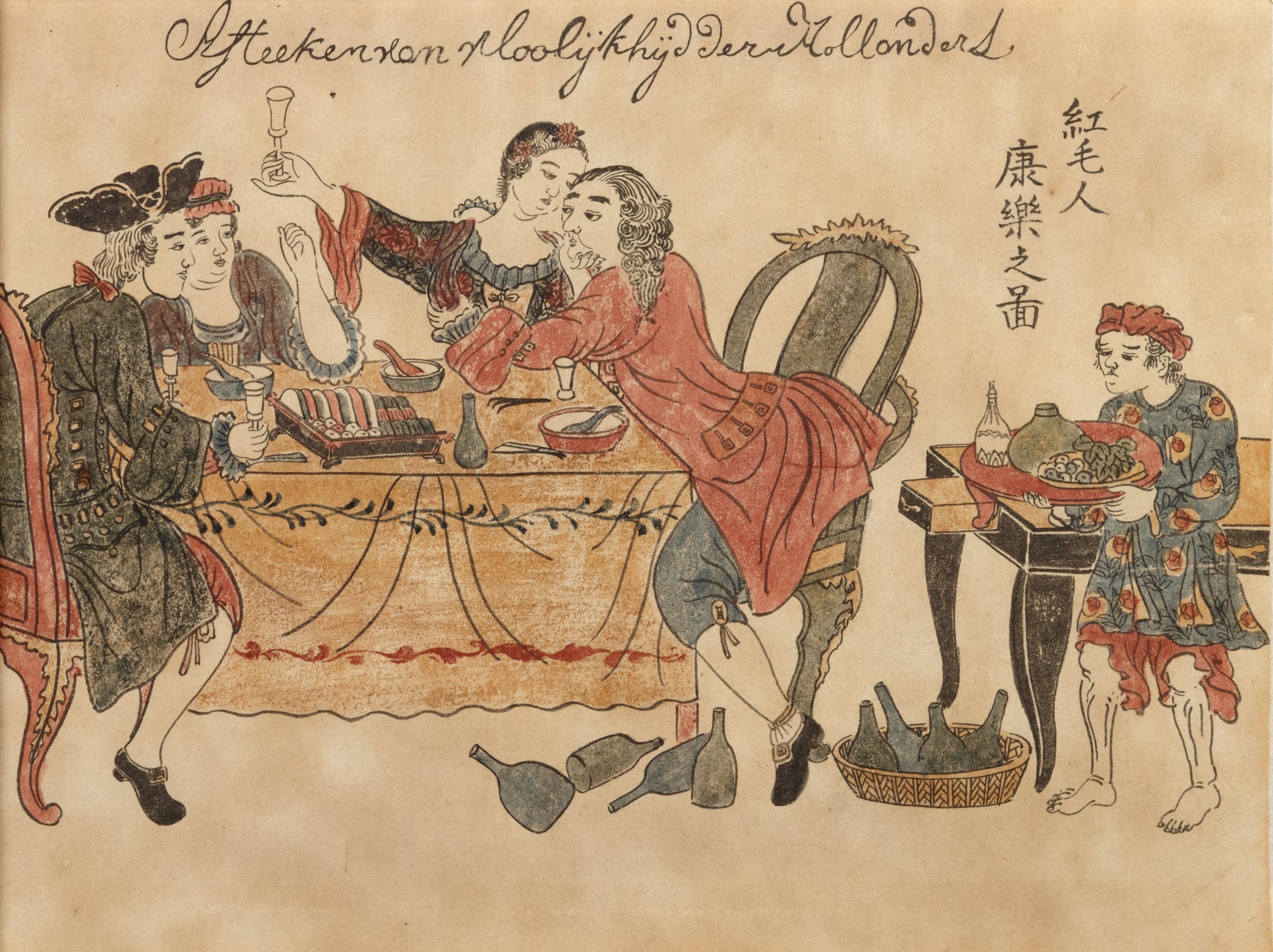 A Japanese woodblock print, Nagasaki-e, depicting drunk Dutchmen (for sale)