Agostino Brunias (1730-1796)
Oil on canvas, H. 56 x W. 61 cm
Provenance:
Commissioned by Sir William Young, 1st Bt (1725–1788), Governor of Dominica
By descent to his son, Sir William Young, F.R.S. (1749–1815), Governor of Tobago
Anonymous sale, Paris, Hotel Drouot, 9 March 1951, lot 74 (as one of a pair)
Private collection, France
Anonymous sale, London, Christie's, 25 September 2003, lot 425 (where titled ‘Pacification of the Maroon Negros in the Island of Jamaica’); where acquired by the mother of the previous owner
Exhibited:
New York, El Museo del Barrio, The Studio Museum in Harlem, and the Queens Museum of Art, Caribbean: Art at the Crossroads of the World, 12 June 2012 – 6 January 2013
London, Tate Britain, Artist and Empire, 25 November 2015 – 10 April 2016
Literature:
L. Honychurch, ‘Chatoyer’s Artist: Agostino Brunias and the Depiction of St Vincent’, in: Journal of the Barbados Museum and Historical Society, 1, 2004, pp. 105–28, fig. 15T.
Milton, published in: B. Edwards,The History, Civil and Commercial of the British Colonies in the West Indies, 4th ed., London 1807, vol. I, facing p. 407.
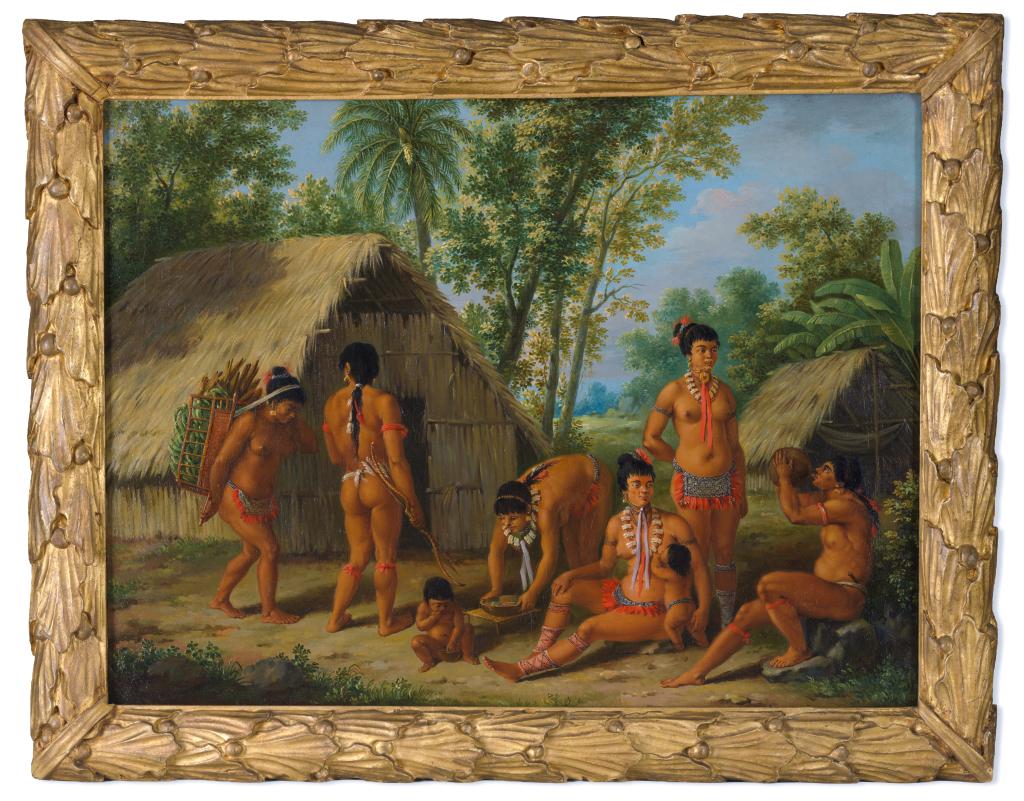
This painting is among Brunias’s most important images of the Lesser Antilles. It offers an unusual eighteenth-century view of Kalinago life at a moment when indigenous communities in the region were already facing sharp population loss and sustained pressure on land and autonomy.
The Kalinago—often called “Island Caribs” (Charaibes) in eighteenth-century sources—were Indigenous Amerindians of the Lesser Antilles with cultural and linguistic ties to northern South America. Europeans first recorded encounters with them at the end of the fifteenth century. By the 1760s, contemporary observers described their numbers on St Vincent as very small, yet they maintained a strong presence in the island’s mountainous interior. Kalinago communities also continued on Dominica, and both islands have seen renewed public attention to Kalinago identity and cultural practice in recent decades.
Brunias shows six adults and two infants gathered in a forest clearing beside two palm‑thatched structures: a larger enclosed hut (taboui) and an open shelter (mouina) with a hammock. The figures are presented with careful attention to dress and objects: beadwork, ear ornaments, decorated aprons, and feathered hair adornments; a pegal laden with plantains; a clay bowl (chamacou) set on a wicker stand (mattoutou); a calabash gourd (mouloutoucou); and bows and arrows. The setting includes recognisable local flora, notably broad‑leafed Heliconia bihai (“Balisier”) and a tall native palm. The scene echoes French ethnographic descriptions and prints from the previous century, especially the engravings after Le Clerc for Du Tertre’s Histoires générales des Antilles. At the same time, Brunias filters the group through an Enlightenment taste for ordered, “classical” presentation—an approach that can idealise what it depicts. Even so, the work remains a valuable visual record of Vincentian Kalinago material culture, and later artists have repeatedly returned to its motifs.
Brunias trained in Rome and worked as a draughtsman for Robert Adam in Italy in 1756, returning with him to England in 1758. He exhibited landscapes in London in 1762 and 1763 and also worked for William Chambers. In London he met Sir William Young, appointed in 1764 to the Commission for the Sale of Lands in the Ceded Islands after the Treaty of Paris. Young later became the first British Governor of Dominica and brought Brunias to the West Indies as his artist, using images like this to frame the islands for British patrons and audiences.
Related objects
Augustino Brunias (1730-1796)
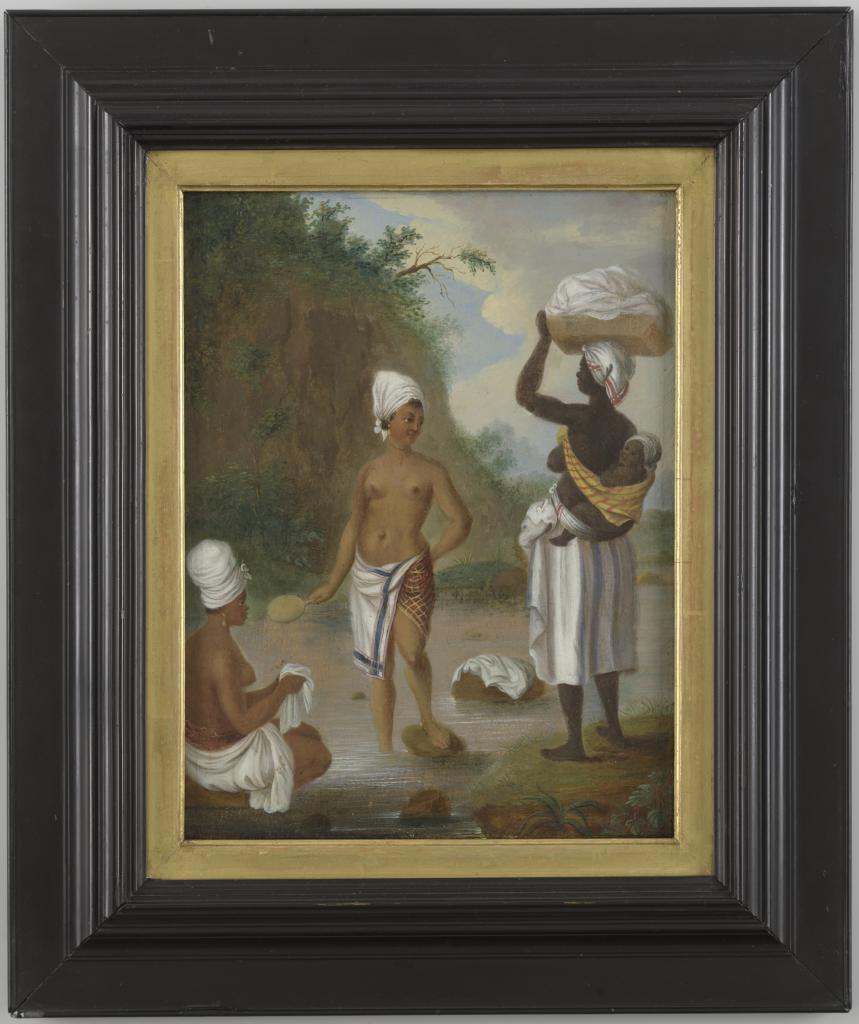
_’People of Saint Dominique’_ Oil on panel, _H. 24 x W. 17.7 cm (each)_ Provenance: Descendants of a family owning plantations in the French Caribbean (by repute Saint-Dominique)
Augustin Brunias (c. 1730-1796)
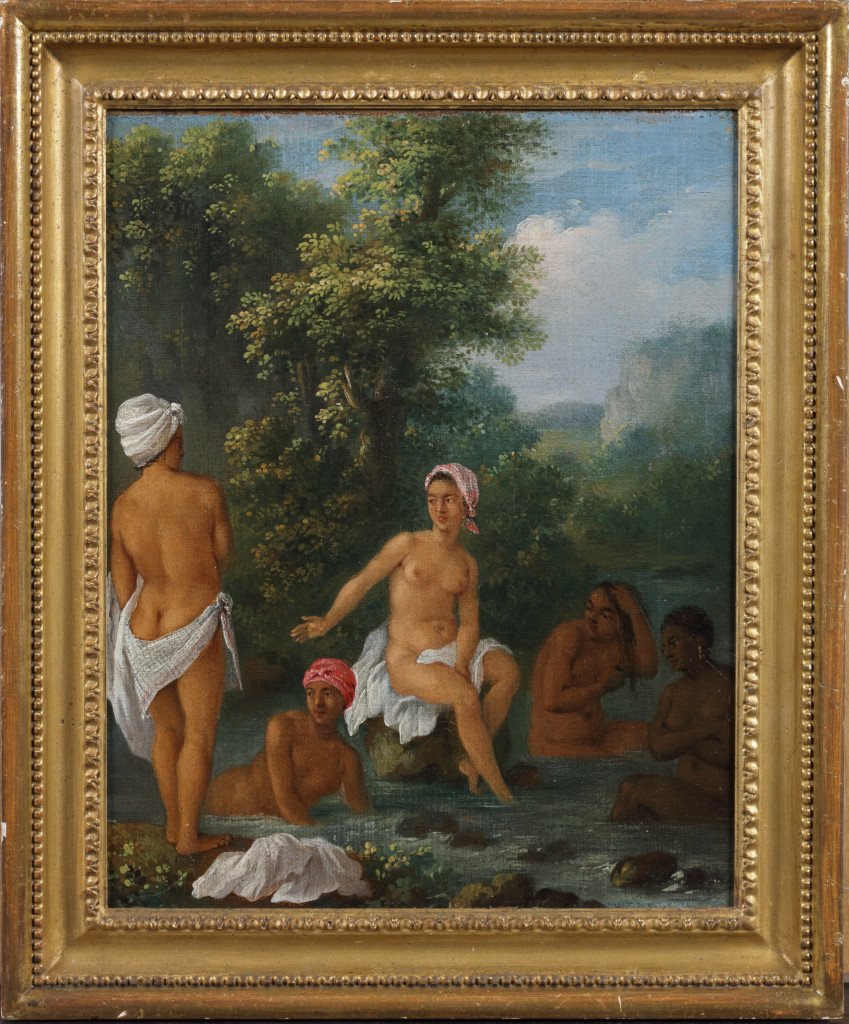
'The painter of The West Indies'
Augustin Brunias (1730-1796)
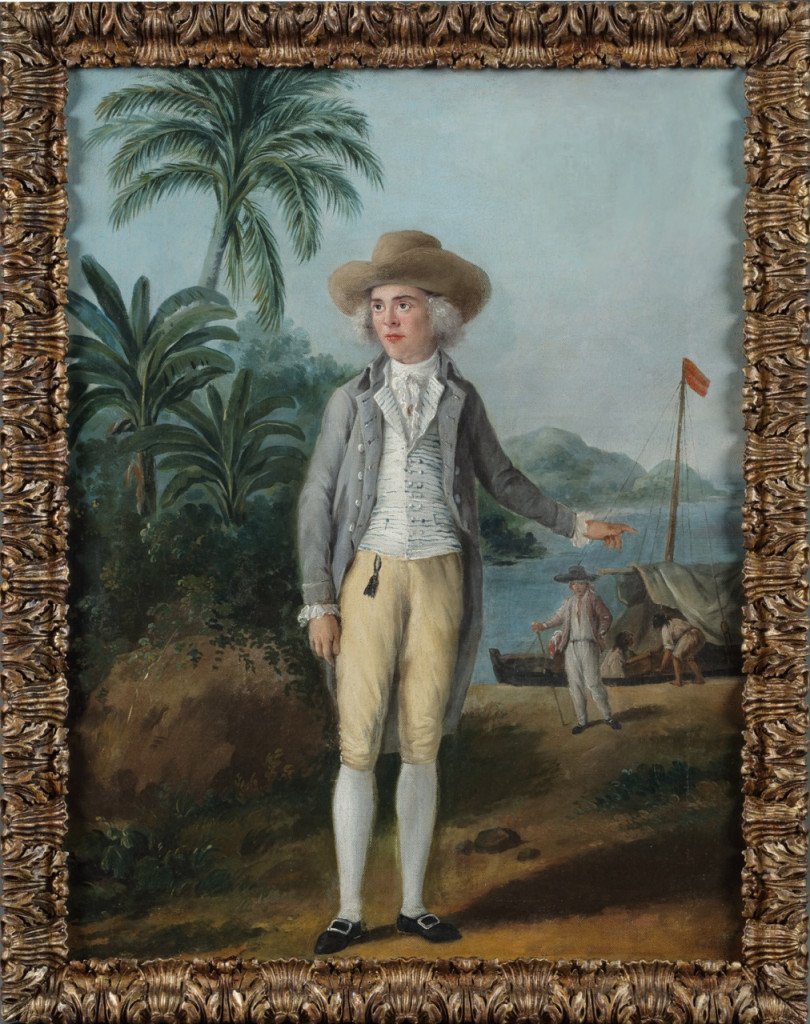
Aesthetically pleasing, yet not without political intent, Brunias' paintings served as a form of propaganda. Promoting Young's imperialist mission, he promoted the West Indies as a 'thriving colonial economy', a place of opportunity where the generations of deported African peoples were not resisting their enslavement. By depicting an entirely new geographical setting unknown to British audiences, Brunias tapped into the nation's projected fantasies of the 'exotic', while portraying the ‘West Indies’ as a (largely fictionalised) tropical, harmonious land of abundance and prosperity.