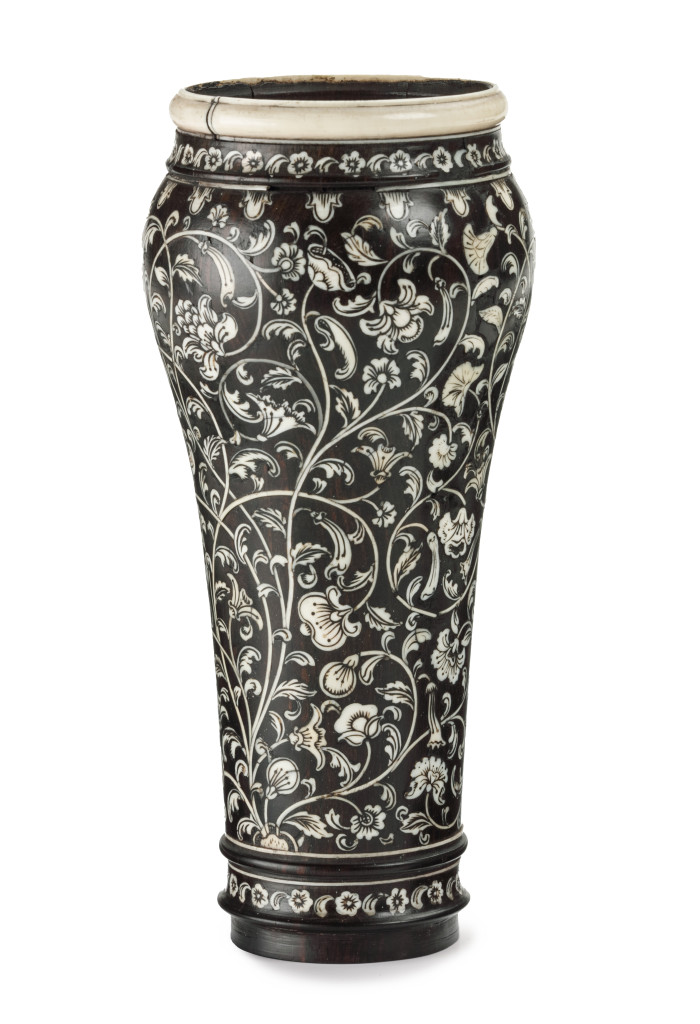
A unique Anglo-Indian pen-engraved bone-inlaid spill holder or spill vase
Of cylindrical shape, with rimmed foot, bulbous and spreading to the rimmed top, with ivory rim, overall decorated with a foliate motif.
H. 17.4 cm
Diam. of opening 6.5 cm
A spill vase is a cylindrical vase for containing splints, spills and tapers for transferring fire, for example, to light a candle or pipe from a lit fire. A spill vase was usually kept on the mantelpiece, filled with spills used to transfer fire from the fireplace to candles, lamps, a pipe or a cigar. Spills are made of tightly rolled paper or thin wood sticks. Spill vases can be made of wood, iron, porcelain, pottery, brass or even glass. Commercial matches surfaced in England during the 1820s, but were a relatively expensive commodity until the end of the 19th century, and therefore spills, for a long time, were a more cost-effective solution to light a cigar.
Part of the Indian Ocean collection.
Related objects
18th century engraved commemorative glass
"Glass to commemorate and to celebrate"A major advancement in the making of glass was George Ravenscroft's usage of lead oxide in the chemical makeup of glass in 1674. This meant glass got a more transparent, clearer and sparkling appearance as well as increased strength. This also meant that the engravings on glass became more elaborate, which can be seen in the glasses present. The engravings were done in two techniques. First the diamond-point technique, with a tiny diamond on a pen, which allowed free decorations. Second, the wheel-cut technique; in which the glass is held against a rotating copper wheel, which gives a fine matte decoration against the lustrous background.
An Indian gem-set and enamelled gold throne for a deity
_Probably Rajasthan, 19th century_ _H. approx. 11 cm_ Provenance: Private collection, Switzerland (since the 1960s) A comparable gold throne for an idol from Gujarat or Maharashtra is illustrated in: M.E. Aitken, _When Gold Blossoms: Indian Jewelry from the Susan L. Beningson Collection_, London, Asia Society & Philip Wilson Publishers, 2004, p. 57.
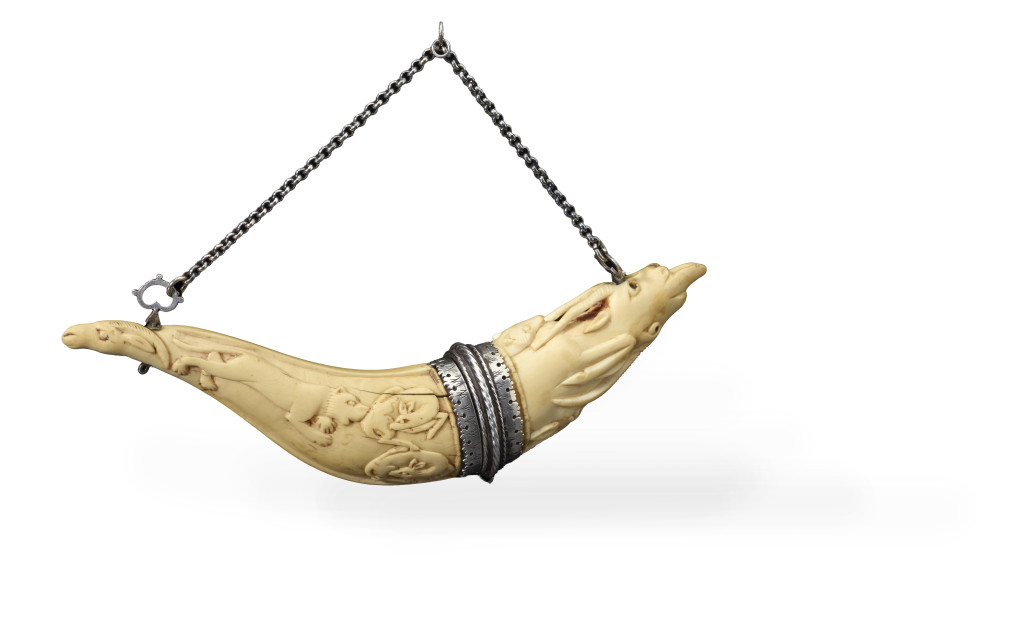
A Mughal Indian ivory powder flask with Portuguese-colonial silver mounts
The flask is in the form of morphing wild animals, one end ending in the form of a goat, the other of an Indian blackbuck. On the side decorated with a hunting tiger and prey. Along the middle there is a beautiful silver mount possibly covering an old break.