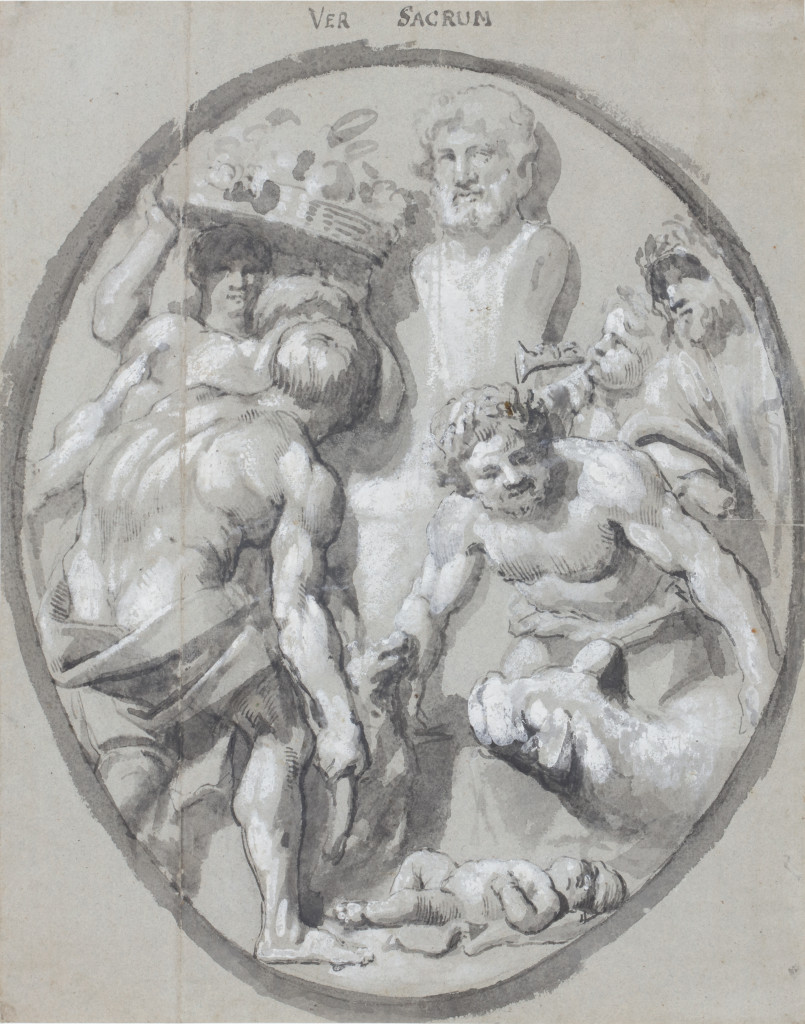
Jacob van Campen (1596-1657)
Provenance:
- Fundatie van de Vrijvrouwe van Renswoude, Utrecht (according to a handwritten note verso)
- Auction De Vries, Amsterdam, L.X. Lannoy et al, 19 May 1925, lot 355 (as by Jacob Jordaens)
- Unicorno Collection, Saam and Lily Nijstad, Lochem
- Their sale, Auction Sotheby’s Amsterdam, 19 May 2004, lot 53 (as Flemish School, 17th century)
- Collection Saskia Nijstad, The Hague
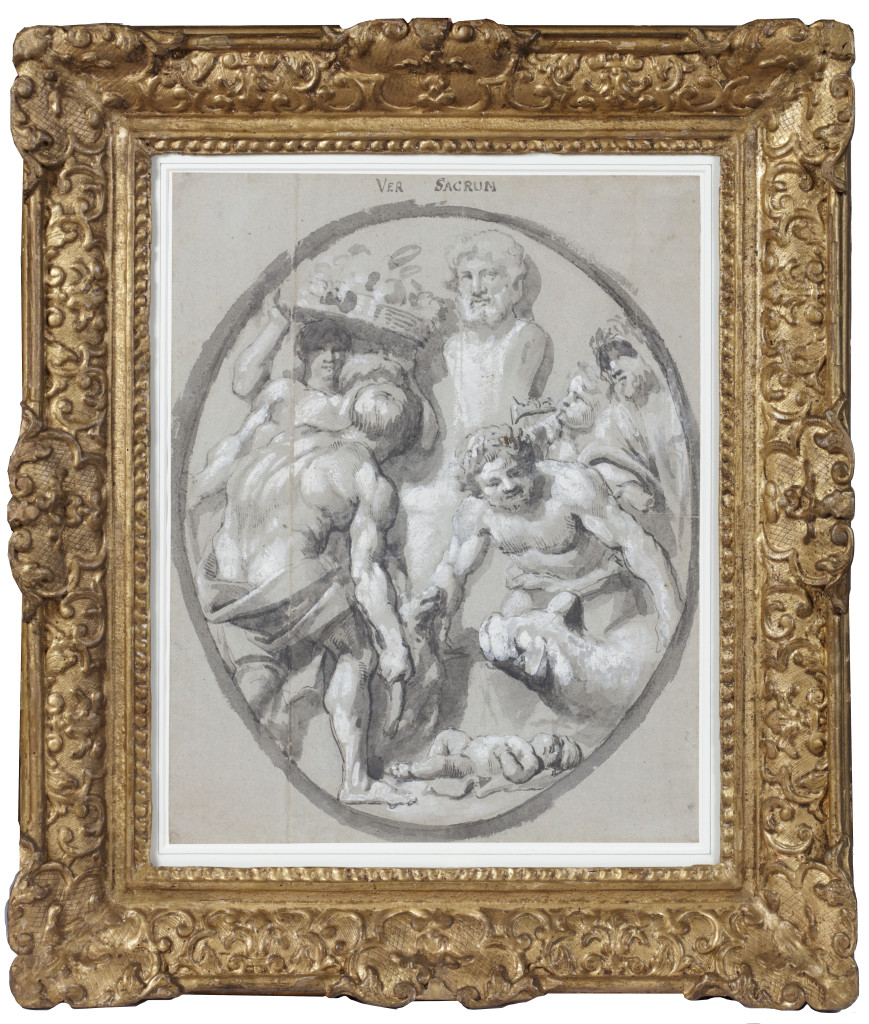
The Ver Sacrum or Sacred Spring, mentioned in Livy and Strabo, was a mysterious ritual amongst the early tribes that inhabited the Apennine Peninsula. It consisted of sacrificing the full harvest of spring in times of scarcity, after disasters or during wartime and all young men born in the given year were sent out to found colonies as soon as they had reached the age of adolescence. This narrative perfectly lent itself to “conceal the shameful and cruel reality (of colonization) under the banner of poetry and the prestige of religion. Charged with a sacred mission, (the people) became both the instruments of a divine will and of a rite.” (Jacques Heurgon, Trois études sur le ‘Ver sacrum’, Brussels 1957). Thus, the present drawing can be understood as the allegory and justification for the foundation of colonies. Strabo's version of the legend was taken as a principal source for the composition, given his steadfast reputation amongst the 17th-century elite. The Greek geographer was the only one to mention child sacrifices dedicated to the god Mars, in addition to the usual offerings. According to Strabo, the young men were led to their final settling place by a bull, here depicted in the right foreground. The drawing is stylistically related to the decorations that Van Campen painted for the Hoogerhuis in Amersfoort during the second half of the 1640s (Rijksmuseum, Amsterdam, inv. sk-a-4254-4 and 5), and also shows similarities with the capital painting of Mercury, Argus and Io (c. 1640) in the collection of the Mauritshuis (inv. 1062).
In the mid-1630s, Van Campen became involved as an architect in the design and construction of the Mauritshuis, which was a collaboration between the client Johan Maurits and his neighbour the secretary and poet Constantijn Huygens who supervised the building process. Van Campen also signed for the interior design, that was clad with precious woods from the West Indian colonies. As with all commissions that he carried out for the palaces of Frederik Hendrik, complex decoration programs were devised for each space with allegorical paintings, tapestries and sculptures, to the greater honour and glory of the occupant. Van Campen’s design was in all likelihood intended for execution in trompe l'oeil or stucco as adornment for the Mauritshuis and justification of his actions. A drawing by Pieter Post from 1652 shows a painted oval under the stairs in the vestibule, in direct eyesight of anyone entering the house, however, it remains uncertain whether the design was actually implemented. In the archive of Johan Maurits there is a complex decoration-sketch attributed to Van Campen, which has not been applied as such (Royal Archives, inv. A4-1476-103). Unfortunately, the original interior of the Mauritshuis was lost in a fire in 1704.
'The Brazilian'
Johan Maurits obtained the position in Brazil because of his family connection to stadholder Frederik Hendrik, who had succeeded his half-brother Maurits. The colony consisted of a coastal area in the north-east of Brazil that admiral Loncq had captured from the Portuguese for the WIC in 1630 (for a portrait of Loncq see Uit Verre Streken, November 2015, no. 4). The Portuguese had set up a lucrative sugar industry there, with sugar cane plantations and sugar mills that were reliant on the labour of enslaved Africans. ‘Dutch Brazil’ became the first large Dutch plantation colony in the Atlantic area. At first, the Dutch regarded slavery as an ‘unchristian’ act perpetrated by their Catholic Spanish and Portuguese enemies. But with the arrival of the Dutch East India Company (VOC) in ‘the East’ and the WIC in ‘the West’, the Dutch too started to use slave labour outside the borders of the Dutch Republic. There were a number of Dutch individuals in the early decades of the 17th century, including pastors but also administrators, who spoke out against inhumane slavery, but the beckoning profits silenced their criticism.
Johan Maurits occupies a central role in this history. After his arrival in Brazil, he revived the plantation economy by providing loans to the Portuguese to run the (abandoned) sugar mills. The governor was reliant on the Portuguese who had stayed behind – there were too few Dutch able or willing to take over their work. Another problem was the hard-daily labour: the mills had to run around the clock and who was going to do that? As early as 1637, the governor equipped a fleet tasked with capturing the Portuguese trading post Elmina Castle (Ghana) on the west coast of Africa. Three years later, Johan Maurits sent another fleet and the city of Luanda (Angola) was captured from the Portuguese. These locations were among the most important slave depots at that time. As such, Johan Maurits, under the orders of the WIC, brought the Dutch into the slave trade. Johan Maurits often is regarded as an enlightened ruler, with respect for Catholics, Jews and the Indigenous population. However, we should not overestimate Johan Maurits’s tolerance which was more pragmatic in nature than it was ethical: he needed the Portuguese Catholics and Jews to keep sugar production going and the indigenous peoples as allies and to provide the settlement with food.
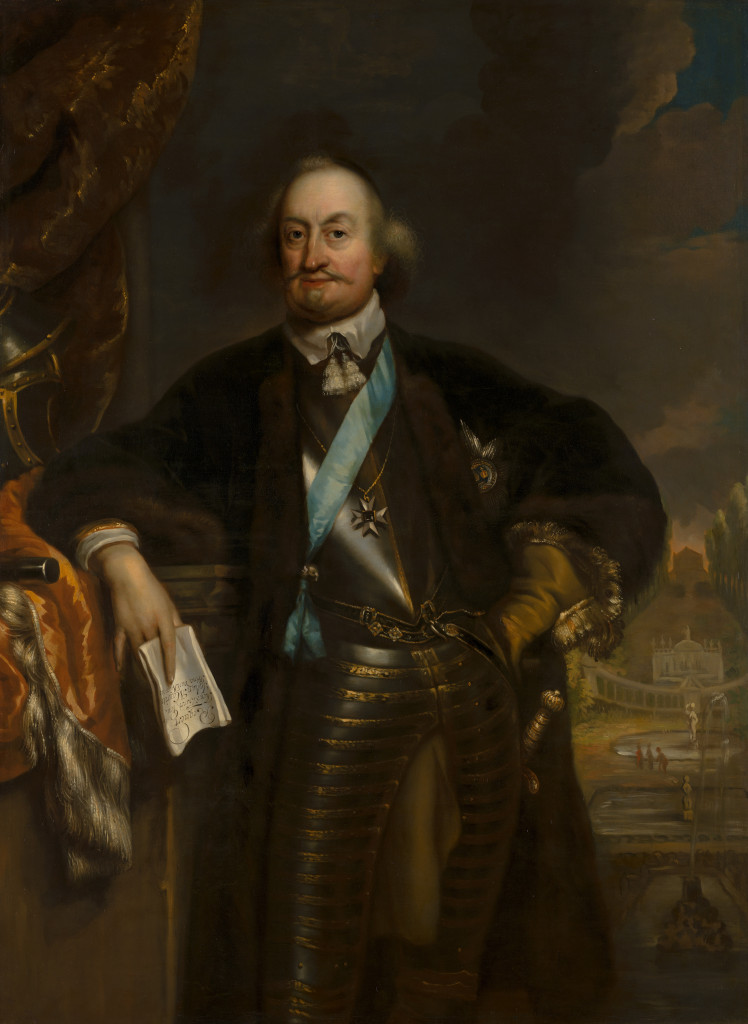
We are grateful to the Mauritshuis in The Hague for background information and image of the oil-painting above.
Part of the Europe collection.
Related objects
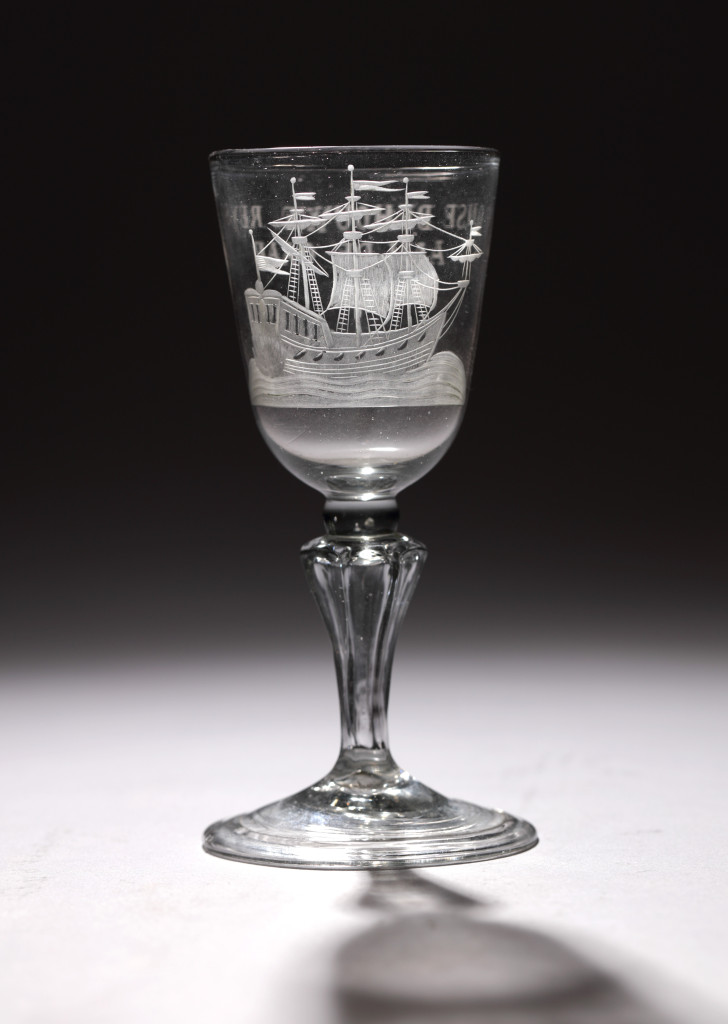
A glass with the engraving of an East-Indiaman and with text "HET WEL VAAREN VAN DE OOSTINDISCHE COMPAGNIE"
The Dutch have a long tradition of drinking games, and various glasses were made to get your guests as drunk as possible, the sooner the better. The Dutch liked (and still like) their drinks, and also during celebratory moments, the glass was raised. Often, with birth, marriage or any other family celebration, special glasses were made that were used to toast with and that would be passed to one another. But also amongst colleagues drinking was greatly appreciated. The glasses present show that the different chambers of the East and West India Trading Companies drank on the welfare of their ships and trade, and the glass welcoming people to Batavia shows that even upon arrival drinks were mandatory.
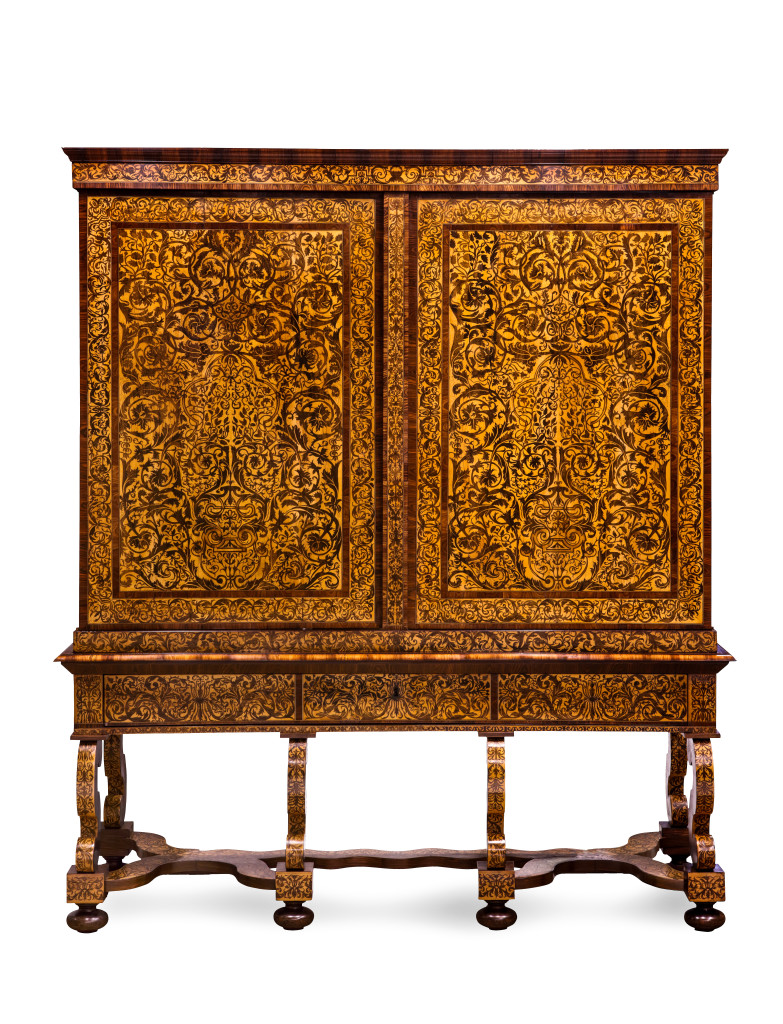
A magnificent Dutch marquetry cabinet on stand, by Jan van Mekeren (1658-1733) possibly made for William III and Mary of England
A magnificent Dutch marquetry cabinet on stand, by Jan van Mekeren (1658-1733) possibly made for William III and Mary of England. The oak cabinet is decorated with 'arabesque' or 'seaweed' marquetry in Turkish walnut (Juglans regia) on a holly (Ilex aquifolium) font, surrounded by a kingwood (Dalbergia cearensis) border. The top has a modest rectangular cornice of a frieze over two doors revealing the interior fitted with four shelves and five drawers. The inside of the doors and the drawer fronts are veneered with plain cedar (probably Cedrus atlantica). The stand has a frieze drawer and is raised on six S-shaped legs, joined by shaped stretchers and raised on turned ball feet. The entire cabinet, from the cornice to the stretchers, is covered in marquetry.
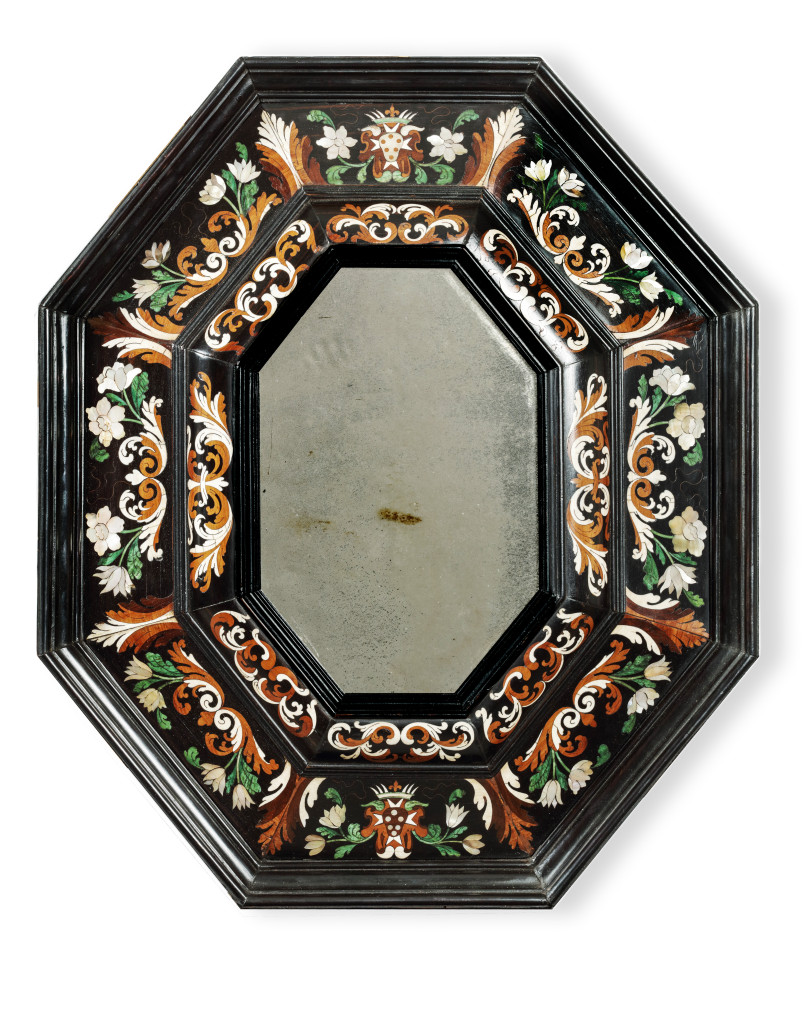
A bone, mother-of-pearl, and various wood inlaid ebony mirror with the Medici coats-of-arms by Leonardo van der Vinne (act. 1659-1713)
_Florence, late 17th-century_ _H. 49 x W. 42 cm_ Provenance: Noble collection, Belgium