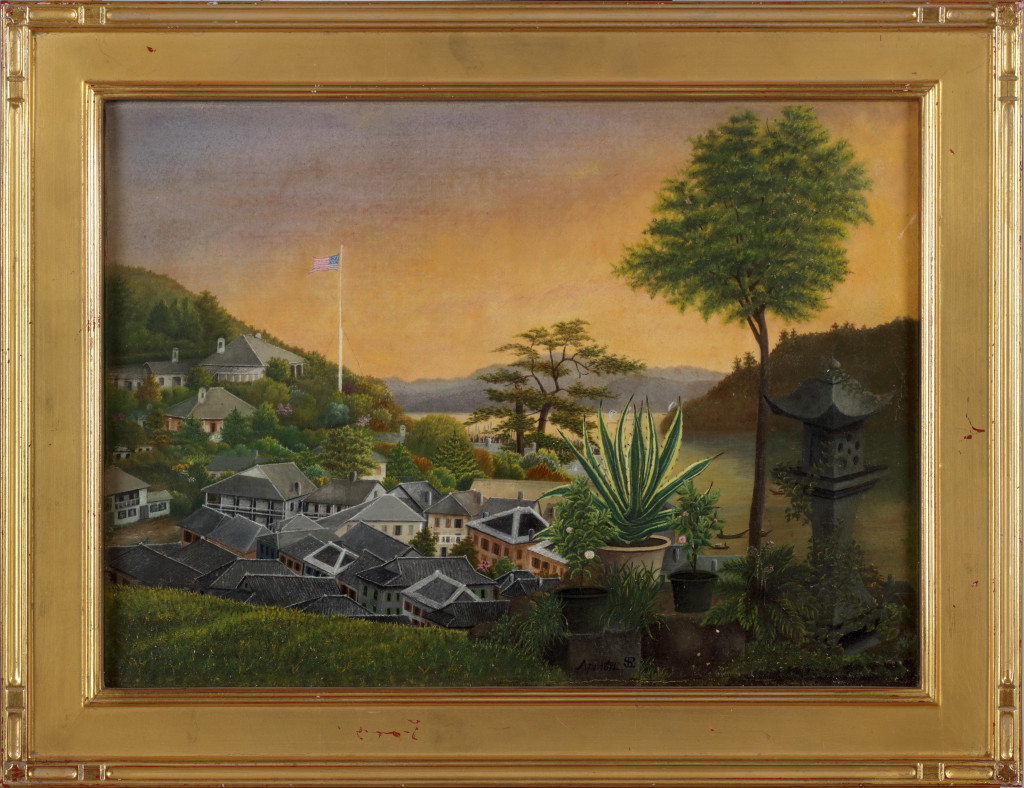
A painting depicting the Star and Stripes flying over the American Consulate in Nagasaki
Oil on canvas, 29 x 39.5 cm
In July 1859, coerced by Commodore Perry and his paddle-wheel warship diplomacy, Japan was forced to end its policy of national seclusion, sakudo, and to accept a ‘Treaty of Amity and Commerce.’ The country had to open five Treaty Ports, Nagasaki, Kanagawa, Hakodate, Niigate and Yokohama to five Western powers, the United States, Great Britain, France, Russia and the Netherlands. The first foreign Consulates were established in Nagasaki where the Dutch already for over two hundred years had their quarters on Deshima. Finding accommodation was the first problem the other Treaty Nations had to solve. The first British Consulate in Nagasaki in 1860, was located in a Japanese temple. The locations of the English, French and Russian Consulates in 1860 can be seen in a large panoramic painting of the harbour of Nagasaki in Uit Verre Streken, March 2020, nr. 66. The Americans apparently arrived later in Nagasaki and bought the old British consulate. In 1890 William H. Abercombie was appointed American consulate in Nagasaki, succeeding John M. Birch. Abercombie arrived in Nagasaki in August 1890. However, he could not open his office until November 1890, after the town was declared free of cholera (over 2500 mostly Japanese died of the epidemic). Whether the cholera epidemic had any effect on his health is difficult to say, but he did complain about his health. Maybe because of his health problems Abercombie did little to distinguish himself as consul to Nagasaki. Abercombie had been a medical doctor in Jersey before, and his sole qualification for the consul office apparently was that he was the nephew of Admiral Robert Shufelt, who had strong connections with the Republican administration. In 1898 Abercombie, succeeded by Charles B. Harris, returned to the United States, settled in Yonkers, New York and never took on another diplomatic position.
Nagasaki was to become the most important Japanese marine base, but Yokohama, being closer to the capital Edo, Tokyo, took over as the more important trade port. The work for the American Consul in Nagasaki consisted mainly of rescuing his nationals from the clutches of the Japanese police. In the winter months the harbour of Nagasaki was crowded with up to fifteen or more whalers under American flag at one time, that came to refit. Tea houses and saloons were busy with drink-and-women-crazed seamen and the American Consul was a harassed man trying at the same time to rescue his countrymen from the police and the Japanese public from the drunken sailors. The Bishop of Hong Kong in 1860 wrote that the foreign community in Nagasaki comprised of the disorderly elements of California adventurers, Portuguese desperadoes, runaway sailors, piratical outlaws, and the moral refuse of European nations. No wonder the Consul was an harassed man.
Nowadays the American Consulate in Nagasaki is called “the Grover House,” on Consulate Hill.
Part of the China collection.
Related objects
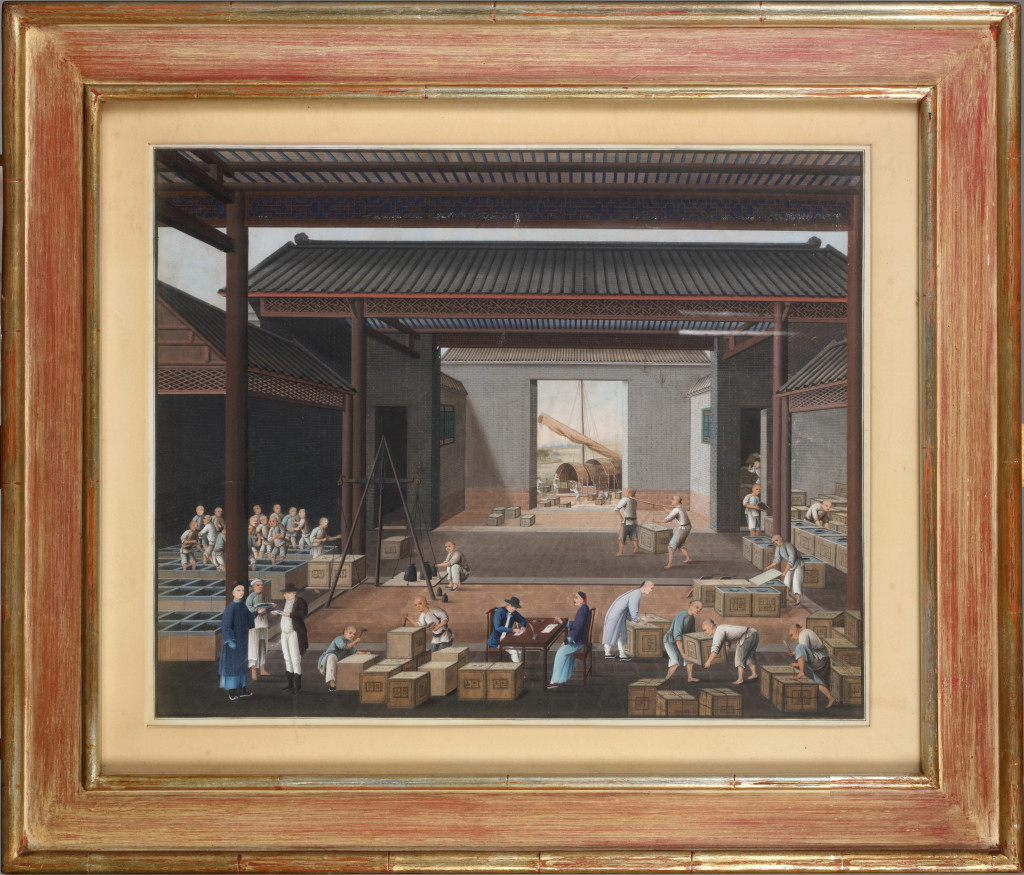
A Chinese export painting of a Canton tea-warehouse
A Chinese export painting of a Canton tea-warehouse Anonymous, Canton, late 18th century Gouache on paper, H. 30.5 x W. 26 cm A view inside a Canton tea warehouse with two British merchants, one tasting tea, the other at a table with a Chinese ‘hong’ merchant signing contracts, and Chinese workers trampling the tea into chests, packing, weighing on tripod scales, marking, and boarding tea chests into a sampan to be taken to an East Indiaman anchored at Whampoa, for export to the West. Huge fortunes were made on both sides as Western demand for tea increased throughout the 18th and19th centuries. Western merchants and shippers ordered and bought paintings like the present one as souvenirs of their lucrative trade in China.
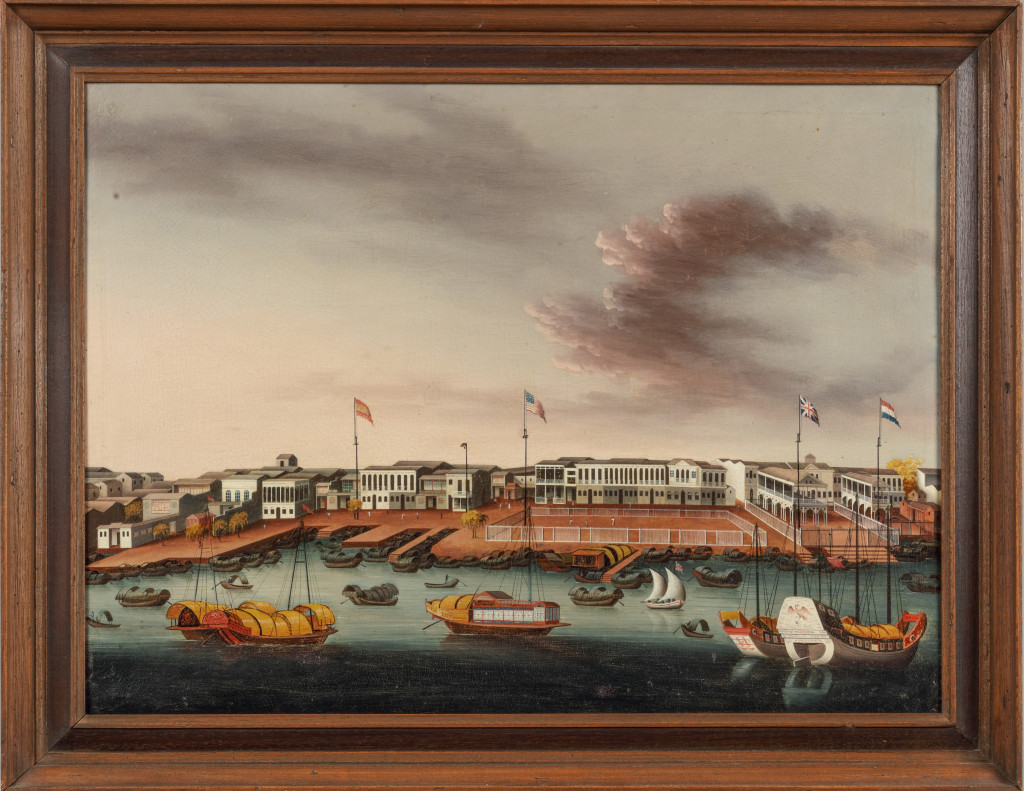
A Chinese export painting depicting the Western Hongs of Canton
Along the Canton waterfront, four flags are seen aloft, from left to right: the Spanish, the American, the British and the Dutch. The Stars and Stripes were first hoisted here in 1799, the Union Jack was added with the red saltire of St Patrick in 1801 and in 1803. The Spanish flag was replaced by the French Tricolor, which was taken down on the death of Jean Baptiste Piron, the French supercargo and 'Agent de la République' in October 1804, not to reappear on the Canton waterfront until the 1830s. So this picture must represent the situation of the Western Hongs in Canton between 1801 and 1803.