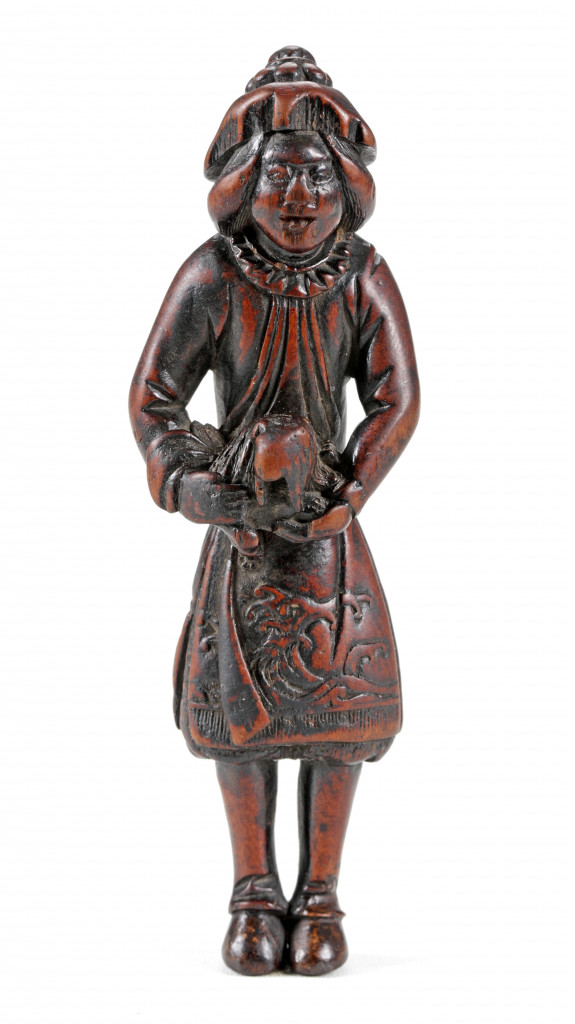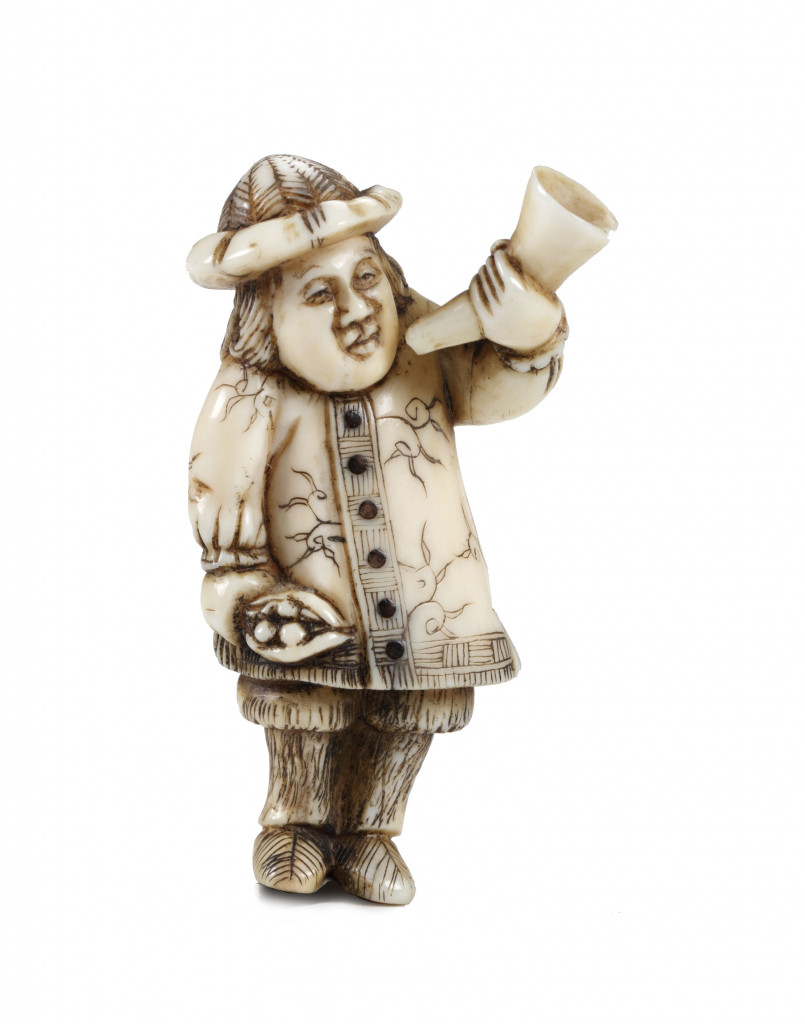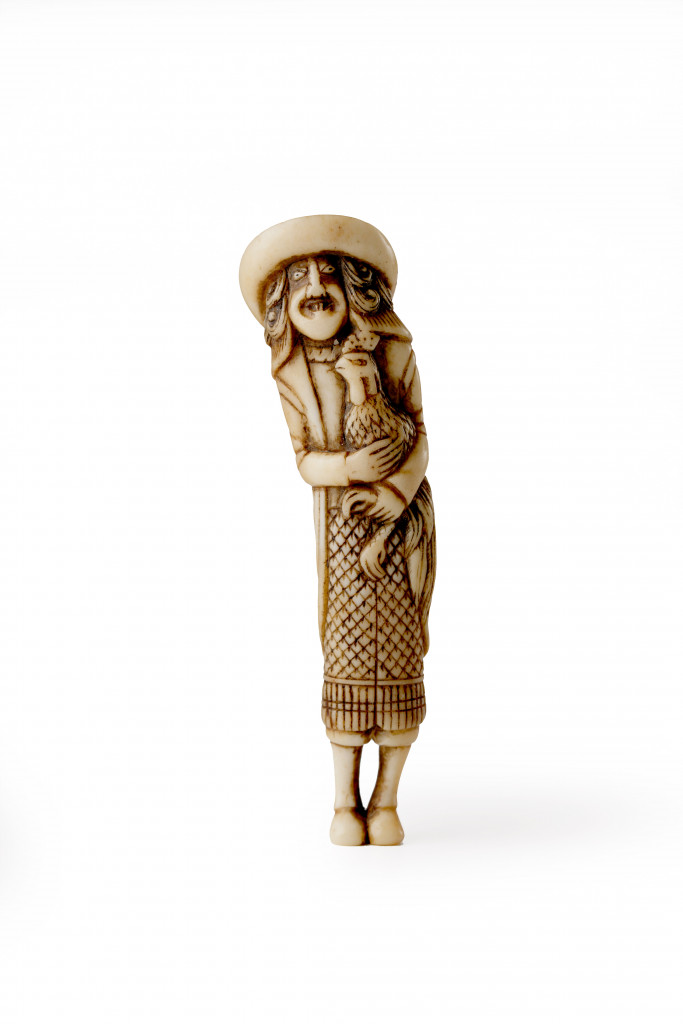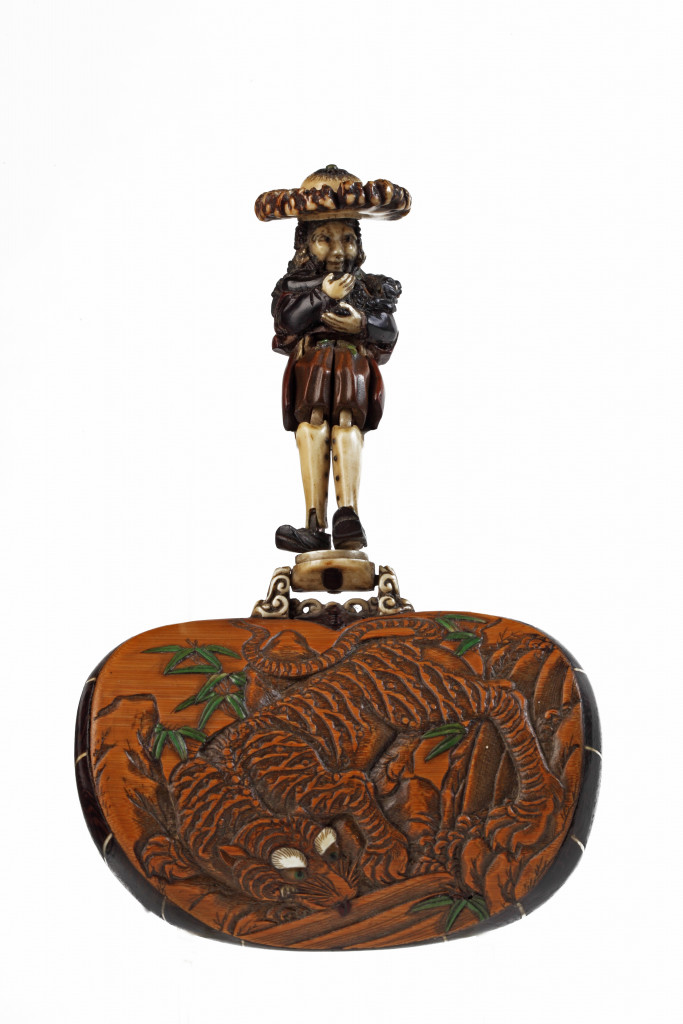
A Tonkotsu (tobacco pouch) and Dutchman netsuke, signed Hasegawa Ikko
Japan, Edo period, circa 1820
Tonkotsu in bamboo and wood with a decoration of clouds, tiger and dragon, the inside gilt, the netsuke in wood, antler, ivory, horn and mother of pearl depicting a Dutchman, with movable limbs, holding a dog in his arms.
Tonkotsu H. 7 x W. 10 x D. 4 cm
Netsuke H. 9 cm
The signature is worn but without doubt of Hasegawa
Ikko. Hasegawa Ikko worked in Kansai around 1800 and is considered one of the very best artists, working in many different materials, including, ivory, bamboo, ebony, kakhi-wood, antler, and mother of pearl. His best work is in pipe cases and tobacco boxes, giving any subject a very artistic form. The quality of the carving on this tonkotsu is exceptional and the netsuke isn’t only the very best, it is also unique in having movable limbs and witty in that the Dutchman has an inro.
Provenance:
Collection Lü Xiaguang (1906- 1994). Lü arrived in Paris in 1930 together with his friend Wu Zuoren (1908-1997), both of them students of the famous Chinese painter of horses Xu Beihong (1895-1953). Lü studied beaux art in Paris and Brussels. He married in Paris but returned to China in 1936 where he joined
the Kuomintang under Chang Kai-Check. He became a general in 1937 during the Chinese-Japanese war. In 1946 he returned to France where he settled as painter and art dealer.
In the sixties he exhibited in the Biennale. In 1993 Lü gave part of his collection of European and Chinese paintings to the museum of the province Zhejiang in Hangzou. As a dealer Lü collected Asian and European art for over a period of 40 years.
Tonkotsu in bamboo and wood with a decoration of clouds, tiger and dragon, the inside gilt, the netsuke in wood, antler, ivory, horn and mother of pearl depicting a Dutchman, with movable limbs, holding a dog in his arms.
Tonkotsu H. 7 x W. 10 x D. 4 cm
Netsuke H. 9 cm
The signature is worn but without doubt of Hasegawa
Ikko. Hasegawa Ikko worked in Kansai around 1800 and is considered one of the very best artists, working in many different materials, including, ivory, bamboo, ebony, kakhi-wood, antler, and mother of pearl. His best work is in pipe cases and tobacco boxes, giving any subject a very artistic form. The quality of the carving on this tonkotsu is exceptional and the netsuke isn’t only the very best, it is also unique in having movable limbs and witty in that the Dutchman has an inro.
Provenance:
Collection Lü Xiaguang (1906- 1994). Lü arrived in Paris in 1930 together with his friend Wu Zuoren (1908-1997), both of them students of the famous Chinese painter of horses Xu Beihong (1895-1953). Lü studied beaux art in Paris and Brussels. He married in Paris but returned to China in 1936 where he joined
the Kuomintang under Chang Kai-Check. He became a general in 1937 during the Chinese-Japanese war. In 1946 he returned to France where he settled as painter and art dealer.
In the sixties he exhibited in the Biennale. In 1993 Lü gave part of his collection of European and Chinese paintings to the museum of the province Zhejiang in Hangzou. As a dealer Lü collected Asian and European art for over a period of 40 years.