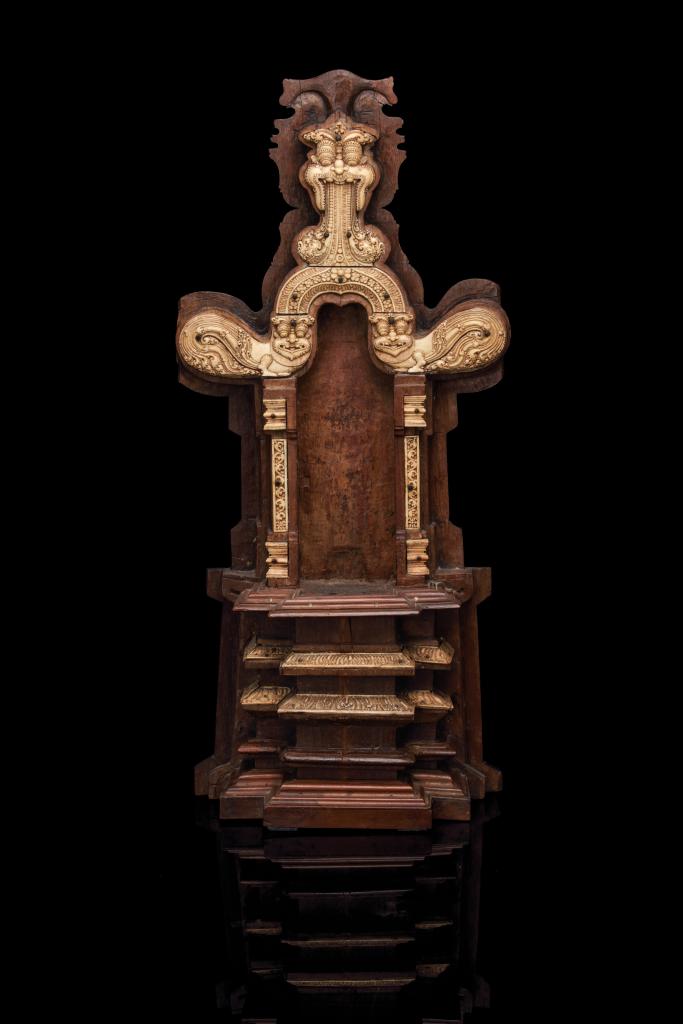
A Sinhalese hardwood and carved ivory home altar or shrine
Sri Lanka, Kingdom of Kötte, 17th century or earlier
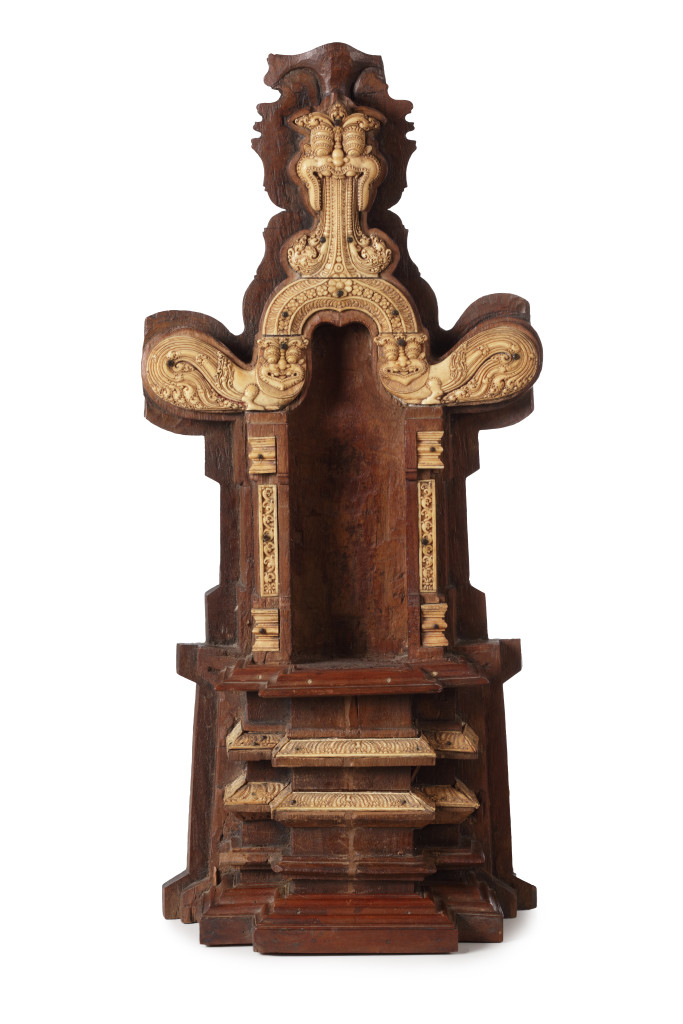
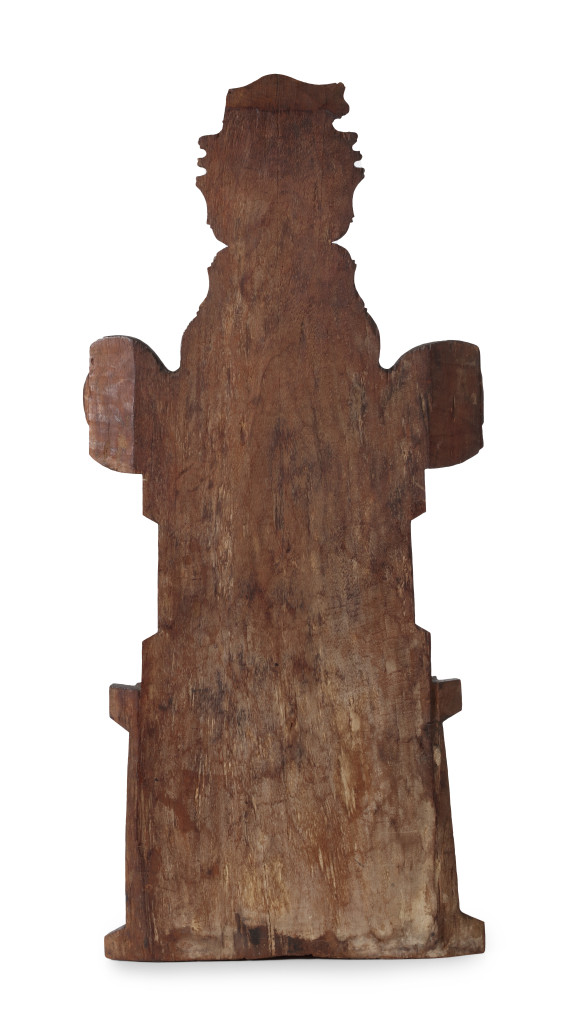
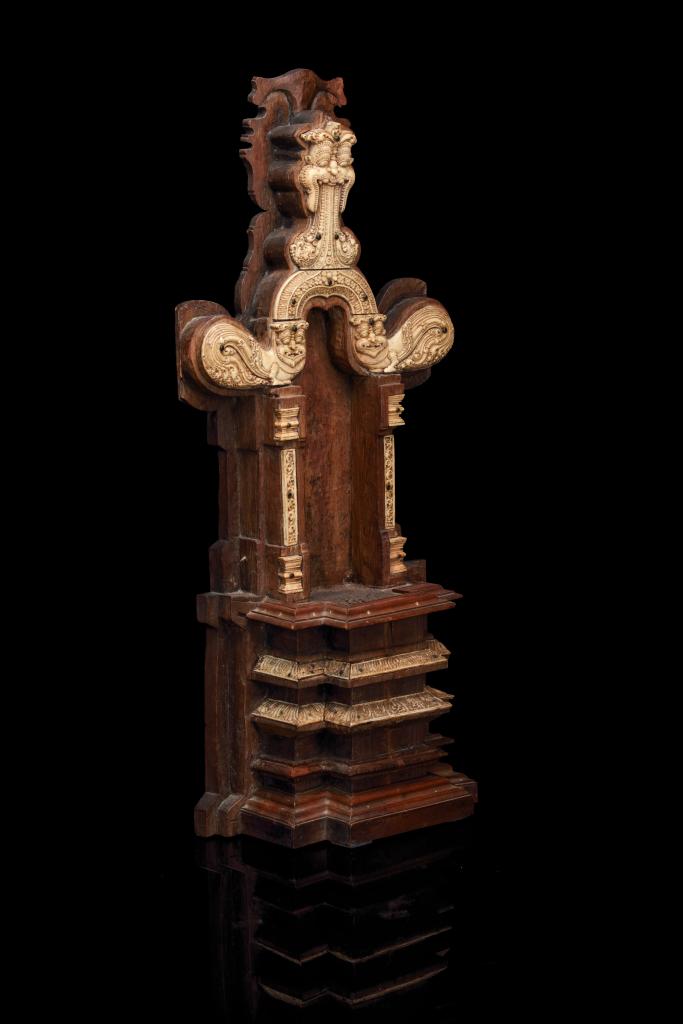
In this home altar, a small statue of the owner’s or family’s personal deity was kept, honored, and worshipped. The shrine is crafted from wood and decorated with ivory. It features a curved wooden top, beneath which there is a recessed niche. This niche is framed and decorated with multiple intricately carved ivory panels, forming a continuous pattern. This design extends downward into a stepped wooden pedestal, which is again adorned and refined with various ivory panels, creating a seamless decorative motif.
H. 73 cm
Kingdoms of Sri Lanka
It originates from the Kingdom of Kotte, named after its capital, Kotte, a Sinhalese kingdom that flourished in Sri Lanka during the 15th century. In the 17th century, Sri Lanka (then known as Ceylon) was a land of great wealth, making it highly attractive to European traders, such as the Portuguese, who were the first Europeans to discover in the 16th century that it was a source of spices such as cinnamon, as well as other valuable goods. In addition to spices, intricately carved ivory created by Sinhalese artisans was highly prized. From the 16th century onward, the kingdoms had to resist invasions from Portuguese, Spanish, English, and Dutch maritime powers and colonizers. The Portuguese established themselves in 1517, first in Kotte, then in Colombo. In 1656, the Dutch conquered the Portuguese fort in Colombo, taking control of the island’s trade until the British took over in 1798. The Kingdom of Kandy (1597–1815) was the last independent monarchy of Sri Lanka before the whole island was taken over and incorporated into the British Empire.
Sacred Ivory
The art of ivory carving and woodworking in Sri Lanka was highly esteemed for its exceptional craftsmanship and refinement. These traditional ivory artisans were extraordinarily skilled in working with this organic material. It is remarkable how they could produce such exquisite carvings using only handcrafted techniques and limited tools. The tusks of the Sri Lankan elephant were recognized as high-quality ivory, valued for their thickness and appealing colour. Ivory was considered a sacred material and a prestigious symbol. For this reason, ivory carving and decoration flourished as a traditional craft, passed down through generations—not only as an expression of skill but also for practical applications, including combs, knife handles, daggers, and window and door frames. Indeed, ivory panels were used to embellish the doorways of Buddhist temples and shrines, signifying the sacredness of the space. The same principle applies to this early home altar, which is adorned with ivory around the sacred niche, where the deity is to be placed.
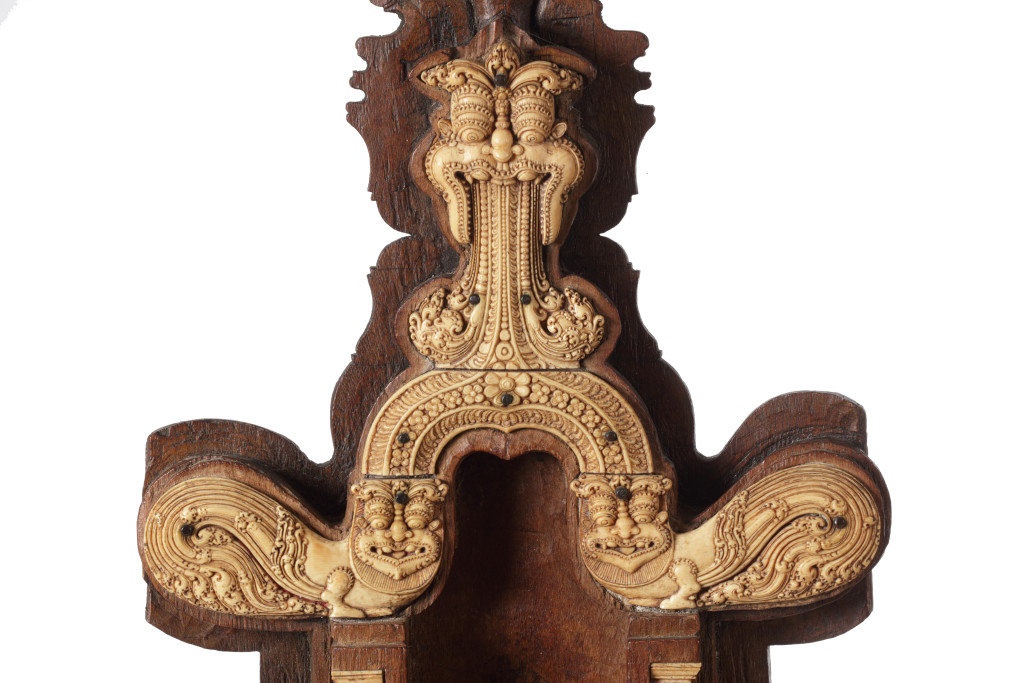
A characteristic feature of Indian temple architecture is the graceful arch leading to the temple entrance, accentuating the doorway to the sanctuary. Similarly, this sacred altar features a carved arch, supported at both ends by two Makara, mythical creatures that take on various animal forms but are always depicted with full, elegant plume-like tails. Additionally, wooden chests were adorned with elaborately carved ivory panels featuring highly refined decorative patterns. Other objects, such as fans and parasol handles, were also considered valuable possessions, beautifully adorned with geometric and floral motifs, all carved from sacred ivory.
The Art of Ivory Carving and Social Hierarchy
Ivory carving was a craft practiced exclusively by artisans from the highest master craftsman caste. This caste system played a crucial role in preserving the artistic tradition at a high level. There was a broad distinction within the artisan hierarchy, particularly in woodworking and, most notably, in ivory carving. Due to the sacred nature of ivory, only artisans of high rank were permitted to carve it. The tradition of ivory carving had existed on the island for centuries, but after the 15th century, Sri Lankan ivory gained broader recognition in European markets. The craftsmanship of Kotte and Kandy artisans was characterized by precision, perfection, and an exceptionally high level of carving skill.
Religious Influence and Iconography
The Sinhalese practiced both Buddhism and Hinduism, though Buddhism was the dominant religion. Buddhist and Hindu styles are evident in temples, houses, and carved objects used in religious rituals. These artistic traditions frequently depict protective deities, celestial beings, mythical creatures, and composite figures, and this symbolism has been consistently present for centuries in Sri Lankan wood carvings, ivory reliefs, temple friezes, and ritual objects. The depiction of deities in Hinduism and Buddhism and Christian figures introduced by the Portuguese and later influenced by Dutch preferences was highly sought after by Europeans.
This home altar is adorned at the top with ivory-carved fragments, featuring a lion-demon head (Kirtimukha) and two Makara, mythical lion-dogs. The Makara is a composite creature, combining features of various land and sea animals. Nearly any unusual combination of animals could be considered a Makara, but one of its key features is its full, elaborate, plume-like tail.
A grinning lion is depicted at the top of the arch, with a cascade of heavenly flora and fauna flowing from its mouth, interwoven with finely carved flowers and vines. This motif is known as the 'Glory Face'. These motifs seamlessly transition into the two flanking Makara, standing on either side, their richly adorned tails serving as a characteristic symbol of Sri Lankan art.
Home Altars in Buddhist and Hindu Rituals
In Buddhism and Hinduism, visiting temples and undertaking pilgrimages is important, but creating a home shrine for daily worship is equally significant. Whether made from fine or simple materials, a home shrine is a fundamental part of religious life.
A sacred space within the home - featuring a small altar and a deity, accompanied by daily offerings such as fruit, food, and drinks - is an essential aspect of ritual devotion. Additional offerings are also made to the deity in the sacred space, including fragrant flowers - another fundamental element of worship. These flowers are carefully arranged in various patterns and colors around the altar.
The color (vanna), fragrance (gandha), and quality (guna) of the flowers are significant, as are other offerings such as candles and incense, which engage the senses during meditation and serve to purify the atmosphere. Some additional rituals include chanting mantras or beating drums, all forming an essential part of daily worship. The primary goal of these rituals is to honor and worship the deity, always with dedication and reverence.
For comparison see: British Museum 1898,0703.2 and 1905,0616.83
In this home altar, a small statue of the owner’s or family’s personal deity was kept, honored, and worshipped. The shrine is crafted from wood and decorated with ivory. It features a curved wooden top, beneath which there is a recessed niche. This niche is framed and decorated with multiple intricately carved ivory panels, forming a continuous pattern. This design extends downward into a stepped wooden pedestal, which is again adorned and refined with various ivory panels, creating a seamless decorative motif.
H. 73 cm
Kingdoms of Sri Lanka
It originates from the Kingdom of Kotte, named after its capital, Kotte, a Sinhalese kingdom that flourished in Sri Lanka during the 15th century. In the 17th century, Sri Lanka (then known as Ceylon) was a land of great wealth, making it highly attractive to European traders, such as the Portuguese, who were the first Europeans to discover in the 16th century that it was a source of spices such as cinnamon, as well as other valuable goods. In addition to spices, intricately carved ivory created by Sinhalese artisans was highly prized. From the 16th century onward, the kingdoms had to resist invasions from Portuguese, Spanish, English, and Dutch maritime powers and colonizers. The Portuguese established themselves in 1517, first in Kotte, then in Colombo. In 1656, the Dutch conquered the Portuguese fort in Colombo, taking control of the island’s trade until the British took over in 1798. The Kingdom of Kandy (1597–1815) was the last independent monarchy of Sri Lanka before the whole island was taken over and incorporated into the British Empire.
Sacred Ivory
The art of ivory carving and woodworking in Sri Lanka was highly esteemed for its exceptional craftsmanship and refinement. These traditional ivory artisans were extraordinarily skilled in working with this organic material. It is remarkable how they could produce such exquisite carvings using only handcrafted techniques and limited tools. The tusks of the Sri Lankan elephant were recognized as high-quality ivory, valued for their thickness and appealing colour. Ivory was considered a sacred material and a prestigious symbol. For this reason, ivory carving and decoration flourished as a traditional craft, passed down through generations—not only as an expression of skill but also for practical applications, including combs, knife handles, daggers, and window and door frames. Indeed, ivory panels were used to embellish the doorways of Buddhist temples and shrines, signifying the sacredness of the space. The same principle applies to this early home altar, which is adorned with ivory around the sacred niche, where the deity is to be placed.
A characteristic feature of Indian temple architecture is the graceful arch leading to the temple entrance, accentuating the doorway to the sanctuary. Similarly, this sacred altar features a carved arch, supported at both ends by two Makara, mythical creatures that take on various animal forms but are always depicted with full, elegant plume-like tails. Additionally, wooden chests were adorned with elaborately carved ivory panels featuring highly refined decorative patterns. Other objects, such as fans and parasol handles, were also considered valuable possessions, beautifully adorned with geometric and floral motifs, all carved from sacred ivory.
The Art of Ivory Carving and Social Hierarchy
Ivory carving was a craft practiced exclusively by artisans from the highest master craftsman caste. This caste system played a crucial role in preserving the artistic tradition at a high level. There was a broad distinction within the artisan hierarchy, particularly in woodworking and, most notably, in ivory carving. Due to the sacred nature of ivory, only artisans of high rank were permitted to carve it. The tradition of ivory carving had existed on the island for centuries, but after the 15th century, Sri Lankan ivory gained broader recognition in European markets. The craftsmanship of Kotte and Kandy artisans was characterized by precision, perfection, and an exceptionally high level of carving skill.
Religious Influence and Iconography
The Sinhalese practiced both Buddhism and Hinduism, though Buddhism was the dominant religion. Buddhist and Hindu styles are evident in temples, houses, and carved objects used in religious rituals. These artistic traditions frequently depict protective deities, celestial beings, mythical creatures, and composite figures, and this symbolism has been consistently present for centuries in Sri Lankan wood carvings, ivory reliefs, temple friezes, and ritual objects. The depiction of deities in Hinduism and Buddhism and Christian figures introduced by the Portuguese and later influenced by Dutch preferences was highly sought after by Europeans.
This home altar is adorned at the top with ivory-carved fragments, featuring a lion-demon head (Kirtimukha) and two Makara, mythical lion-dogs. The Makara is a composite creature, combining features of various land and sea animals. Nearly any unusual combination of animals could be considered a Makara, but one of its key features is its full, elaborate, plume-like tail.
A grinning lion is depicted at the top of the arch, with a cascade of heavenly flora and fauna flowing from its mouth, interwoven with finely carved flowers and vines. This motif is known as the 'Glory Face'. These motifs seamlessly transition into the two flanking Makara, standing on either side, their richly adorned tails serving as a characteristic symbol of Sri Lankan art.
Home Altars in Buddhist and Hindu Rituals
In Buddhism and Hinduism, visiting temples and undertaking pilgrimages is important, but creating a home shrine for daily worship is equally significant. Whether made from fine or simple materials, a home shrine is a fundamental part of religious life.
A sacred space within the home - featuring a small altar and a deity, accompanied by daily offerings such as fruit, food, and drinks - is an essential aspect of ritual devotion. Additional offerings are also made to the deity in the sacred space, including fragrant flowers - another fundamental element of worship. These flowers are carefully arranged in various patterns and colors around the altar.
The color (vanna), fragrance (gandha), and quality (guna) of the flowers are significant, as are other offerings such as candles and incense, which engage the senses during meditation and serve to purify the atmosphere. Some additional rituals include chanting mantras or beating drums, all forming an essential part of daily worship. The primary goal of these rituals is to honor and worship the deity, always with dedication and reverence.
For comparison see: British Museum 1898,0703.2 and 1905,0616.83
Part of the Indian Ocean collection.
Related objects
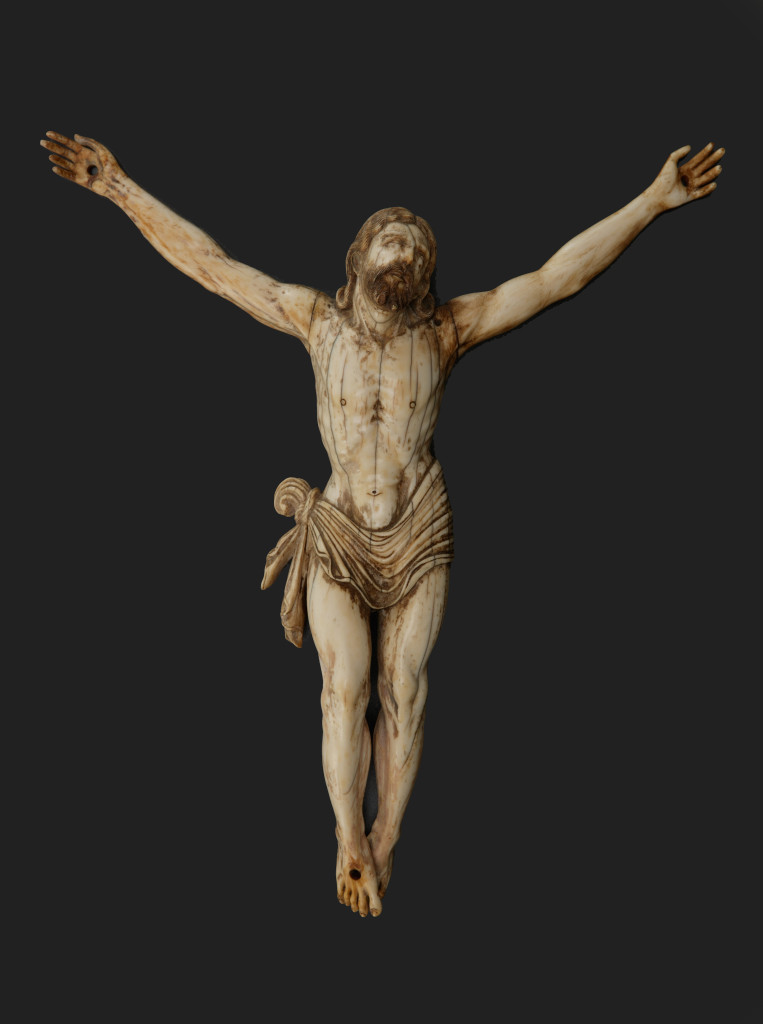
A delicately carved ivory Portuguese Sri Lankan crucifix
Portuguese Sri Lankan ivory crucifix
No image
An ivory Bakongo Christian crucifix 'Nkangi Kidutu'
_Democratic Republic of Congo, late 19th/early 20th century_ _H. 11 x W. 10 cm,_
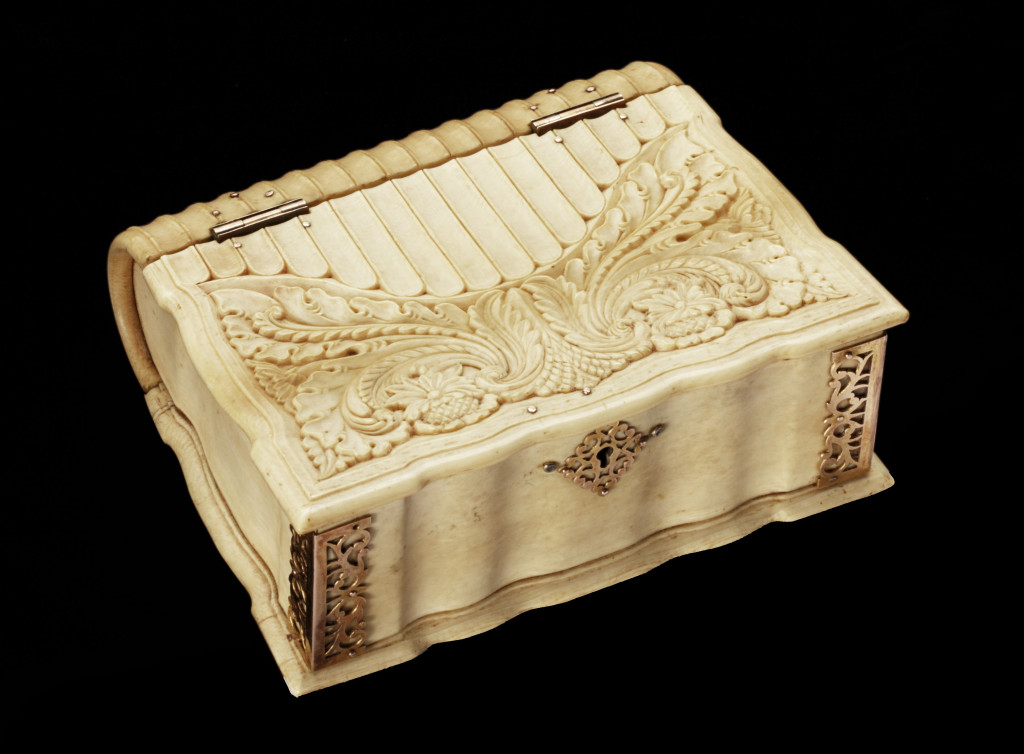
A very fine Sri Lankan ivory and gold bible box
Fine Sri Lankan Ivory and Gold Bible box