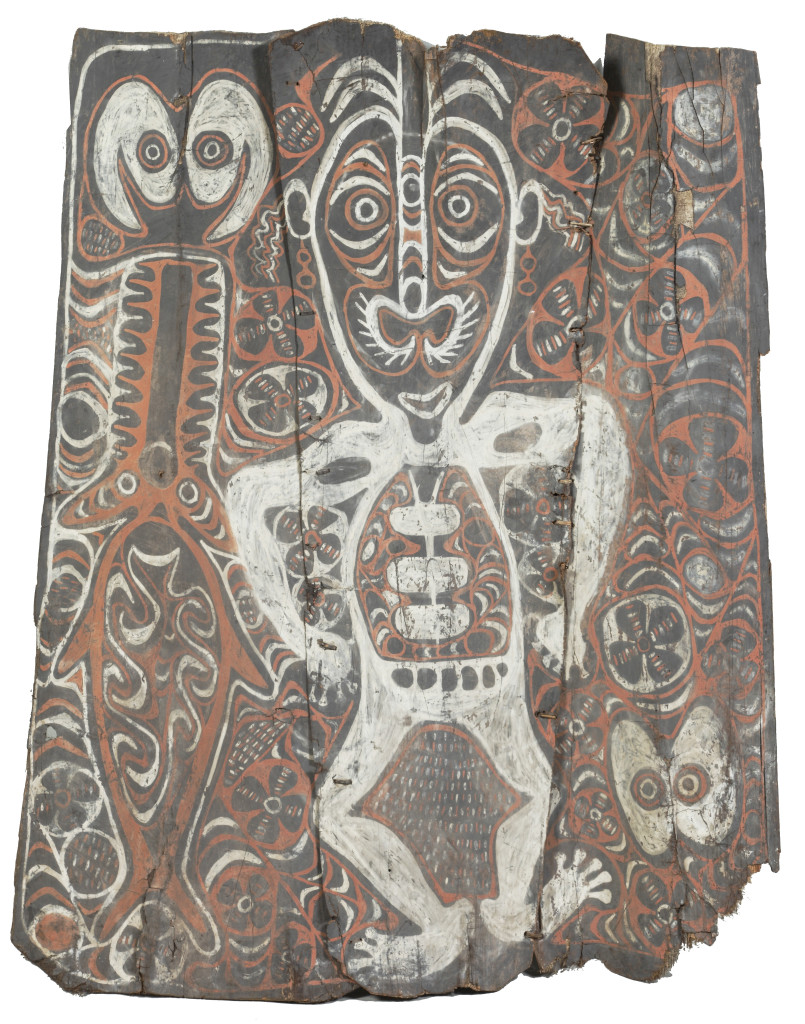
A Sepik 'panggal' sago spathe or tree bark painting of an ancestral figure
The painting in non-binded pigment on sago spathe, bark of a sago palm, depicts an ancestral figure surrounded by a saw fish, two masks and several floral and seed motives.
H. 139 x W. 111 cm
Provenance:
Collected by missionary Georg Hölker between 1934 and 1938, for the collection of The Divine World Missionaries, founded at Steyl near Venlo in the Netherlands in 1875
Sago spathe is a protective, often fibrous or woody sheath that encloses the flower cluster (inflorescence) of the sago palm, particularly Metroxylon sagu. The spathe is also a large bract that shields the palm's developing flowers and seeds until they are mature. In traditional practices, the spathe of the sago palm is sometimes harvested for its material, which can be used for various purposes, including crafting containers, tools, or decorative items. The sago palm is mainly valued for the starchy pith within its trunk, which is processed into sago, a staple food in many parts of Southeast Asia and the Pacific Islands.
The original mission house in Steyl, where the Society of the Divine Word (SVD) was founded in 1875, is now home to the Missiemuseum Steyl, founded in 1931. Items like the present panggal were brought back by missionaries from all corners of the globe, particularly Asia, Africa, and Latin America. They served to educate apprentice missionaries about what they would encounter on a mission.
The museum's exhibits, which include taxidermy, cultural artefacts, Indigenous art, and items related to the everyday life of people in mission areas, offer a global perspective on the history of missionary work and the intercultural encounters that were part of the SVD’s mission. Visitors can explore displays that illustrate the interaction between European missionaries and the cultures they engaged with, offering perspectives on both controversial and positive aspects of missionary work. However contentious, one could be thankful the missionaries decided to collect, preserve and exhibit all these objects instead of burning, throwing them in lakes or destroying them in the name of our Good Lord.
Part of the Indonesian Archipelago and Oceania collections.
Related objects
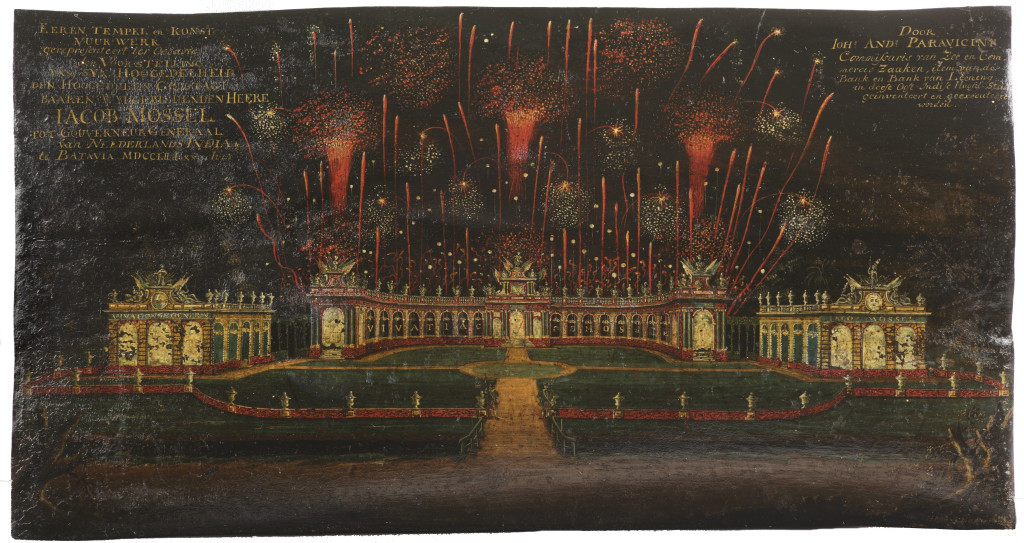
An extremely rare painting depicting the celebrations in honour of the inauguration of Governor-General Jacob Mossel (1704-1761) of the Dutch East Indies on the 24th of July in 1752
Temple and fireworks presented for the inauguration of the highly esteemed Jacob Mossel as Governor-General of the Dutch East Indies in Batavia 1752, 24 July. Invented and executed by Johannes Andreas Paravicini, Commissioner of Sea and Trade and of the Bank of the Capital of East India.
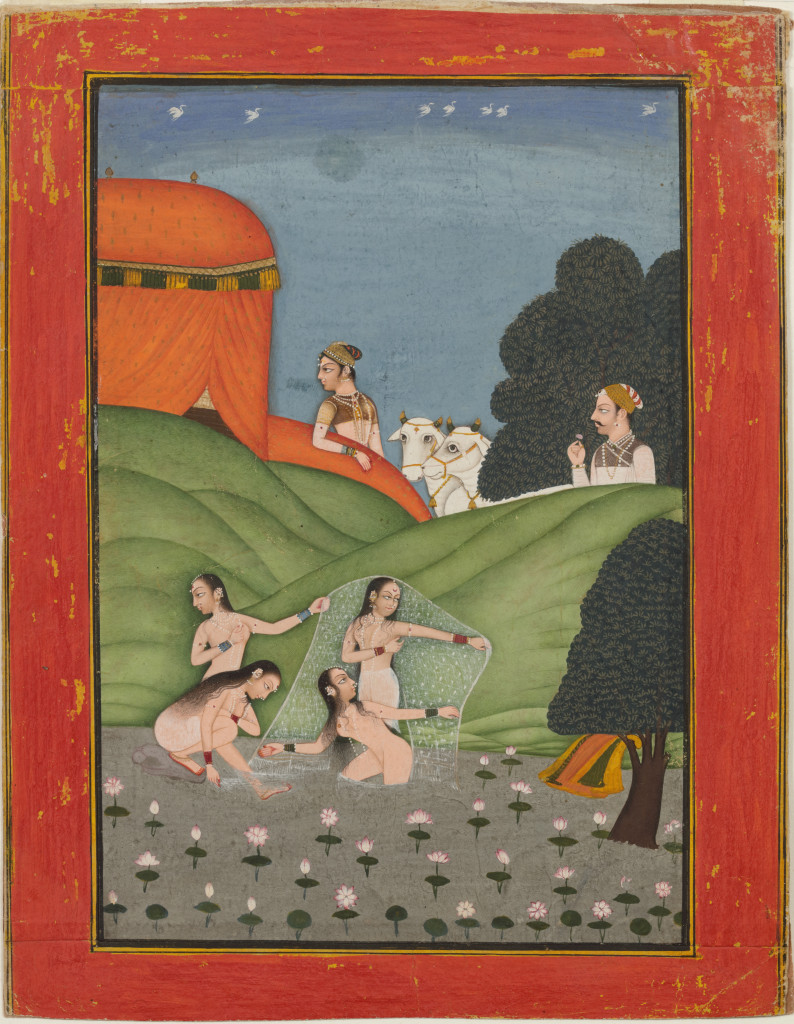
An Indian miniature painting depicting a prince spying on bathing women
The prince and his courtier are curiously attended by some cows, alluding to depictions of a popular episode from the story of Krishna's youthful years when he stole the clothes of the gopis, female cowherds, who had left their clothes on the Yamuna river bank while bathing. Krishna, high up in a tree with the stolen clothes dares the gopis to come out of the water and beg for their clothes with arms raised in supplication, revealing themselves fully before their god. However, stealing clothes is only for the Gods, so the prince in the present painting doesn't even dare look.
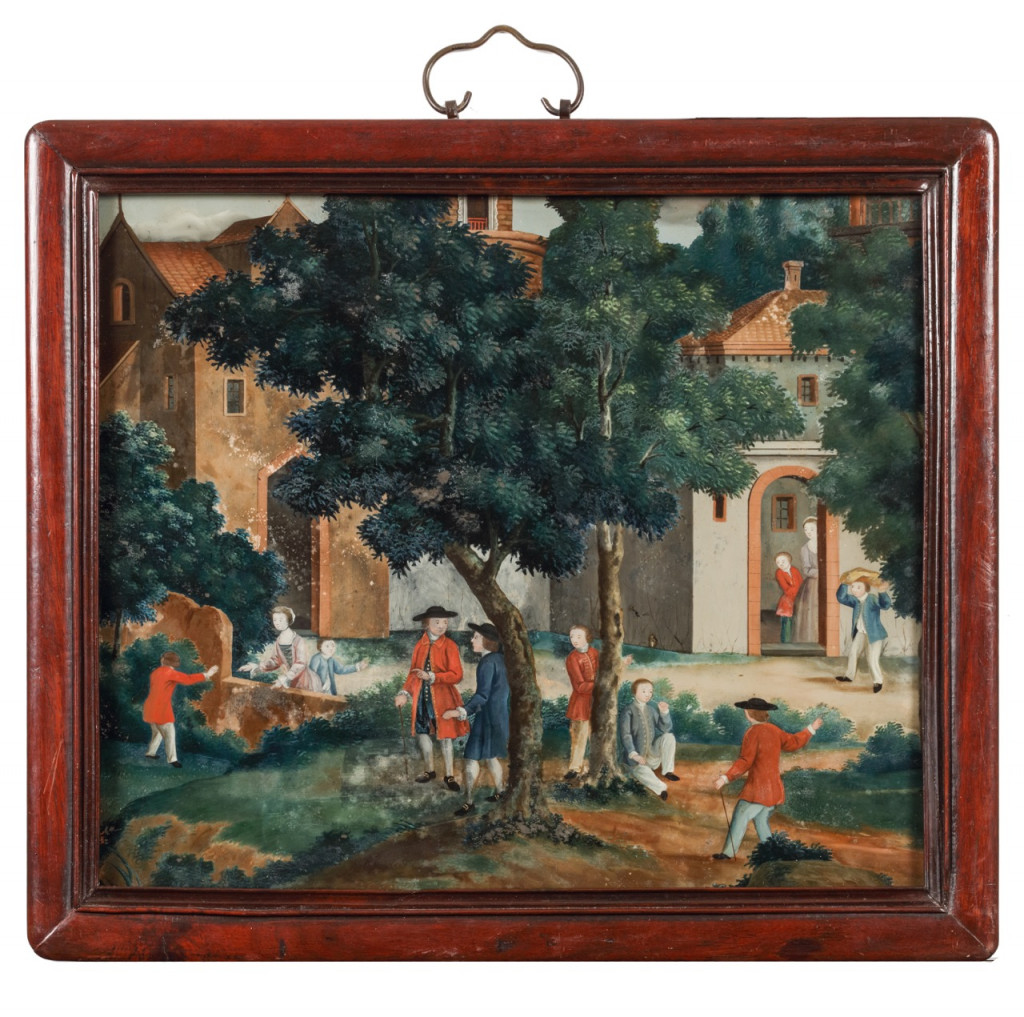
A Chinese export reverse-glass painting after an English print in original hardwood frame
Chinese reverse glass paintings for export are known since mid 18th century. By the 1780's the copying of European, mainly English, engravings came into vogue in Chinese paintings on glass, and often reverse glass paintings were mirrored or with silver backs. Particularly in England, they became very popular as over mantel mirrors in copied English frames. Because of their nature, many have been lost over time.