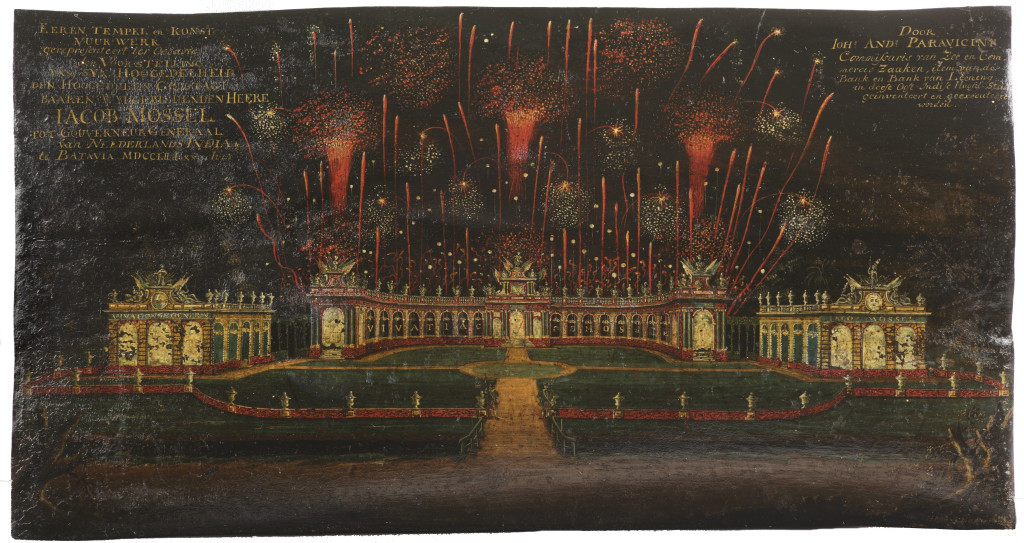
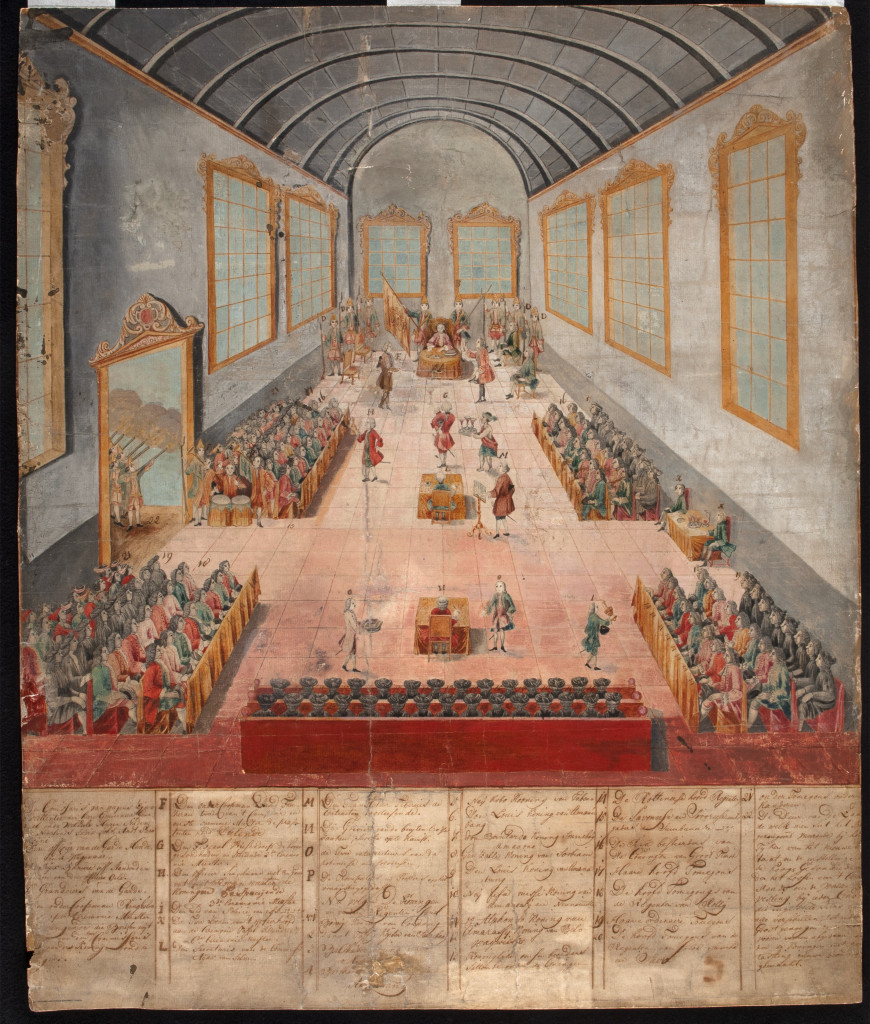
An extremely rare painting depicting the celebrations in honour of the inauguration of Governor-General Jacob Mossel (1704-1761) of the Dutch East Indies on the 24th of July in 1752
Batavia (Jakarta), circa 1752
Inscribed:
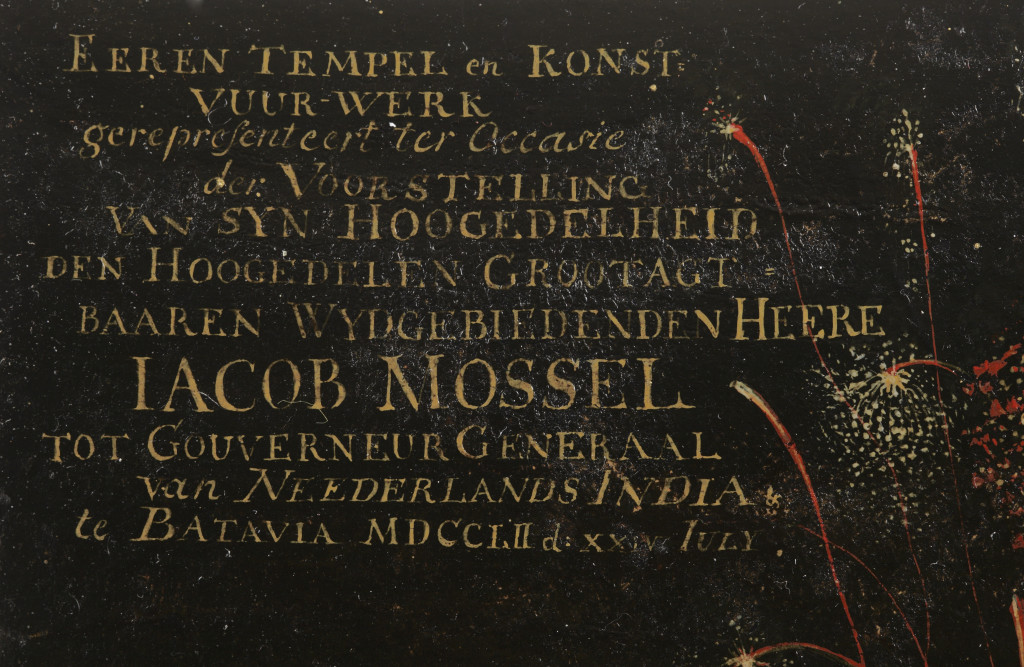
Eeren Tempel en t Konst Vuurwerk gepresenteerd ter Occasie der Voorstelling van syn Hoogedelheid den Hoogedelen Grootaachtbaaren Wijdgebiedenden Heere Jacob Mossel tot Gouverneur Generaal van Neederlands India te Batavia MDCCLII d: XXVI luly.
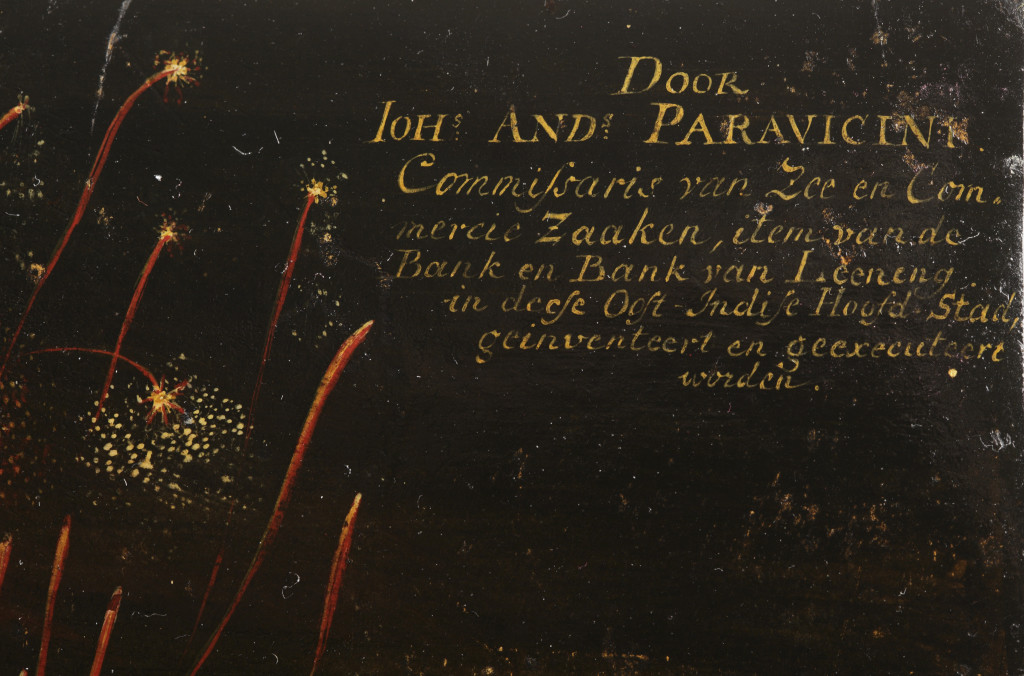
Door Johannes Andreas Paravicini, Commissaris van Zee en Commercie Zaaken, item van de Bank en Bank van Leening in deese Oost Indise Hoofd Stad geinventeerd en geëxecuteert worden.
(Temple and fireworks presented for the inauguration of the highly esteemed Jacob Mossel as Governor-General of the Dutch East Indies in Batavia 1752, 24 July. Invented and executed by Johannes Andreas Paravicini, Commissioner of Sea and Trade and of the Bank of the Capital of East India.)
Indistinctly signed in the bottom right corner
Oil on vellum, H. 16 x W. 29.4 cm
Jacob Mossel (Enkhuizen 1704 - Batavia 1761) arrived as a sailor in Batavia in 1720. The following year, he was sent to the Coromandel Coast, where he stayed for 12 years, learning much from the successful British private trade and becoming Governor of the Coromandel Coast in 1738. In 1741, he was called back to Batavia where he was appointed Director-General. Upon the death of Governor-General Van Imhoff in 1750, Jacob Mossel was elected his successor by the Council in Batavia. After approval by De Heren XVII, the directors of the VOC, in Amsterdam he was officially inaugurated with fireworks, pomp and splendour in 1752. In 1753, however, Mossel deemed it necessary to curb ostentatious displays of wealth. In his “Regulation against Pomp and Splendour” it was decreed in detail who was allowed a carriage and how many, how many horses were allowed in front, what jewellery women were allowed to wear in public and who could bring a bible in a gold, silver or other precious material to church.
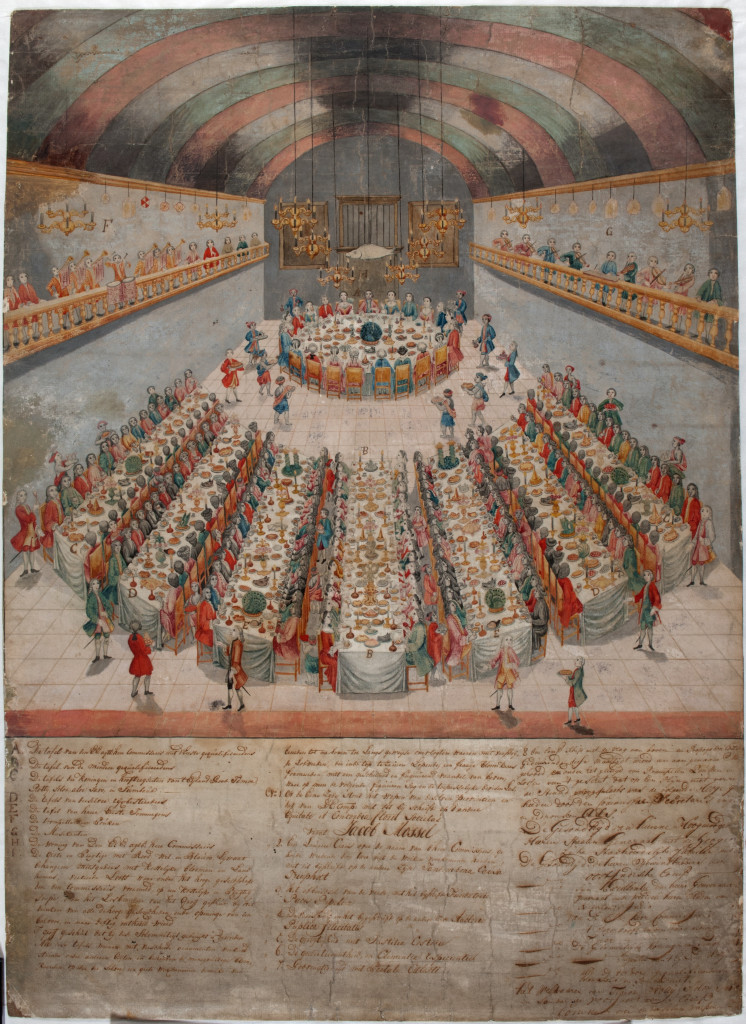
Johannes Andreas Paravicini (1710-1771) came to Amsterdam at only 14 or 16 years old, where he joined the VOC as a ziekenrooster, a position as a mixed religious and medical caretaker of the VOC staff. When he arrived in Asia is not certain, but the first mention of his presence was in 1740 in Sri Lanka (Ceylon) and in 1746 he appeared to be in Batavia (Jakarta). In the collection of the Koninklijk Instituut voor de Tropen (Dutch Royal Institute of the Tropics), there are two unsigned watercolours (inv. 3728-540a & 541a) by an artist in the retinue of Paravicini. They were made when Governor-General Mossel sent Paravicini on a mission in 1756 to end a conflict between Portuguese and Dutch on the Isle of Timor. One of the watercolours shows the pomp and splendour surrounding the treaty's signing, and the other is the dazzlingly exuberant banquet to celebrate the treaty. Paravicini clearly liked to have his exploits immortalized and the unknown artist of the present painting probably is the same as the one who made the two watercolours. Mossel and Paravicini became close partners in the shady business of (illegal) profitable private dealings by VOC officials.
Inscribed:
Eeren Tempel en t Konst Vuurwerk gepresenteerd ter Occasie der Voorstelling van syn Hoogedelheid den Hoogedelen Grootaachtbaaren Wijdgebiedenden Heere Jacob Mossel tot Gouverneur Generaal van Neederlands India te Batavia MDCCLII d: XXVI luly.
Door Johannes Andreas Paravicini, Commissaris van Zee en Commercie Zaaken, item van de Bank en Bank van Leening in deese Oost Indise Hoofd Stad geinventeerd en geëxecuteert worden.
(Temple and fireworks presented for the inauguration of the highly esteemed Jacob Mossel as Governor-General of the Dutch East Indies in Batavia 1752, 24 July. Invented and executed by Johannes Andreas Paravicini, Commissioner of Sea and Trade and of the Bank of the Capital of East India.)
Indistinctly signed in the bottom right corner
Oil on vellum, H. 16 x W. 29.4 cm
Jacob Mossel (Enkhuizen 1704 - Batavia 1761) arrived as a sailor in Batavia in 1720. The following year, he was sent to the Coromandel Coast, where he stayed for 12 years, learning much from the successful British private trade and becoming Governor of the Coromandel Coast in 1738. In 1741, he was called back to Batavia where he was appointed Director-General. Upon the death of Governor-General Van Imhoff in 1750, Jacob Mossel was elected his successor by the Council in Batavia. After approval by De Heren XVII, the directors of the VOC, in Amsterdam he was officially inaugurated with fireworks, pomp and splendour in 1752. In 1753, however, Mossel deemed it necessary to curb ostentatious displays of wealth. In his “Regulation against Pomp and Splendour” it was decreed in detail who was allowed a carriage and how many, how many horses were allowed in front, what jewellery women were allowed to wear in public and who could bring a bible in a gold, silver or other precious material to church.
Johannes Andreas Paravicini (1710-1771) came to Amsterdam at only 14 or 16 years old, where he joined the VOC as a ziekenrooster, a position as a mixed religious and medical caretaker of the VOC staff. When he arrived in Asia is not certain, but the first mention of his presence was in 1740 in Sri Lanka (Ceylon) and in 1746 he appeared to be in Batavia (Jakarta). In the collection of the Koninklijk Instituut voor de Tropen (Dutch Royal Institute of the Tropics), there are two unsigned watercolours (inv. 3728-540a & 541a) by an artist in the retinue of Paravicini. They were made when Governor-General Mossel sent Paravicini on a mission in 1756 to end a conflict between Portuguese and Dutch on the Isle of Timor. One of the watercolours shows the pomp and splendour surrounding the treaty's signing, and the other is the dazzlingly exuberant banquet to celebrate the treaty. Paravicini clearly liked to have his exploits immortalized and the unknown artist of the present painting probably is the same as the one who made the two watercolours. Mossel and Paravicini became close partners in the shady business of (illegal) profitable private dealings by VOC officials.
Related objects
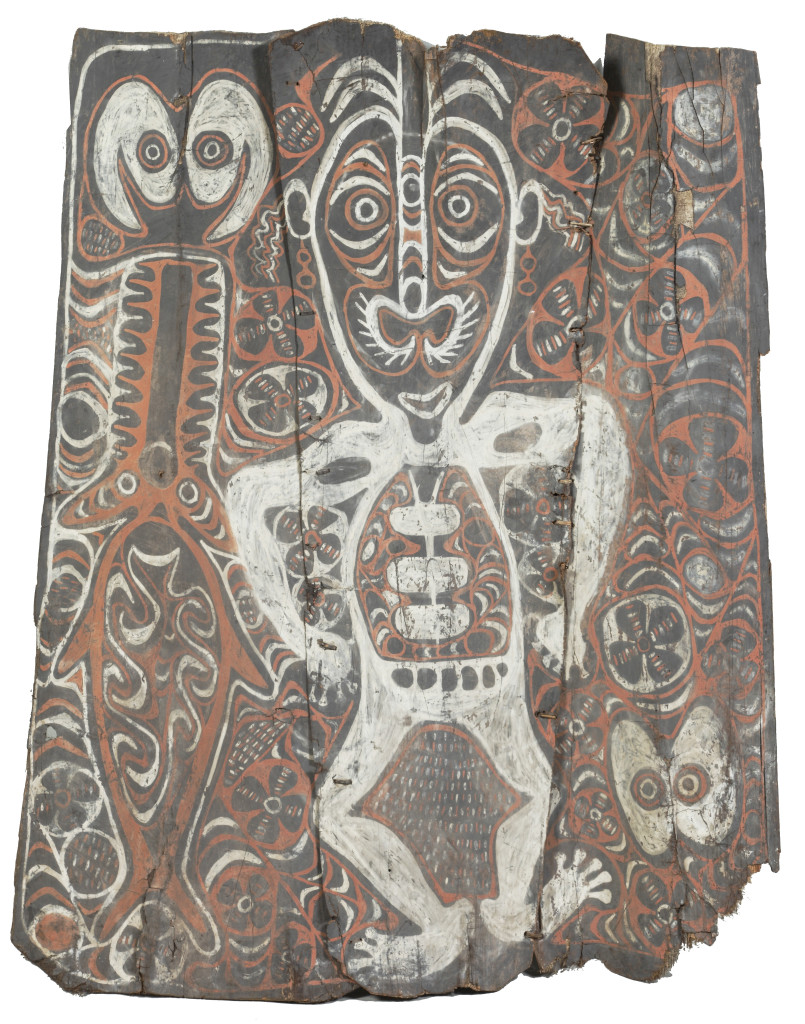
A Sepik 'panggal' sago spathe or tree bark painting of an ancestral figure
From the East-Sepik Province, Keram River, early 20th century, the painting in non-binded pigment on sago spathe, bark of a sago palm, depicts an ancestral figure surrounded by a saw fish, two masks and several floral and seed motives.
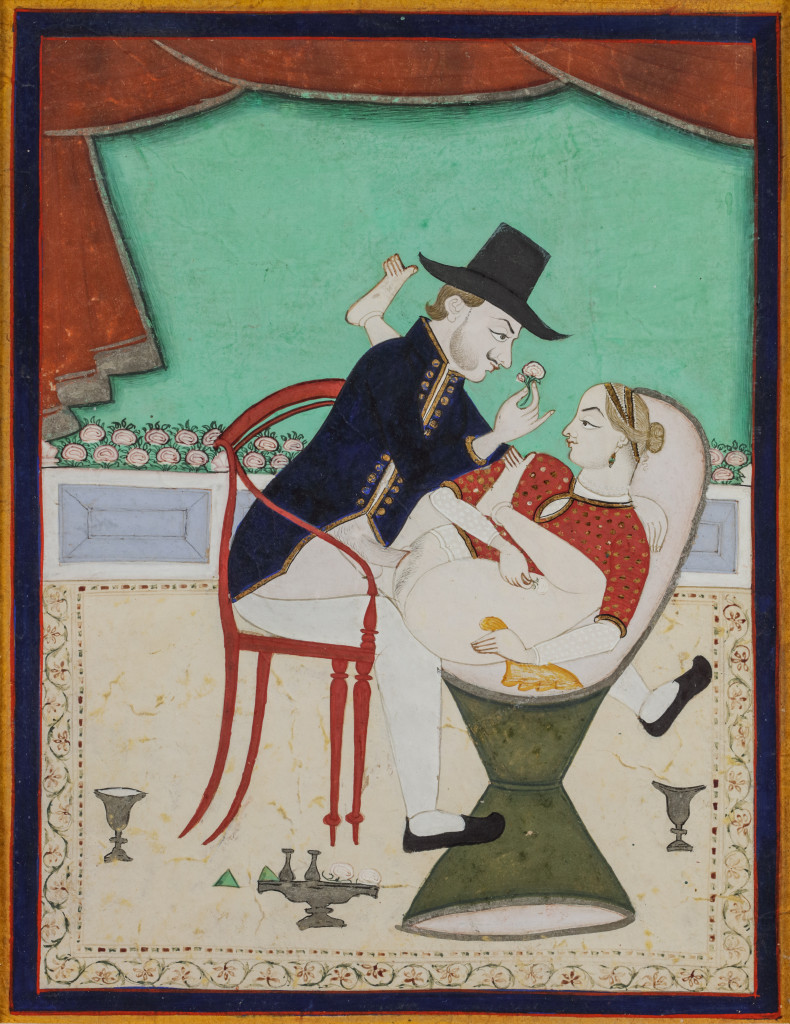
An Indian miniature painting depicting a European couple in a love scene
Indian Erotic Miniature of Europeans
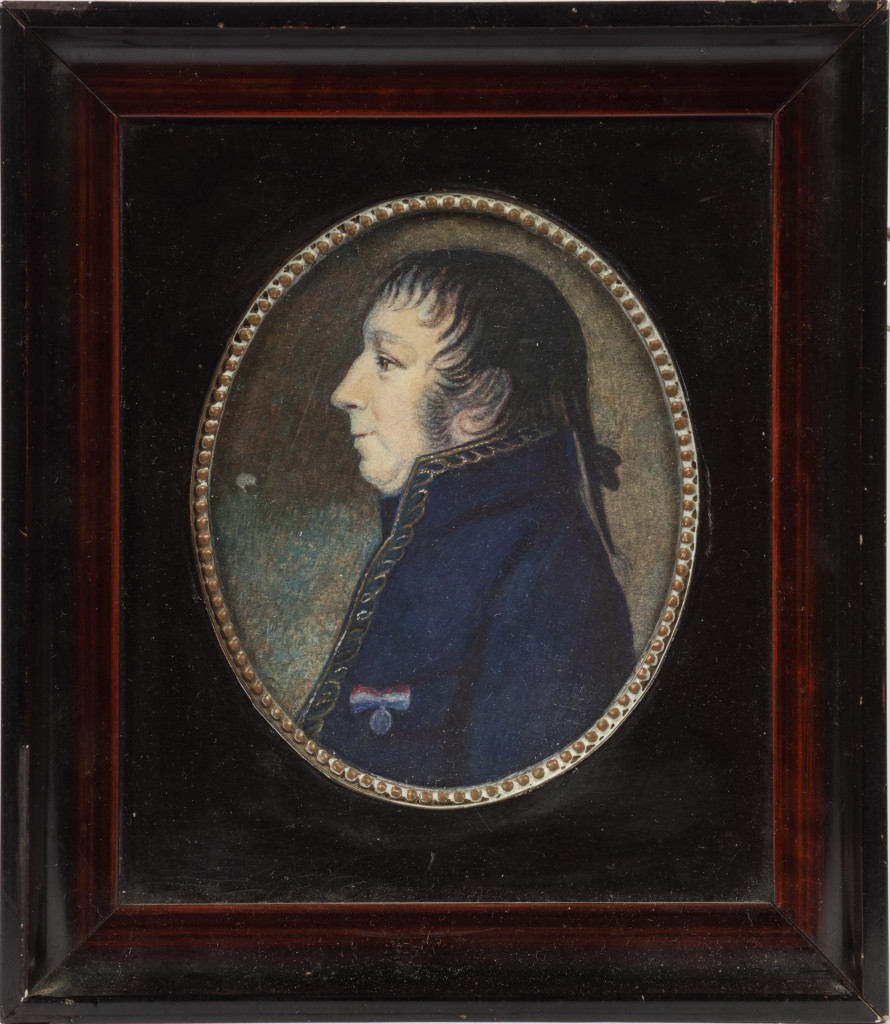
A pair of miniature portraits by Johannes Anspach (1752- 1823) depicting Vice-Admiral and Governor- General of Curaçao, Aruba and Bonaire Albert Kikkert (1762-1819) and presumably his brother Klaas Kikkert
Johannes Anspach - Governor Kikkert