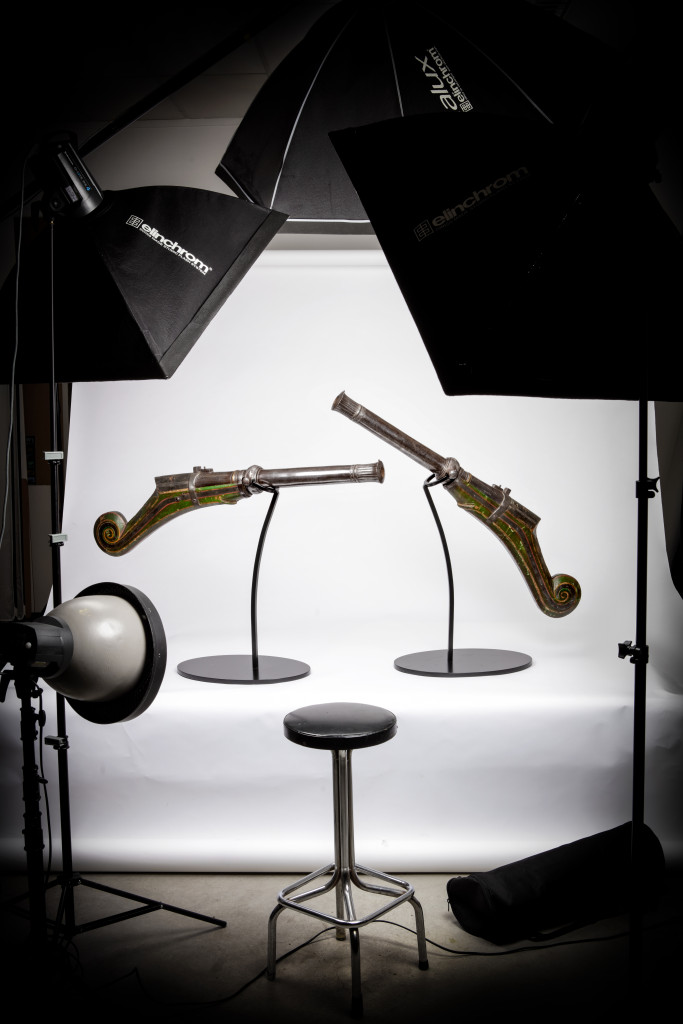
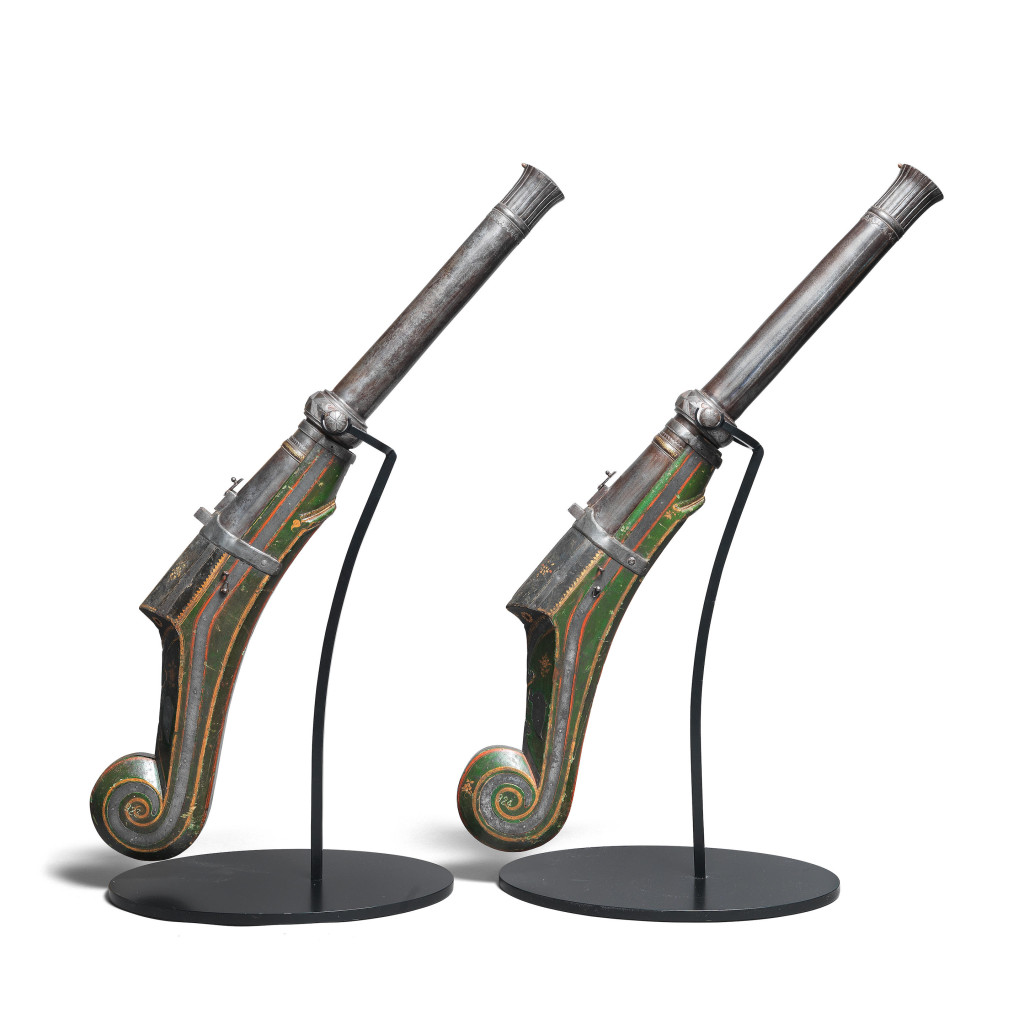
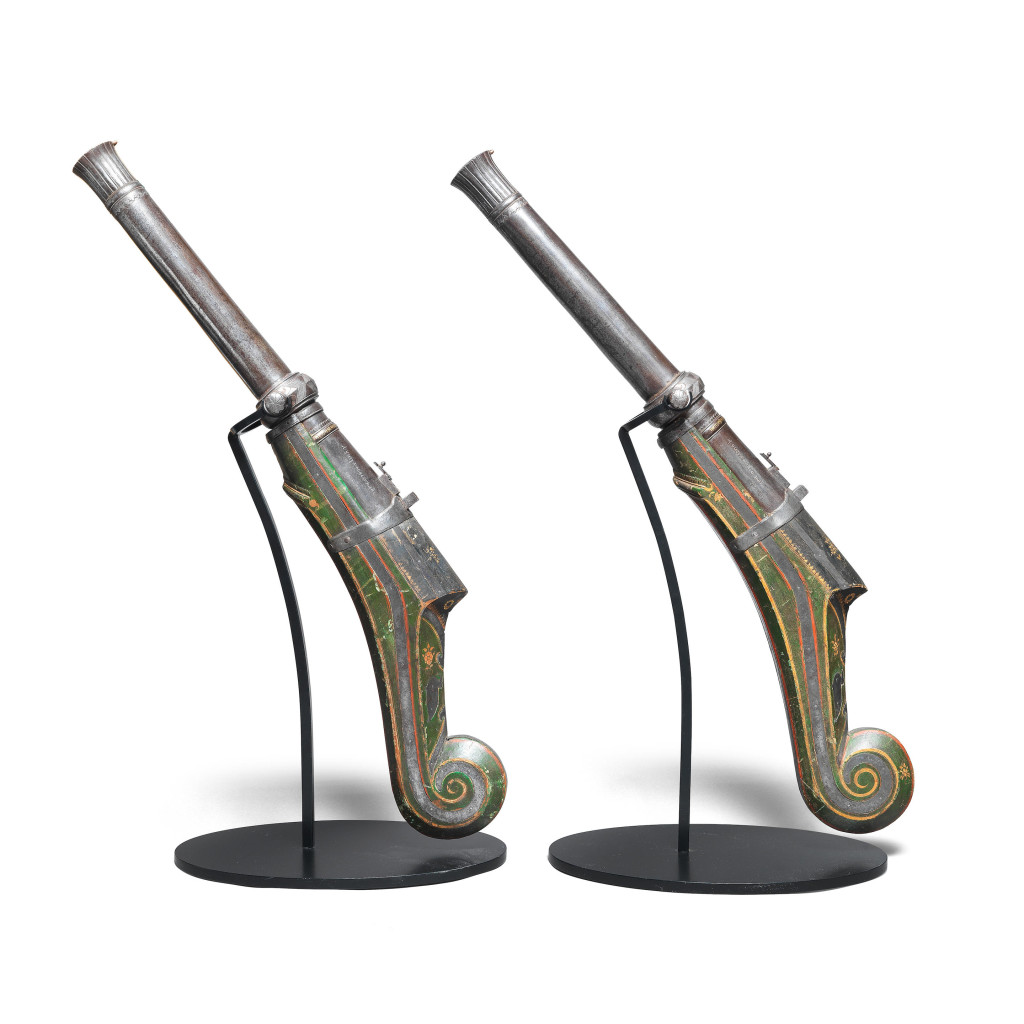
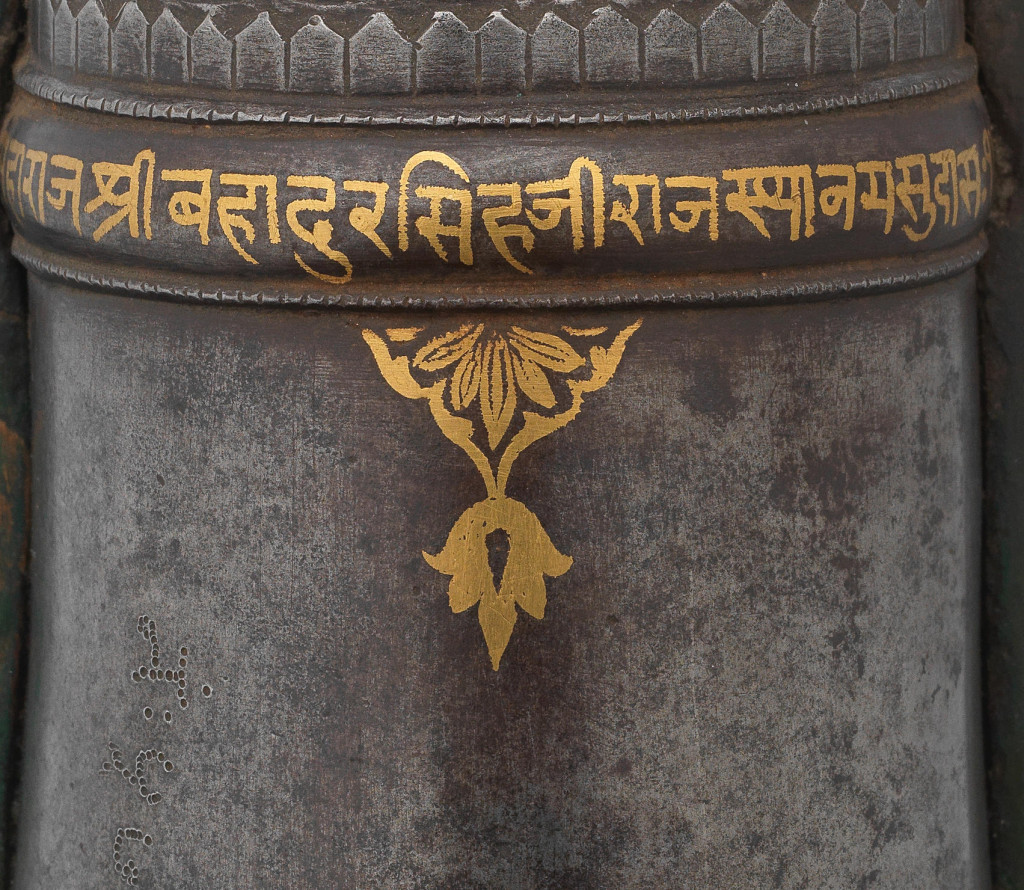
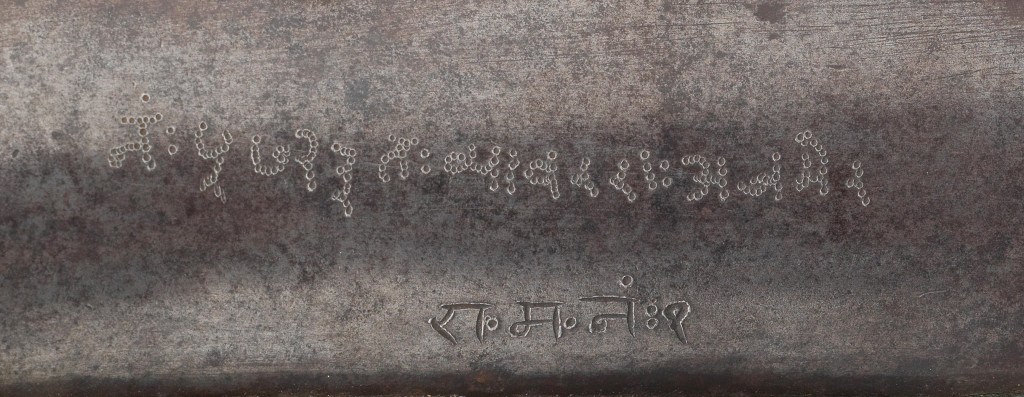
A rare pair of Royal camel-guns or 'zamburak', formerly belonging to 'Maharaja' Bahadur Singh of Ajmer (1857-1903)
Rajasthan, Ajmer, dated Samvat 1952 (1895 CE)
Each cannon in polychrome wood and koftgari gold steel, inscribed 'Maharaj Shri Bahadur Singh Ji, Rajasthan Masuda Samvat 1952'.
L. 116 cm (each)
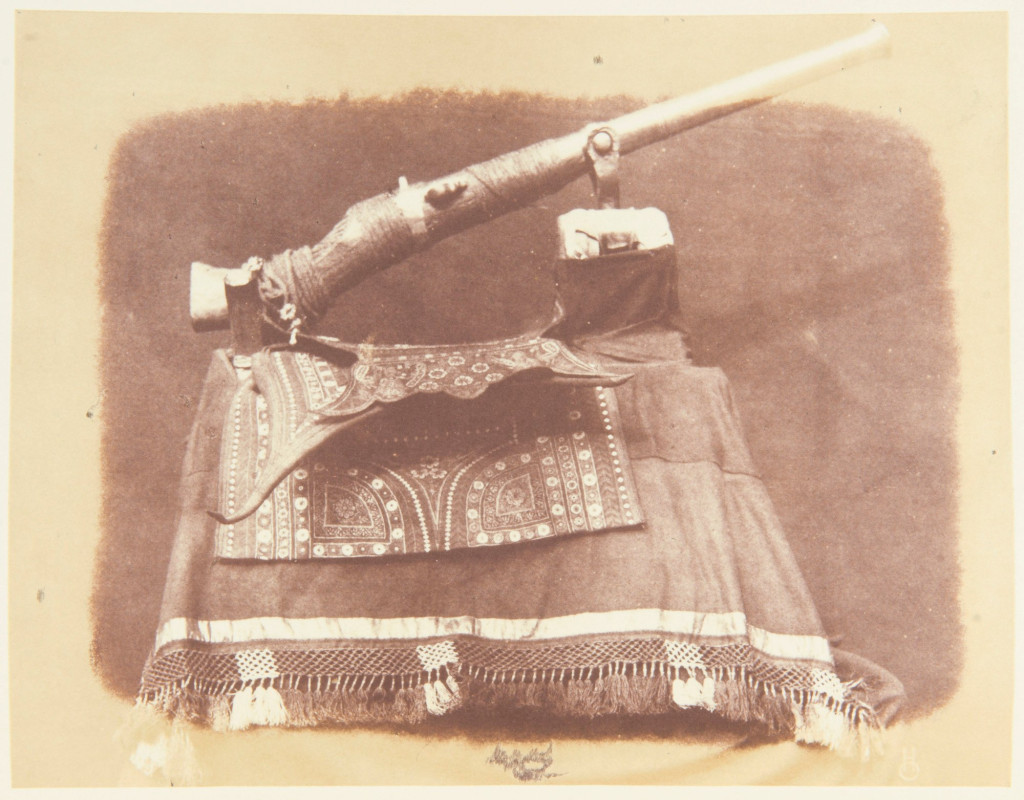
A zanburak, pronounced zamburak, is known in Arabic, Persian and Turkish as wasp, bee or hornet. ‘Zambur’ means hornet, and ‘ak’ is the diminutive - so ‘little wasp’. These swivel guns were carried by camels and were used by the Persians in the eighteenth century until their demise in 1849. In battle, the animals would be restrained on their knees and loaded as bombardiers, after which the weapons would be fired from atop their backs. Zamburaks were the Indian response to European horse artillery. However, the zamburaks were less mobile and thus less manoeuvrable than horse artillery. An Ottoman example of one of these guns mounted on a camel is illustrated by Marsigli in L'Etat militaire de l'Empire Ottoman in 1732. During the Sikh Wars (1846-1847 & 1848-1849), the speed of movement of the European horse artillery made the zamburaks useless. They were too slow, and their power was inadequate. They couldn’t catch up with the European horse artillery. That doesn’t, however, make them less impressive and frightening.
Provenance:
- The Thakur of Madua, Rao Saheb Bahadur Singh (reign 1863-1903)
- Collection William Edward Simon (1927-2000), United States Secretary of the Treasury
- Noble collection, Saudi Arabia
- Collection Peter Finer, London
- Collection Toor, London
Sources:
- Roy Kaushik, ‘Military Synthesis in South Asia: Armies, Warfare and Indian Society, c. 1740-1849’, in: The Journal of Military History, Volume 69, no. 3, 2005, p. 662
- Robert Elgood, Firearms of the Islamic World in the Tareq Rajab Museum, Kuwait, I.B. Tauris & Co. Ltd, 1995, p. 137-139
Each cannon in polychrome wood and koftgari gold steel, inscribed 'Maharaj Shri Bahadur Singh Ji, Rajasthan Masuda Samvat 1952'.
L. 116 cm (each)
A zanburak, pronounced zamburak, is known in Arabic, Persian and Turkish as wasp, bee or hornet. ‘Zambur’ means hornet, and ‘ak’ is the diminutive - so ‘little wasp’. These swivel guns were carried by camels and were used by the Persians in the eighteenth century until their demise in 1849. In battle, the animals would be restrained on their knees and loaded as bombardiers, after which the weapons would be fired from atop their backs. Zamburaks were the Indian response to European horse artillery. However, the zamburaks were less mobile and thus less manoeuvrable than horse artillery. An Ottoman example of one of these guns mounted on a camel is illustrated by Marsigli in L'Etat militaire de l'Empire Ottoman in 1732. During the Sikh Wars (1846-1847 & 1848-1849), the speed of movement of the European horse artillery made the zamburaks useless. They were too slow, and their power was inadequate. They couldn’t catch up with the European horse artillery. That doesn’t, however, make them less impressive and frightening.
Provenance:
- The Thakur of Madua, Rao Saheb Bahadur Singh (reign 1863-1903)
- Collection William Edward Simon (1927-2000), United States Secretary of the Treasury
- Noble collection, Saudi Arabia
- Collection Peter Finer, London
- Collection Toor, London
Sources:
- Roy Kaushik, ‘Military Synthesis in South Asia: Armies, Warfare and Indian Society, c. 1740-1849’, in: The Journal of Military History, Volume 69, no. 3, 2005, p. 662
- Robert Elgood, Firearms of the Islamic World in the Tareq Rajab Museum, Kuwait, I.B. Tauris & Co. Ltd, 1995, p. 137-139
Related objects
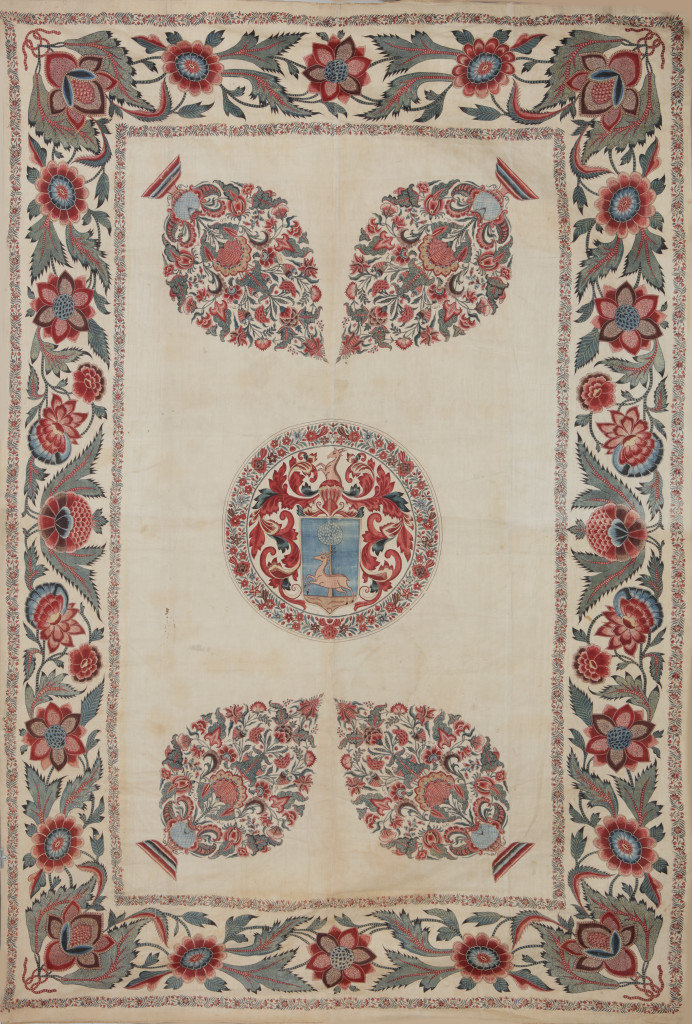
A very rare Indian Armorial Palempore Chintz for the Dutch Market
Coromandel coast, probably Sadraspatnam (Sadras), first half 18th century. “Palempore” refers to large chintzes laid on a bed or hung behind it. The present very large palempore in the centre shows a coat of arms with a redish salient deer in front of a green tree on the ground, the crest with a deer issuant. The mantling shows scrolling leaves and European style scrollwork in red and green, within a circle of flowers. In the corners of the white field four vases with large flower bouquets. The borders are decorated with undulating vines with flowers and leaves issuing from large flowers and leaves in each corner and in the middle of the long sides.
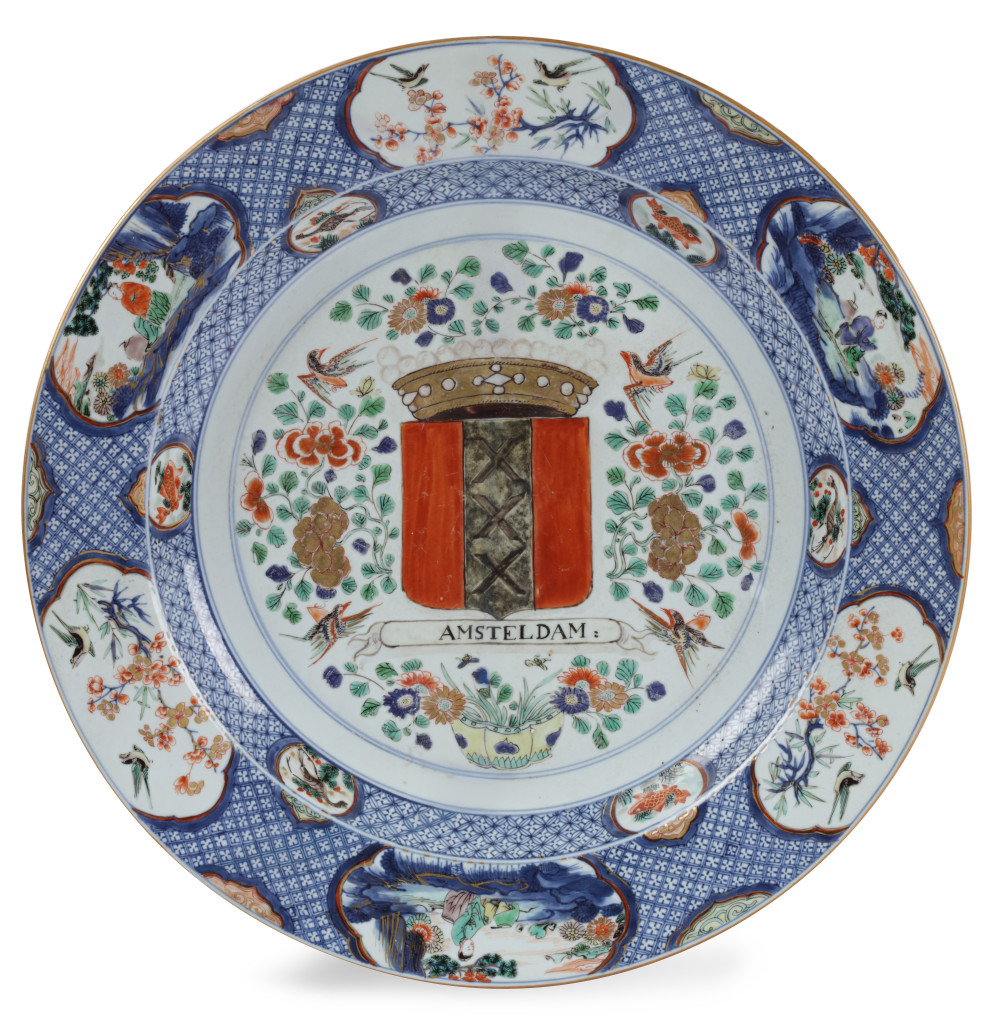
An extremely rare and large Chinese famille verte armorial dish with the Amsterdam coat-of-arms
Kangxi period, circa 1710-1720
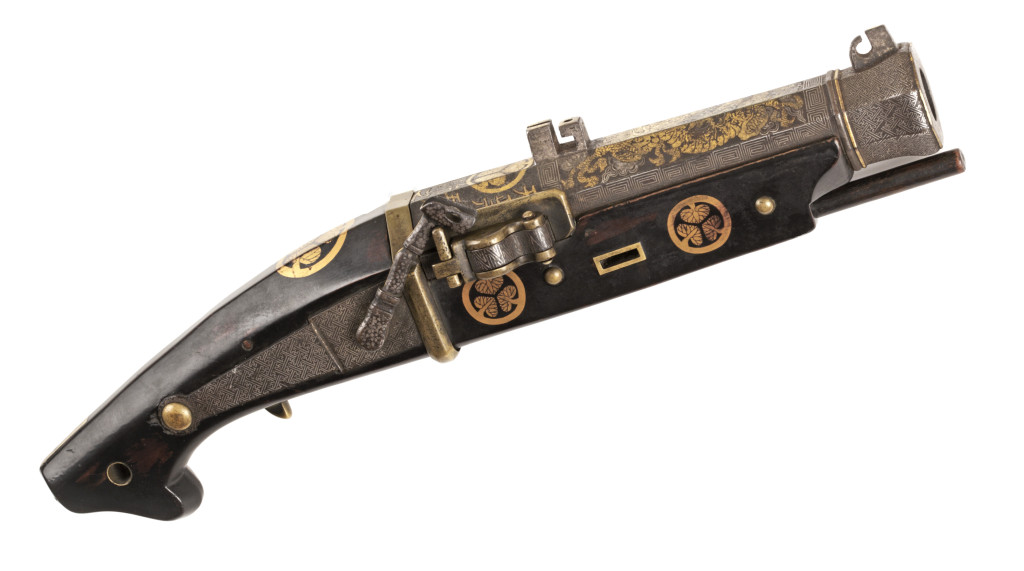
A Japanese matchlock pistol inscribed Tenshõ Gan-Nen G-Gatsu, Kazari-No, Matsudaira-Awa-No-Kami (for the feudal lord of the Awa area)
Edo period 17th/18th century