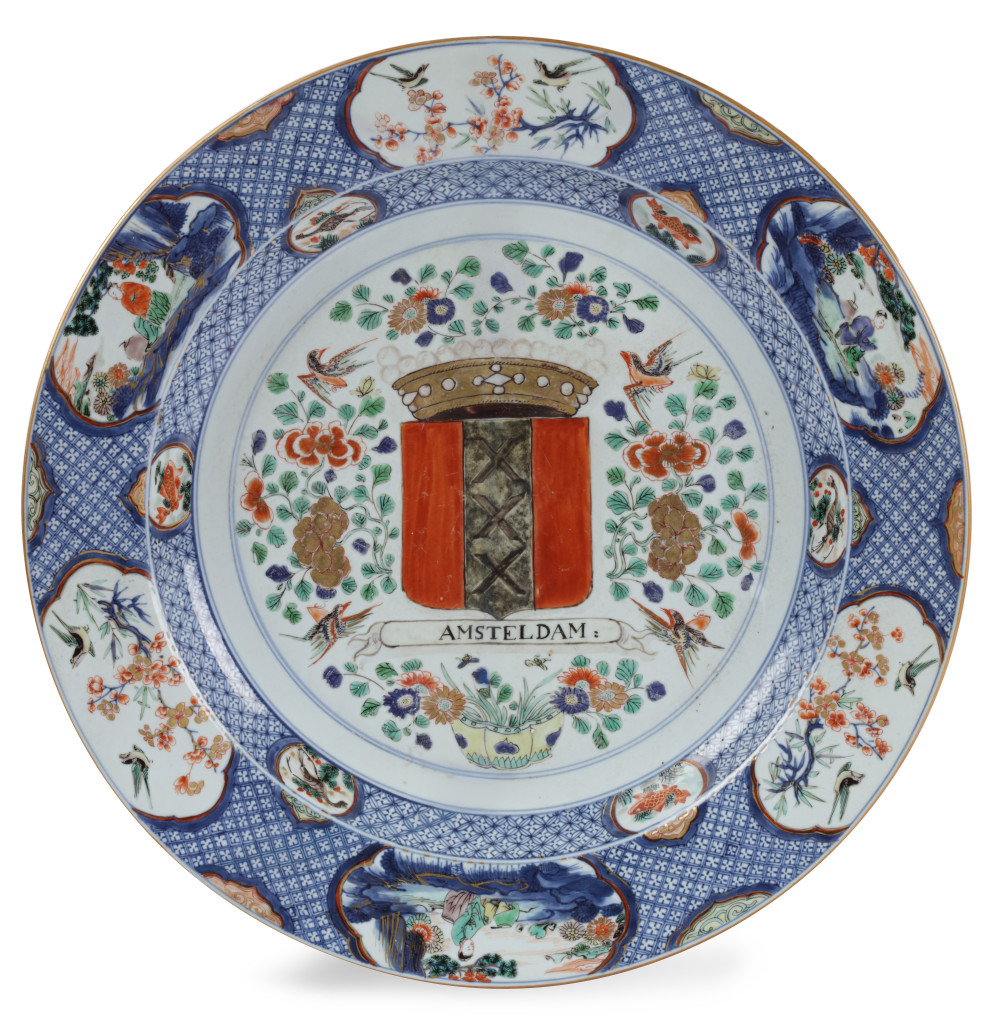
An extremely rare and large Chinese famille verte armorial dish with the Amsterdam coat-of-arms
Diam. 47 cm
In under glaze decoration, in the centre the coat-of-arms of Amsterdam beneath a crown, over a ribbon with inscription AMSTELDAM, surrounded by birds, insects, peonies and flowering stems, the edge with a geometric blue pattern, decorated with six large cartouches, three with Chinese figures in landscapes and three with birds and branches of flowering cherry, and six smaller medallions with pink fish and grey shrimps.
This dish belongs to a group of so-called ‘provincieborden’, dishes with the coat-of-arms of Dutch and Belgian cities and provinces, and also of a few French and English places. In total about 21 different coats-of-arms of provinces and cities are known, in four different patterns, produced between 1710 and 1730. This early in the 18th century the VOC hardly ordered any porcelain in China, so these ‘provincieborden’ probably have been ordered by one or more Dutch private merchants who clearly were quite successful commercially with these dishes.
The decoration of the present dish is exactly the same as in a dish with the coat-of-arms of the city of Groningen
in the collection of the Rijksmuseum Amsterdam.
In 2013 the KVVAK (Royal Asian Art Society) acquired an even bigger (diam. 54 cm) dish, dated slightly later (c. 1720-1725). This latter dish also bears the coat-of-arms
of the city of Amsterdam and is now exhibited in the Rijksmuseum. The decoration of this Rijksmuseum dish is different from the present one, with the coat-of-arms being held by two lions in a stage-like setting with to the left and the right a Chinese lady in a recess.
Related objects
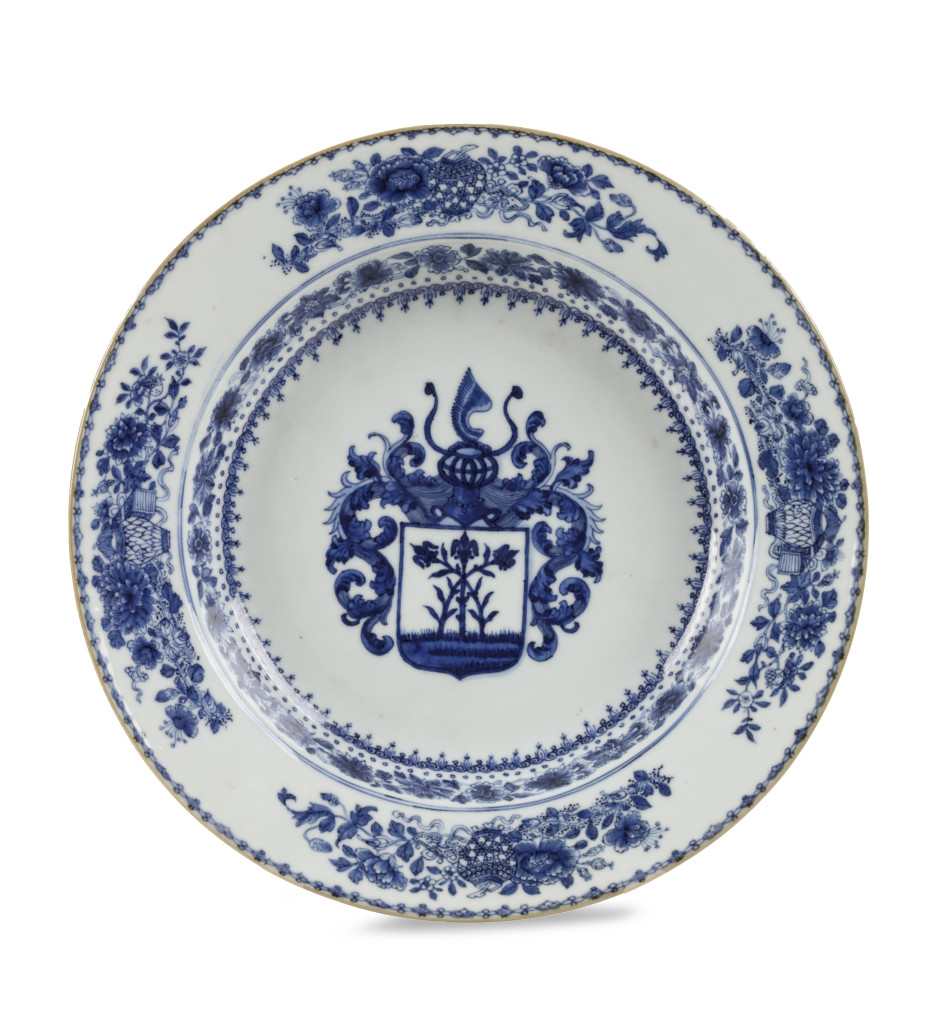
A Chinese armorial export blue and white 'Schreuder' plate
Qianlong period, circa 1735-1740
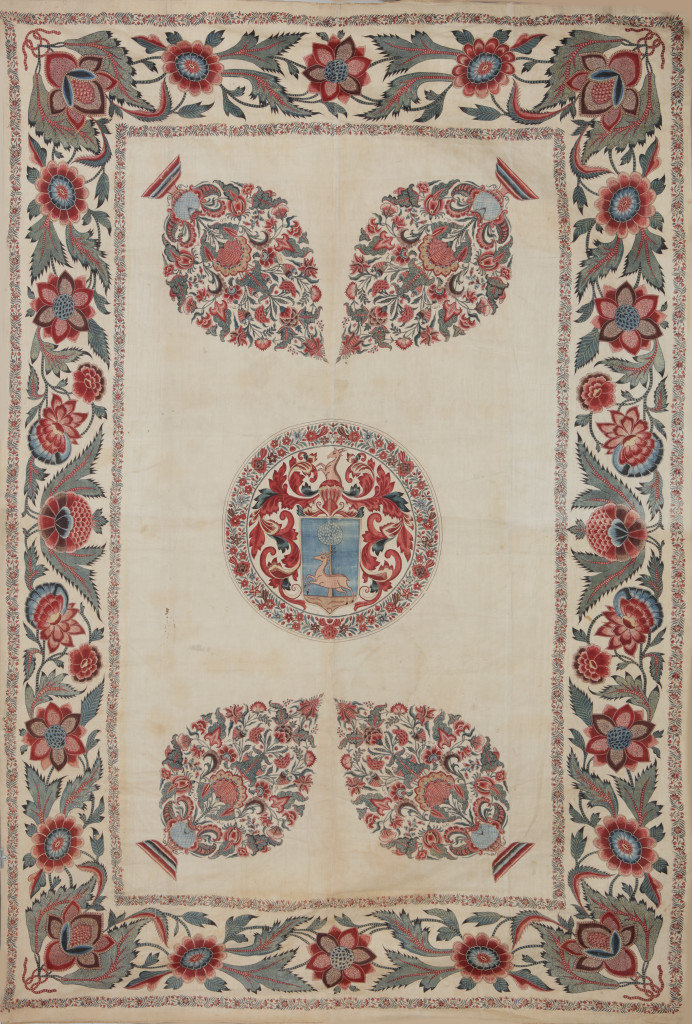
A very rare Indian Armorial Palempore Chintz for the Dutch Market
Coromandel coast, probably Sadraspatnam (Sadras), first half 18th century. “Palempore” refers to large chintzes laid on a bed or hung behind it. The present very large palempore in the centre shows a coat of arms with a redish salient deer in front of a green tree on the ground, the crest with a deer issuant. The mantling shows scrolling leaves and European style scrollwork in red and green, within a circle of flowers. In the corners of the white field four vases with large flower bouquets. The borders are decorated with undulating vines with flowers and leaves issuing from large flowers and leaves in each corner and in the middle of the long sides.
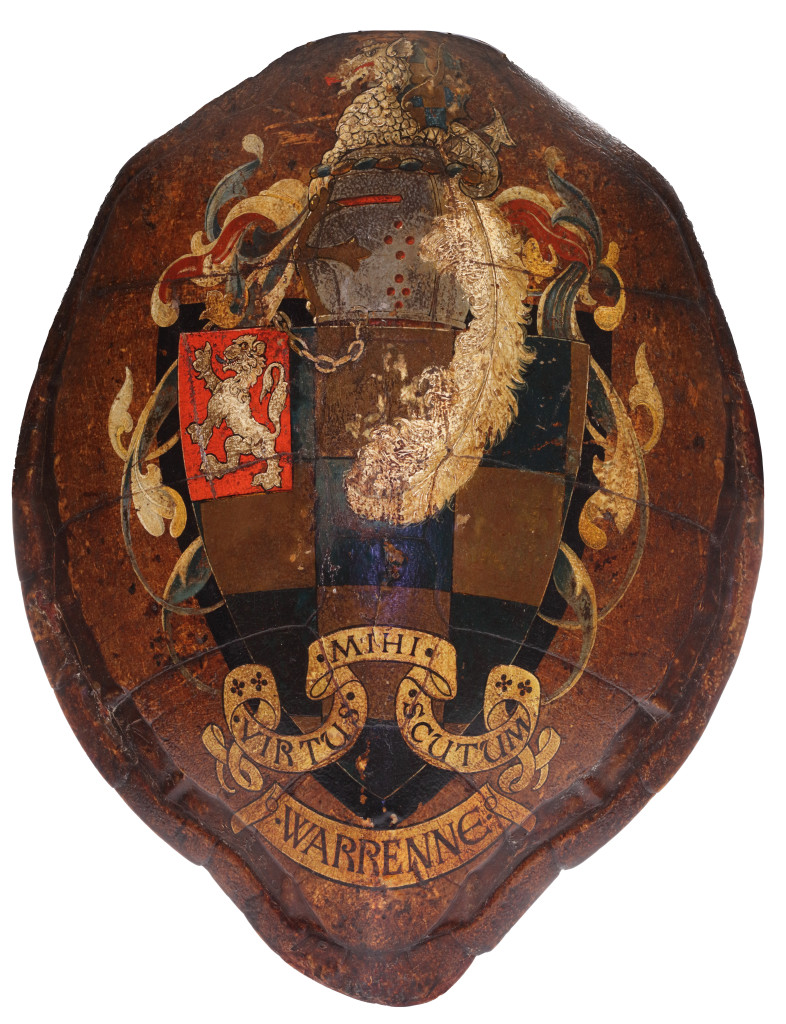
A rare pair of painted armorial Green Sea Turtle shells (Chelonia mydas), with the Tyerman and Warren coats-of-arms
_England, late 19th century _ _H. 91 x W. 72.5 cm (Tyerman)_ _H. 92 x W. 75.5 cm (Warren)_