A Peruvian silver-mounted engraved 'mate burilano' gourd bowl
Peru, circa 1800-1850
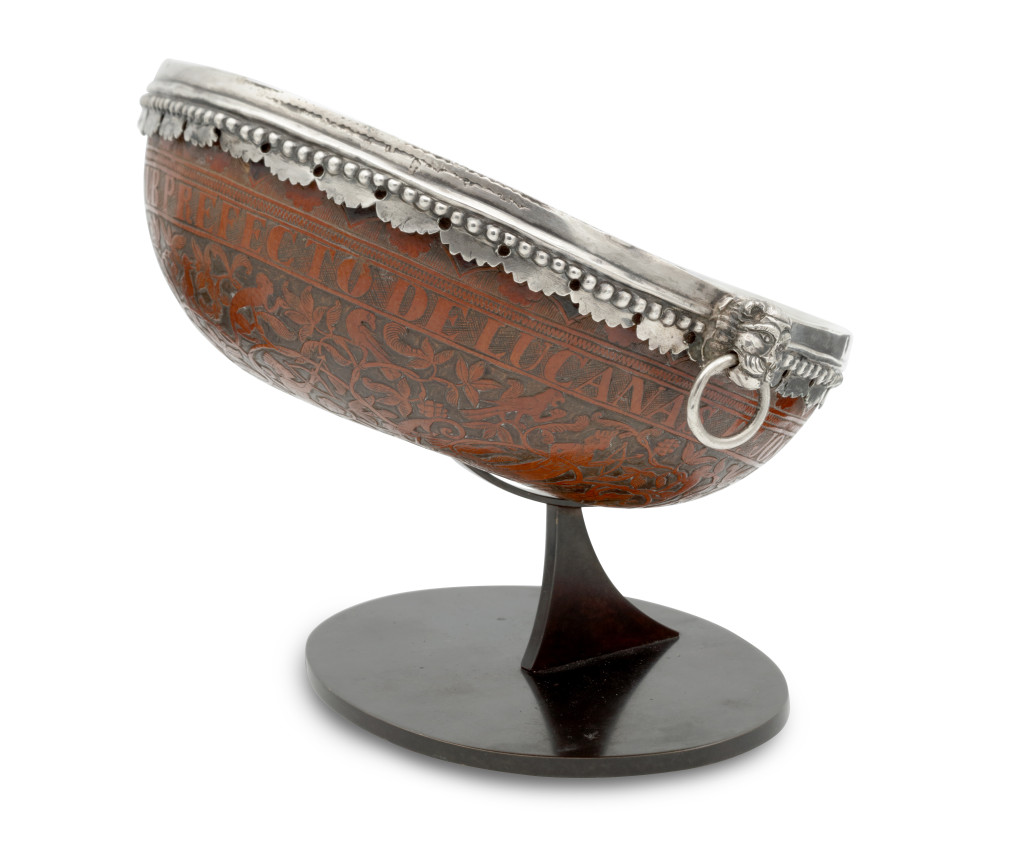
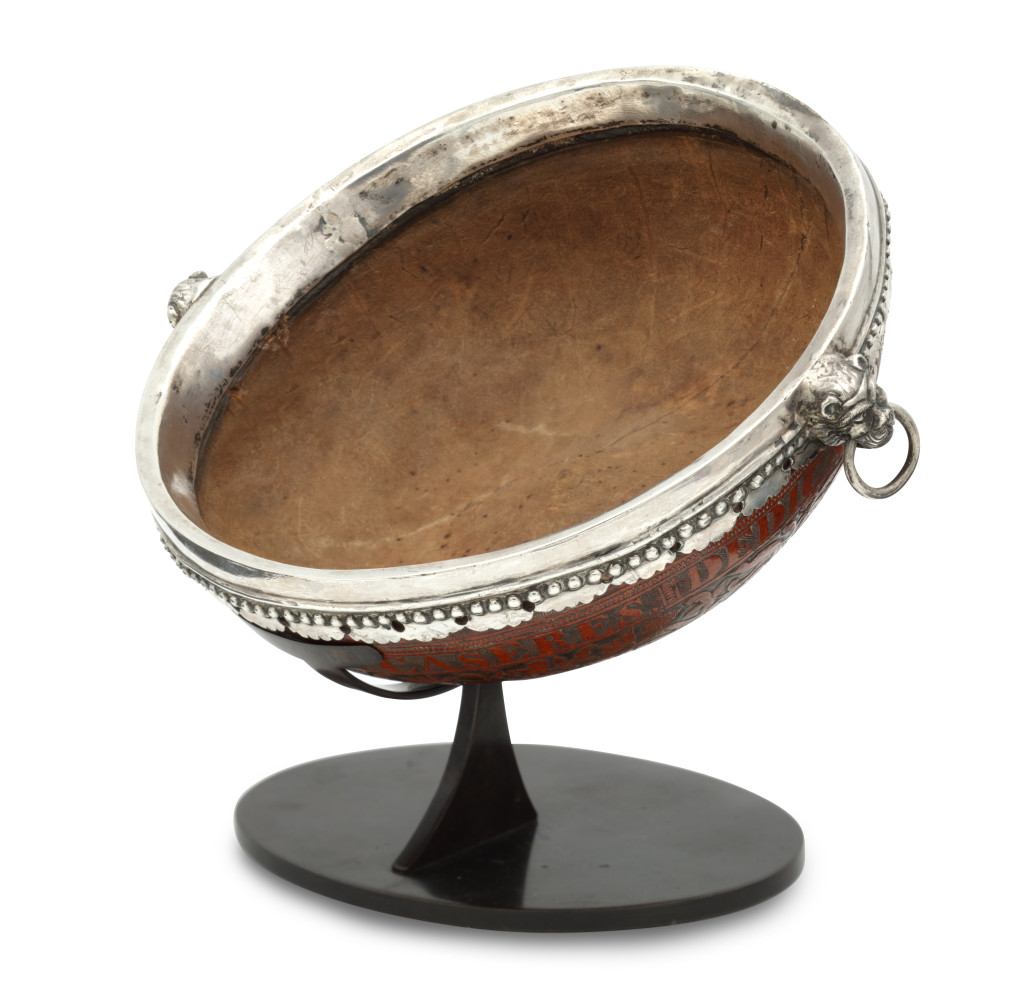
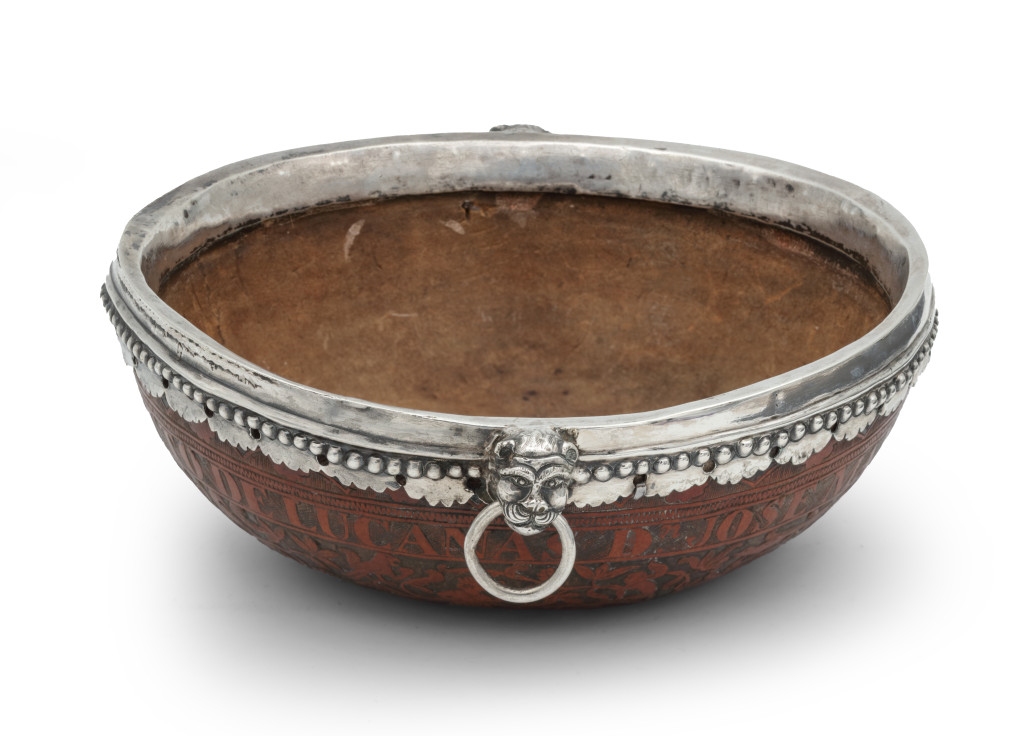
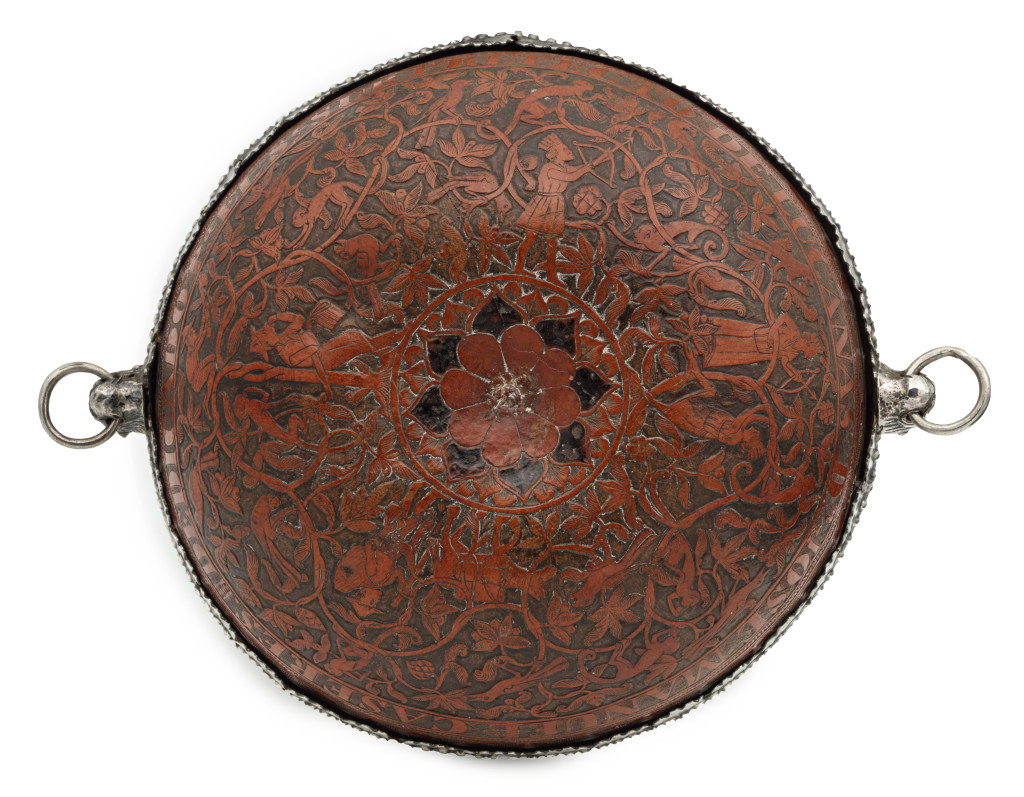
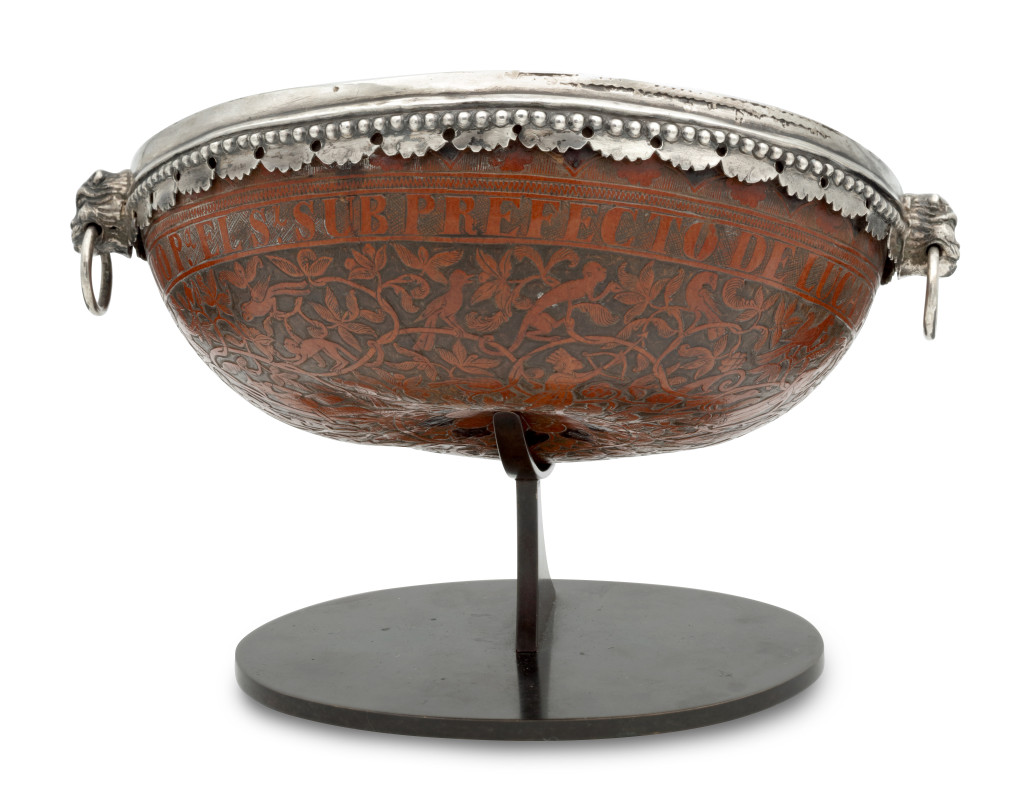
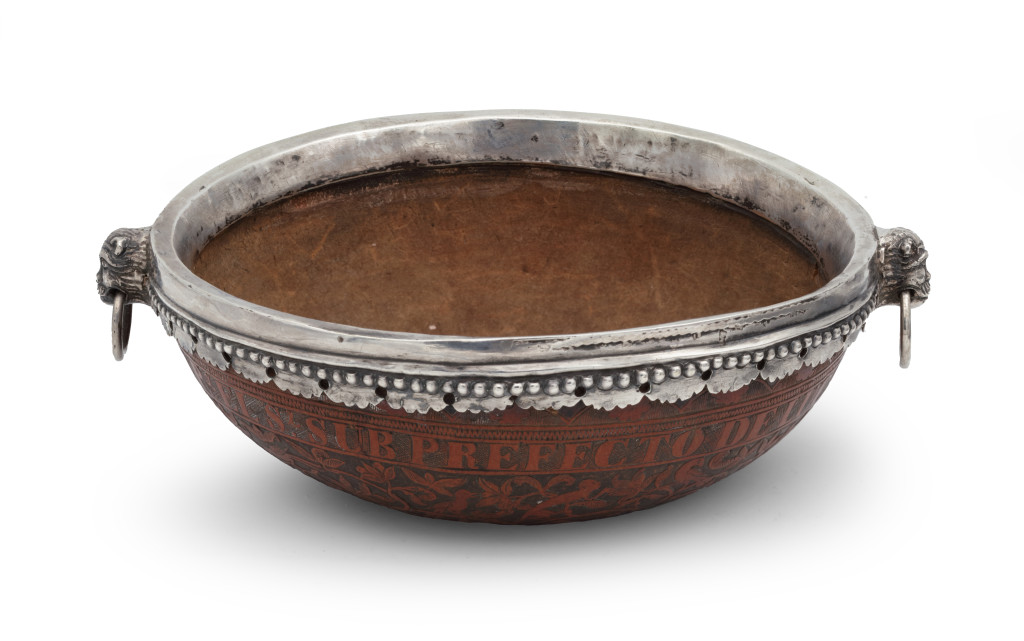
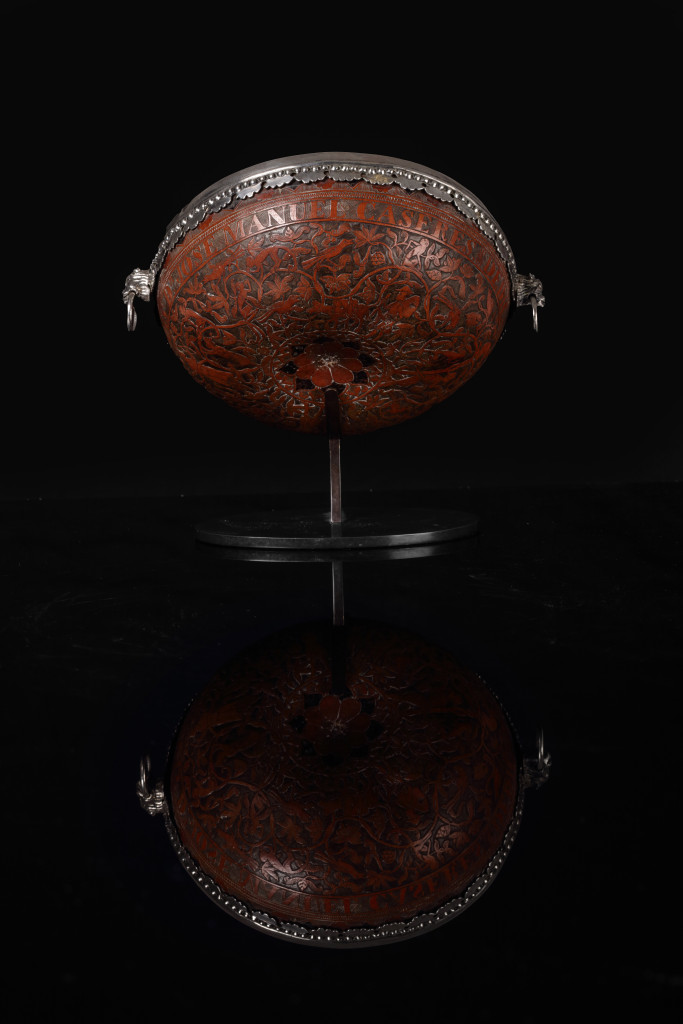
The bowl's exterior is superbly engraved in blackened background relief, with a female figure representing America, Indigenous figures, a farmer, and a hunter, surrounded by animals such as monkeys and parrots, all in a lush jungle-like forest. The bowl is mounted with a refined silver rim and two lion-head handles with loose rings in their mouths. Along the rim an inscription is engraved, reading: DEDICADO P.a EL SUB PREFECTO DE LUCANA D.n JOSE MANUEL CASERES.
Diam. 20 x H. 6 cm
Provenance :
Collection of Eugène Boban (1834-1908), Paris/New York
Boban was the first French dealer in ancient American arts and the official archaeologist at the court of Maximilian I of Mexico, a member of the French Scientific Commission in Mexico and head of the expedition commissioned by Napoleon III to collect Mexican art and artifacts which later were exhibited at the Trocadéro Museum in connection with the International Exposition of 1867.
Collection Le Kalevala, Paris
Collection Jean Roudillon, Paris (1923–2020)
Mates burilados, or engraved gourds, are a traditional Peruvian folk art that features intricate carvings on dried gourds. Originating from the Andean region, this craft involves using a buril, or small chisel, to etch detailed scenes depicting everyday life, folklore, and nature onto the gourd’s surface. These artworks not only showcase the artisans’ exceptional skill and precision but also serve as cultural artefacts, preserving the stories and traditions of the Andean people. Passed down through generations, mates burilados continue to be cherished both within Peru and by art collectors worldwide for their beauty and cultural significance. It is the only art expression that has been continuous and uninterrupted from the inception of civilization in Peru till today.
Due to Peru's diverse geography and rich cultural heritage, the local government system is complex and layered. At the heart of this system are the sub-prefects, key officials who play a crucial role in maintaining order and implementing policies at the provincial level. They are appointed by the central government and serve as the principal representatives of the national executive power within their respective provinces.
They are tasked with various responsibilities, from overseeing the implementation of national policies to ensuring public order and safety. Historically, the position of sub-prefect has been pivotal in bridging the gap between local needs and national directives. This is particularly important in a country like Peru, where vast geographical differences and many ethnic groups create a complex administrative landscape. Sub-prefects must navigate the local political terrain, balancing the interests of Indigenous communities, urban centres, and rural areas.
In the case of Jose Manuel Caseres, building bridges between local communities came rather literally. In 1848, the sub-prefect had the Puente Vado bridge over the de Lucaras River reconstructed - after it had been in use for a century.
The first mention of Don Jose Manuel Caseres, but written as Cáceres, can be found in the Holy Church of Yaguas records in Ayachuo. On the first of October in 1801, the son of Jose Manuel and his wife Michaela Liu, named Manuel, was baptized by Vicar and Sacristan Don Angel Cárdenas. As the godfather Mr. José Gregorio Cáceres was noted. Up until 1859, Don Jose Manuel himself is noted as godfather more than six times in the records of the same church.
This Holy Church of Yaguas
on the first day of the month of October of the year eighteen hundred
I, vicar and sacristan Don Angel Cárdenas,
certify and give faith that I have solemnly
baptized Manuel, a newborn today, legitimate son of
Don José Manuel Cáceres, of this parish, and Mrs. Michaela Liu.
Godfather, the priest Mr. José Gregorio Cáceres, to
whom I warned about the spiritual relationship established
by the Council of Trent, being witness
Mr. Mariano Mendoza and others.
Angel Cárdenas*
The bowl's exterior is superbly engraved in blackened background relief, with a female figure representing America, Indigenous figures, a farmer, and a hunter, surrounded by animals such as monkeys and parrots, all in a lush jungle-like forest. The bowl is mounted with a refined silver rim and two lion-head handles with loose rings in their mouths. Along the rim an inscription is engraved, reading: DEDICADO P.a EL SUB PREFECTO DE LUCANA D.n JOSE MANUEL CASERES.
Diam. 20 x H. 6 cm
Provenance :
Collection of Eugène Boban (1834-1908), Paris/New York
Boban was the first French dealer in ancient American arts and the official archaeologist at the court of Maximilian I of Mexico, a member of the French Scientific Commission in Mexico and head of the expedition commissioned by Napoleon III to collect Mexican art and artifacts which later were exhibited at the Trocadéro Museum in connection with the International Exposition of 1867.
Collection Le Kalevala, Paris
Collection Jean Roudillon, Paris (1923–2020)
Mates burilados, or engraved gourds, are a traditional Peruvian folk art that features intricate carvings on dried gourds. Originating from the Andean region, this craft involves using a buril, or small chisel, to etch detailed scenes depicting everyday life, folklore, and nature onto the gourd’s surface. These artworks not only showcase the artisans’ exceptional skill and precision but also serve as cultural artefacts, preserving the stories and traditions of the Andean people. Passed down through generations, mates burilados continue to be cherished both within Peru and by art collectors worldwide for their beauty and cultural significance. It is the only art expression that has been continuous and uninterrupted from the inception of civilization in Peru till today.
Due to Peru's diverse geography and rich cultural heritage, the local government system is complex and layered. At the heart of this system are the sub-prefects, key officials who play a crucial role in maintaining order and implementing policies at the provincial level. They are appointed by the central government and serve as the principal representatives of the national executive power within their respective provinces.
They are tasked with various responsibilities, from overseeing the implementation of national policies to ensuring public order and safety. Historically, the position of sub-prefect has been pivotal in bridging the gap between local needs and national directives. This is particularly important in a country like Peru, where vast geographical differences and many ethnic groups create a complex administrative landscape. Sub-prefects must navigate the local political terrain, balancing the interests of Indigenous communities, urban centres, and rural areas.
In the case of Jose Manuel Caseres, building bridges between local communities came rather literally. In 1848, the sub-prefect had the Puente Vado bridge over the de Lucaras River reconstructed - after it had been in use for a century.
The first mention of Don Jose Manuel Caseres, but written as Cáceres, can be found in the Holy Church of Yaguas records in Ayachuo. On the first of October in 1801, the son of Jose Manuel and his wife Michaela Liu, named Manuel, was baptized by Vicar and Sacristan Don Angel Cárdenas. As the godfather Mr. José Gregorio Cáceres was noted. Up until 1859, Don Jose Manuel himself is noted as godfather more than six times in the records of the same church.
This Holy Church of Yaguas
on the first day of the month of October of the year eighteen hundred
I, vicar and sacristan Don Angel Cárdenas,
certify and give faith that I have solemnly
baptized Manuel, a newborn today, legitimate son of
Don José Manuel Cáceres, of this parish, and Mrs. Michaela Liu.
Godfather, the priest Mr. José Gregorio Cáceres, to
whom I warned about the spiritual relationship established
by the Council of Trent, being witness
Mr. Mariano Mendoza and others.
Angel Cárdenas*
Part of the The Americas collection.
Related objects
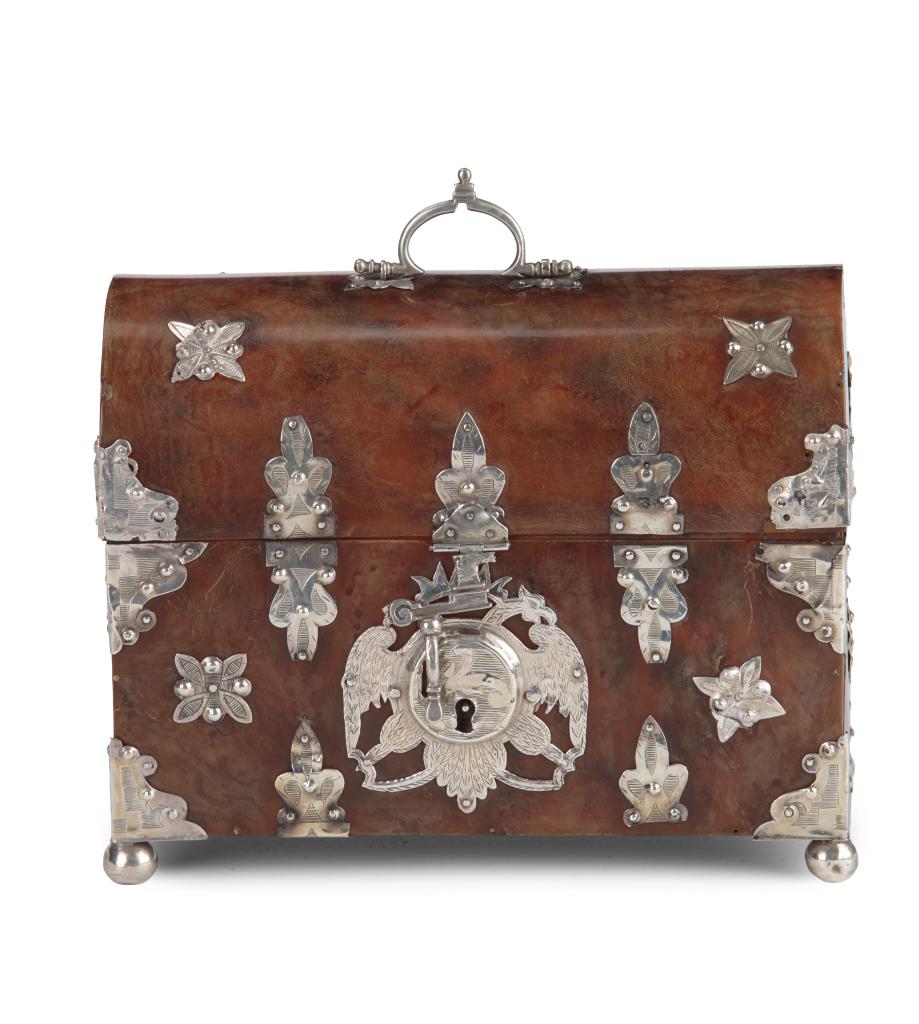
A Spanish-colonial tortoiseshell casket with silver mounts
_Probably Mexico, 17th century_ _H. 12.5 x W. 16 x D. 7 cm_ Provenance: Private Collection, The Hague
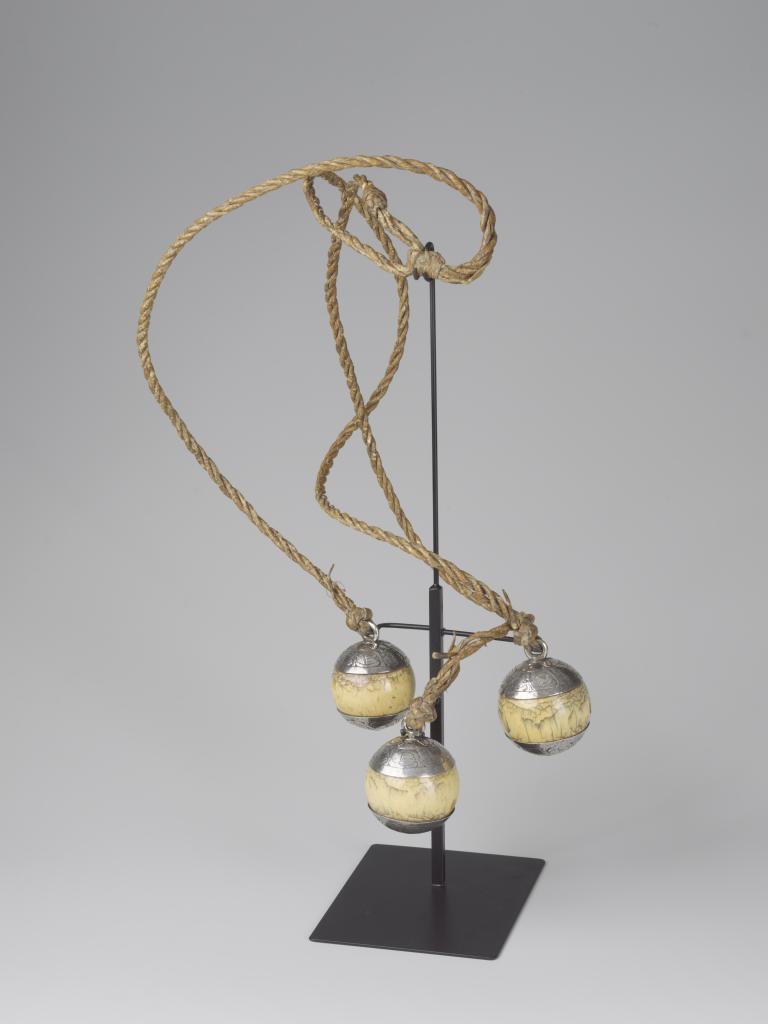
A set of ivory and silver mounted Gaucho 'Bolas' or 'Gaucho Balls' with leather lace
_Argentina, circa 19th century_ _Diam. 5 cm (each)_ Provenance: Private collection, London Acquired by us in 2019