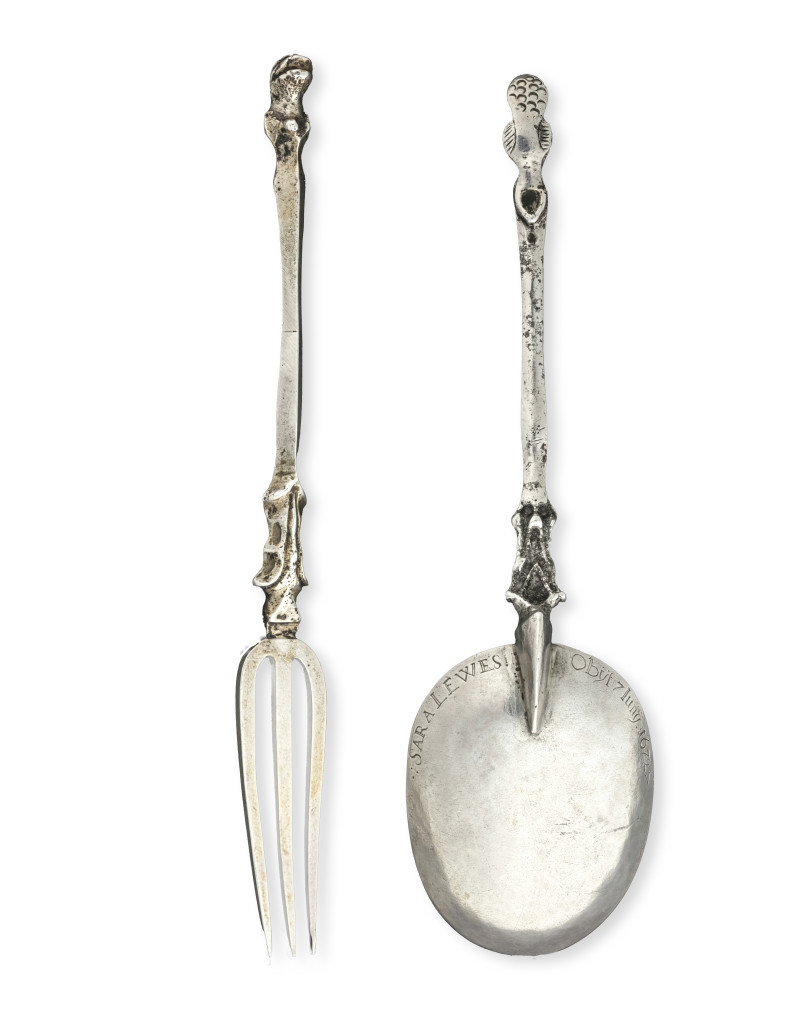
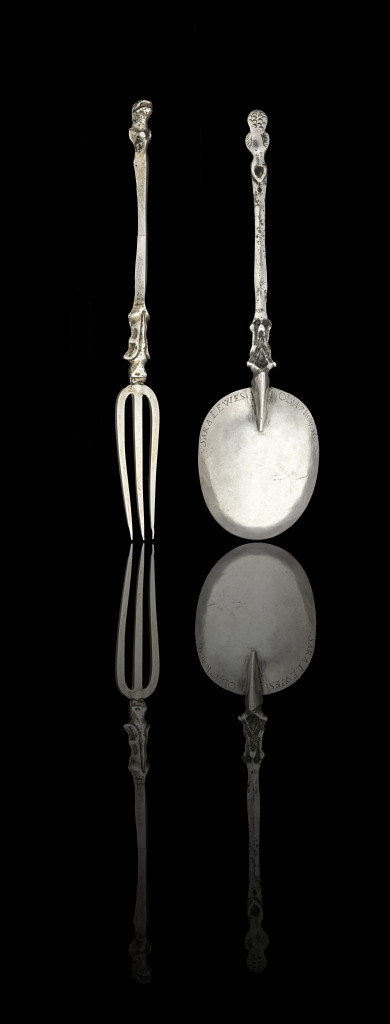
An extremely rare New Amsterdam commemorative spoon and fork
Possibly Dutch colonial, New Amsterdam (New York), circa 1672, apparently unmarked
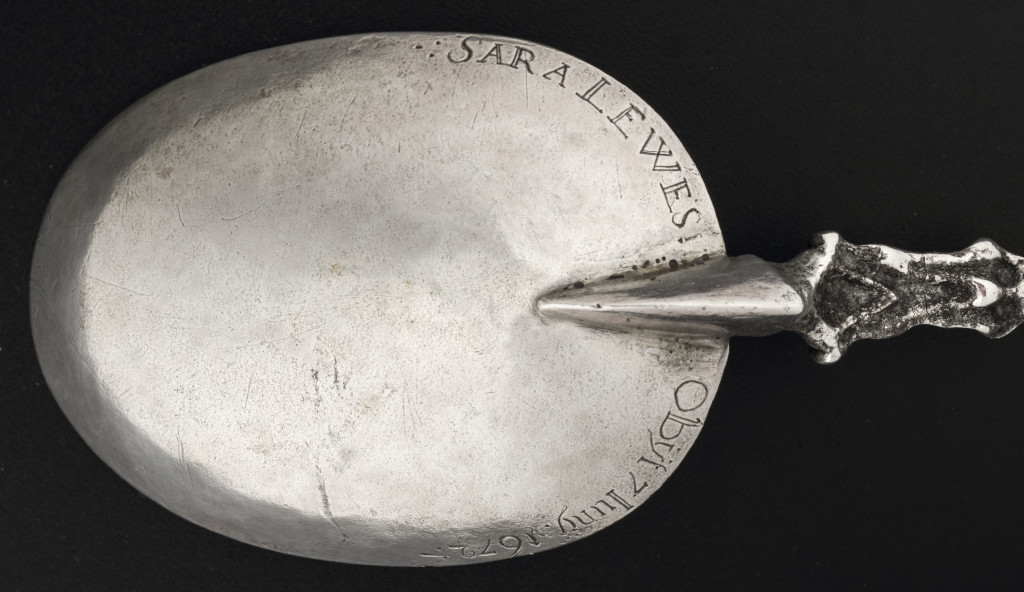
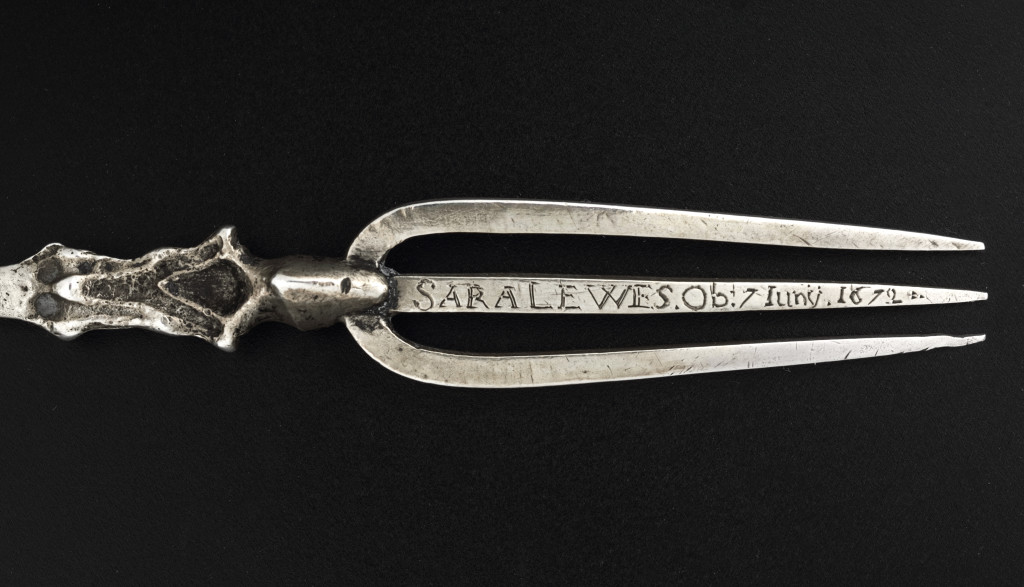
The unusual triangular handles are decorated with zoomorphic ornaments in the ‘kwab-stijl’, the Auricular or lobed style, made popular in the Netherlands by silversmith Paulus van Vianen in the first quarter of the 17th century, the spoon engraved to the back of the bowl “SARA LEWES. Obijt 7 Iunij 1672” and the fork engraved to the back of the centre prong “SARA LEWES Ob. 7 Iunij 1672”.
L. 16.5 / 16.3 cm
Weight spoon 43 grams
Weight fork 34 grams
Commemorating a deceased relative in silver was a Dutch tradition in the 17th and 18th centuries. In the Dutch East Indies, particularly in Jakarta (Batavia), commemorative salvers were made in large quantities, and still many survived, although undoubtedly most have been melted down over time. Sometimes salvers made in Holland were later engraved in Batavia. Commemorative spoons made in Batavia are very rare, and only a few colonial ones are known.(1)
The first time the present spoon and fork were described was by Stephan Welz in Cape Silver (1976).(2) Welz assumed the set was made in the Cape colony, which seems very unlikely. No ‘kwab’ decorations are known in Cape silver because all silversmiths in the Cape were of German or English origin. Besides, Cape silver spoons are, without exceptions, always in Hanoverian or Old English style, and no Cape silver spoons are known that date from before the early 18th century.
The second mention of the set is by Kevin Brown, who bought the set in Cape Town.(3) He argues that the set is the earliest known New York silver. In two further articles.(4) Kevin Brown substantiates his supposition that the set was made in New York. The ‘Kwabstijl’ was very popular in Holland and Friesland, and many spoons with zoomorphic finials were made there in the first quarter of the 17th century.
Later in the 17th century, in the 1650s, Christiaan van Vianen, along with Theodorus van Kessel, was responsible for the publication of “Constighe Modellen, van verscheijden silvere vaten, en andere sinnighe wercken”, featuring various silver vessels and other ingenious works found and designed by the renowned nobleman, crafted mainly by him from a single piece of silver, very useful for all lovers of art, with prints of the work of his father. Jacob Lutma
(c. 1624–1654), son of Johannes Lutma, quickly followed with a series on the work of his father. Cornelis Danckertsz. I (c. 1603–1656) released a collection titled “Verscheyde Constige Vindigen om in Gout, Silver, Hout en Steen te wercken”, with prints by Michiel Mosyn. All these publications were provided with texts in multiple languages and were apparently intended for the international market.
It is important to note that Dutch silver spoons are practically always marked. In New York, one other spoon in the ‘Kwabstijl’ is known, made and marked by Cornelius Van Der Burch (New Amsterdam 1653 – New York 1699), commissioned for the funeral in New York of Henricus, son of Pieter and Hester Deursen in 1692 (collection of the Yale University Art Gallery). The form of this spoon is almost identical to the present spoon.
Sara Lieuwes was born in Leeuwarden, Friesland, in 1643, as the younger sister of Sytske Lieuwes (b. 1642). Sytske married Gerrit de Wees in 1662, and in 1663, they moved to New Amsterdam, America, where Sytske appears in the records of the Dutch Reformed Church, with the name Lieuwes spelt as “Lievens”. The Frisian name “Lieuwes” apparently was not well understood by the church recorder and was transformed into the common Dutch/Amsterdam name “Lievens”.
As New Amsterdam was conquered by the English in 1664, in the same way, in 1672, Lieuwes may probably
was anglicised into Lewes. There are no records of Sara’s presence in New York. Presumably, Sytske and Gerrit had the set made in New York (by Cornelius Van Der Burch?) to memorialise Sara Lieuwe’s death in 1672 in Leeuwarden, as every few months post would arrive from the Netherlands.
The other possibility is that Sytske and Gerrit already had the set with them when they moved to New York and had it engraved in 1672, but this is unlikely since the set shows no wear. Memorial spoons were made to commemorate a deceased loved one and certainly not for practical use. In addition to the set being the oldest memorial silver from North America, this would make the fork the oldest known silver fork made in New York.
The silver was analysed by the Dutch authorities on gold and silver Waarborg Gouda and showed that the silver
is of the same origin as Dutch silver of suggested date. There are no modern metals or chemicals that one would expect in newer silver. It is very likely that silver in New Amsterdam/New York is the same as Dutch silver, as often settlers would bring silver coins with them. This was then taken to a silversmith who would make the requested object with it.
Sources:
1 Guus Röell & Dickie Zebregs, Schenkpirings: Social Media in Silver, March 2021, no. 3
2 A.A. Balkema, Cape Silver, Rotterdam, 1976, pp. 90-91
3 Kevin Brown, “A 1672 Dutch Memento Mori Spoon and Fork Set”, in: Silver Magazine, September/October 2008, pp. 20-24
4 Kevin Brown, “A Dutch Memento Mori Spoon & Fork set, 1672 from New York?”, in: The Finial, Journal of the Silver Spoon Club of Great Britain, December 2011, Vol. 22, pp. 5-10; Alena Buis and Kevin Brown, “Trifling Things? The Sara Lewes Memorial Lepel and Vork”, in: Dutch Crossing, Vol. 36, No. 6, November 2012
The unusual triangular handles are decorated with zoomorphic ornaments in the ‘kwab-stijl’, the Auricular or lobed style, made popular in the Netherlands by silversmith Paulus van Vianen in the first quarter of the 17th century, the spoon engraved to the back of the bowl “SARA LEWES. Obijt 7 Iunij 1672” and the fork engraved to the back of the centre prong “SARA LEWES Ob. 7 Iunij 1672”.
L. 16.5 / 16.3 cm
Weight spoon 43 grams
Weight fork 34 grams
Commemorating a deceased relative in silver was a Dutch tradition in the 17th and 18th centuries. In the Dutch East Indies, particularly in Jakarta (Batavia), commemorative salvers were made in large quantities, and still many survived, although undoubtedly most have been melted down over time. Sometimes salvers made in Holland were later engraved in Batavia. Commemorative spoons made in Batavia are very rare, and only a few colonial ones are known.(1)
The first time the present spoon and fork were described was by Stephan Welz in Cape Silver (1976).(2) Welz assumed the set was made in the Cape colony, which seems very unlikely. No ‘kwab’ decorations are known in Cape silver because all silversmiths in the Cape were of German or English origin. Besides, Cape silver spoons are, without exceptions, always in Hanoverian or Old English style, and no Cape silver spoons are known that date from before the early 18th century.
The second mention of the set is by Kevin Brown, who bought the set in Cape Town.(3) He argues that the set is the earliest known New York silver. In two further articles.(4) Kevin Brown substantiates his supposition that the set was made in New York. The ‘Kwabstijl’ was very popular in Holland and Friesland, and many spoons with zoomorphic finials were made there in the first quarter of the 17th century.
Later in the 17th century, in the 1650s, Christiaan van Vianen, along with Theodorus van Kessel, was responsible for the publication of “Constighe Modellen, van verscheijden silvere vaten, en andere sinnighe wercken”, featuring various silver vessels and other ingenious works found and designed by the renowned nobleman, crafted mainly by him from a single piece of silver, very useful for all lovers of art, with prints of the work of his father. Jacob Lutma
(c. 1624–1654), son of Johannes Lutma, quickly followed with a series on the work of his father. Cornelis Danckertsz. I (c. 1603–1656) released a collection titled “Verscheyde Constige Vindigen om in Gout, Silver, Hout en Steen te wercken”, with prints by Michiel Mosyn. All these publications were provided with texts in multiple languages and were apparently intended for the international market.
It is important to note that Dutch silver spoons are practically always marked. In New York, one other spoon in the ‘Kwabstijl’ is known, made and marked by Cornelius Van Der Burch (New Amsterdam 1653 – New York 1699), commissioned for the funeral in New York of Henricus, son of Pieter and Hester Deursen in 1692 (collection of the Yale University Art Gallery). The form of this spoon is almost identical to the present spoon.
Sara Lieuwes was born in Leeuwarden, Friesland, in 1643, as the younger sister of Sytske Lieuwes (b. 1642). Sytske married Gerrit de Wees in 1662, and in 1663, they moved to New Amsterdam, America, where Sytske appears in the records of the Dutch Reformed Church, with the name Lieuwes spelt as “Lievens”. The Frisian name “Lieuwes” apparently was not well understood by the church recorder and was transformed into the common Dutch/Amsterdam name “Lievens”.
As New Amsterdam was conquered by the English in 1664, in the same way, in 1672, Lieuwes may probably
was anglicised into Lewes. There are no records of Sara’s presence in New York. Presumably, Sytske and Gerrit had the set made in New York (by Cornelius Van Der Burch?) to memorialise Sara Lieuwe’s death in 1672 in Leeuwarden, as every few months post would arrive from the Netherlands.
The other possibility is that Sytske and Gerrit already had the set with them when they moved to New York and had it engraved in 1672, but this is unlikely since the set shows no wear. Memorial spoons were made to commemorate a deceased loved one and certainly not for practical use. In addition to the set being the oldest memorial silver from North America, this would make the fork the oldest known silver fork made in New York.
The silver was analysed by the Dutch authorities on gold and silver Waarborg Gouda and showed that the silver
is of the same origin as Dutch silver of suggested date. There are no modern metals or chemicals that one would expect in newer silver. It is very likely that silver in New Amsterdam/New York is the same as Dutch silver, as often settlers would bring silver coins with them. This was then taken to a silversmith who would make the requested object with it.
Sources:
1 Guus Röell & Dickie Zebregs, Schenkpirings: Social Media in Silver, March 2021, no. 3
2 A.A. Balkema, Cape Silver, Rotterdam, 1976, pp. 90-91
3 Kevin Brown, “A 1672 Dutch Memento Mori Spoon and Fork Set”, in: Silver Magazine, September/October 2008, pp. 20-24
4 Kevin Brown, “A Dutch Memento Mori Spoon & Fork set, 1672 from New York?”, in: The Finial, Journal of the Silver Spoon Club of Great Britain, December 2011, Vol. 22, pp. 5-10; Alena Buis and Kevin Brown, “Trifling Things? The Sara Lewes Memorial Lepel and Vork”, in: Dutch Crossing, Vol. 36, No. 6, November 2012
Part of the The Americas and Europe collections.
Related objects
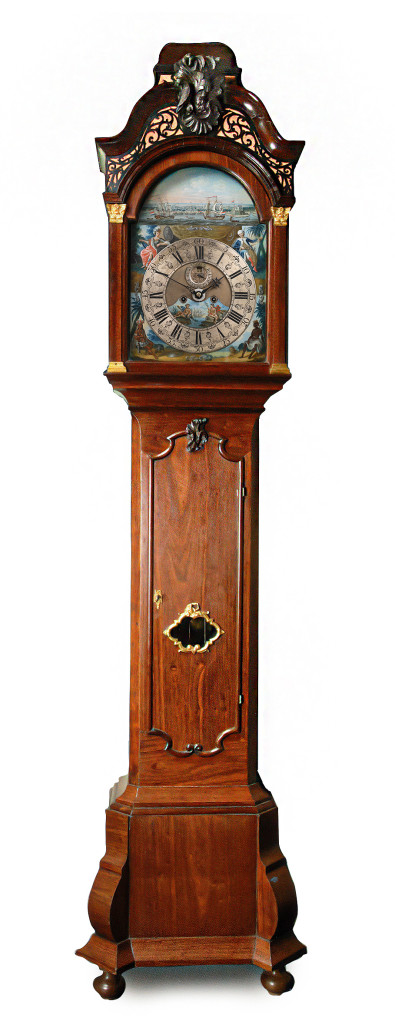
A Surinam-themed Amsterdam long-case clock
The Netherlands, 1746-1756, dial signed Nicolaas Weylandt/Amsterdam
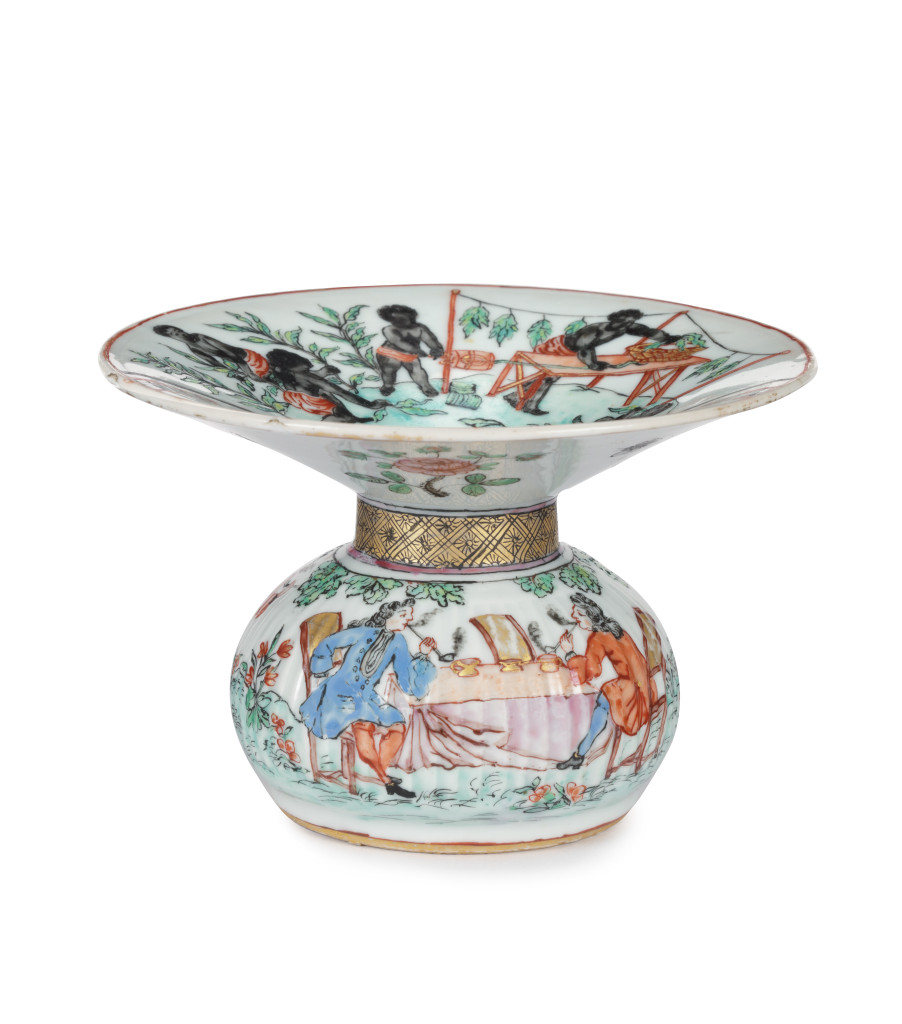
A rare 'Amsterdam decorated' Chinese export porcelain plantation spittoon
Yongzheng/Qianlong period, circa 1720-1740, over-decorated in Holland _H. 9 x Diam. 13.5 cm_ Provenance: Private collection, France
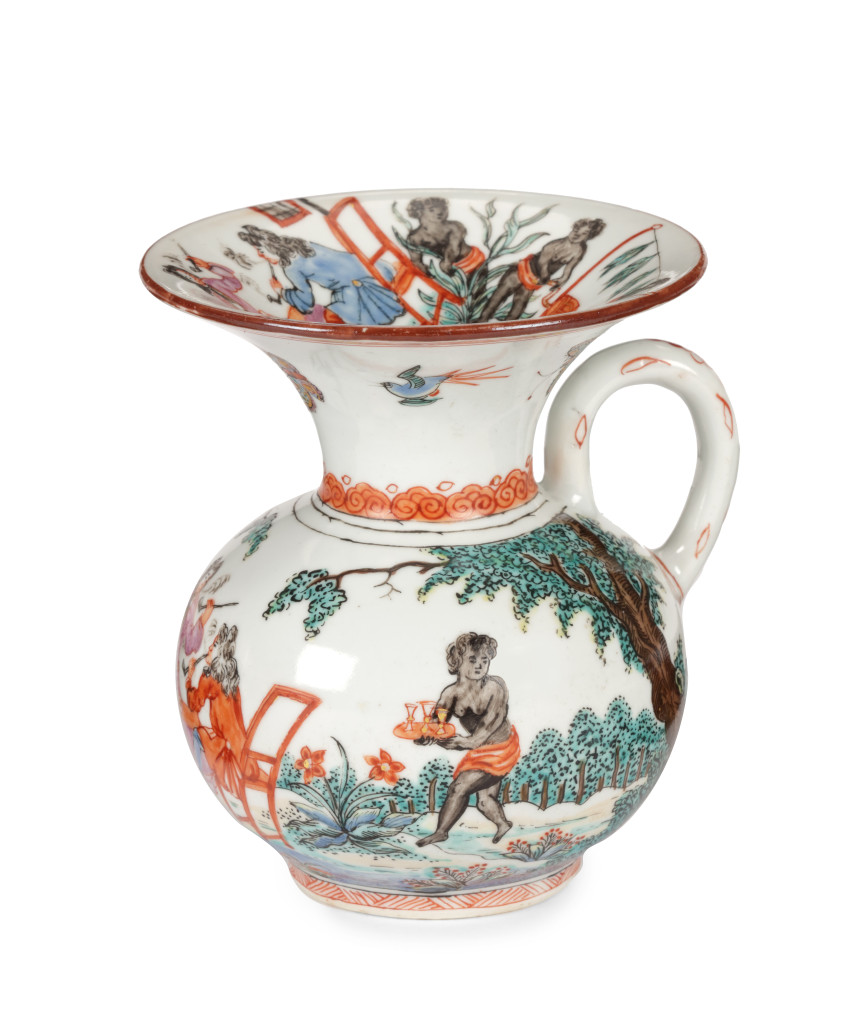
A rare Amsterdam decorated Chinese export porcelain plantation spittoon
_Yongzheng/Qianlong period, circa 1720-1740, over-decorated in Holland_ _H. 11 x Diam. 9.5 cm_ Provenance: -Private collection, the Netherlands -Private collection, the Netherlands (since the early 2000s)