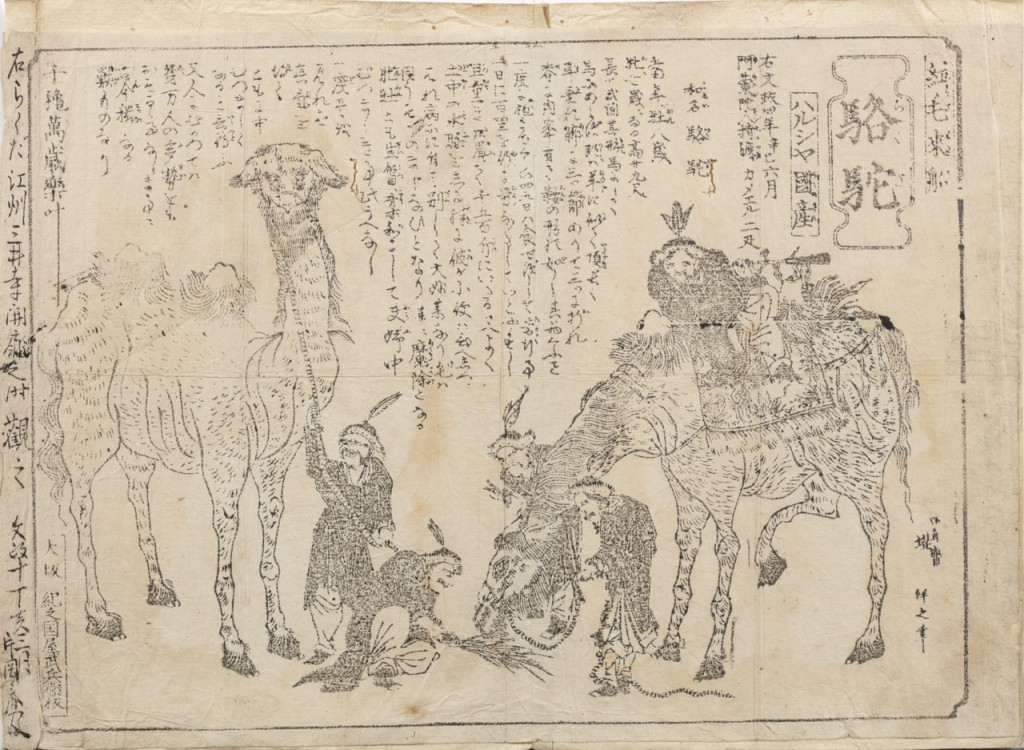
A Japanese Nagasaki-e print, nishiki-e, depicting two camels
Drawn by Kataoka Harukyu, published by Osaka Kinokuniya, Bunsei 4 6gatu (4 June 1821)
Woodblock print, H. 30.4 x W. 42 cm
The text translates to:
'Rakuda (camel) arrived from Harusha (Arabia) on a Dutch ship, the 4th of June 1821. A male 8 years old and a female seven years old. The camel is 9 feet tall. Its head resembles that of a sheep, and the nape of its neck is long. Its legs have three joints. When lying down, the legs are folded into three. Thus, it is convenient for riding. It eats plants and trees and especially likes radishes. They can walk 100 ri (miles) a day with a heavy load on their backs without difficulty. They are gentle and easily accustomed to people. In addition, they are effective as spirit animals. Camel urine is a life-saving elixir. If you hang this print, children's illnesses will be lightened, and thunder will be avoided.’
During the court journey of 1646, Opperhoofd Willem Verstegen presented two camels from Persia to the shogun, who gladly accepted this present after the camels had respectfully bowed their heads for him.
The two camels the Dutch brought to Nagasaki in 1821 were bought by a promoter to show them all over Japan, as earlier Blomhoff's Japanese wife had done with two camels Blomhoff had given her as financial security after his return to the Netherlands in 1824. The present show of camels started in Nagasaki and visited many places before reaching Edo after three years. The show was so popular that the promoter earned a lot of money. The present scene was depicted in front of the Mi-I temple of Goshu (Otsu, Shiga).
Woodblock print, H. 30.4 x W. 42 cm
The text translates to:
'Rakuda (camel) arrived from Harusha (Arabia) on a Dutch ship, the 4th of June 1821. A male 8 years old and a female seven years old. The camel is 9 feet tall. Its head resembles that of a sheep, and the nape of its neck is long. Its legs have three joints. When lying down, the legs are folded into three. Thus, it is convenient for riding. It eats plants and trees and especially likes radishes. They can walk 100 ri (miles) a day with a heavy load on their backs without difficulty. They are gentle and easily accustomed to people. In addition, they are effective as spirit animals. Camel urine is a life-saving elixir. If you hang this print, children's illnesses will be lightened, and thunder will be avoided.’
During the court journey of 1646, Opperhoofd Willem Verstegen presented two camels from Persia to the shogun, who gladly accepted this present after the camels had respectfully bowed their heads for him.
The two camels the Dutch brought to Nagasaki in 1821 were bought by a promoter to show them all over Japan, as earlier Blomhoff's Japanese wife had done with two camels Blomhoff had given her as financial security after his return to the Netherlands in 1824. The present show of camels started in Nagasaki and visited many places before reaching Edo after three years. The show was so popular that the promoter earned a lot of money. The present scene was depicted in front of the Mi-I temple of Goshu (Otsu, Shiga).
Part of the Japan collection.
Related objects
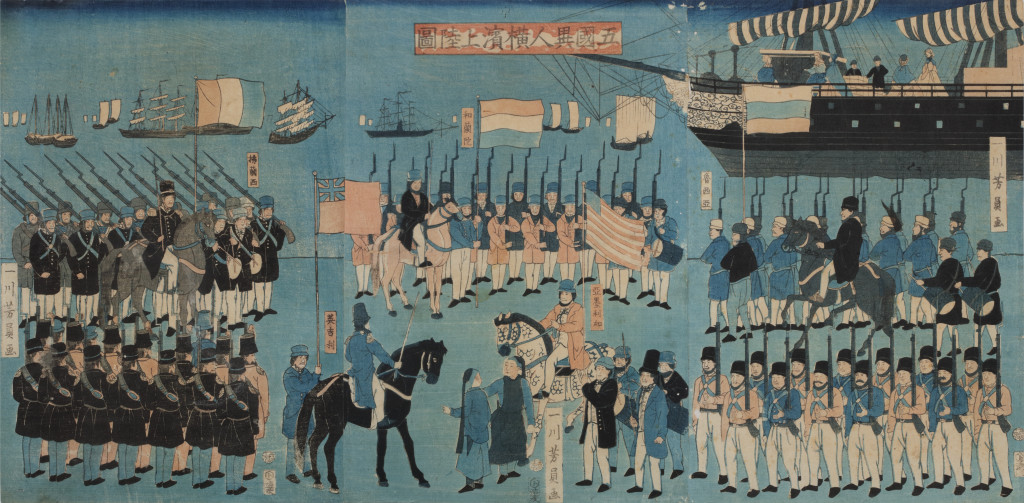
A woodblock print by Yoshikazu, titled 'Picture of the Landing of Foreigners of the Five Nations in Yokohama’, Gokakoku ijin Yokohama jõriku no zu
A woodblock print by Yoshikazu, titled 'Picture of the Landing of Foreigners of the Five Nations in Yokohama’, Gokakoku ijin Yokohama jõriku no zu Published by Enshũya Hikobei, 1861
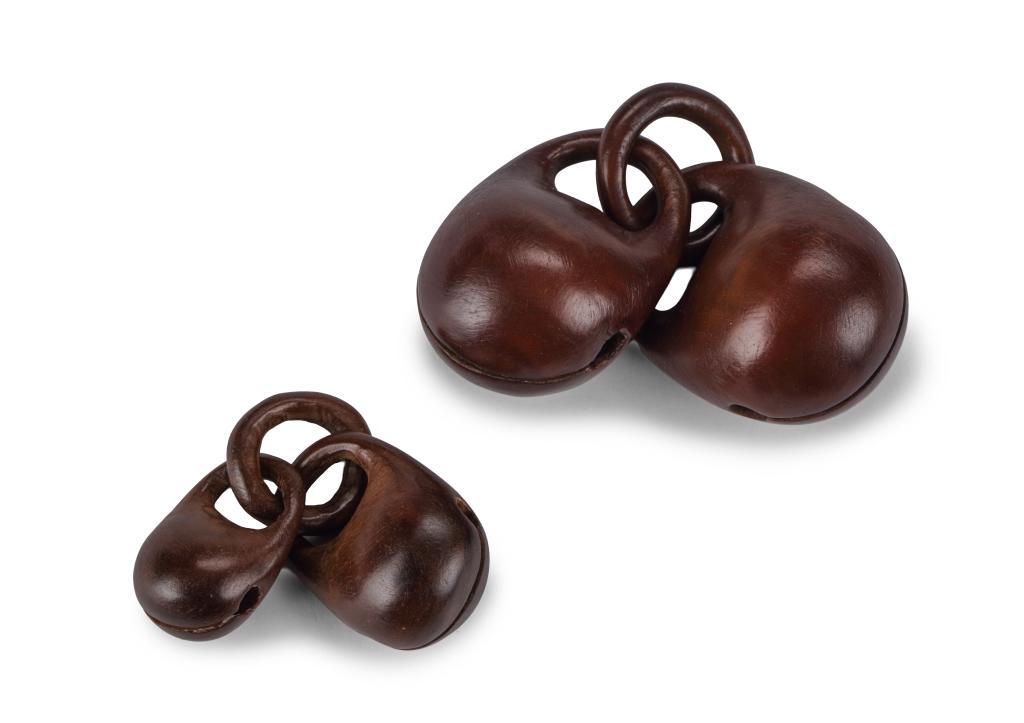
Two rare netsuke of linked bells
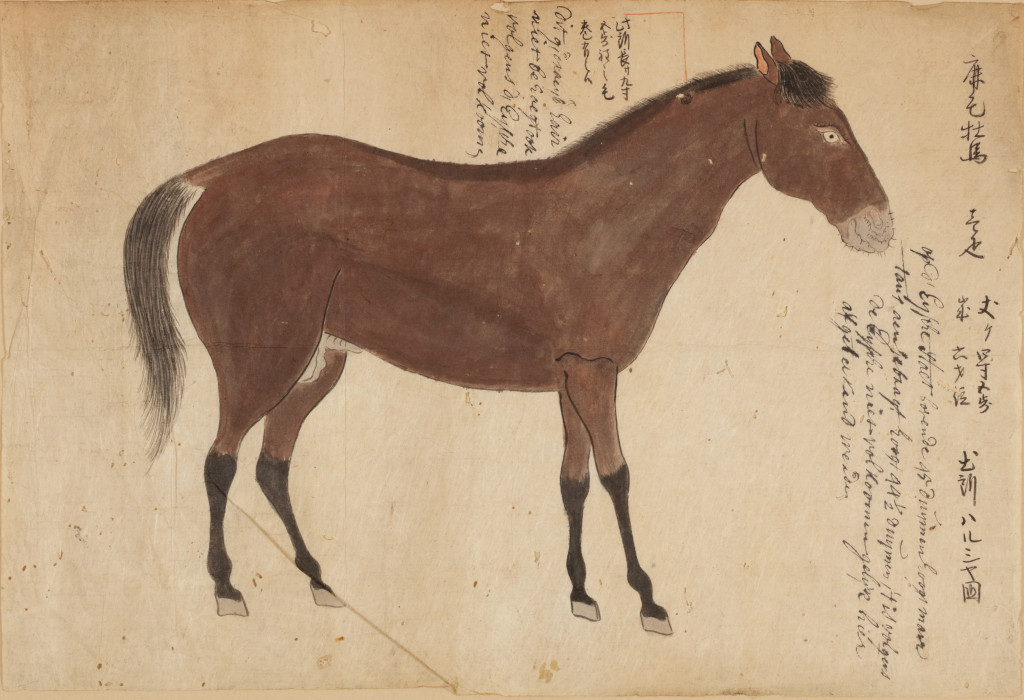
An important Japanese drawing of a Persian horse ordered by the Shogun ‘Eene Eysche van den Keyser’ (the Emperor’s demand)
With inscriptions in Japanese reading: ‘The horse is a chestnut male horse from Persia. Age is approximately 6 years old. The length of the face is approximately 27 cm (?). Hair is approximately 14 cm long. Mane is approximately 15 cm long of curly hair.'