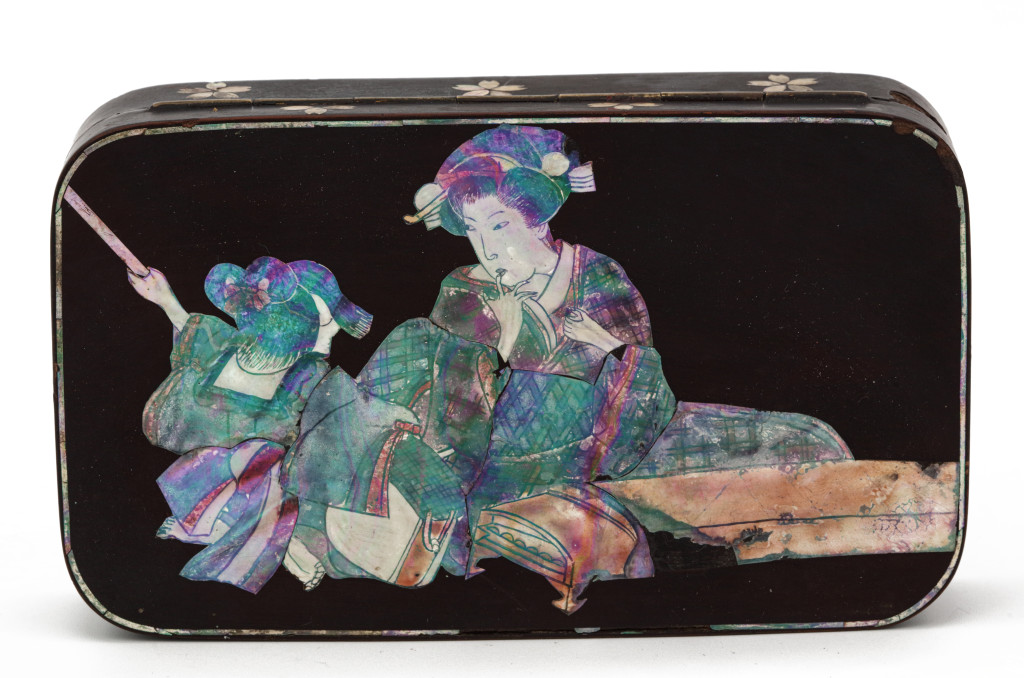
A Japanese lacquered and mother-of-pearl inlaid copper tobacco box with a scene of two ladies playing the koto and the shamisen
H. 2.5 x W. 13.2 x D. 7.8 cm
The koto is a long box-like hollow body of paulownia wood over which thirteen silk or tetoron strings are attached. The performer places the instrument in front and uses the first three fingers of his right hand while his left hand manipulates the movable struts placed under the strings to determine the pitch. The koto is of Chinese origin where it was an extremely prestigious instrument associated with Chinese literati culture. It was introduced into Japan during the Nara period (710-794).
The shamisen, played by the lady on the left, is the most commonly used instrument in Japanese music. It was introduced in Japan during the Eiroku period (1558-1570), from the Ryũkyũ islands. In spite of having only three strings, the shamisen is capable of producing a wide variety of sounds.
The band, obi, of the kimono of the lady on the left has the colours of the Dutch flag.
Part of the Japan collection.
Related objects
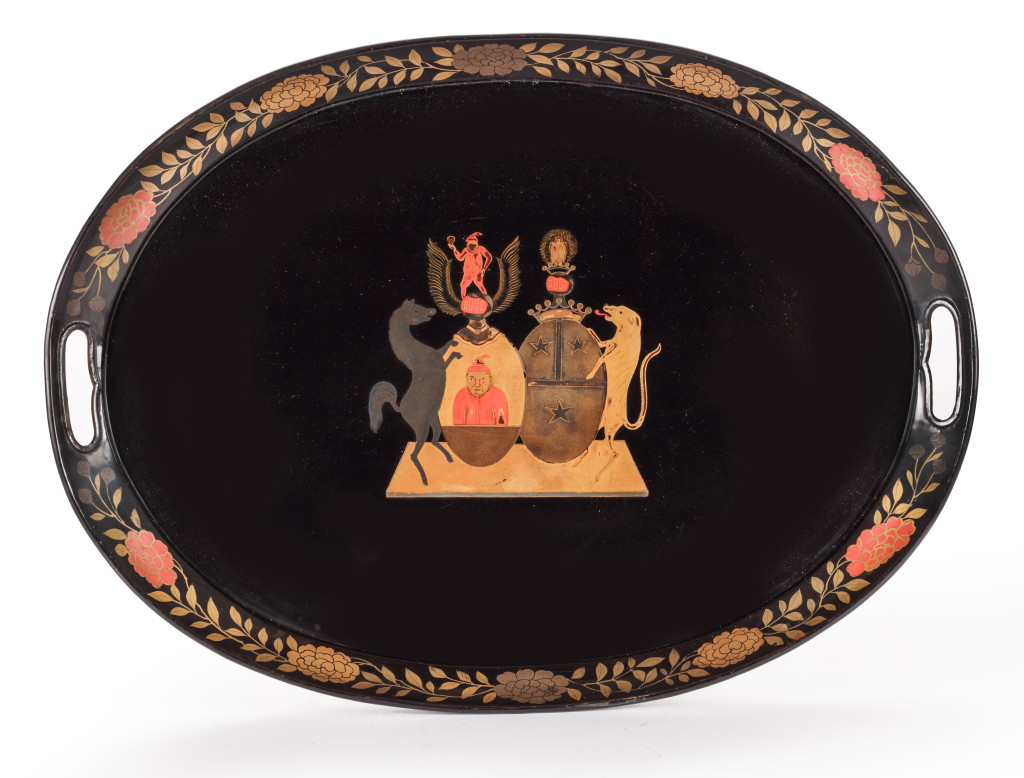
An oval Japanese export lacquer tray decorated with the alliance of the coats of arms of the Mooyaart and Pauw families
This tray most likely was made on the occasion of the marriage in 1798 in Delft of Mr. Anthony Noël Mooyaart (Jaffnapatnam 1777 - Batavia 1820), secretary-general of the ‘Indische Marine’, son of Gualtherus Mooyaart, Governor of Jaffnapatam, and Anna Petronella Maria Pauw (Delft 1777 – The Hague 1858), daughter of Engelbert Imansz Pauw, bailiff and burgomaster of Delft. The tray might well have been ordered as a gift by the groom’s father, who probably had close connections with colleagues in Batavia and Deshima.
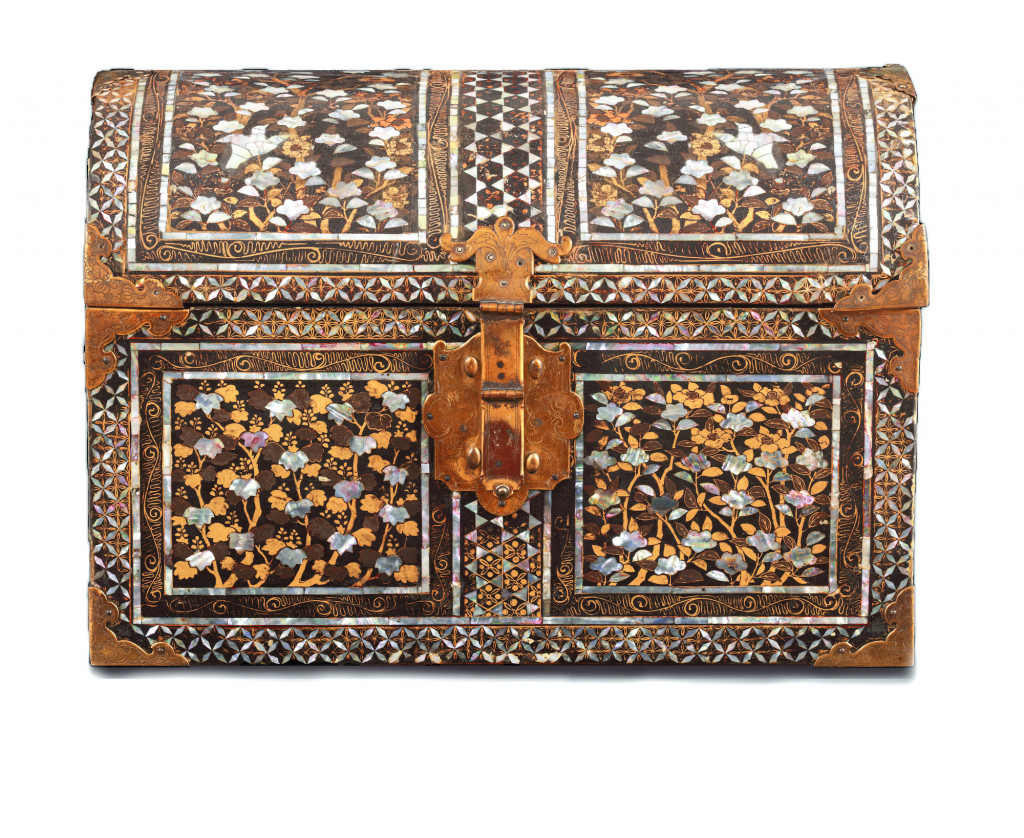
A Japanese Namban lacquer coffer with copper mounts for the European market, signed by Arisato
A medium-sized Namban coffer with a domed lid, delicately inlaid with mother-of-pearl and abundantly covered in gold and silver hira-maki-e. Particularly noteworthy are the two pearl sparrows decorating the lid and the swirling bands of golden arabesques that show the steady hand of an experienced painter. Most importantly though, the whole coffer remains in a remarkably pristine condition, a rarity amongst export lacquer from the eventful era that marks the transition from Momoyama into Edo. Furthermore, the original fittings include a lock with a trick mechanism that makes it harder for an unwanted visitor to lay hands on the coffer’s contents.
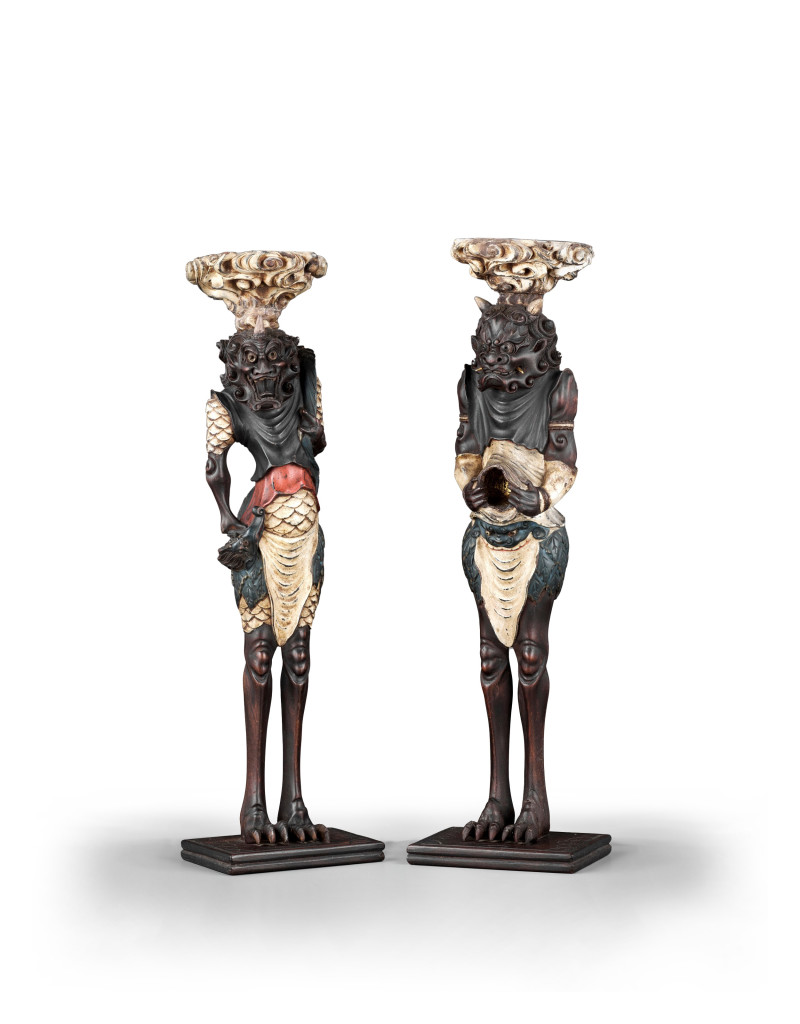
A pair of Japanese painted and lacquered wood candlesticks in the form of oni
Each standing atop a flat rectangular base incised with scrolling vines, wearing short robes with cloud designs at the back as well as leaf-skirts. The one-horned oni further wearing a scaly undergarment covering the stomach, upper arms, and thighs, holding a baku coiled around his body, and with the mouth wide open revealing tongue and teeth. The two-horned oni with his bone-inlaid fangs is tearing a hole in its belly with both hands. Both show fierce expressions, their heads surmounted by a rising cloud base to hold the candle, one with a circular bone-inlaid fitting.