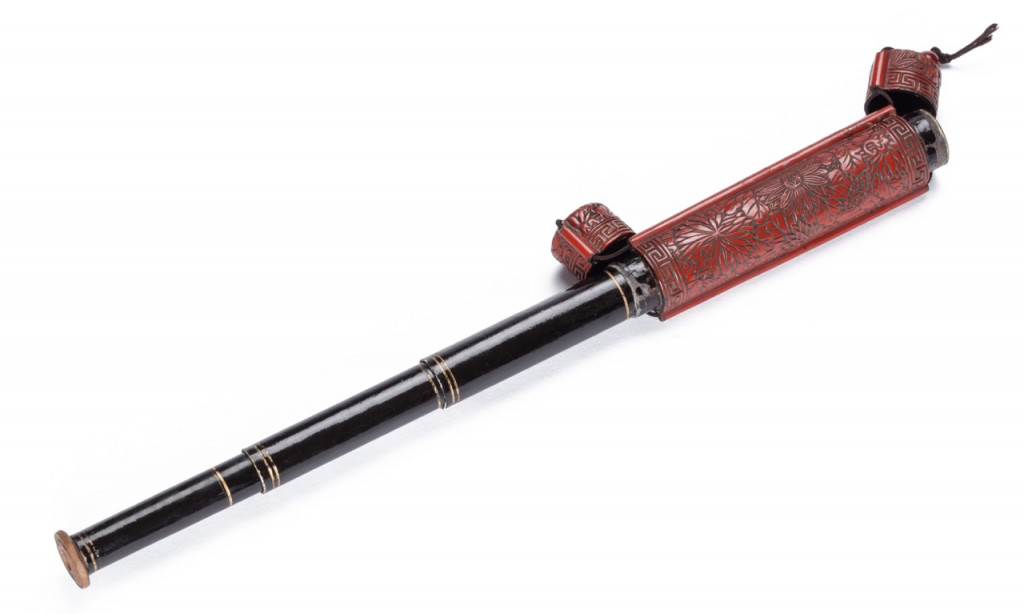
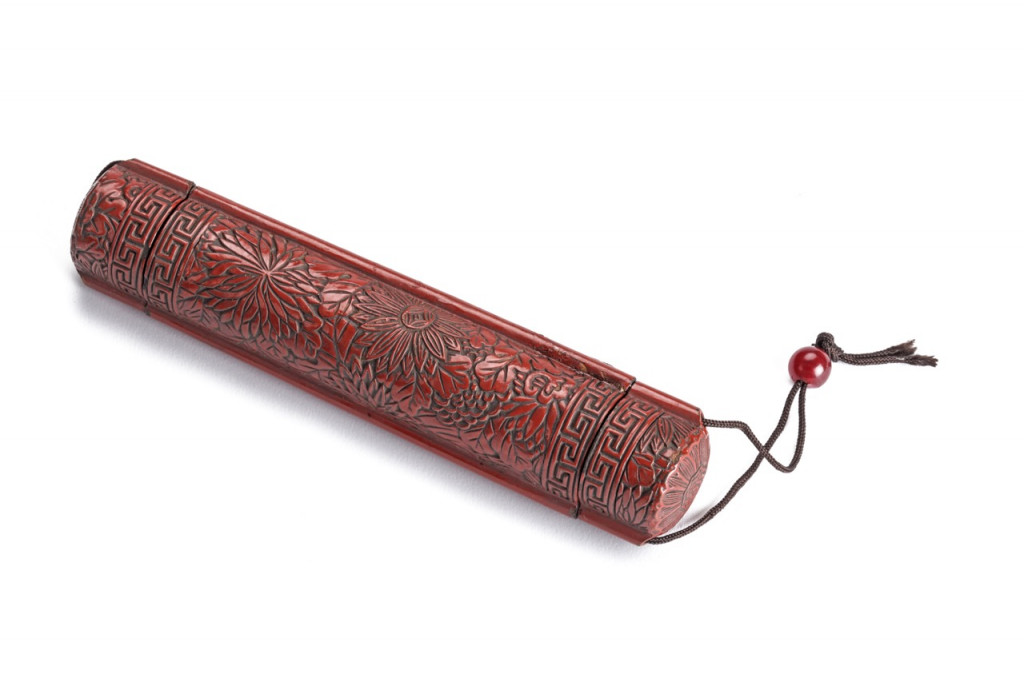
An exceptional Japanese carved red choshitsu lacquer telescope
Edo period, late 18th century
L. 17.9 cm
L. 37 cm (fully extended)
In Japan, unlike in China, carved lacquer ware was rare. It involves carving patterns through layers of lacquer. This small telescope, with a chrysanthemum design, extending parts black lacquered paper-maché with wooden eye-piece, is reminiscent of the Chinese carved lacquer technique much admired, but only occasionally imitated in Japan. Spectacles arrived in Japan in the mid-16th century mainly through Jesuits from China. The first telescopes in Japan probably were presented to Shogũn Ieyasu, given by the British East India Company in 1613, and in 1632, after the Taiwan Incident, the Shogũn asked the Dutch to help suppress the (Christian) Shimbara uprising by providing cannons and telescopes, which the Dutch did. At the end of the seventeenth century, telescopes started to be made in Japan, mainly in Nagasaki where the Japanese had seen the Dutch using telescopes. In 18th and 19th century watercolours and woodblock prints, Dutchmen are often depicted looking through a telescope, possibly as a phallic symbol. The best-known opticians during the Edo period were Mori Nizaemon (1673-1754) of Nagasaki and Iwahashi Zenbei (1756-1811) of Osaka.
For examples of late eighteenth-early nineteenth-century black and gold lacquered leather and paper-maché Japanese telescopes see: Uit Verre Streken, October 2016, no. 61, and December 2020, no. 66, and for two Japanese glass tube telescopes see Uit Verre Streken March, 2015, no. 59 and 60.
L. 17.9 cm
L. 37 cm (fully extended)
In Japan, unlike in China, carved lacquer ware was rare. It involves carving patterns through layers of lacquer. This small telescope, with a chrysanthemum design, extending parts black lacquered paper-maché with wooden eye-piece, is reminiscent of the Chinese carved lacquer technique much admired, but only occasionally imitated in Japan. Spectacles arrived in Japan in the mid-16th century mainly through Jesuits from China. The first telescopes in Japan probably were presented to Shogũn Ieyasu, given by the British East India Company in 1613, and in 1632, after the Taiwan Incident, the Shogũn asked the Dutch to help suppress the (Christian) Shimbara uprising by providing cannons and telescopes, which the Dutch did. At the end of the seventeenth century, telescopes started to be made in Japan, mainly in Nagasaki where the Japanese had seen the Dutch using telescopes. In 18th and 19th century watercolours and woodblock prints, Dutchmen are often depicted looking through a telescope, possibly as a phallic symbol. The best-known opticians during the Edo period were Mori Nizaemon (1673-1754) of Nagasaki and Iwahashi Zenbei (1756-1811) of Osaka.
For examples of late eighteenth-early nineteenth-century black and gold lacquered leather and paper-maché Japanese telescopes see: Uit Verre Streken, October 2016, no. 61, and December 2020, no. 66, and for two Japanese glass tube telescopes see Uit Verre Streken March, 2015, no. 59 and 60.
Part of the Japan collection.
Related objects
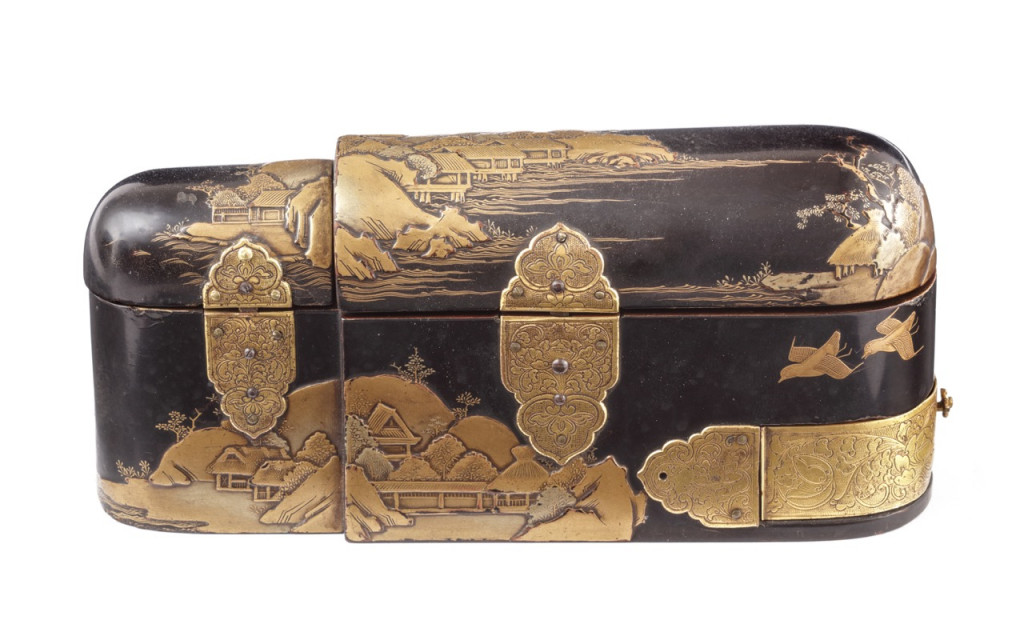
A rare Japanese export lacquer medical instrument box
_Edo-period, Japan, 1650-1700_ _L. 19 x W. 6 x H. 8.5 cm_ Provenance: - Auctioned at Christie’s in 1996 - Similar box illustrated in Oliver Impey & Christiaan Jörg, Japanese Export Lacquer 1580-1850, Hotei Publishing, Leiden, 2005, p. 115
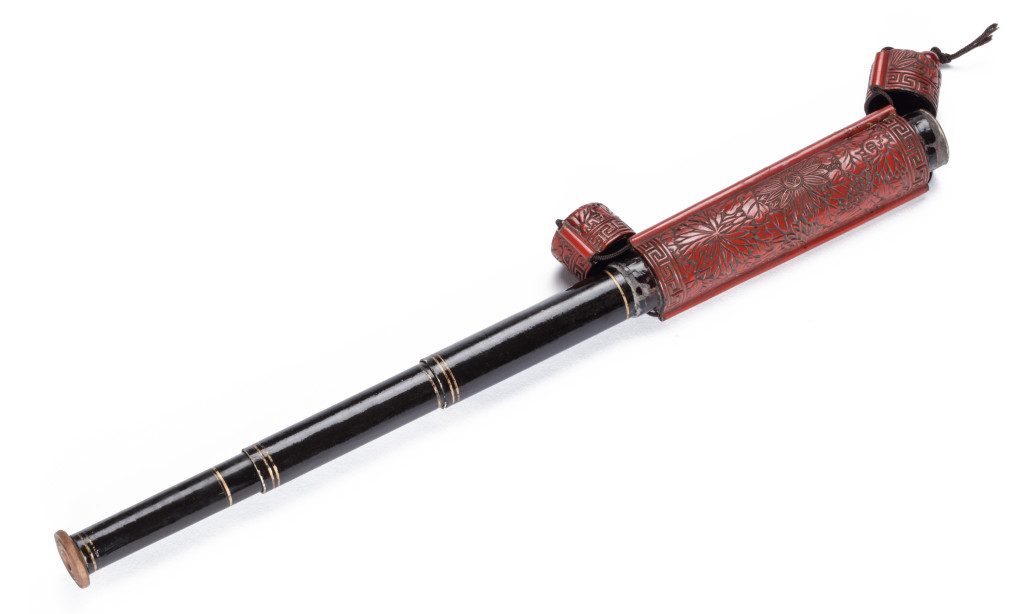
A collection of five exceptional Japanese telescopes
Japanese Edo Telescopes for sale
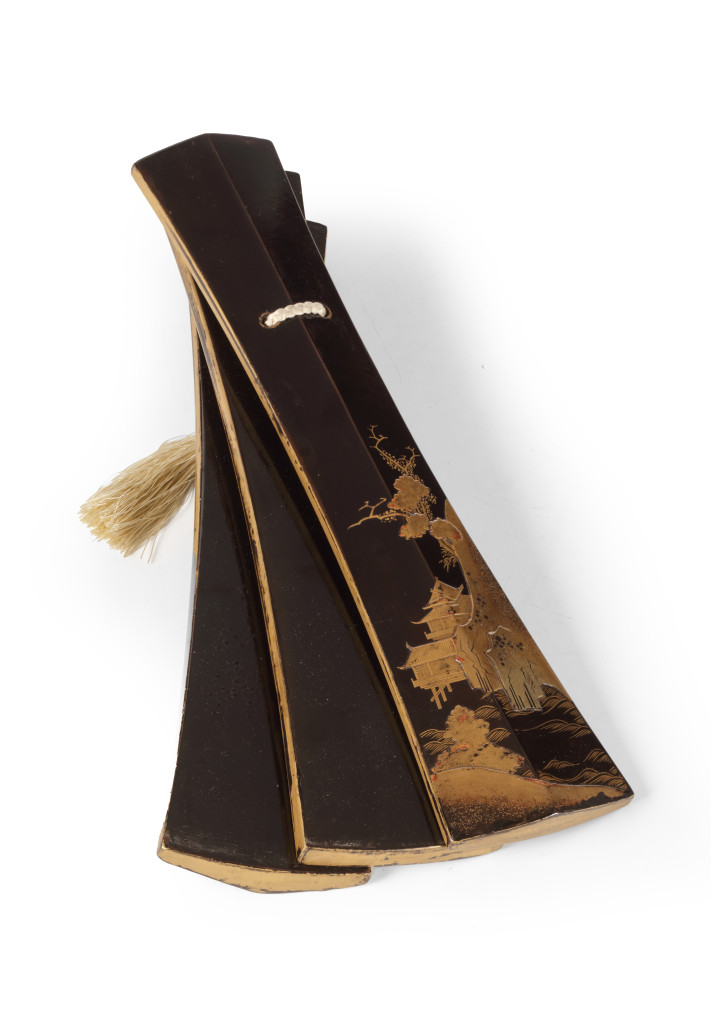
A Japanese lacquered Sanba instrument
_Okinawa, Edo period, early 18th century_ _L. 26 cm, lacquered wood_