A collection of five exceptional Japanese telescopes
Five Japanese telescopes of the Edo period, ranging from a diminutive carved lacquer example to a fully extending leather draw-tube of almost a metre. The telescope reached Japan in 1613, when a gift from King James I (1566–1625) was presented to Shogun Tokugawa Ieyasu (1543–1616) by John Saris of the English East India Company; thereafter the shogun and many provincial lords requested telescopes as tribute from the Dutch East India Company at Deshima. Domestic production began towards the end of the seventeenth century, centred on Nagasaki, and the best-known opticians of the period were Mori Nizaemon (1673–1754) of Nagasaki and Iwahashi Zenbei (1756–1811) of Osaka.
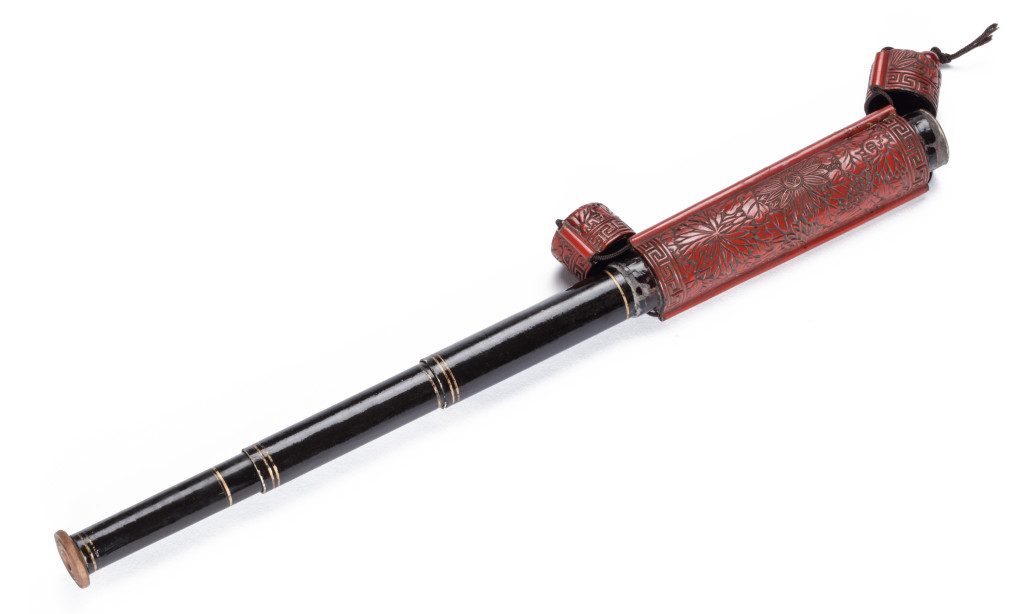
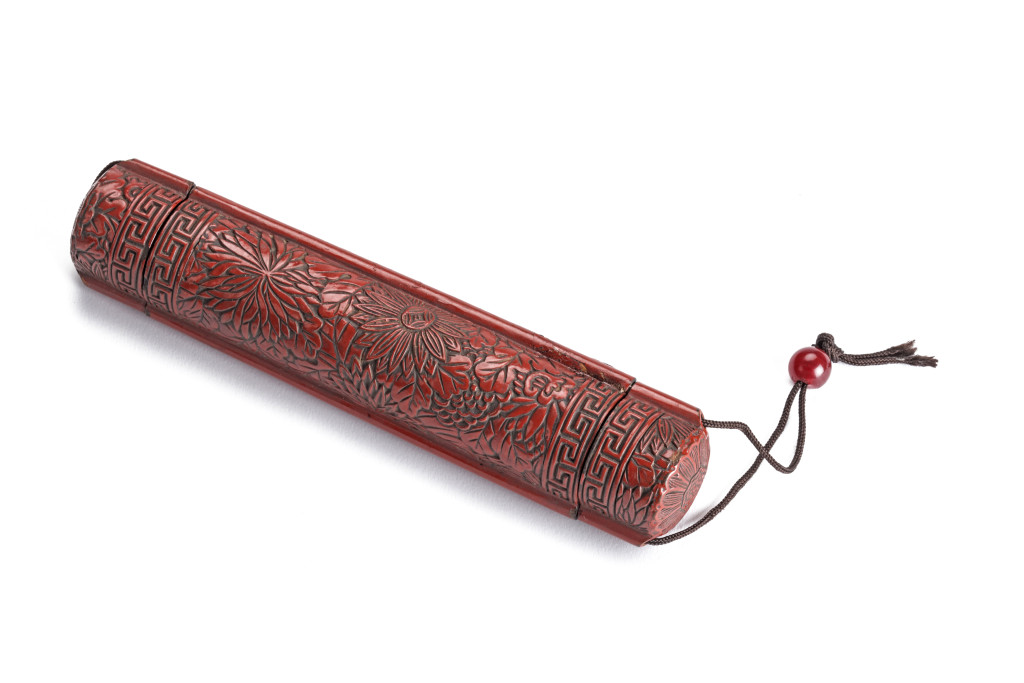
A rare Japanese carved lacquer telescope with chrysanthemum design
Edo period, late 18th century
L. 17.9 cm (retracted) L. 37 cm (fully extended)
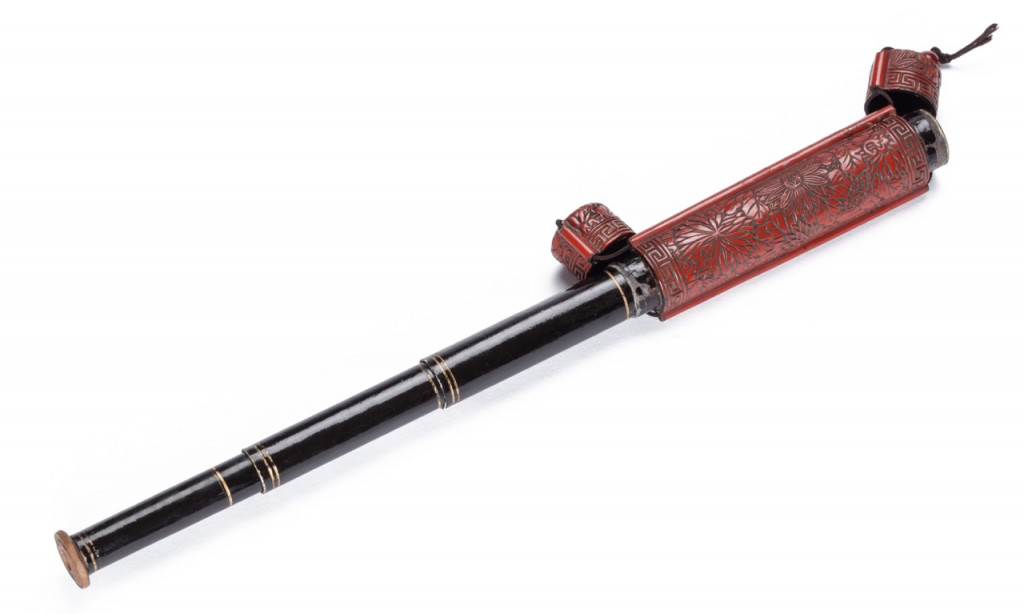
The extending sections of black lacquered papier-mâché with a wooden eye-piece, carved through the layers of lacquer with a chrysanthemum design. In Japan, unlike in China, carved lacquer ware was rare: the technique, which involves carving patterns through successive layers of lacquer, was much admired but only occasionally imitated. Spectacles had arrived in Japan in the mid-sixteenth century, largely through Jesuits coming from China, and optical instruments retained their association with the West throughout the Edo period. In 1638 the shogunate called on the Dutch for cannon and for the bombardment of Hara Castle during the Shimabara uprising, and in eighteenth- and nineteenth-century watercolours and woodblock prints Dutchmen are frequently shown looking through a telescope – an image read by Timon Screech as carrying phallic connotations.
Literature: Timon Screech, The Western Scientific Gaze and Popular Imagery in Later Edo Japan, Cambridge, 1996. For comparable late eighteenth- and early nineteenth-century black and gold lacquered leather and papier-mâché Japanese telescopes see Uit Verre Streken, October 2016, no. 61, and December 2020, no. 66; for two Japanese glass tube telescopes see Uit Verre Streken, March 2015, nos. 59 and 60.
An extremely rare Japanese glass telescope with lacquered leather case
Edo period, late 18th/early 19th century
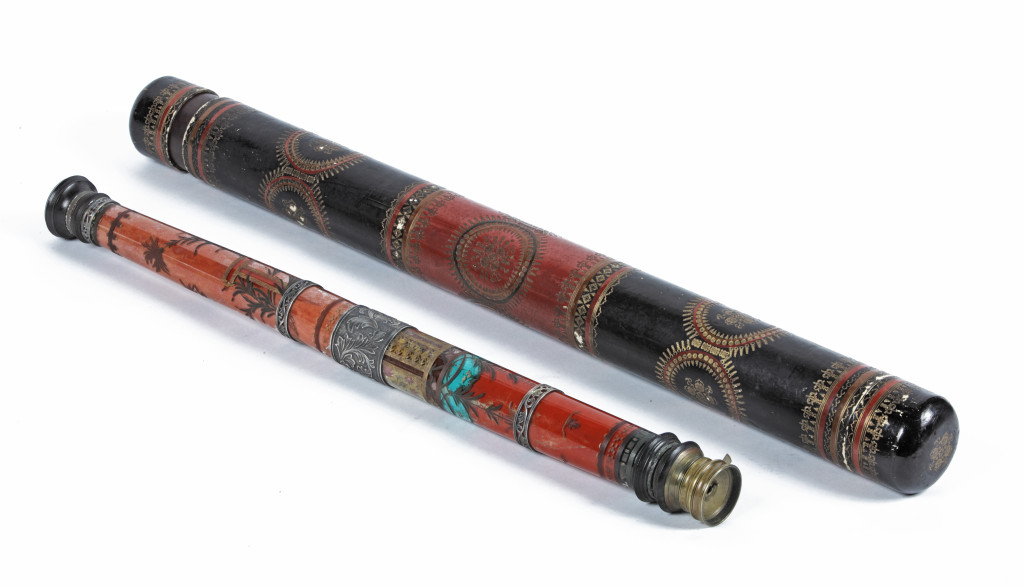
L. 56.7 cm (telescope) L. 68.3 cm (case)
The telescope decorated in various colours and gilt with flowers, foliage and geometric designs over and beneath the finely wheel-engraved glass, the glass sections separated by silverwork and copper rims. The cylindrical case of lacquered leather and paper is impressed with European style ornaments and applied with gold and lacquer.
Literature: Suntory Museum of Art, exhibition catalogue Japanese Glass: Stylish Vessels, Playful Shapes, Tokyo, 2010, no. 18 (ill.)
Exhibitions: Suntory Museum of Art, Japanese Glass: Stylish Vessels, Playful Shapes, 27 March – 23 May 2010
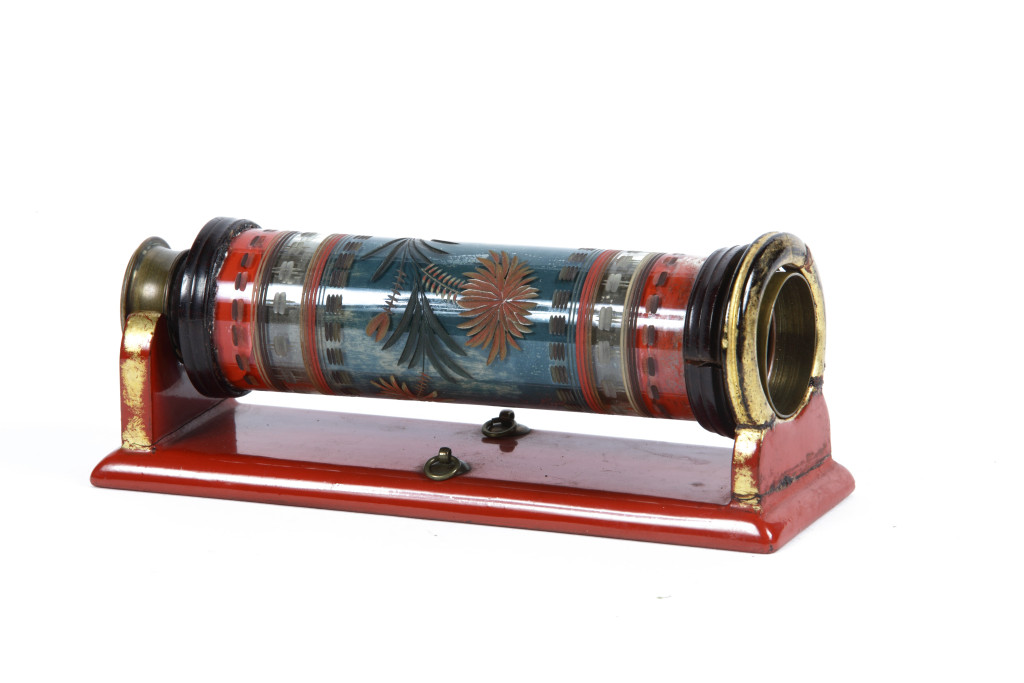
An extremely rare Japanese glass telescope with lacquered stand
Edo period, late 18th/early 19th century
L. 15.3 cm (telescope) L. 16.2 cm (stand)
The telescope decorated in various colours with birds and sprays of flowers painted over finely wheel-cut engraved glass, the glass sections and copper rims separated by lacquered wood, the stand of lacquered wood. With the original wooden box inscribed tōmegane (telescope) and the name of a previous owner, Mr. Nakata.
A similar, larger telescope, formerly in the collection of Ikenaga Hajime, is now in the Kobe City Museum.
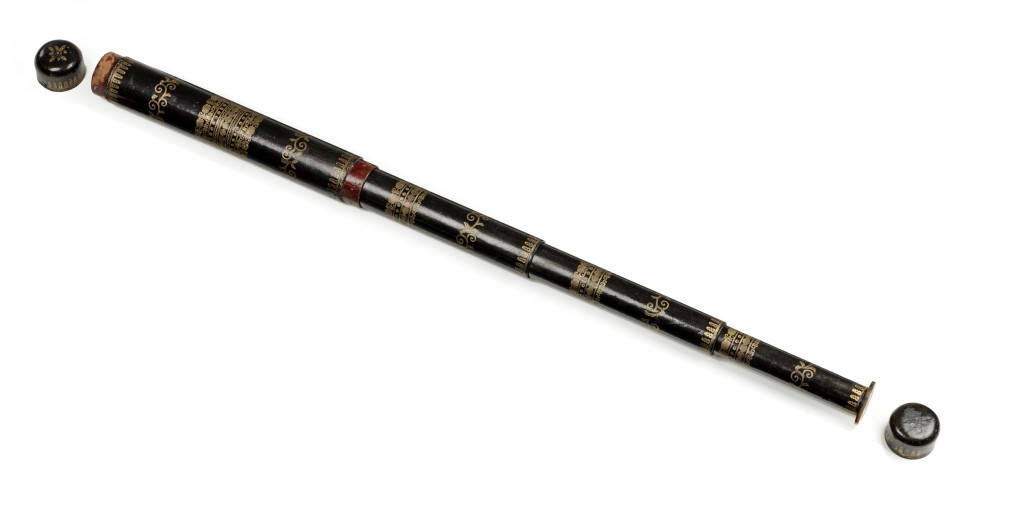
A rare large Japanese lacquered leather telescope
Edo period, late 18th century
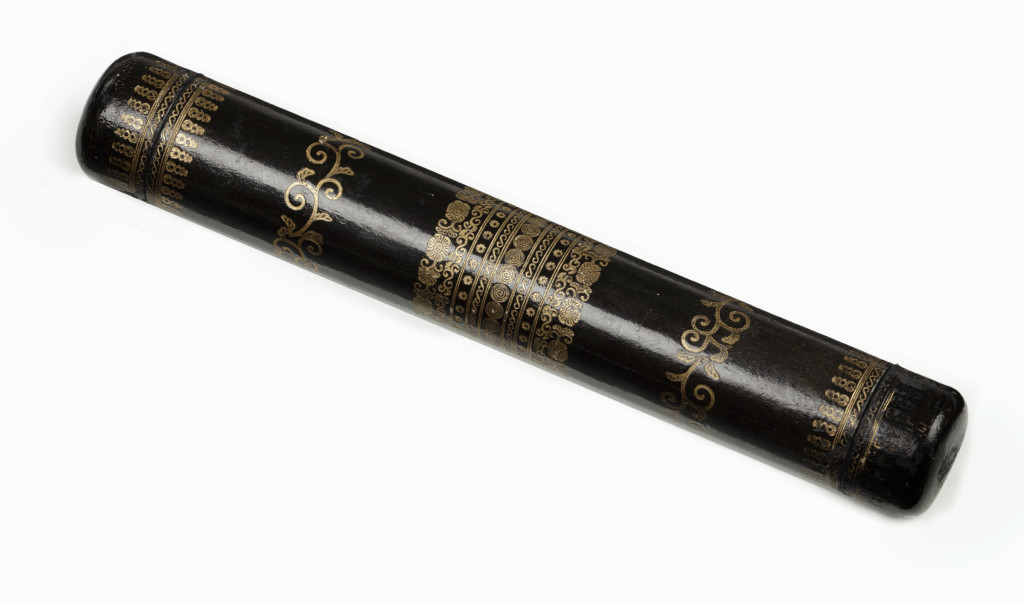
L. 32 cm (retracted, with the two end covers) L. 87 cm (fully extended)
In four sections, the smaller innermost end fitted with a cow horn disc pierced with a central hole to maximise the use of the centre of the lens, the largest outermost section finished with a copper disc with a central hole. All four sections of lacquered leather, embossed and applied with gold lacquer on a black ground with bands of European style patterns including flowers, scrolling foliage and geometric designs. With two covers for both ends.
Literature: Timon Screech, The Western Scientific Gaze and Popular Imagery in Later Edo Japan, Cambridge, 1996, for the role of telescopes of both European and Japanese manufacture in the visual culture of the Edo period. For a similar example see NHK Service Centre and Siebold Council, Chikuzō 350-shūnen Nagasaki Dejima ten (exhibition commemorating the 350th anniversary of Deshima in Nagasaki), Tokyo and Osaka, 1986, cat. no. 134; see also Doris Croissant and Lothar Ledderose (eds.), Japan und Europa, 1543–1929, exhibition catalogue, Berlin, 1993, pl. 61. A further example is in the Kobe City Museum, and two glass tube telescopes are published in Uit Verre Streken, Maastricht, March 2015, cat. nos. 59 and 60.
A Japanese lacquered leather telescope
Edo period, late 18th century
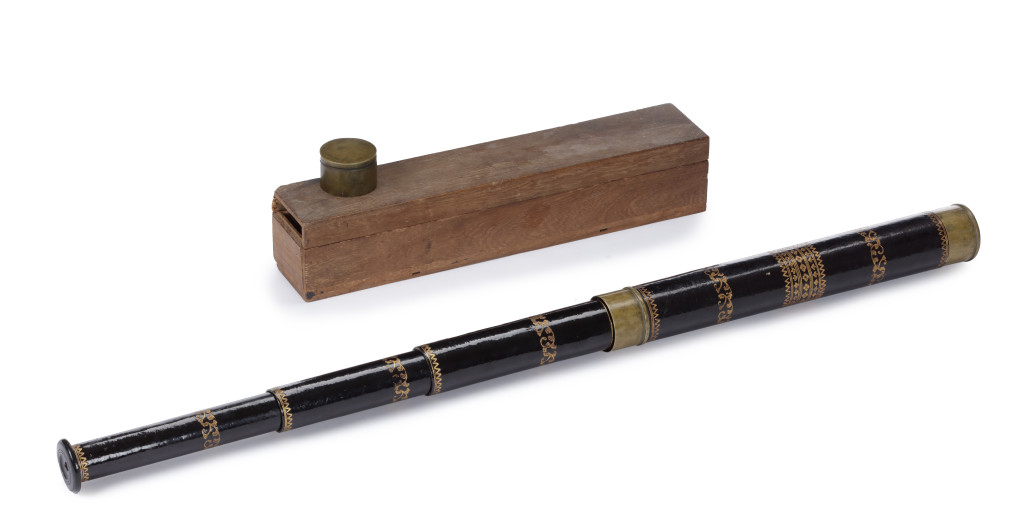
L. 37 cm (retracted) L. 87 cm (fully extended)
In four sections, the smallest innermost end fitted with a black lacquered wooden disc pierced with a central hole to look through, both ends finished with copper bands and one end with a copper cap. All four sections of lacquered leather, impressed and applied with gold on a black ground with bands of European style floral and geometric patterns.
Part of the Japan collection.
Related objects
An exceptional Japanese carved red choshitsu lacquer telescope
An exceptional Japanese carved red chõshitsu lacquer telescope. In Japan, unlike in China, carved lacquer ware was rare. It involves carving patterns through layers of lacquer. This small telescope, with a chrysanthemum design, extending parts black lacquered paper-maché with wooden eye-piece, is reminiscent of the Chinese carved lacquer technique much admired, but only occasionally imitated in Japan. Spectacles arrived in Japan in the mid-16th century mainly through Jesuits from China.
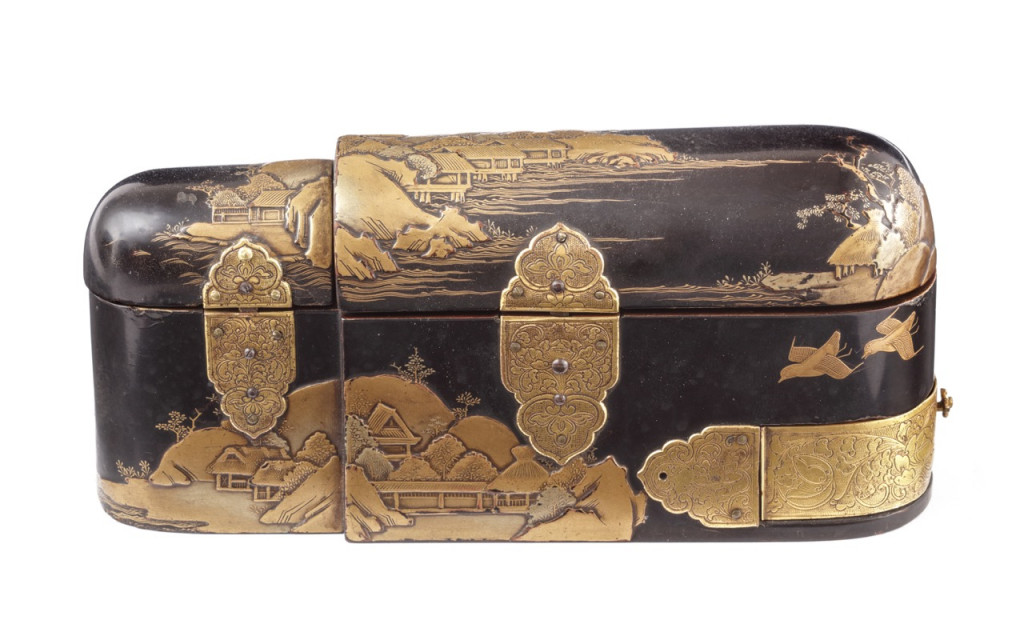
A rare Japanese export lacquer medical instrument box
_Edo-period, Japan, 1650-1700_ _L. 19 x W. 6 x H. 8.5 cm_ Provenance: - Auctioned at Christie’s in 1996 - Similar box illustrated in Oliver Impey & Christiaan Jörg, Japanese Export Lacquer 1580-1850, Hotei Publishing, Leiden, 2005, p. 115
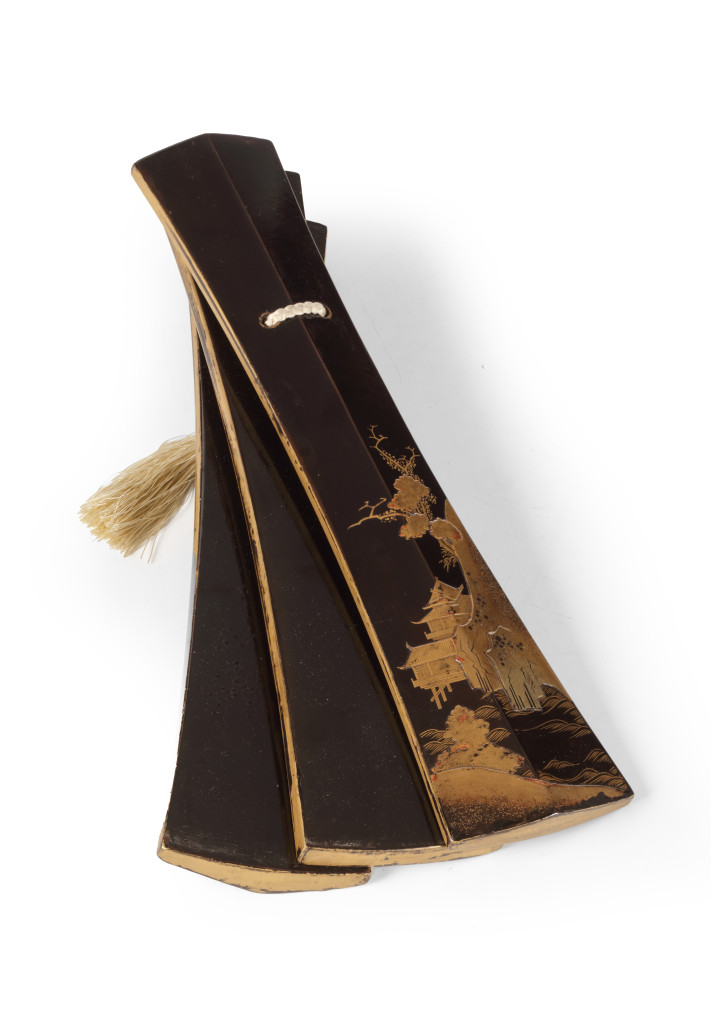
A Japanese lacquered Sanba instrument
_Okinawa, Edo period, early 18th century_ _L. 26 cm, lacquered wood_