
Jan Daniel Beynon (1830-1877)
Signed and dated J D Beynon Java 1876 lower right
Oil on canvas, H. 62 x W. 88 cm
Provenance:
Collection N.J. Raland, Haarlem (at least since 1883); thence by descent
Exhibited:
- The World Exhibition for International Colonial and Export Trade (Internationale Koloniale-en Uitvoerhandel Tentoonstelling), Amsterdam, May - October 1883
- Singer Museum, Laren, De Werelden van Jan Toorop / The Worlds of Jan Toorop, 21 January - 10 May 2026
Literature:
- Catalogus der Afdeeling Nederlandsche koloniën van de Internationale koloniale en uitvoerhandel tentoonstelling te Amsterdam, 1883, listed in ‘Groep II’, p. 10, no. 7a (as ‘Een karbou-wachter (toekang karbou)’, collection N.J. Raland, Haarlem’)
- Jan Veenendaal & Titus M. Eliëns (ed.), Aziatische Kunst en de Nederlandse Smaak, appendix IV: “‘Traced paintings Jan Daniel Beijnon”, Waanders, Zwolle, 2014, p. 230 (ill.)
Part of the Indonesian Archipelago collection.
Related objects

A magnificent Dutch floral marquetry cabinet-on-stand by Jan van Mekeren (1658-1733)
The present and V&A cabinet were both possibly ordered by Jens Wijbergen, a Dutch merchant living in Copenhagen. According to the Van Mekeren archives an order was placed by Wijbergen in 1700, probably for two cabinets, because the price was comparable to other orders for a pair of Van Mekeren cabinets. The previous owner of the present cabinet, living in Austria, is a descendant of a patrician family from Riga. Some members of the Danish Wijbergen family are known to have moved to Riga in the early 18th century.
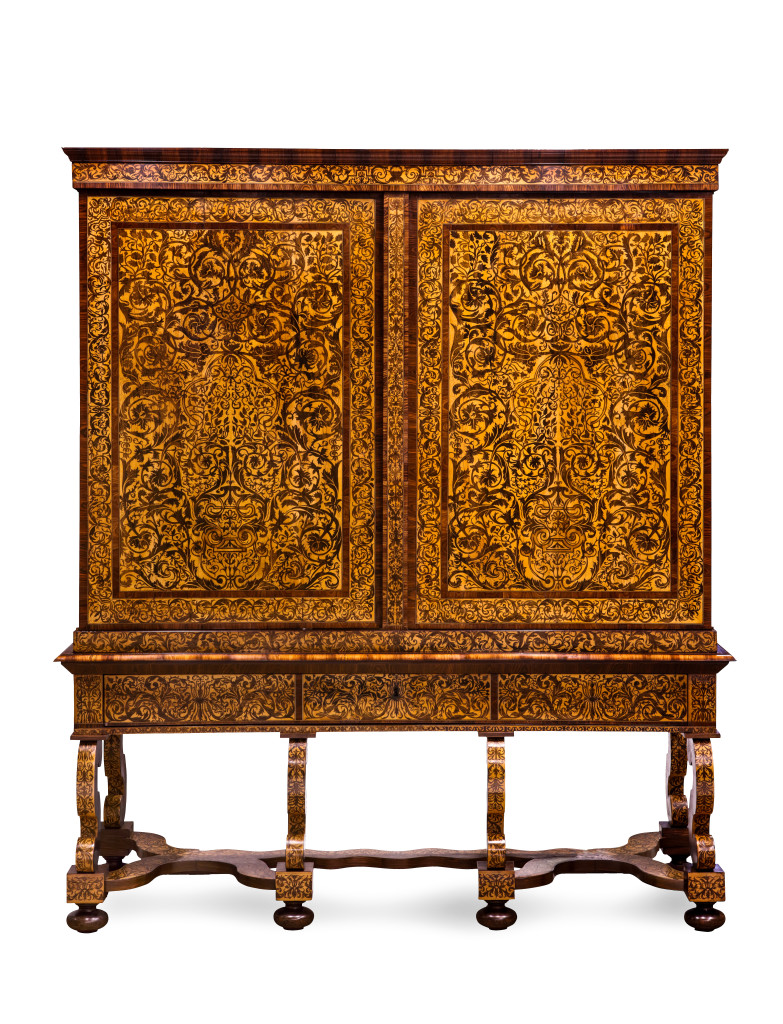
A magnificent Dutch marquetry cabinet on stand, by Jan van Mekeren (1658-1733) possibly made for William III and Mary of England
A magnificent Dutch marquetry cabinet on stand, by Jan van Mekeren (1658-1733) possibly made for William III and Mary of England. The oak cabinet is decorated with 'arabesque' or 'seaweed' marquetry in Turkish walnut (Juglans regia) on a holly (Ilex aquifolium) font, surrounded by a kingwood (Dalbergia cearensis) border. The top has a modest rectangular cornice of a frieze over two doors revealing the interior fitted with four shelves and five drawers. The inside of the doors and the drawer fronts are veneered with plain cedar (probably Cedrus atlantica). The stand has a frieze drawer and is raised on six S-shaped legs, joined by shaped stretchers and raised on turned ball feet. The entire cabinet, from the cornice to the stretchers, is covered in marquetry.
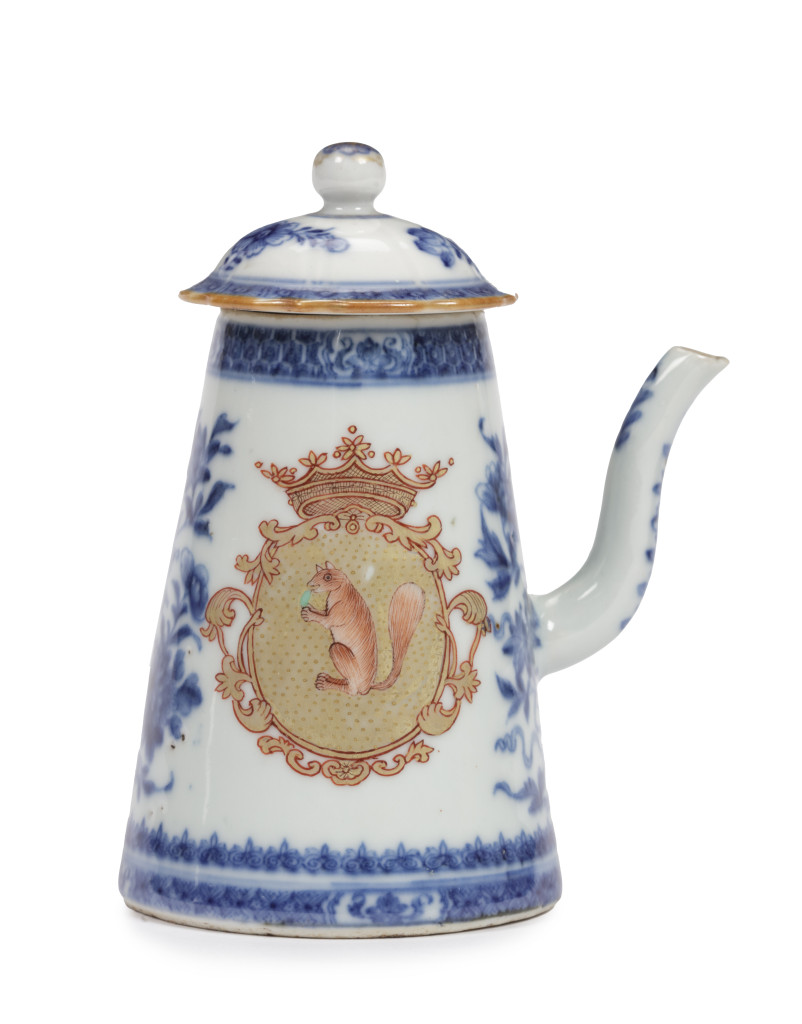
A small Chinese export porcelain coffeepot bearing the arms of Jan Albert Sichterman (1692-1764)
The conical-shaped coffeepot has a long, s-shaped sprout at right angles to the handle with a domed cover and bud finial. It is decorated in underglaze blue with the coat-of-arms of Sichterman, a seated squirrel nibbling on a leaf in rouge de fer, brown and green enamels on a gold background, and an oval shield with a coronet on top.