A rare complete Indian Sadeli inlaid work and writing box
British India, Bombay (present-day Mumbai), early 19th century
H. 12.6 x W. 43.2 x D. 28.5 cm
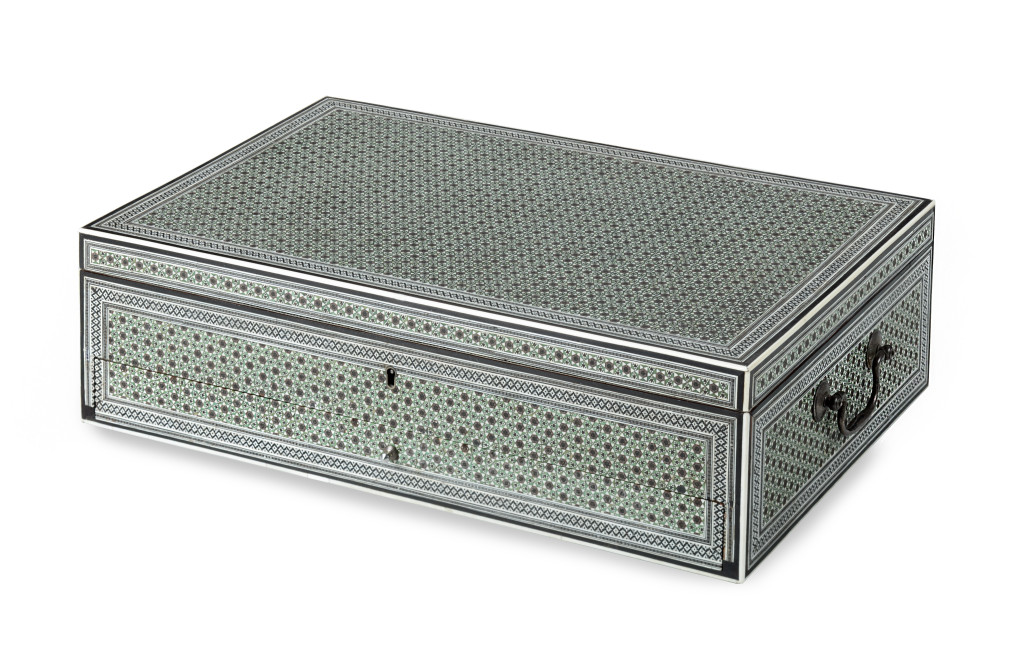
Micromosaic inlaid wood, with fitted ivory interior and tools, and silver fittings.
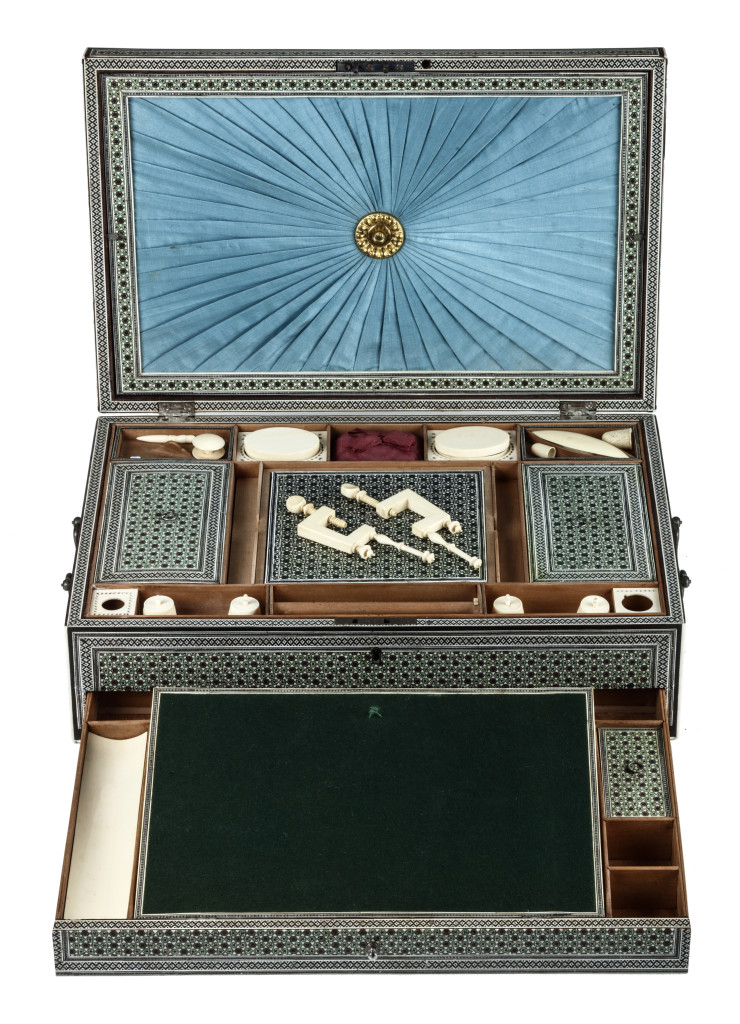
This combination workbox and writing-desk, is unusual for its completeness, with a fitted interior comprising a variety of ivory bobbins, thimbles, clamps and pin boxes. A secretaire drawer in the base of the box is fitted with a writing slope and small boxes. Silver was used for drawer pulls, handles, hinges and locks.
Workboxes, portable writing desks, inkstands and jewellery boxes were among the variety of nineteenth-century items decorated with geometric micromosaic patterns, called sadeli. Although the generic term “Bombay boxes” is used for a range of boxes decorated in this fashion, production was not limited to Bombay, as Amin Jaffer points out (A. Jaffer, Furniture from British India and Ceylon, London 2001, p. 313). Sadeli boxes were popular souvenirs with travellers to India, as Mrs. Postans observed in the 1830s: “the liberality of homeward-bound friends has now rendered (mosaic work) so much appreciated in England, in the form of presentation workboxes, desks, watch-stands, and numerous other ornamental souvenirs”. Queen Charlotte owned three sadeli boxes “of Bombay work”(Jaffer 2001, p.314).
The sadeli technique came to India from Shiraz in the sixteenth century. It consists of binding together lengths of geometrically shaped rods of diverse materials such as tin, copper, horn, ivory, sappan wood and ebony arranged in symmetrical geometric patterns. These rods are sliced through transversely and formed into thin sheets of repeating patterns that are laid over and glued to the wooden carcass (see Jaffer 2001, p.313).
H. 12.6 x W. 43.2 x D. 28.5 cm
Micromosaic inlaid wood, with fitted ivory interior and tools, and silver fittings.
This combination workbox and writing-desk, is unusual for its completeness, with a fitted interior comprising a variety of ivory bobbins, thimbles, clamps and pin boxes. A secretaire drawer in the base of the box is fitted with a writing slope and small boxes. Silver was used for drawer pulls, handles, hinges and locks.
Workboxes, portable writing desks, inkstands and jewellery boxes were among the variety of nineteenth-century items decorated with geometric micromosaic patterns, called sadeli. Although the generic term “Bombay boxes” is used for a range of boxes decorated in this fashion, production was not limited to Bombay, as Amin Jaffer points out (A. Jaffer, Furniture from British India and Ceylon, London 2001, p. 313). Sadeli boxes were popular souvenirs with travellers to India, as Mrs. Postans observed in the 1830s: “the liberality of homeward-bound friends has now rendered (mosaic work) so much appreciated in England, in the form of presentation workboxes, desks, watch-stands, and numerous other ornamental souvenirs”. Queen Charlotte owned three sadeli boxes “of Bombay work”(Jaffer 2001, p.314).
The sadeli technique came to India from Shiraz in the sixteenth century. It consists of binding together lengths of geometrically shaped rods of diverse materials such as tin, copper, horn, ivory, sappan wood and ebony arranged in symmetrical geometric patterns. These rods are sliced through transversely and formed into thin sheets of repeating patterns that are laid over and glued to the wooden carcass (see Jaffer 2001, p.313).
Part of the Indian Ocean collection.
Related objects
A superb inlaid walrus ivory and blue glass Ottoman knife
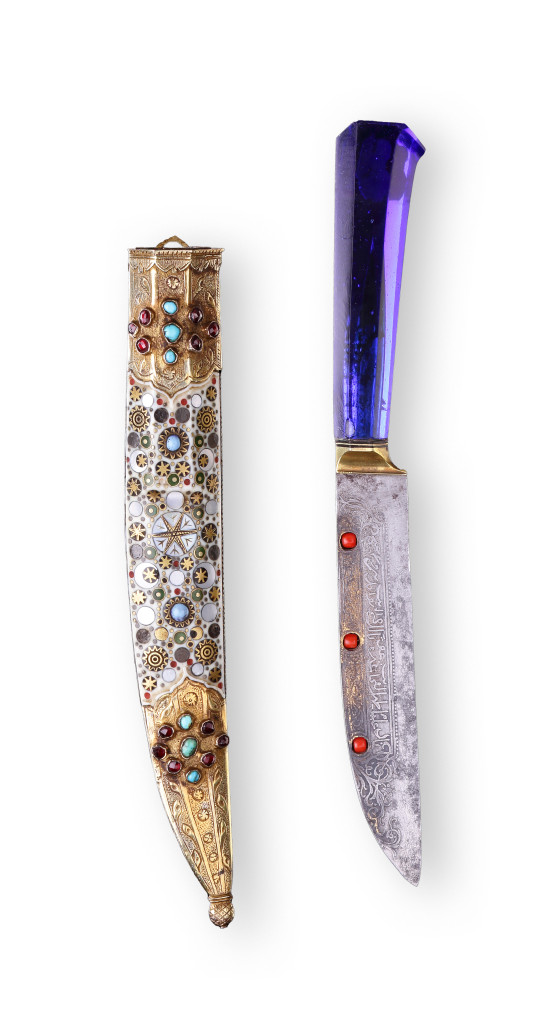
The hilt is formed of a faceted blue glass, while the blade of steel exhibits faux-watering and is inset with beads of coral at three equidistant slots just beneath the spine. The surface of the blade has also been etched over the greater part of its length with an inscription on one face with a part of the Nada ‘Ali quatrain and on the other with *“… Muluk (?) sultan malik tahir (?)” (“… of Kings (?), Sultan Malik Tahir (?)”)* among vine tendrils that exhibit remnants of the original gilding. Gilt stellar motifs also line the spine of the blade.
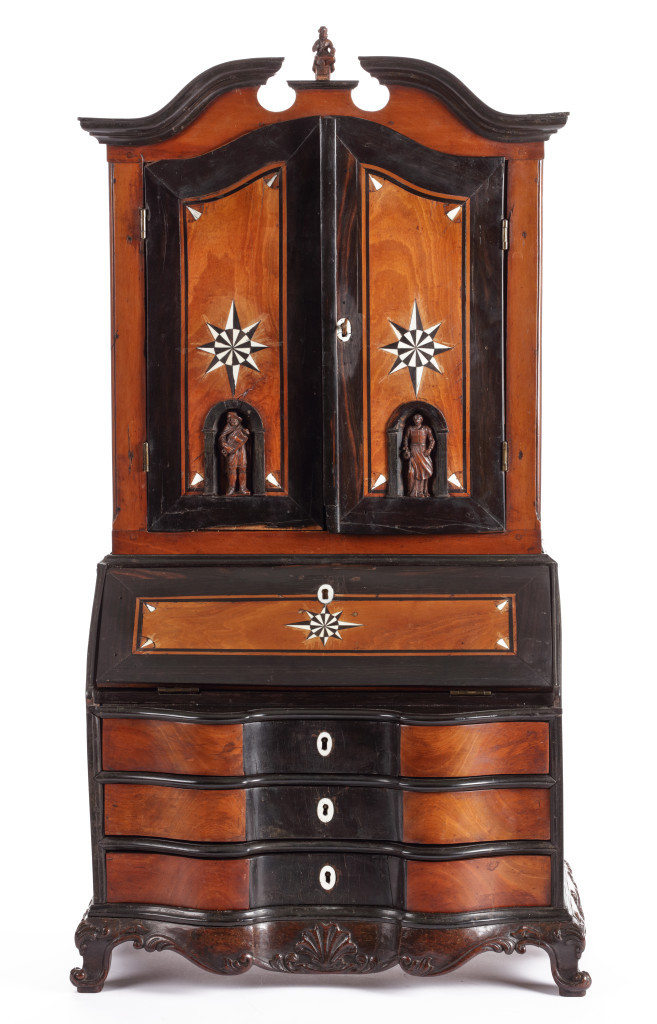
An exquisite Dutch-colonial satinwood, sono keeling, Macassar ebony, teak and bone-inlaid miniature bureau-cabinet
Batavia (Jakarta) or Sri Lanka, 18th century, with later added 'historismus’ figures