A superb inlaid walrus ivory and blue glass Ottoman knife
Ottoman Empire, Turkey, probably Constantinople (Istanbul), late 17th/early 18th century
L. 19.7 cm (overall)
Provenance:
With Runjeet Singh, London
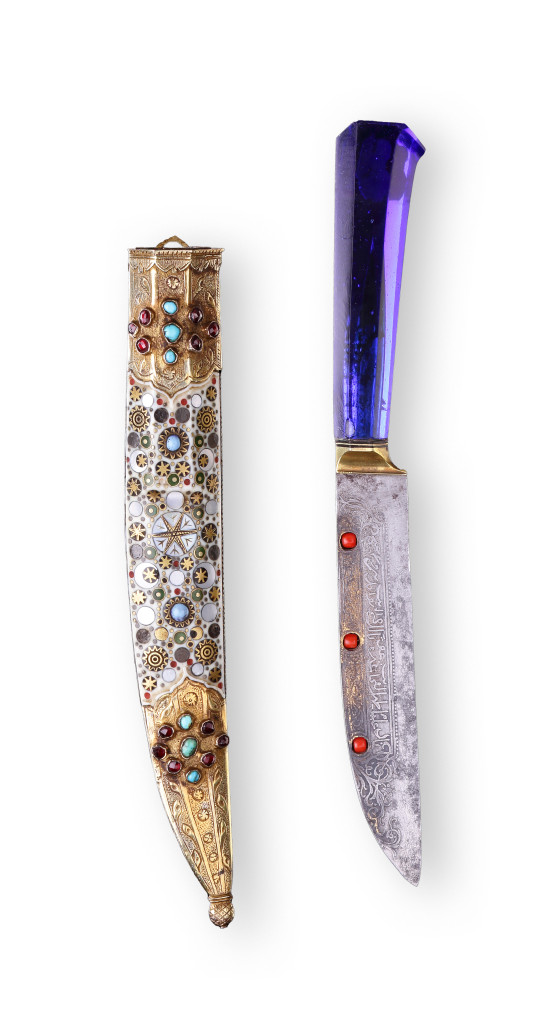
The hilt is formed of faceted blue glass, while the blade of steel exhibits faux-watering and is inset with beads of coral at three equidistant slots just beneath the spine. The surface of the blade has also been etched over the greater part of its length with an inscription on one face with a part of the Nada ‘Ali quatrain and on the other with “... Muluk (?) sultan malik tahir (?)” (“... of Kings (?), Sultan Malik Tahir (?)” among vine tendrils that exhibit remnants of the original gilding.
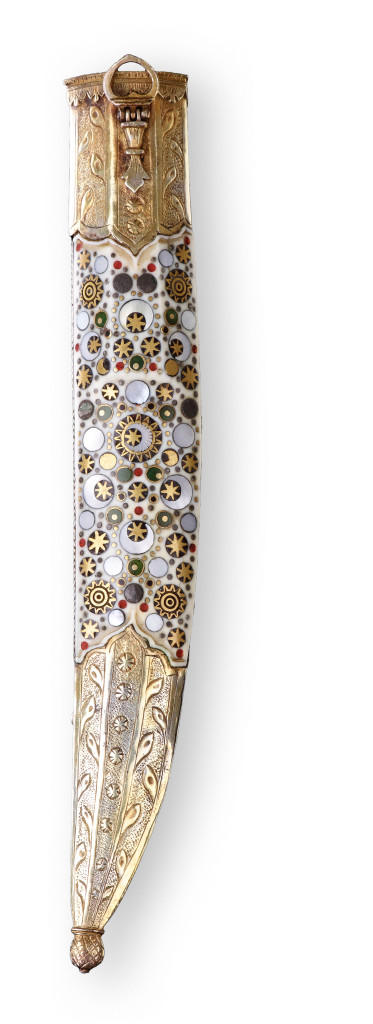
Gilt stellar motifs also line the spine of the blade. The scabbard is inset with a generous array of khatamkari roundels depicting celestial motifs with gems, mother- of-pearl and various metals. Of particular splendour are the ebony tesserae, which are overlaid with pointed stars in gold, some of the larger examples decorated at their centres with inset turquoise or gold concentric circles. The craftsman has expended great efforts to ensure almost no space is left unfilled, inviting the spectator to inspect the scabbard’s surface as one might survey a busy night sky.
It is interesting to note, too, that the central roundel of the front face is decorated on a shimmering white ground in mother-of-pearl, whilst that on the reverse is black (ebony) as if the front and reverse of the scabbard signified the day and night skies respectively. The scabbard’s gilt-silver collar and chape are punched and chased to depict stylised leaves and roundels in imitation of the scabbard’s central surface, and are further inset with small turquoises as well as coloured gemstones, the chape terminating in a cross-hatched acorn finial. This remarkable knife brilliantly exemplifies the artistry so often applied to exceptional pieces of arms and armour, its scabbard proficiently decorated throughout with roundels in a dazzling array of colours and patterns.
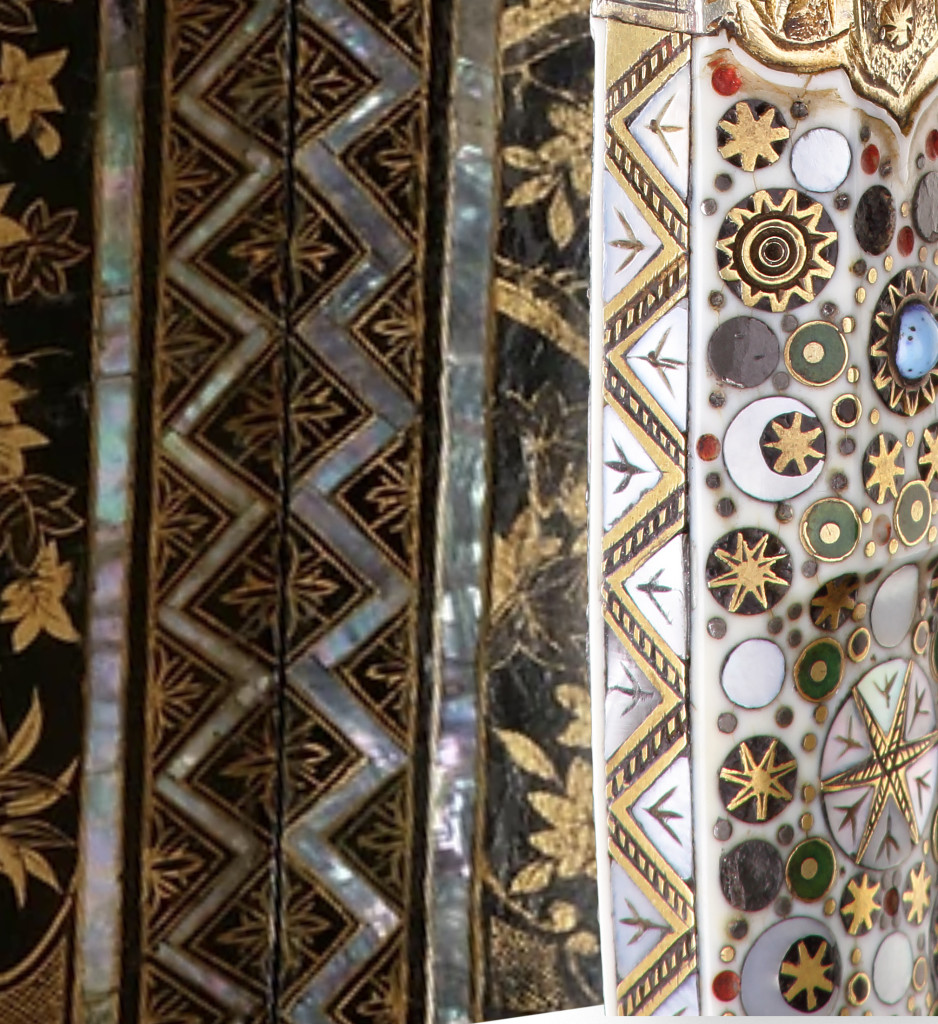
Remarkably, the side of the scabbard shows a zig-zag motif, to some immediately recognisable from Japanese Namban export lacquer ordered by the Portuguese (see for for instance no. 33 in this publication). This lacquerware was not intended for the Portuguese market only and was often given as diplomatic gifts to different courts, including the Ottoman court. The resemblance is so uncanny that it is tempting to suggest that the craftsman took inspiration from such a piece. After all, it is widely known that at the Ottoman court, Chinoiserie was also in fashion.
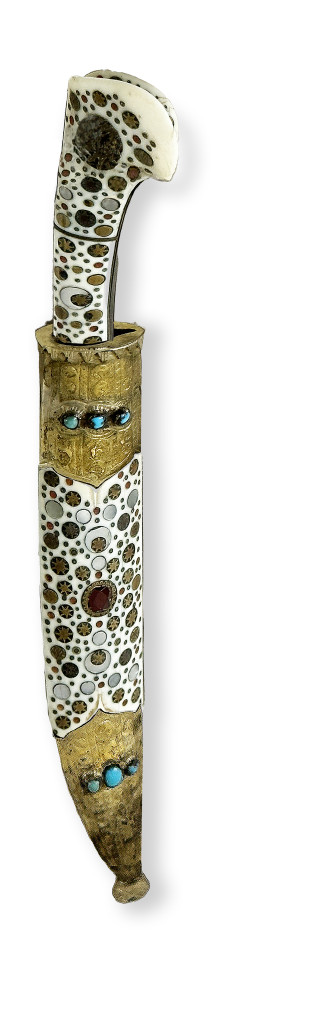
A comparable knife and scabbard can be found in the Schatzkammer of the Bavarian Palace in Munich (inv.no. 1235
or 1819/20). According to the museum the knife entered the collection through the Pfälzer Wittelsbacher line, who, in the 16th and 17th centuries, were known to collect Ottoman artefacts as Turquerie, also known as Turkomania, was in vogue.
L. 19.7 cm (overall)
Provenance:
With Runjeet Singh, London
The hilt is formed of faceted blue glass, while the blade of steel exhibits faux-watering and is inset with beads of coral at three equidistant slots just beneath the spine. The surface of the blade has also been etched over the greater part of its length with an inscription on one face with a part of the Nada ‘Ali quatrain and on the other with “... Muluk (?) sultan malik tahir (?)” (“... of Kings (?), Sultan Malik Tahir (?)” among vine tendrils that exhibit remnants of the original gilding.
Gilt stellar motifs also line the spine of the blade. The scabbard is inset with a generous array of khatamkari roundels depicting celestial motifs with gems, mother- of-pearl and various metals. Of particular splendour are the ebony tesserae, which are overlaid with pointed stars in gold, some of the larger examples decorated at their centres with inset turquoise or gold concentric circles. The craftsman has expended great efforts to ensure almost no space is left unfilled, inviting the spectator to inspect the scabbard’s surface as one might survey a busy night sky.
It is interesting to note, too, that the central roundel of the front face is decorated on a shimmering white ground in mother-of-pearl, whilst that on the reverse is black (ebony) as if the front and reverse of the scabbard signified the day and night skies respectively. The scabbard’s gilt-silver collar and chape are punched and chased to depict stylised leaves and roundels in imitation of the scabbard’s central surface, and are further inset with small turquoises as well as coloured gemstones, the chape terminating in a cross-hatched acorn finial. This remarkable knife brilliantly exemplifies the artistry so often applied to exceptional pieces of arms and armour, its scabbard proficiently decorated throughout with roundels in a dazzling array of colours and patterns.
Remarkably, the side of the scabbard shows a zig-zag motif, to some immediately recognisable from Japanese Namban export lacquer ordered by the Portuguese (see for for instance no. 33 in this publication). This lacquerware was not intended for the Portuguese market only and was often given as diplomatic gifts to different courts, including the Ottoman court. The resemblance is so uncanny that it is tempting to suggest that the craftsman took inspiration from such a piece. After all, it is widely known that at the Ottoman court, Chinoiserie was also in fashion.
A comparable knife and scabbard can be found in the Schatzkammer of the Bavarian Palace in Munich (inv.no. 1235
or 1819/20). According to the museum the knife entered the collection through the Pfälzer Wittelsbacher line, who, in the 16th and 17th centuries, were known to collect Ottoman artefacts as Turquerie, also known as Turkomania, was in vogue.
Related objects
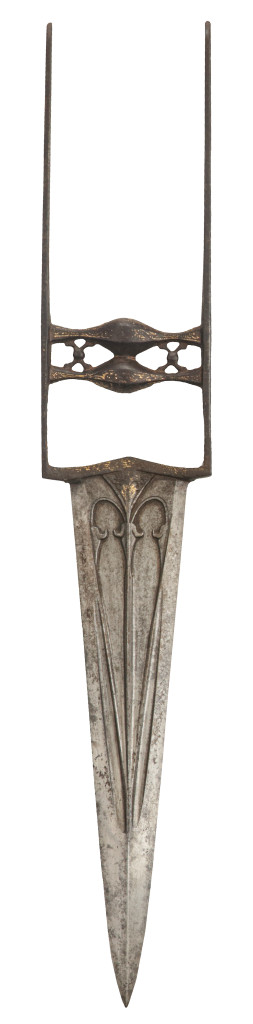
An Indian boy's 'katar', a punch dagger or tiger knife
Indian Boy's Katar Punch Dagger
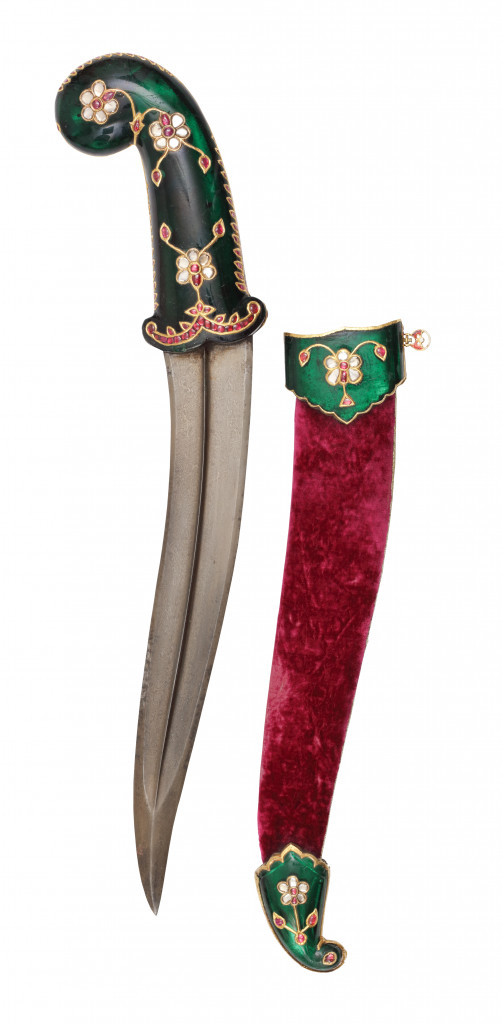
An superb gem-set Mughal glass dagger
An exquisite gem-set Mughal glass dagger formerly in the famous Al-Thani collection, India, Deccan, 18th century. The Al-Thani Collection in one of the most renowned and extensive private collections of art and artefacts in the world, including an exceptional array of weaponry.
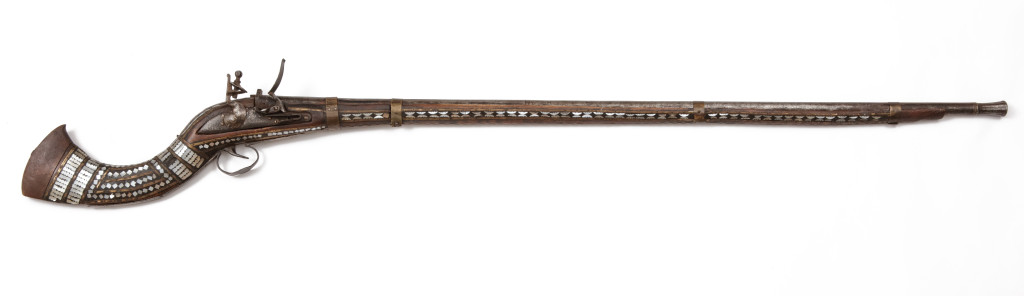
Two Afghan mother-of-pearl inlaid flintlock guns or jezail
Afghanistan or Northern India, circa 1820-1840