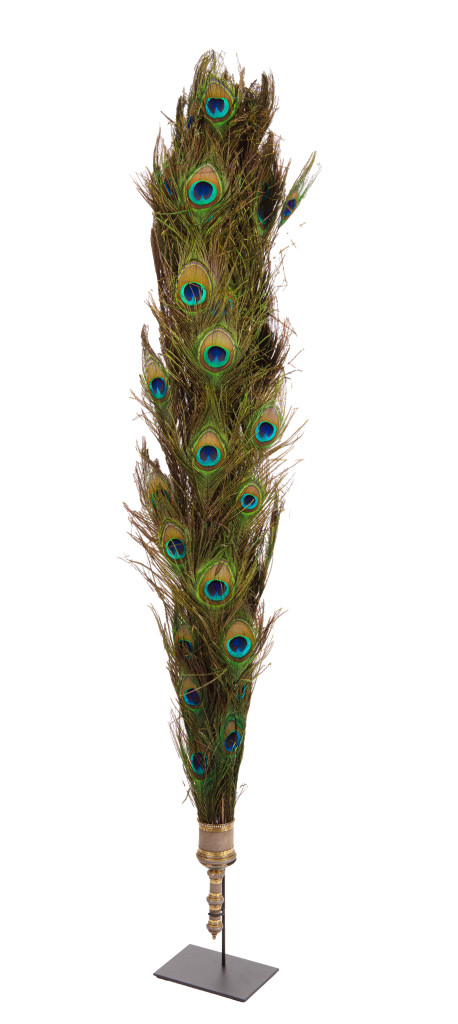
A Mughal silver and silver-gilt enamelled peacock feather fan, or 'morchal'
L. 121 cm (overall) / L. 17.5 x Diam. 5.5 cm (handle)
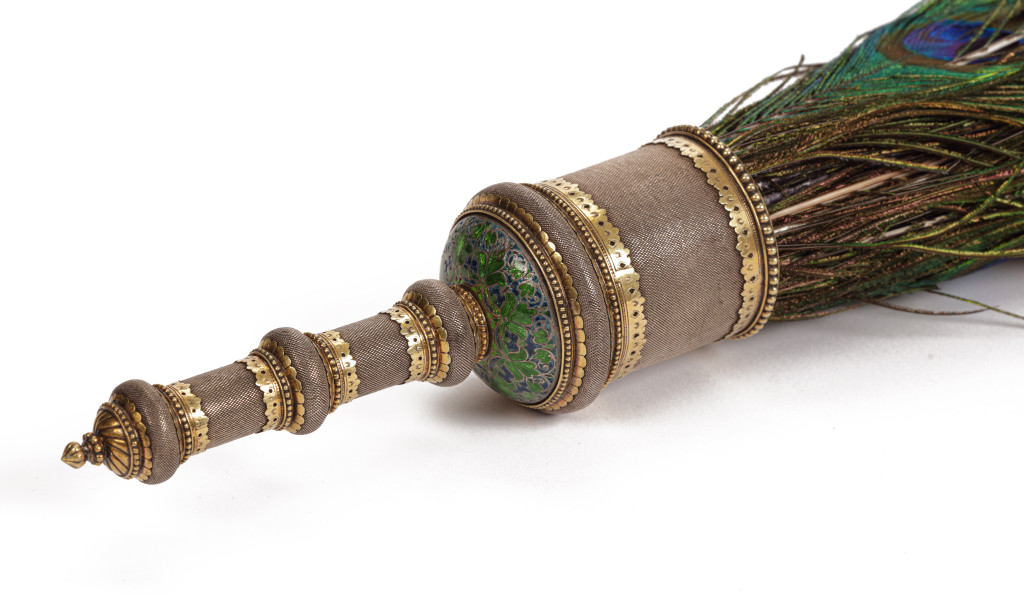
The magnificent silver, silver-gilt and enamelled peacock feather fan (morchal), composed of a cylindrical silver core encased in very fine silver mesh held in place by silver-gilt mounts that are at once both functional, being part of the construction, and ornamental, being elaborately cut, chased and pierced for decoration. Each silver-gilt mount encircling the haft is composed of three horizontal registers: a central row of protruding circular pellets, flanked on one side by a row of lappets that bend upwards to accommodate the rise of the three equally spaced rounded ridges placed at the opposite ends and centre of the handle, and a ridge of continuous trefoil crenellations on the other side, decorated with chased motifs resembling flaming orbs that alternate with punched circles, through which the underlying mesh may be glimpsed. The end of the haft is marked with a flourish by a lotus bud finial emerging from a collar of much larger beads sitting on a flattened dome with swirling lobes.
Similar decorations appear on the cup of the plume holder, which also has a raised ridge at the base, around which the silver-gilt mounts wrap themselves. A frieze of large beads encircles the mouth of the cup. The convex curve at the bottom of the cup is champlevé-enamelled in blue and green on silver. The design is a garland of stylised green trefoil lotus blossoms and leaves connected by silver vines against a dark blue sky. Through the translucent green enamel may be the seen the parallel striations incised onto the hollows of the excavated silver so that the enamel may adhere better to the metal surface. Yet again, as with the silver-gilt mounts, construction revealed is decoration attained, as the striations that we see through the enamelling may be read as the veins of the petals and leaves, adding visual interest and texture to the already rich and intoxicating mix. The choice of the colour palette is an artistic decision of great success, as the shimmering greens and blues perfectly and deliciously complement the iridescent colours of the peacock feather plume, produced by the optical process of structural colouration, where microscopically structured surfaces are fine enough to interfere with visible light to reflect blue, turquoise and green light.
With the virtuoso display of different metalwork techniques, colourations and finishes (matt, shiny, reflective, translucent, opaque and veiled), this exquisite treasury object demonstrates diverse and exceptional skills on the part of the gifted metalworkers to produce an object combining both opulence and refinement.
Though the enamelled collar displays the palette of green and blue on silver most associated with enamelwork from the city of Lucknow in the later eighteenth century, on stylistic grounds this attribution must be ruled out on account of the overall decorative style being unidiomatic of both Lucknow and the eighteenth century. The closest stylistic match for the lush richness of the flowers and leaves, so different from the restrained naturalism and careful spacing of Mughal art, as well as the combination of green and blue with both silver and silver-gilt, comes from the metalwork and enamelling of the late sixteenth and seventeenth centuries in the Deccan.
A useful comparison may be drawn with the colours and floral motifs of five silver-gilt and champlevé-enamelled Deccani archery rings in the al-Sabah Collection at the Kuwait National Museum, Dar al-Athar al-Islamiyyah, published in Manuel Keene with Salam Kauokji, Treasury of the World: Jewelled Arts of India in the Age of the Mughals, 2001, pp. 64-65, cat. nos. 6.6-6.10. Keene dates these rings to the seventeenth century and assigns them to Hyderabad, which we consider a likely candidate for the origin of our morchal.
The contiguous trefoil lappets of the silver-gilt mounts also point to a dating of circa 1650-1700 as closely related designs appear on two late seventeenth century enamelled pandans published in: Mark Zebrowski, Gold, Silver & Bronze from Mughal India, 1997, p. 91, pls. 81 and 82.The pandan in pl. 81, now in the Jagdish and Kamla Mittal Museum of Indian Art, is also from Hyderabad. A northern Indian silver pandan of slightly later early eighteenth century date on p. 44. pls. 19a and b, has the similar three-lobed lappets holding a loose wire mesh fitted around the silver core, not identical to our morchal, but reminiscent. According to Zebrowski, this is an extremely rare technique, possibly of Chinese origin, exploiting the decorative potential of twisted silver wire placed like a net over a silver core.
The silver mesh on our morchal is constructed of thin silver wire woven tightly together using a technique akin to textile weaving with beaten silver thread as thin and pliable as metal-wrapped silk. It is a highly unusual technique providing a softer finish as an effective contrast to the high polish of the silver-gilt mounts. It also imparts to the morchal a greater textural complexity both visual and tactile, the latter of great relevance to an object to be held in the hand. The extraordinary tightness of the mesh also anticipates the famous eighteenth century silver wire filigree work of Karimnagar, also in the Deccan, thus providing another link with the Deccan as our proposed site of manufacture. A container, a casket and a tray made from this exacting technique are published in Zebrowski, p. 45, pls. 20, 21 and 22.
Pictorial evidence based on the study of miniature paintings of the period provide the final clue. A quick search through any book on Mughal painting such as Susan Stronge, Painting for the Mughal Emperor: The Art of the Book 1560-1660, 2002, reveals the paucity of morchals at the Mughal court; the emperors overwhelmingly preferred the use of chowries (horse or yak hair flywhisks) by their attendants. Perhaps they considered the peacock to have too many associations with the Hindu gods Shiva and Krishna, and associated morchals with their Rajput neighbours. Such associations with Hinduism and Rajput court practice did not seem to bother the Islamic courts of the Deccan and morchals figure prominently in their paintings, which also demonstrate another interesting phenomenon: the lack of chowries, the rulers being most frequently fanned by sashes, scarves and white handkerchiefs. The morchal performs the function of formal regalia on occasions where a white cloth would provide insufficient grandeur or luxury.
A famous Hyderabad painting from the early eighteenth century showing Alivardi Khan with attendants in a garden exemplifies this. The ruler is fanned by two attendants bearing morchals with the same proportions, ridged handles with knops, and non-flaring cups, as seen in our morchal. This painting is illustrated in Stuart Cary Welch, India: Art and Culture 1300-1900, 1985, p. 326, no. 221. Two Golconda paintings of circa 1687 in the David Collection, Copenhagen, show the durbar and procession of the self-important Dutchman, Cornelis van den Bogaerde portraying himself in the style of a local ruler fanned by morchals. These fascinating paintings are illustrated in Navina Najat Haidar and Marika Sardar, Sultans of Deccan India, 1500-1700: Opulence and Fantasy, 2015, pp. 322-323, cat. nos. 194 and 195. In the same volume, the authors illustrate two early eighteenth century Hyderabad procession paintings, p. 248, figs. 77 and 78, where the palanquins are attended by morchal bearers on the march.
Provenance:
The Stuart Cary Welch Collection, London
HH Sheikh Hamad bin Abdullah Al-Thani, Qatar
Exhibited:
Glory and Prosperity: Metalwork of the Islamic World, Arthur M. Sackler Museum, Harvard Art Museums, 2 February - 21 July, 2002
Literature:
Melanie Michailidis, Glory and Prosperity: Metalwork of the Islamic World, Harvard Art Museums, 2002
Related objects
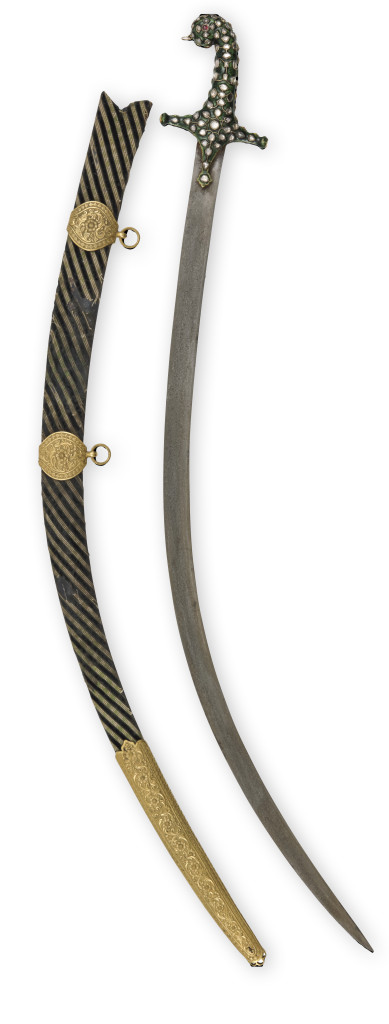
A superb Mughal green diamond-set gold enameled shamshir
The exceptionally fine pistol-grip hilt is decorated in kundan technique with diamonds and rubies set in gold, against a green enameled ground. It has a single-edged curved blade of watered steel. Including an associated striped cloth-covered sheath, two gold sheath mounts and gold chape with very fine scrolling floral repoussé decoration. The term repoussé comes from the French word meaning ‘pushed up’ or ‘raised’. It involves shaping metal from the reverse side to create intricate design and patterns on the front surface. It is achieved by hammering and shaping a sheet of metal, typically brass, gold or silver.
An Indian gem-set and enamelled gold throne for a deity
_Probably Rajasthan, 19th century_ _H. approx. 11 cm_ Provenance: Private collection, Switzerland (since the 1960s) A comparable gold throne for an idol from Gujarat or Maharashtra is illustrated in: M.E. Aitken, _When Gold Blossoms: Indian Jewelry from the Susan L. Beningson Collection_, London, Asia Society & Philip Wilson Publishers, 2004, p. 57.
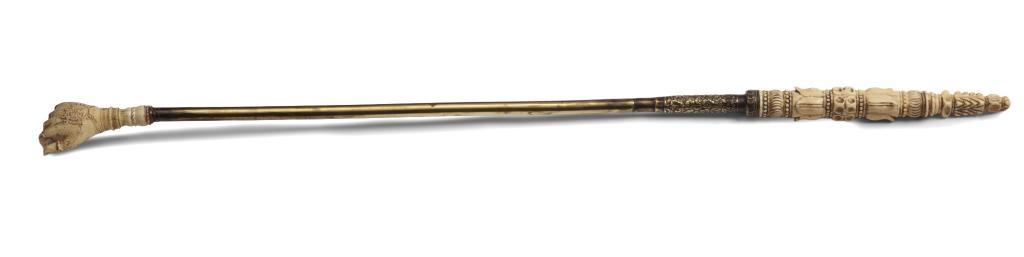
A Mughal silver and ivory backscratcher
_India, 18th century_ _L. 57 cm_ Provenance: Phillipe Missilier, Paris