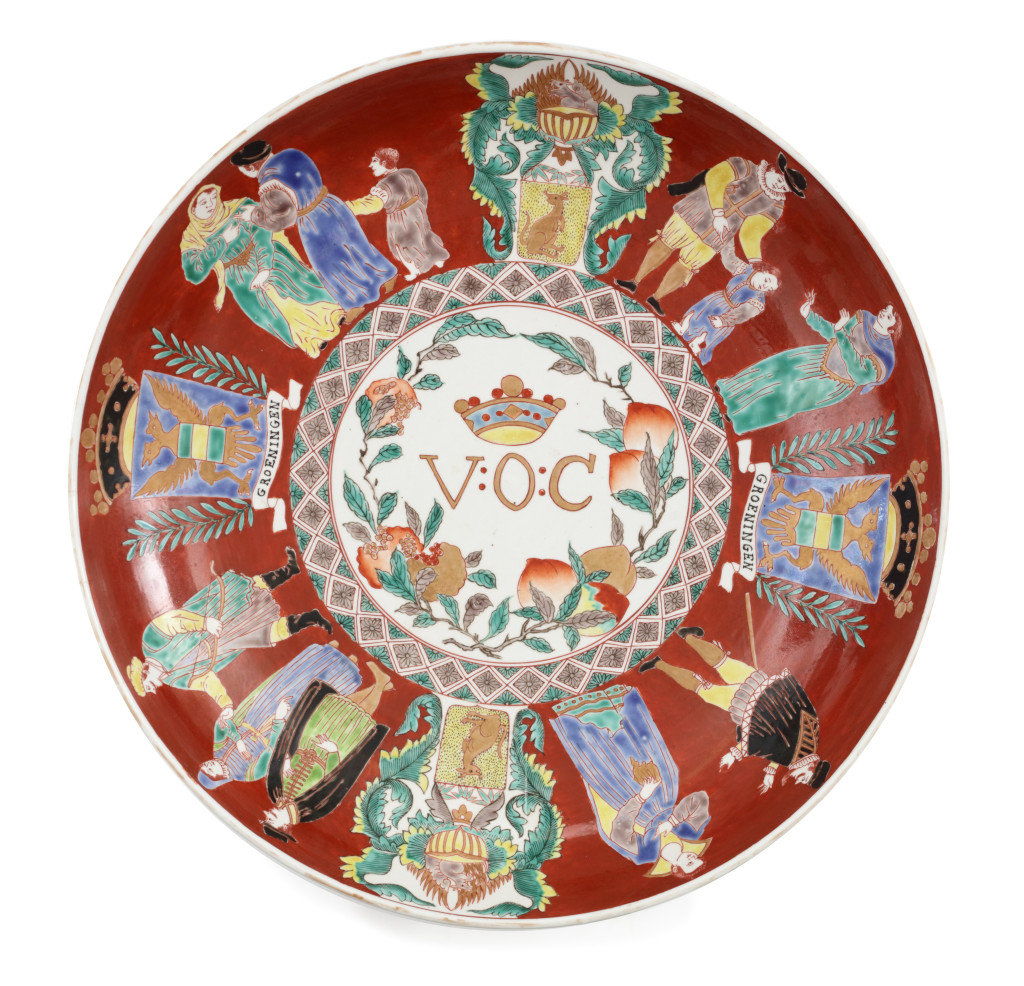
A large Japanese Imari porcelain 'VOC Groningen' dish
Diam. 43 x H. 7.4 cm
This porcelain dish with underglaze blue and overglaze decoration in red, green, yellow, black, aubergine enamels and gold, is depicting in the rim two groups of Dutchmen, -women and children, two groups of Portuguese, twice the crowned coat-of-arms of the city of Groningen over a ribbon inscribed ‘Groeningen’, and twice the coat-of-arms of Jan Albert Sichterman (the Sichterman squirrel looking more like a kangaroo). In the well the initials VOC (Vereenigde Oostindische Compagnie) are under a crown and surrounded by twigs with leaves and peaches. The reverse is decorated with three views of townhouses and a church tower with a cross, supposedly the ‘Martini toren’ of Groningen, and three times the VOC monogram on a red and green background.
These kinds of plates catered to the need for exotic imagery amongst the Japanese tourists visiting the port cities to see the newly arrived Europeans and Americans.
Part of the Japan collection.
Related objects
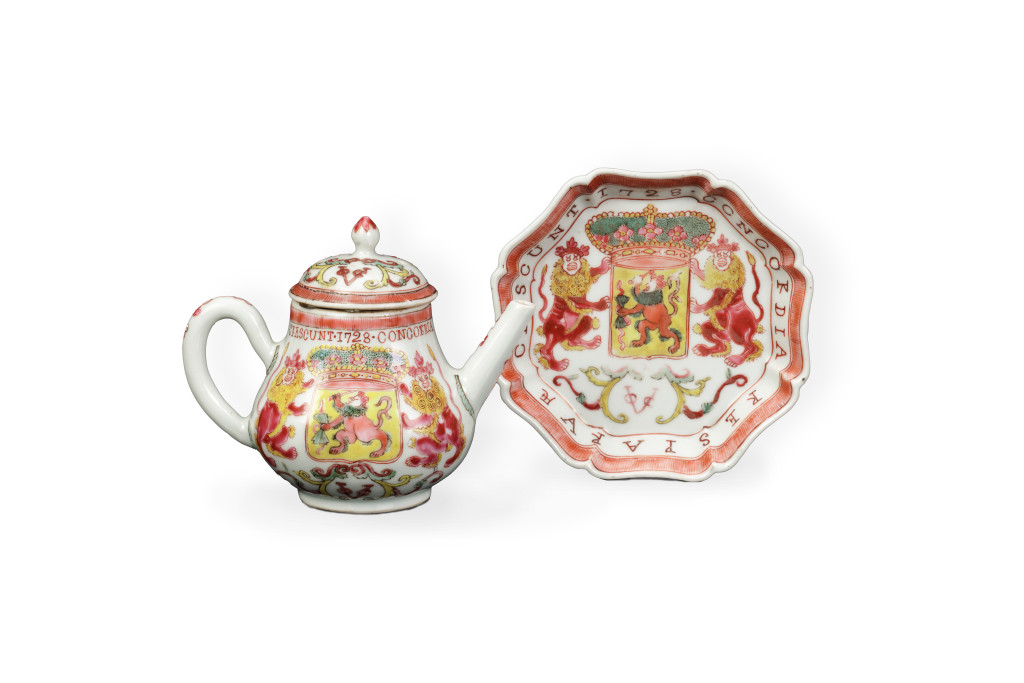
A pink, yellow and green enamelled porcelain VOC teapot and saucer
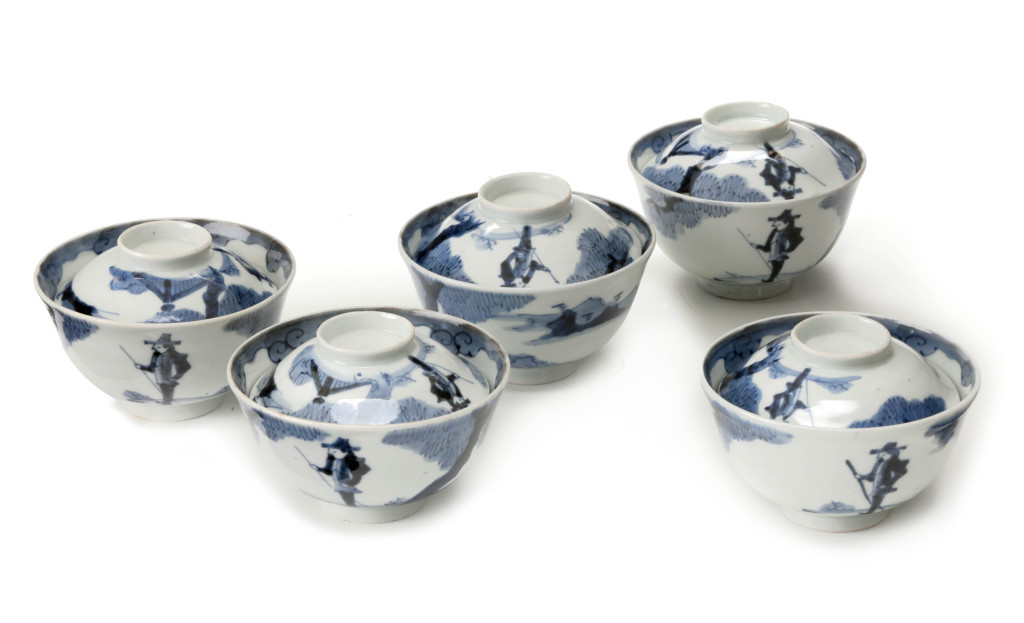
A set of five Arita blue and white porcelain 'Dutchmen' bowls with covers
A SET OF FIVE JAPANESE ARITA BLUE AND WHITE PORCELAIN 'DUTCHMEN' BOWLS WITH COVERS
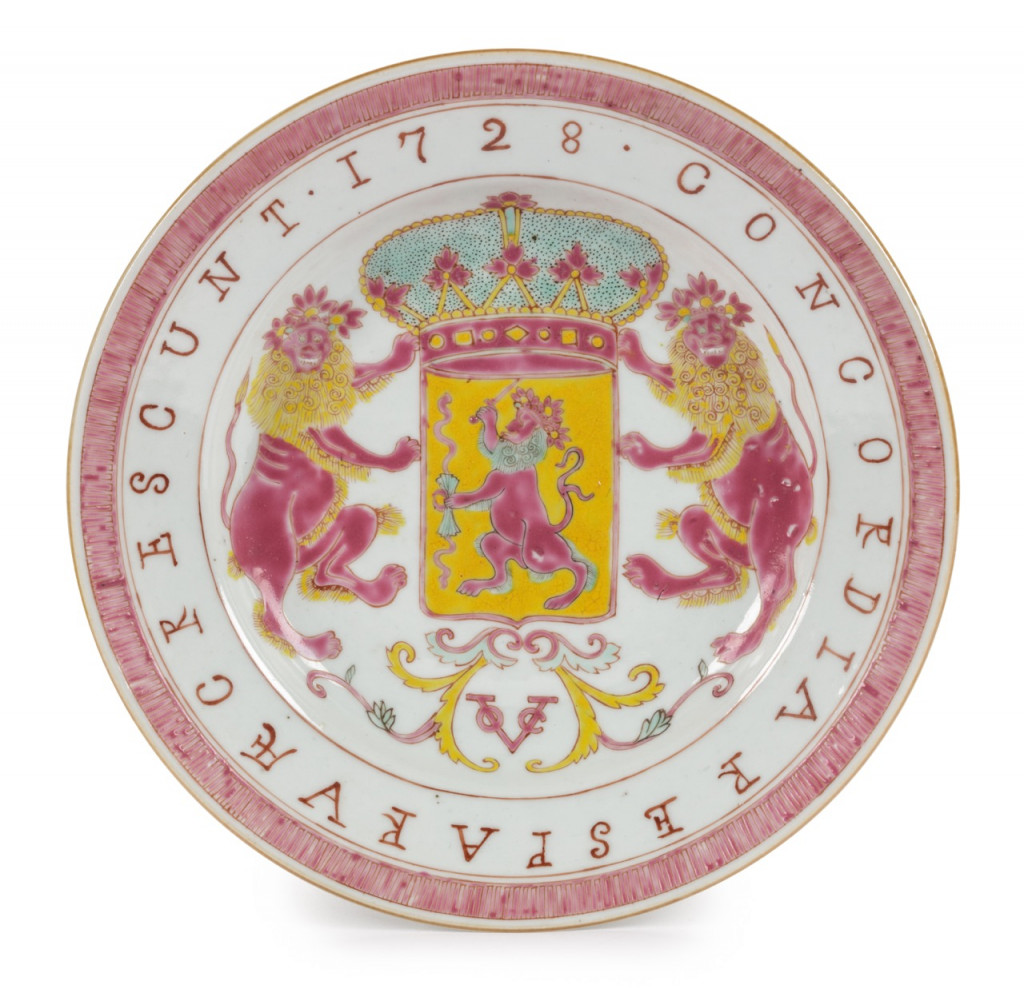
A pink, yellow and green enamelled porcelain VOC plate
Executed in rose-pink, yellow, and soft blue-green enamels, this design follows a silver ducatoon of 1728 in almost every aspect, with even the rim of the plate imitating the ribbed milling of the coin. On a shield is a crowned rampant lion, holding in his left paw a bunch of seven arrows symbolising the seven provinces of the United Netherlands, and in his right paw, a sword is shown supported by two crowned rampant lions. Below the shield is the monogram of the VOC, the Dutch East India Company, above the date 1728, and around it is the heraldic motto of the Dutch Republic CONCORDIA RES PARVAE CRESCUNT (by unity small things grow). The first ducatoon, or zilveren rijder, on which the design of this plate was based, arrived in Canton, China, on the 2nd of August 1729 with the Coxhorn, the first VOC ship to sail straight to Canton and not by way of Batavia. It arrived in Amsterdam in 1730 with the ordered porcelain in this design. This is an early example of the so-called Chine de Commande porcelain. Although the Cantonese artists had a zilveren rijder as an example, they didn’t really understand the design, giving the lions grimacing human faces and cape-like manes. They also didn’t understand the Latin letters, since the R ends truncated, the V is an inverted A, and the E looks more like a Chinese character. The only Chinese porcelain known with this design is a tea set, comprising cup-and-saucers and a theapot. For a cup and saucer, see: Uit Verre Streken, June 2017, no. 49. The Dutch likely took a cup-and-saucer from China to Japan, ordering larger plates like the one present. Until recently, these plates were attributed to Chinese kilns, but they are more likely Japanese. This solves the debate on whether these dishes are modern Chinese forgeries. One has been found in an old Japanese collection and is listed in a catalogue, which makes the latter impossible. The enamel's hues and the porcelain's colour are, indeed, more Japanese than Chinese.