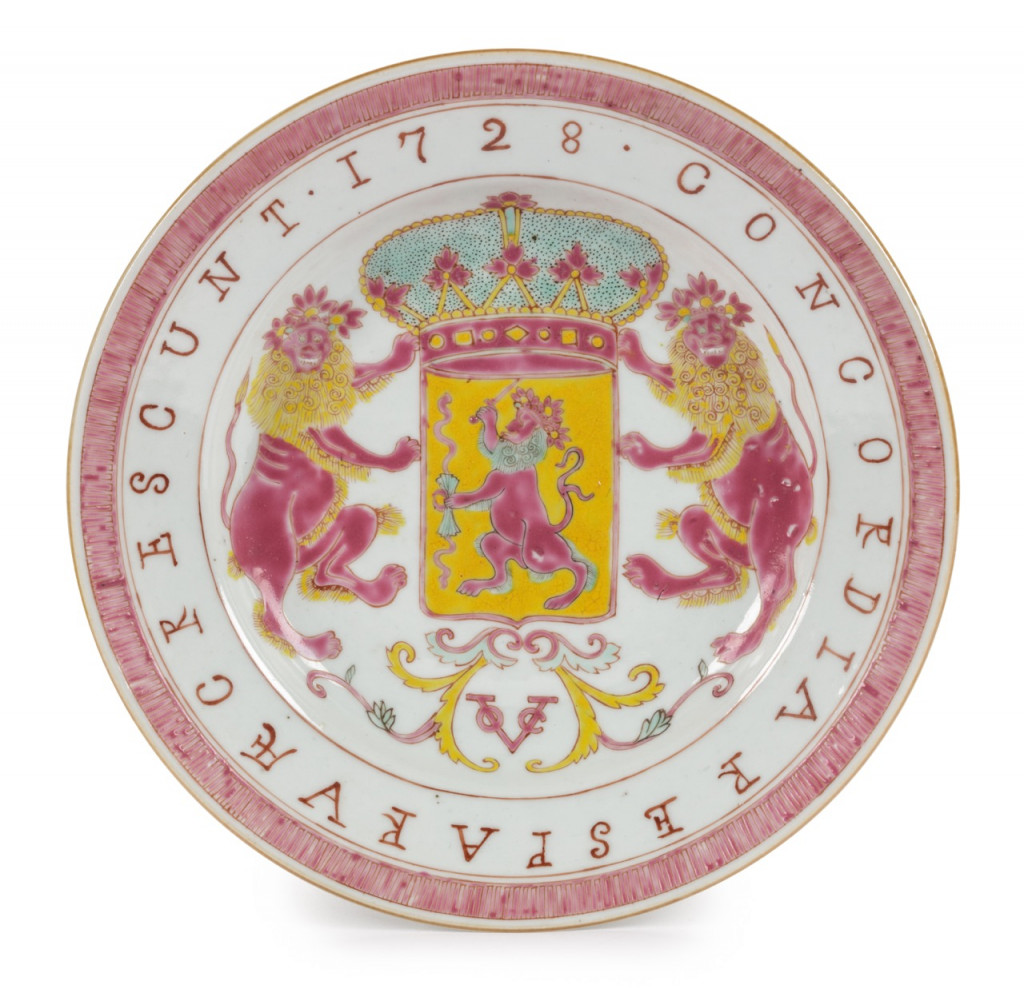
A pink, yellow and green enamelled porcelain VOC plate
Japan or China, circa 1730
Diam. 23 cm
Provenance:
The Dreesmann Collection, the Netherlands
Executed in rose-pink, yellow, and soft blue-green enamels, this design follows a silver ducatoon of 1728 in almost every aspect, with even the rim of the plate imitating the ribbed milling of the coin. On a shield is a crowned rampant lion, holding in his left paw a bunch of seven arrows symbolising the seven provinces of the United Netherlands, and in his right paw, a sword is shown supported by two crowned rampant lions. Below the shield is the monogram of the VOC, the Dutch East India Company, above the date 1728, and around it is the heraldic motto of the Dutch Republic CONCORDIA RES PARVAE CRESCUNT (by unity small things grow).
Other pieces from this service include cups and saucers in the V&A Museum, London (acc.no.645 and a-1907), in the Museum Boymans-van Beuningen, Rotterdam, Netherlands, and in the Metropolitan Museum of Art, New York; a plate in the Mottahedeh collection (Howard and Ayers, 1978, vol.I, pl. 191); a plate, teapot, cup and saucer at the Musees Royaux d’Art et d’Histoire, Brussels, Belgium (Jorg, 1989, no.36); a teapot without lid in
the Rijksmuseum, Amsterdam, Netherlands (Lunsingh Scheurleer, 1974, no.267), and a teapot in the Africana Museum, Johannesburg, South Africa (Woodward, 1974, pl.Al). (Op. Cit. The British Museum, Franks.979).
Until recently, this type of porcelain was attributed to Chinese kilns, but it is more likely Japanese. This could solve the debate on whether these dishes are modern Chinese forgeries. One has been found in the old Japanese Shibata collection and can be found in the , which
makes the latter impossible. After discussing it with many colleagues in the China trade porcelain business, as well
as collectors and curators, this conclusion seems to fit. The enamel’s hues and the porcelain’s colour are, after all, more Japanese than Chinese.
Lastly, this type of porcelain has always been described as rather early chine de commande. However, there wasn’t a lot of trade between the Dutch and China in the 1730s, and the trade in porcelain, lacquer and other goods with Japan was far more lucrative for the VOC.
A near identical dish was in the Ann & Gordon Getty collection, purchased by them in 1985 at Christie’s, London, 12 November 1985, lot 305, and sold again by them at Christie’s in 2023.
Literature:
The Kyushu Ceramic Museum, Commemorative Exhibition of the Shibata Donation, The splendor of Ko-Imari, Japanese exhibition catalogue, Saga, 2002, vol. 8, p. 101, no. 176 (ill.)
Diam. 23 cm
Provenance:
The Dreesmann Collection, the Netherlands
Executed in rose-pink, yellow, and soft blue-green enamels, this design follows a silver ducatoon of 1728 in almost every aspect, with even the rim of the plate imitating the ribbed milling of the coin. On a shield is a crowned rampant lion, holding in his left paw a bunch of seven arrows symbolising the seven provinces of the United Netherlands, and in his right paw, a sword is shown supported by two crowned rampant lions. Below the shield is the monogram of the VOC, the Dutch East India Company, above the date 1728, and around it is the heraldic motto of the Dutch Republic CONCORDIA RES PARVAE CRESCUNT (by unity small things grow).
Other pieces from this service include cups and saucers in the V&A Museum, London (acc.no.645 and a-1907), in the Museum Boymans-van Beuningen, Rotterdam, Netherlands, and in the Metropolitan Museum of Art, New York; a plate in the Mottahedeh collection (Howard and Ayers, 1978, vol.I, pl. 191); a plate, teapot, cup and saucer at the Musees Royaux d’Art et d’Histoire, Brussels, Belgium (Jorg, 1989, no.36); a teapot without lid in
the Rijksmuseum, Amsterdam, Netherlands (Lunsingh Scheurleer, 1974, no.267), and a teapot in the Africana Museum, Johannesburg, South Africa (Woodward, 1974, pl.Al). (Op. Cit. The British Museum, Franks.979).
Until recently, this type of porcelain was attributed to Chinese kilns, but it is more likely Japanese. This could solve the debate on whether these dishes are modern Chinese forgeries. One has been found in the old Japanese Shibata collection and can be found in the , which
makes the latter impossible. After discussing it with many colleagues in the China trade porcelain business, as well
as collectors and curators, this conclusion seems to fit. The enamel’s hues and the porcelain’s colour are, after all, more Japanese than Chinese.
Lastly, this type of porcelain has always been described as rather early chine de commande. However, there wasn’t a lot of trade between the Dutch and China in the 1730s, and the trade in porcelain, lacquer and other goods with Japan was far more lucrative for the VOC.
A near identical dish was in the Ann & Gordon Getty collection, purchased by them in 1985 at Christie’s, London, 12 November 1985, lot 305, and sold again by them at Christie’s in 2023.
Literature:
The Kyushu Ceramic Museum, Commemorative Exhibition of the Shibata Donation, The splendor of Ko-Imari, Japanese exhibition catalogue, Saga, 2002, vol. 8, p. 101, no. 176 (ill.)
Related objects
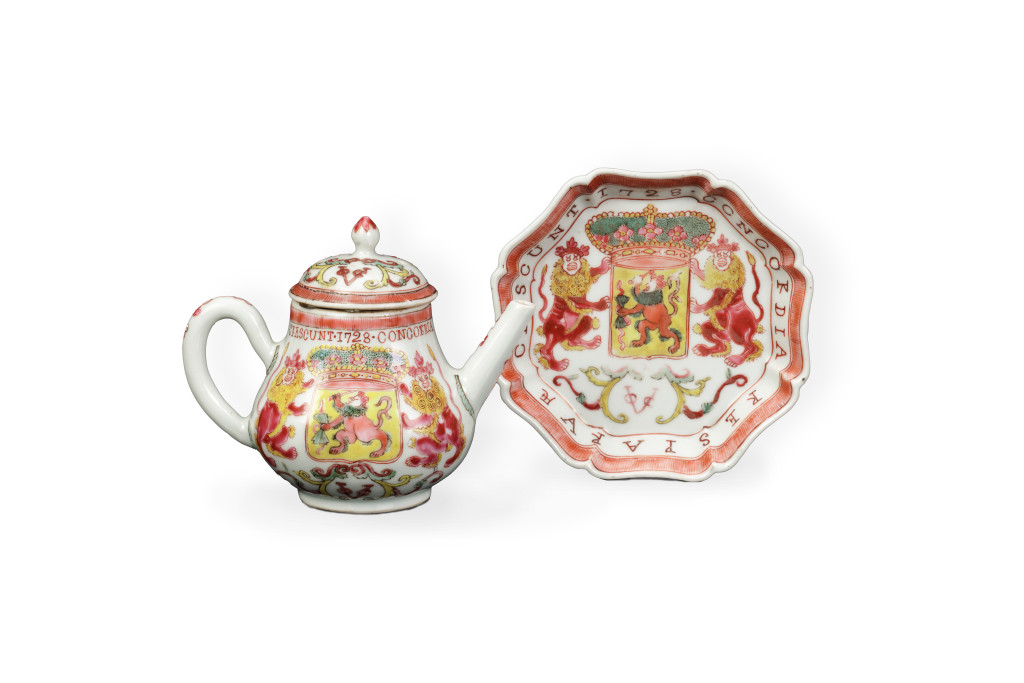
A pink, yellow and green enamelled porcelain VOC teapot and saucer
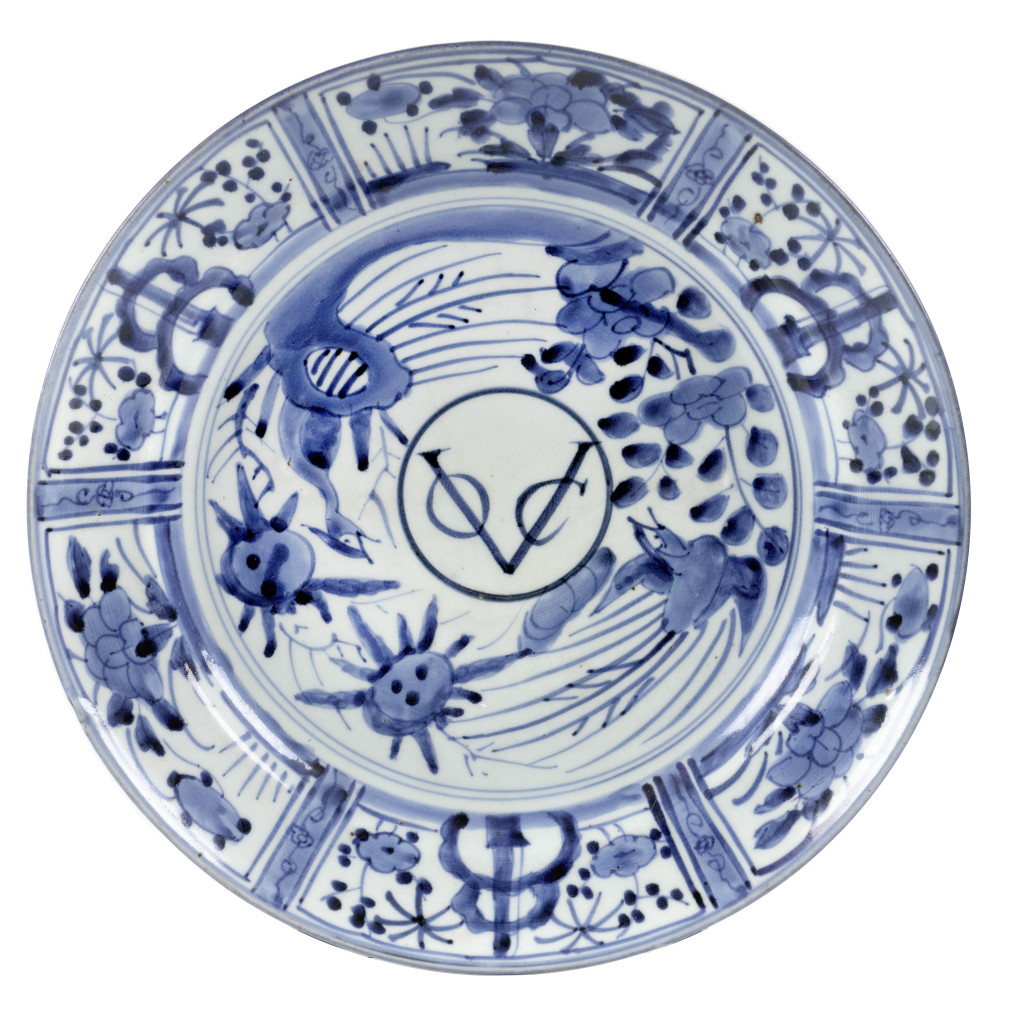
A rare large Japanese Arita blue and white porcelain 'V.O.C' dish
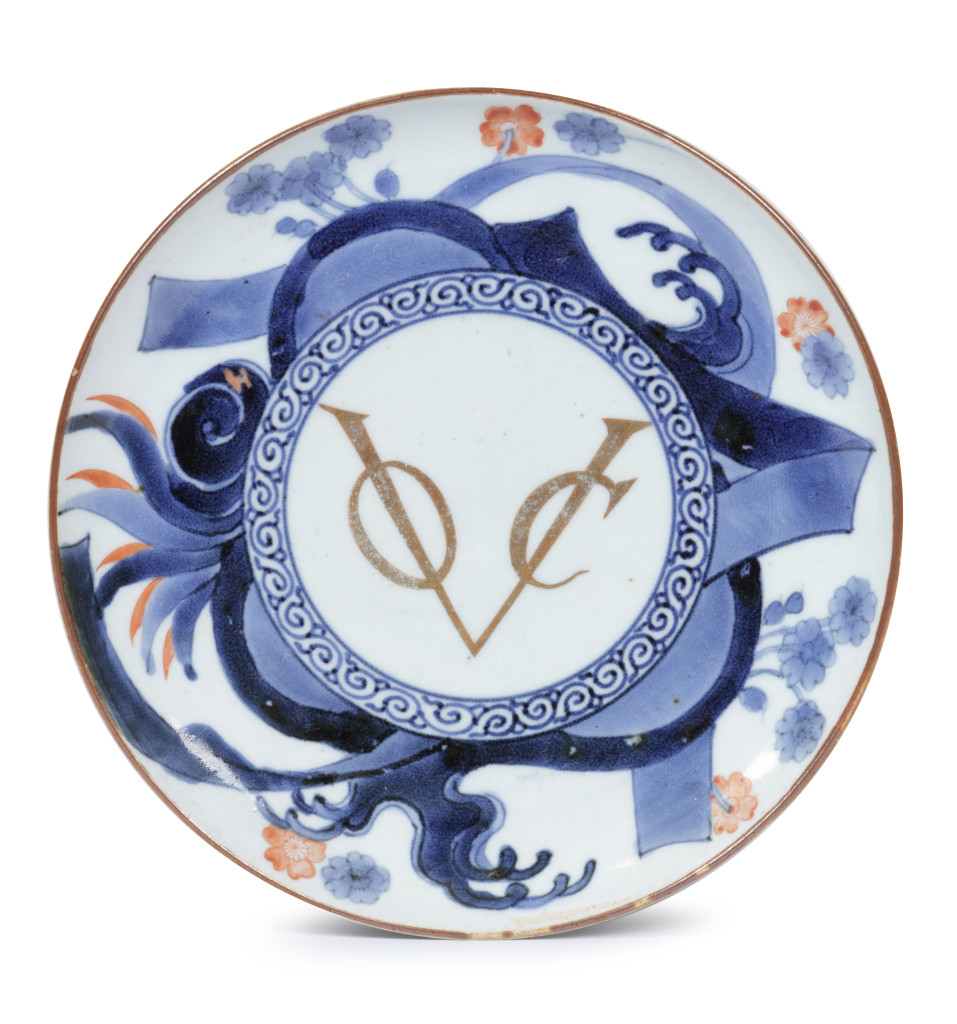
A Japanese Ko-imari porcelain 'VOC' dish
Arita, Edo period, first half 19th century Decorated in blue and iron-red under glaze with in the center the VOC monogram in gold. The bottom with imitation Chinese Ming Dynasty Chenghua marks, 'Great Ming Chenghua period mark'. Diam. 21.2 cm Dishes like the one present were very expensive souvenirs for wealthy Japanese domestic tourists who visited Nagasaki to get a glimpse of the Dutch on Deshima. The design of this particular dish is unknown, and it is possibly unique.