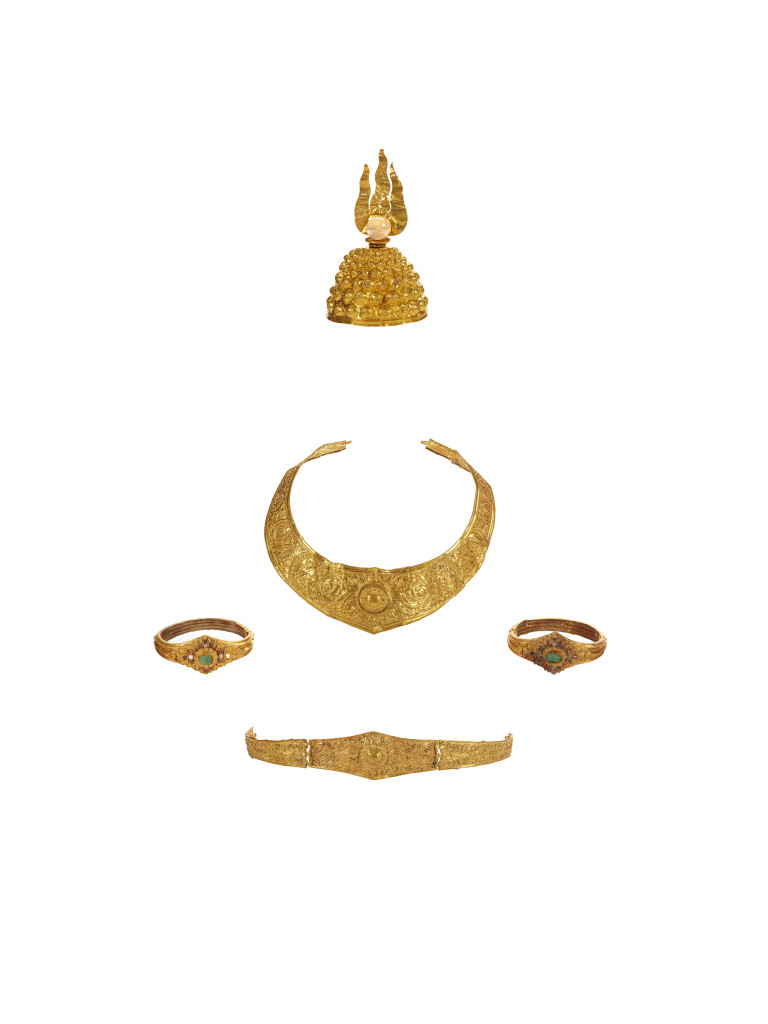
An ancient Javanese royal gold part adornment set for a queen, consisting of a topknot crown with a rock-crystal finial, a breast ornament, a belt, and a pair of gem-set upper-arm bracelets, each in repoussé high-carat gold
Central Javanese period, Kingdom of Mataram, 9th-10th century CE
Provenance:
Collection of a notable from the Hague, who stayed in the former Dutch East Indies around circa 1900; thence by descent
Purchased from the above by a distinguished Dutch collector (name is known to us) between 1970 and 1980
This object is registered at the Documentation Centre for Ancient Indonesian Art in Amsterdam.
We are grateful to the Documentation Centre for Ancient Indonesian Art in Amsterdam and Mr. Jaap Polak for their assistance in determining the specifics and date of this finial above.
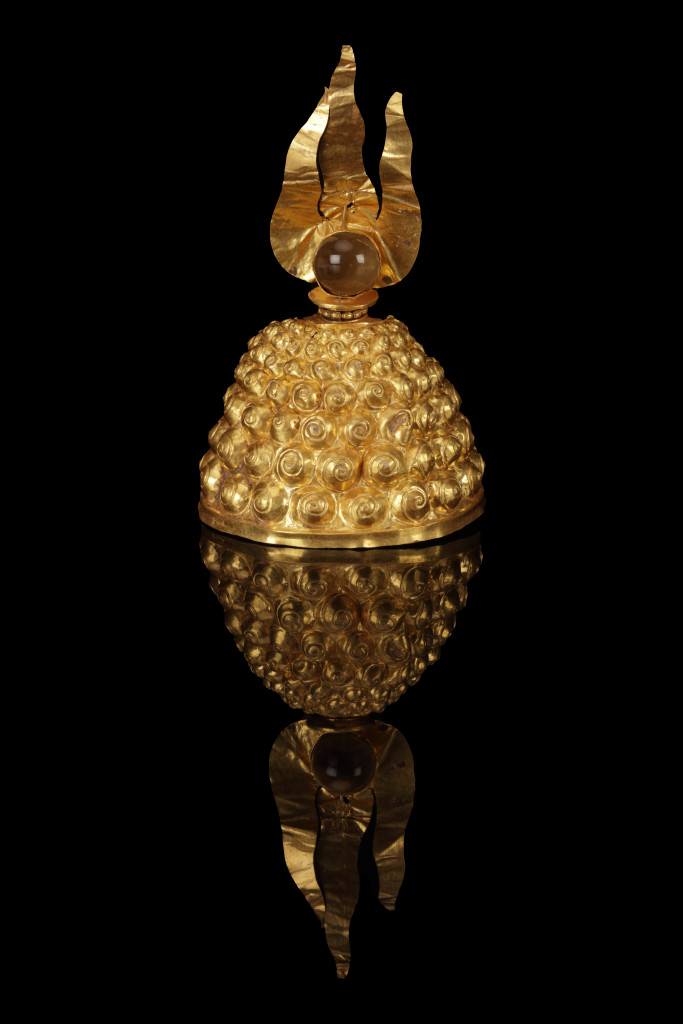
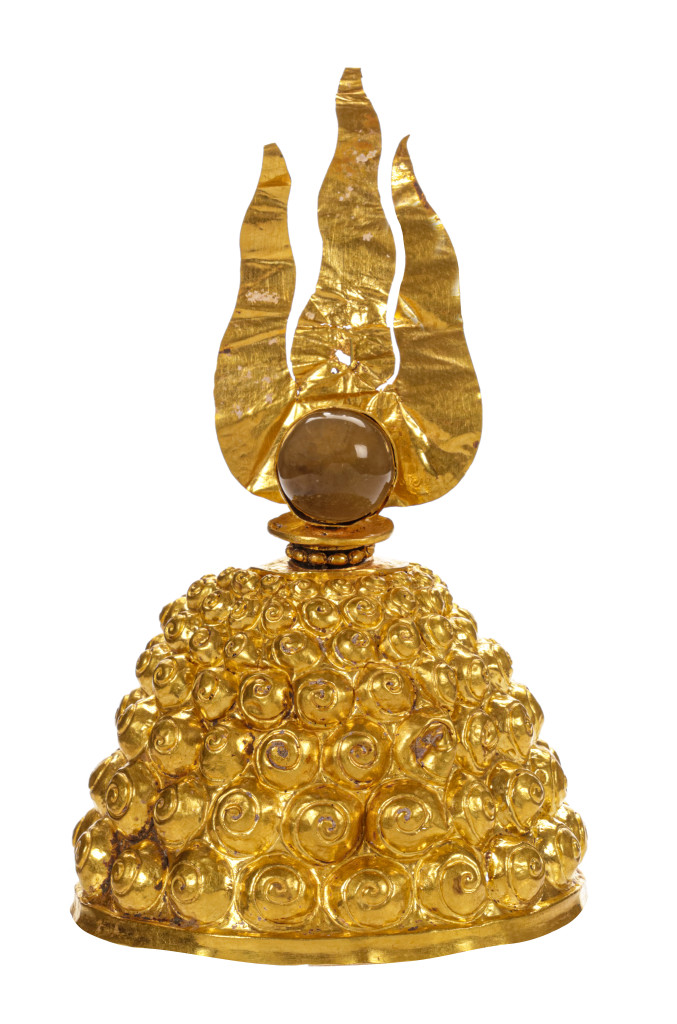
An ancient Javanese royal gold topknot usnisha crown
Made of repoussé gold and adorned with a rock crystal orb finial with a gold flame placed behind it, the crown was used in Buddhist religious ceremonies. This crown, known as an Usnisha cover, was a royal crown from Java, worn by the highest royalty and intended to cover the topknot of a royal figure, or sometimes statues.
H. 14.5 x W. 13.5 cm / Weight: 295 grams
The curls on the crown reference the curls on the head of the Buddha, symbolizing that the king and queen are bodhisattvas - future Buddhas. Bodhisattvas are incarnations of enlightened beings who embody salvation in Buddhism. The small stylised curls symbolise snails, based on the myth of snails climbing onto the Buddha’s head to shield him from the scorching sun during meditation. According to legend, the Buddha was so immersed in his hours-long meditation on a hot day that he forgot the sun’s rays were shining on his bare head. The snails, with their cool and moist bodies, protected and cooled his smooth, exposed scalp. They enabled the Buddha to maintain his meditation for hours, though they themselves dried out from the heat. When the Buddha emerged from his meditation, he discovered 108 snails on his head. He realised that these snails had sacrificed their lives to create a distraction-free environment for his path to enlightenment.
The rock crystal orb atop the crown represents the protrusion on the Buddha’s head, known as the bump of wisdom. The crystal also enables the rulers to radiate light when wearing their crowns. A stylised flame, crafted from gold foil with a gold pin, is positioned behind the crystal sphere, possibly suggesting this light-emitting quality.
Similar crowns, all attributed by scholars to the late 9th and early 10th centuries, were found in central Java. The archaeological unveiling of the so-called Wonoboyo Hoard in 1990 was one of the largest and most significant Javanese gold finds. In 2023, a fire raged at the National Museum in Jakarta, and although in early reports it was said that much of the collection was saved, it slowly became clear that many priceless artefacts were lost. Thus far, it is unknown whether the ancient Javanese gold collection has been saved from fire or theft, but many fear the worst.
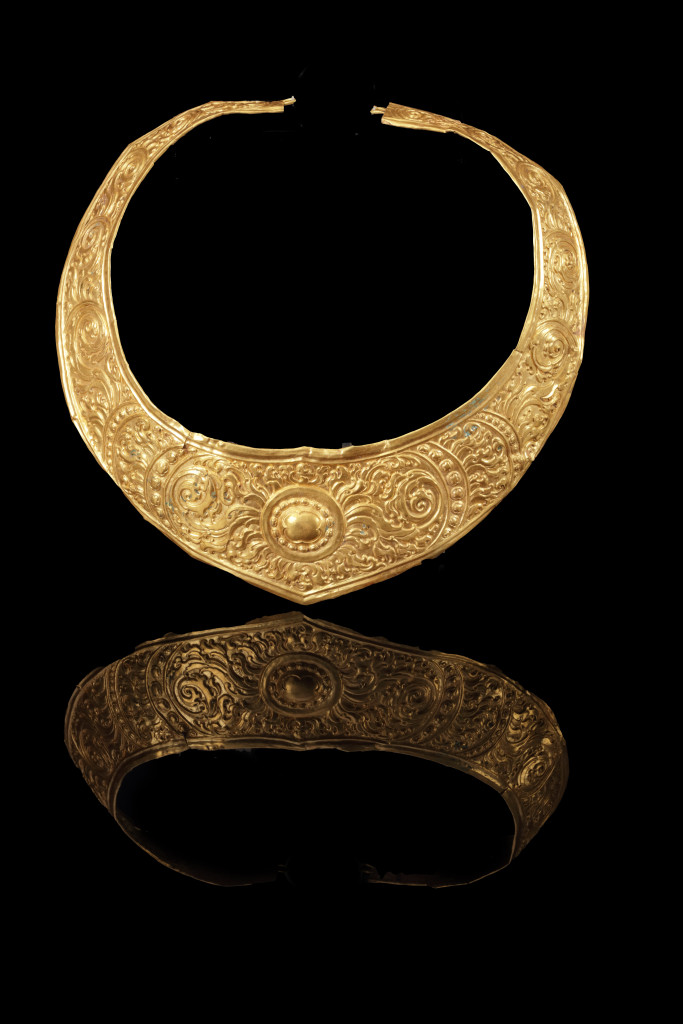
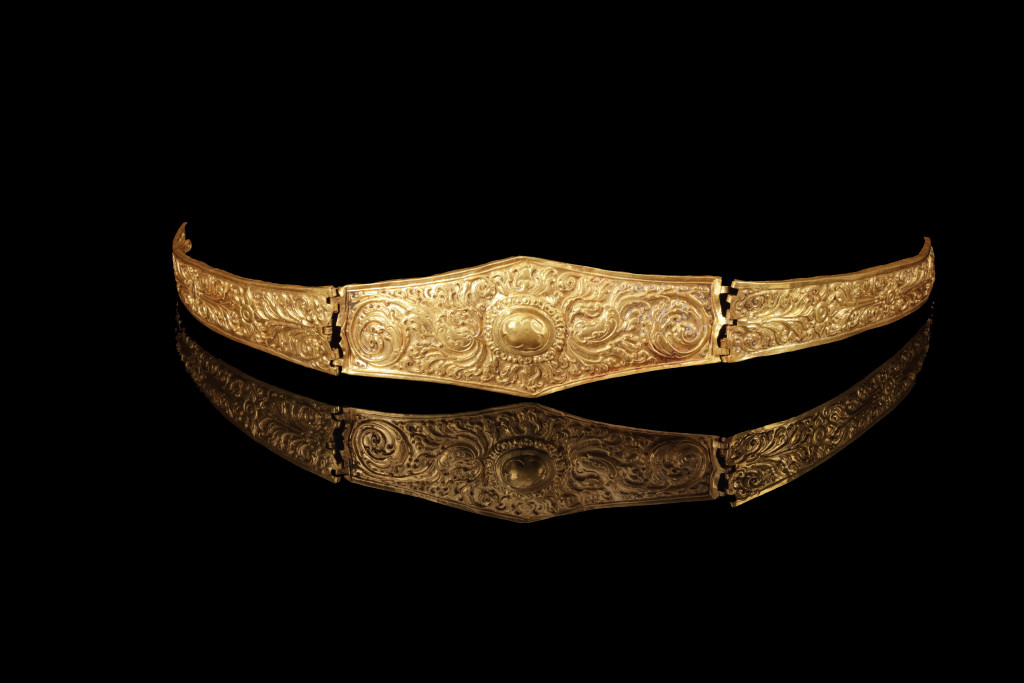
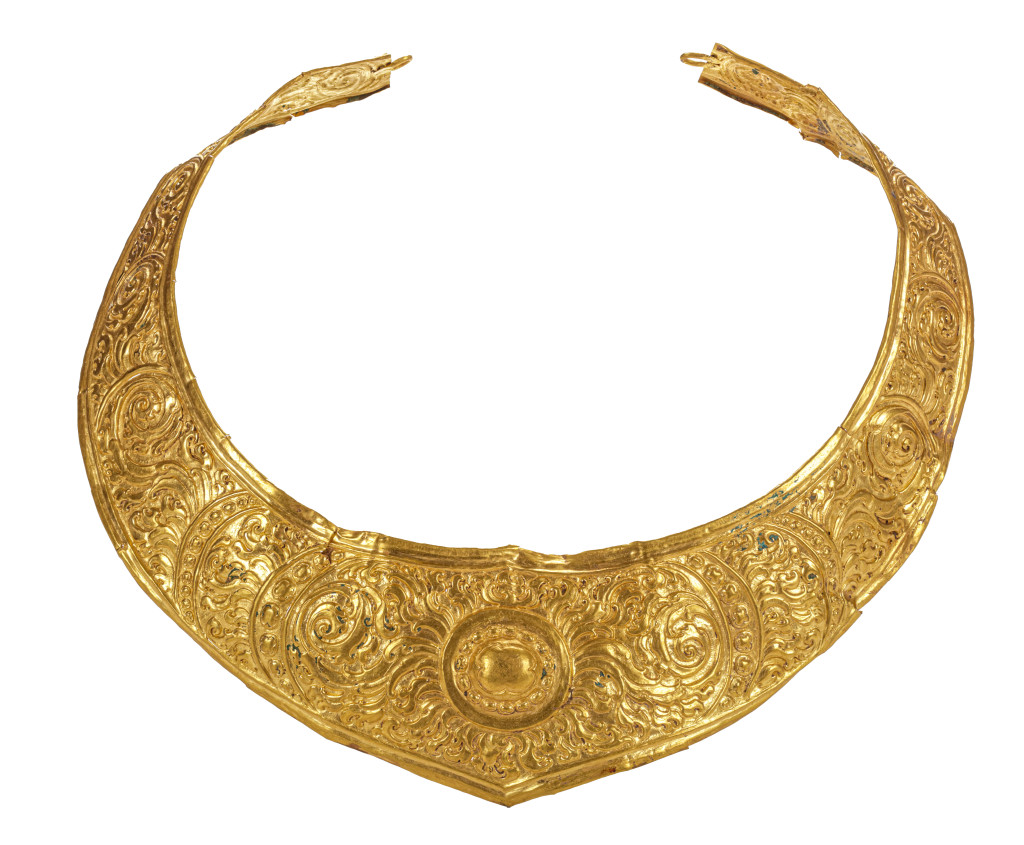
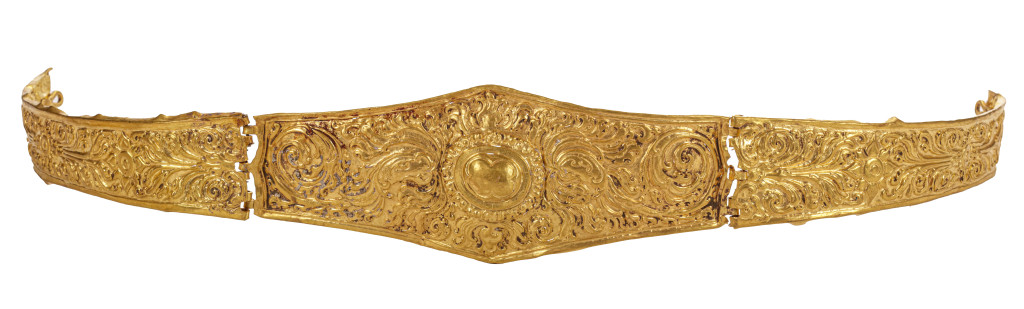
An ancient Javanese royal gold breast ornament and a royal gold belt or waistband
It features elegant scroll motifs and floral decorations and is crafted from one thick sheet of gold, shaped through repoussé, hammering, chasing, and engraving techniques. Gold loops are soldered at both ends of the necklace for fastening around the neck.
The belt, using the same techniques, is crafted from three separate sheets of gold, connected by hinged sections secured with gold pins. Gold loops are soldered at either end for fastening, allowing the belt to be easily worn around the royal waist. Often, one person would wear two, three, or more belts.
Approx. H. 28.5 x W. 28 x D. 8 cm / Weight: 160 grams (breast ornament)
L. 60 x H. max. 7 x D. 1 cm / Weight: 153 grams (waistband)
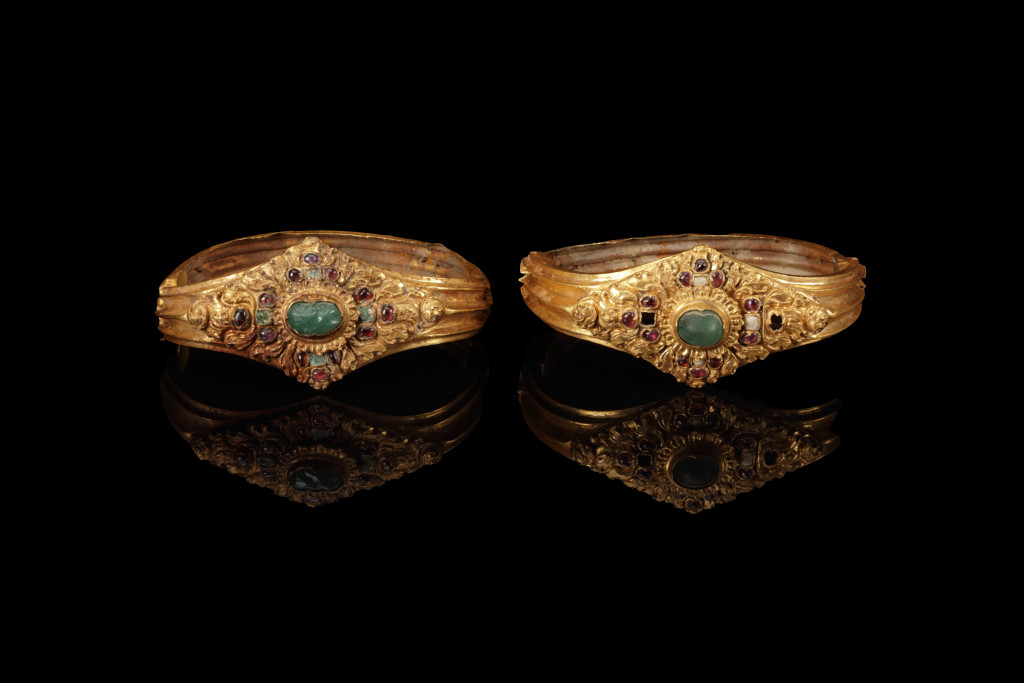
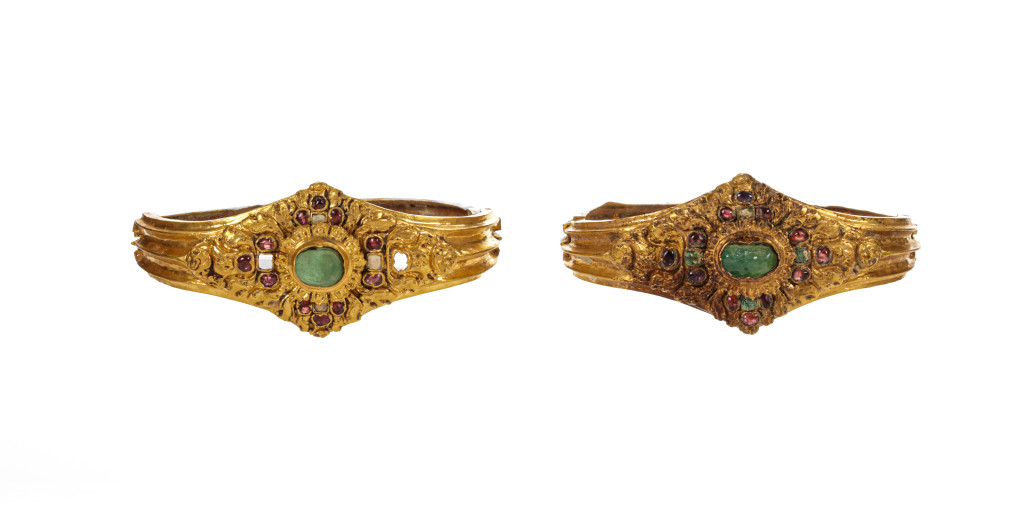
A pair of ancient Javanese royal gem-set gold upper-arm bracelets
These armbands are crafted using the repoussé technique and show elegant scroll motifs and a central floral decoration. A primary green emerald, cut in an oval shape, possibly reused from another culture or period, is set at the centre, surrounded by cabochon-cut rubies, arranged in a repeated floral pattern on four sides. Some stones have eroded, and some are lost, which points to a rather brittle material. Perhaps pearls were used, which would not remain intact after such a long time.
The large-sized bands have a hollow construction and consist of two separate sections connected by a pin (now lost), suggesting that they were intended to be worn on the upper arm rather than the wrist. The distinct scroll motifs, known as ‘rolling ornament’, are seen in Javanese stone-carved temple reliefs and sculptures, including those at Borobudur and temples in Myanmar, Cambodia, and India.
Diam. 11 (each) / Weight: 85 & 89 grams
Royal Gold of Java: Masterpieces of the Mataram Kingdom (8th–12th century)
Royal gold, crafted for the royal court, often with solid parts cast in cire perdue, was adorned with gold plating, gold leaf, finely chased motifs, and repoussé goldwork - a technique in which relief is hammered from the reverse side with precision. These luxurious artefacts originate from Central Java between the 8th and 12th centuries, during the reign of the Mataram Kingdom (Medang), a Hindu-Buddhist kingdom that flourished from the 8th to the 11th century.
This royal goldwork, created using the repoussé technique, was carefully hammered, chased, and inlaid with polished gemstones, including cabochon-cut rubies, emeralds, glass, and black crystal. These gemstones were not merely decorative but were highly valued for their perceived protective qualities against malevolent forces and astrological meaning.
The Repoussé Technique and Javanese Metalwork
Repoussé is a metalworking technique in which relief designs are hammered from the reverse side using various shapes and sizes of steel punches. This method was widely used in Java and other parts of Indonesia, including Bali, Sumatra, and Borneo. The initial form was hammered from the back to create the basic shape, after which the finer details were meticulously chased and refined from the front - a process known as achèvement.
The craftsmen of Java were masters of this technique, achieving an extraordinary level of refinement. The application of repoussé on gold was widespread in ancient Java, particularly in royal jewellery and regalia, showcasing wealth and power and the high level of artistic and metallurgical skill in the region.
Symbolism and Usage in Javanese Society
Gold was a symbol of royalty and a material of divine permanence. Unlike bronze and iron, which rust and corrode, or stone, which erodes over time, gold remains untarnished and unchanging, symbolizing immortality and divine power. The royal courts commissioned elaborate jewellery, regalia, and ceremonial objects, often decorated with floral and mythological motifs symbolising divine authority, protection, and cosmic order. The presence of gold and precious stones in royal ornaments reinforced the sacred status of the ruler, who was often regarded as a divinely appointed leader, a protector of Dharma (cosmic order), and an earthly counterpart of the gods.
Thus, such golden jewellery and royal regalia were not merely accessories but statements of prestige, status, and divine legitimacy. They illustrated the immense wealth of the Javanese elite and reflected the advanced craftsmanship achieved in this early period, highlighting Java’s role as one of the great cultural and artistic centres of the Hindu-Buddhist world.
The Central Javanese Period: A Flourishing Hindu-Buddhist Civilization
The 8th to 12th centuries marked a period of great cultural, artistic, and religious development in Java, particularly under the Mataram Kingdom. Java became a spiritual and artistic hub during this era, heavily influenced by Indian Hindu-Buddhist traditions while developing its own distinct Javanese identity. This period witnessed the construction of some of Southeast Asia's most magnificent religious monuments, including Borobudur—the world’s largest Buddhist temple—and Prambanan, the grand Hindu temple complex dedicated to Shiva. These architectural marvels not only demonstrated the immense wealth and power of the Javanese rulers but also reflected a deep philosophical and religious syncretism that blended Hindu and Buddhist traditions into a uniquely Javanese form of spirituality. Besides architectural achievements, the culture saw a golden age in international trade, writing, science, poetry, music, etc.
As the Mataram Kingdom declined in the 11th century, political power shifted to eastern Java, giving rise to the Majapahit Empire, which would later become one of the greatest maritime empires in Southeast Asia. However, the artistic traditions, goldsmithing techniques, and cultural achievements of the Central Javanese period continued to influence Javanese craftsmanship for centuries, leaving a lasting legacy in Indonesian art and heritage.
Provenance:
Collection of a notable from the Hague, who stayed in the former Dutch East Indies around circa 1900; thence by descent
Purchased from the above by a distinguished Dutch collector (name is known to us) between 1970 and 1980
This object is registered at the Documentation Centre for Ancient Indonesian Art in Amsterdam.
We are grateful to the Documentation Centre for Ancient Indonesian Art in Amsterdam and Mr. Jaap Polak for their assistance in determining the specifics and date of this finial above.
An ancient Javanese royal gold topknot usnisha crown
Made of repoussé gold and adorned with a rock crystal orb finial with a gold flame placed behind it, the crown was used in Buddhist religious ceremonies. This crown, known as an Usnisha cover, was a royal crown from Java, worn by the highest royalty and intended to cover the topknot of a royal figure, or sometimes statues.
H. 14.5 x W. 13.5 cm / Weight: 295 grams
The curls on the crown reference the curls on the head of the Buddha, symbolizing that the king and queen are bodhisattvas - future Buddhas. Bodhisattvas are incarnations of enlightened beings who embody salvation in Buddhism. The small stylised curls symbolise snails, based on the myth of snails climbing onto the Buddha’s head to shield him from the scorching sun during meditation. According to legend, the Buddha was so immersed in his hours-long meditation on a hot day that he forgot the sun’s rays were shining on his bare head. The snails, with their cool and moist bodies, protected and cooled his smooth, exposed scalp. They enabled the Buddha to maintain his meditation for hours, though they themselves dried out from the heat. When the Buddha emerged from his meditation, he discovered 108 snails on his head. He realised that these snails had sacrificed their lives to create a distraction-free environment for his path to enlightenment.
The rock crystal orb atop the crown represents the protrusion on the Buddha’s head, known as the bump of wisdom. The crystal also enables the rulers to radiate light when wearing their crowns. A stylised flame, crafted from gold foil with a gold pin, is positioned behind the crystal sphere, possibly suggesting this light-emitting quality.
Similar crowns, all attributed by scholars to the late 9th and early 10th centuries, were found in central Java. The archaeological unveiling of the so-called Wonoboyo Hoard in 1990 was one of the largest and most significant Javanese gold finds. In 2023, a fire raged at the National Museum in Jakarta, and although in early reports it was said that much of the collection was saved, it slowly became clear that many priceless artefacts were lost. Thus far, it is unknown whether the ancient Javanese gold collection has been saved from fire or theft, but many fear the worst.
An ancient Javanese royal gold breast ornament and a royal gold belt or waistband
It features elegant scroll motifs and floral decorations and is crafted from one thick sheet of gold, shaped through repoussé, hammering, chasing, and engraving techniques. Gold loops are soldered at both ends of the necklace for fastening around the neck.
The belt, using the same techniques, is crafted from three separate sheets of gold, connected by hinged sections secured with gold pins. Gold loops are soldered at either end for fastening, allowing the belt to be easily worn around the royal waist. Often, one person would wear two, three, or more belts.
Approx. H. 28.5 x W. 28 x D. 8 cm / Weight: 160 grams (breast ornament)
L. 60 x H. max. 7 x D. 1 cm / Weight: 153 grams (waistband)
A pair of ancient Javanese royal gem-set gold upper-arm bracelets
These armbands are crafted using the repoussé technique and show elegant scroll motifs and a central floral decoration. A primary green emerald, cut in an oval shape, possibly reused from another culture or period, is set at the centre, surrounded by cabochon-cut rubies, arranged in a repeated floral pattern on four sides. Some stones have eroded, and some are lost, which points to a rather brittle material. Perhaps pearls were used, which would not remain intact after such a long time.
The large-sized bands have a hollow construction and consist of two separate sections connected by a pin (now lost), suggesting that they were intended to be worn on the upper arm rather than the wrist. The distinct scroll motifs, known as ‘rolling ornament’, are seen in Javanese stone-carved temple reliefs and sculptures, including those at Borobudur and temples in Myanmar, Cambodia, and India.
Diam. 11 (each) / Weight: 85 & 89 grams
Royal Gold of Java: Masterpieces of the Mataram Kingdom (8th–12th century)
Royal gold, crafted for the royal court, often with solid parts cast in cire perdue, was adorned with gold plating, gold leaf, finely chased motifs, and repoussé goldwork - a technique in which relief is hammered from the reverse side with precision. These luxurious artefacts originate from Central Java between the 8th and 12th centuries, during the reign of the Mataram Kingdom (Medang), a Hindu-Buddhist kingdom that flourished from the 8th to the 11th century.
This royal goldwork, created using the repoussé technique, was carefully hammered, chased, and inlaid with polished gemstones, including cabochon-cut rubies, emeralds, glass, and black crystal. These gemstones were not merely decorative but were highly valued for their perceived protective qualities against malevolent forces and astrological meaning.
The Repoussé Technique and Javanese Metalwork
Repoussé is a metalworking technique in which relief designs are hammered from the reverse side using various shapes and sizes of steel punches. This method was widely used in Java and other parts of Indonesia, including Bali, Sumatra, and Borneo. The initial form was hammered from the back to create the basic shape, after which the finer details were meticulously chased and refined from the front - a process known as achèvement.
The craftsmen of Java were masters of this technique, achieving an extraordinary level of refinement. The application of repoussé on gold was widespread in ancient Java, particularly in royal jewellery and regalia, showcasing wealth and power and the high level of artistic and metallurgical skill in the region.
Symbolism and Usage in Javanese Society
Gold was a symbol of royalty and a material of divine permanence. Unlike bronze and iron, which rust and corrode, or stone, which erodes over time, gold remains untarnished and unchanging, symbolizing immortality and divine power. The royal courts commissioned elaborate jewellery, regalia, and ceremonial objects, often decorated with floral and mythological motifs symbolising divine authority, protection, and cosmic order. The presence of gold and precious stones in royal ornaments reinforced the sacred status of the ruler, who was often regarded as a divinely appointed leader, a protector of Dharma (cosmic order), and an earthly counterpart of the gods.
Thus, such golden jewellery and royal regalia were not merely accessories but statements of prestige, status, and divine legitimacy. They illustrated the immense wealth of the Javanese elite and reflected the advanced craftsmanship achieved in this early period, highlighting Java’s role as one of the great cultural and artistic centres of the Hindu-Buddhist world.
The Central Javanese Period: A Flourishing Hindu-Buddhist Civilization
The 8th to 12th centuries marked a period of great cultural, artistic, and religious development in Java, particularly under the Mataram Kingdom. Java became a spiritual and artistic hub during this era, heavily influenced by Indian Hindu-Buddhist traditions while developing its own distinct Javanese identity. This period witnessed the construction of some of Southeast Asia's most magnificent religious monuments, including Borobudur—the world’s largest Buddhist temple—and Prambanan, the grand Hindu temple complex dedicated to Shiva. These architectural marvels not only demonstrated the immense wealth and power of the Javanese rulers but also reflected a deep philosophical and religious syncretism that blended Hindu and Buddhist traditions into a uniquely Javanese form of spirituality. Besides architectural achievements, the culture saw a golden age in international trade, writing, science, poetry, music, etc.
As the Mataram Kingdom declined in the 11th century, political power shifted to eastern Java, giving rise to the Majapahit Empire, which would later become one of the greatest maritime empires in Southeast Asia. However, the artistic traditions, goldsmithing techniques, and cultural achievements of the Central Javanese period continued to influence Javanese craftsmanship for centuries, leaving a lasting legacy in Indonesian art and heritage.
Part of the Indonesian Archipelago collection.
Related objects
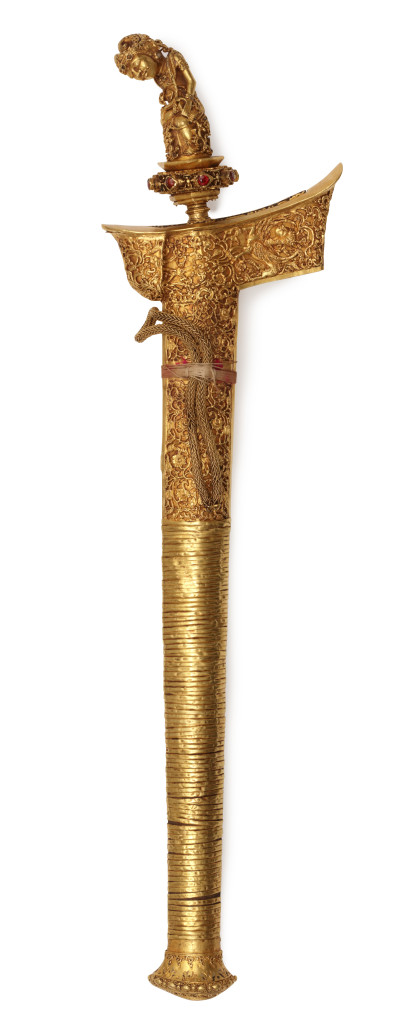
An exceptionally fine and rare Indonesian gold Royal keris probably owned by King Arung Palakka (1634 or 1635-1696) of Bone
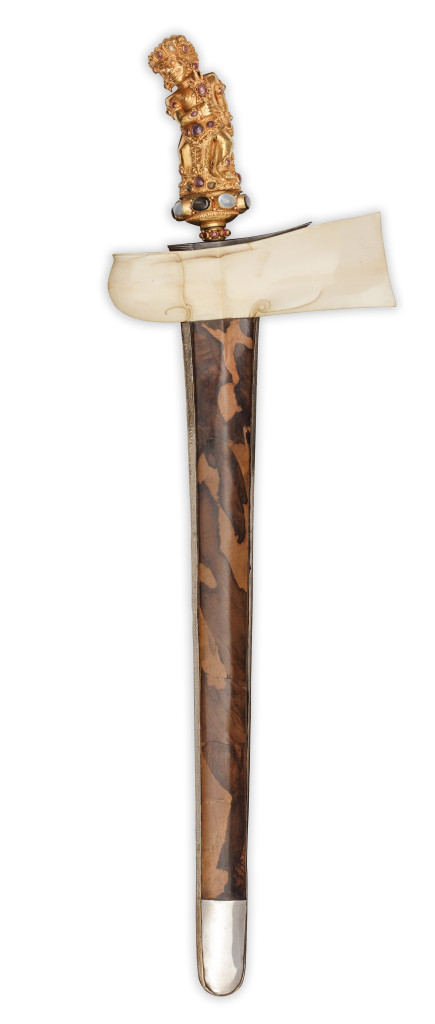
A Balinese gem-set kayu pelet and gold keris
With a dapur sempana beber, the pamor wahyu tumurun and an ivory wrangka of kekandikan form. The gandar is in penjeyer with kayu pelet holy wood with nyamel forms in the grain. The pendok in sili asih with a Bonaspati mask and floral motif, also known as lung worawari or hibiscus. The hilt in the form of Bayu in 22 carat gold, encrusted with gems, with in its arms an amrita vase for good luck.