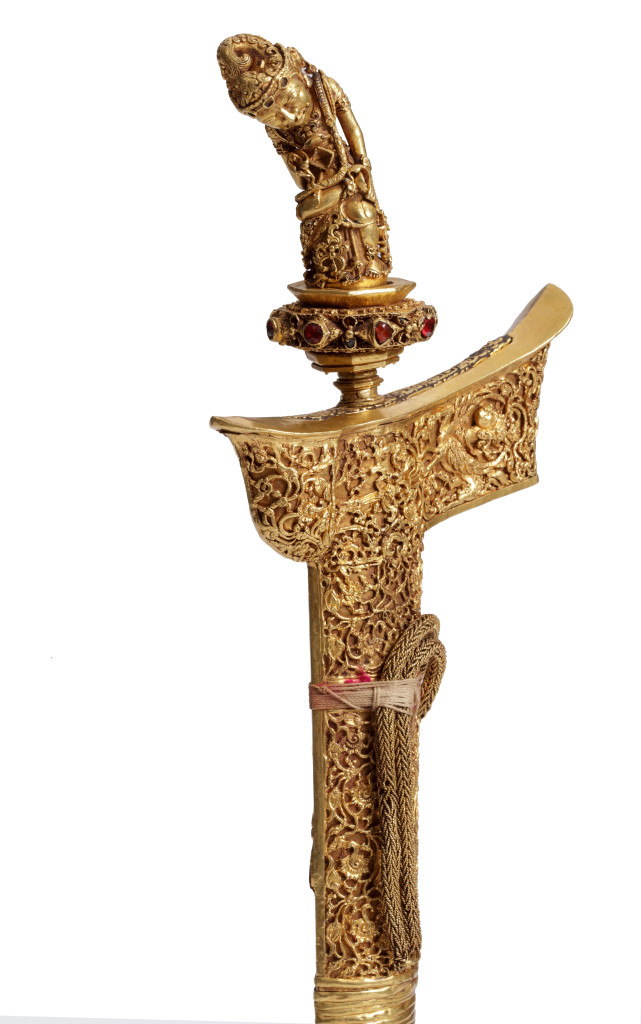
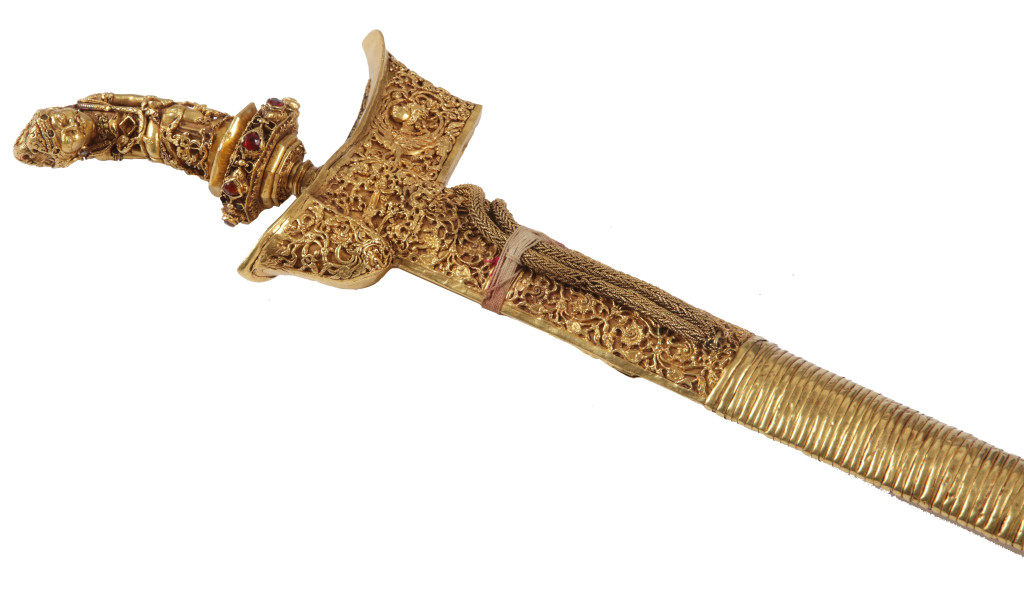
An exceptionally fine and rare Indonesian gold Royal keris probably owned by King Arung Palakka (1634 or 1635-1696) of Bone
South Sulawesi, Buginese, Kingdom of Bone, 16th to early 17th century
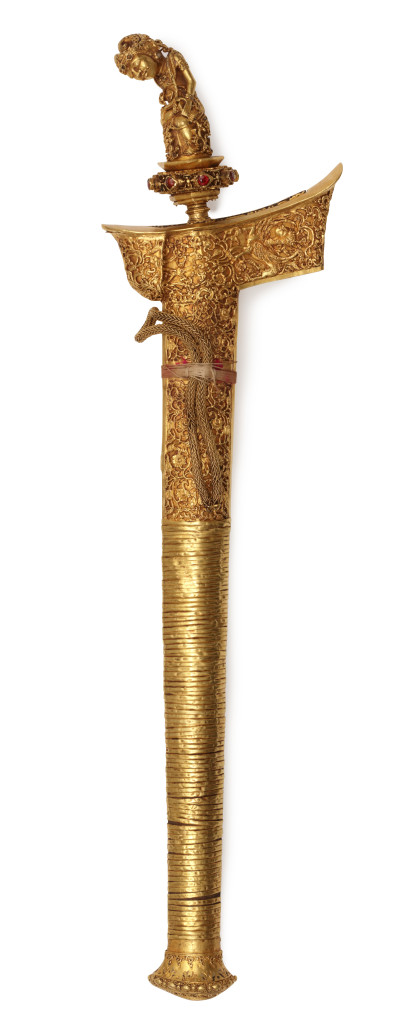
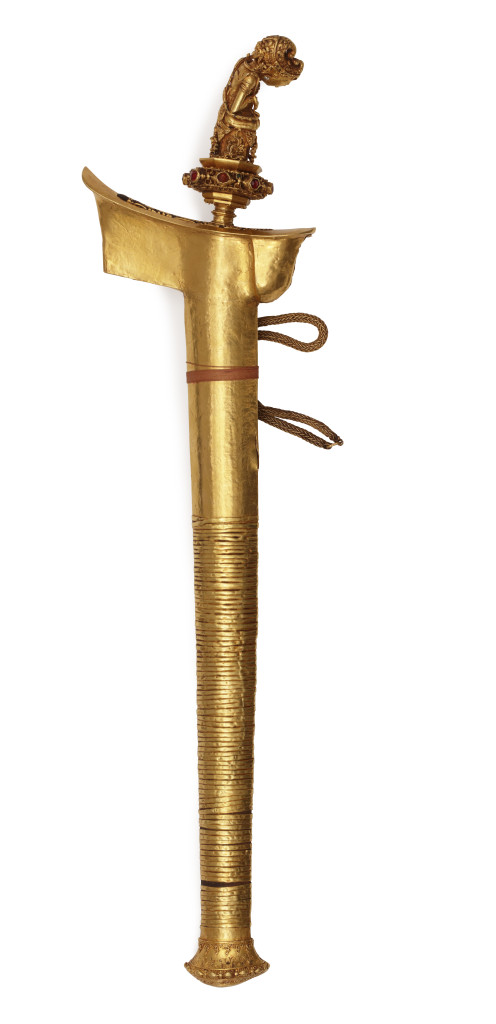
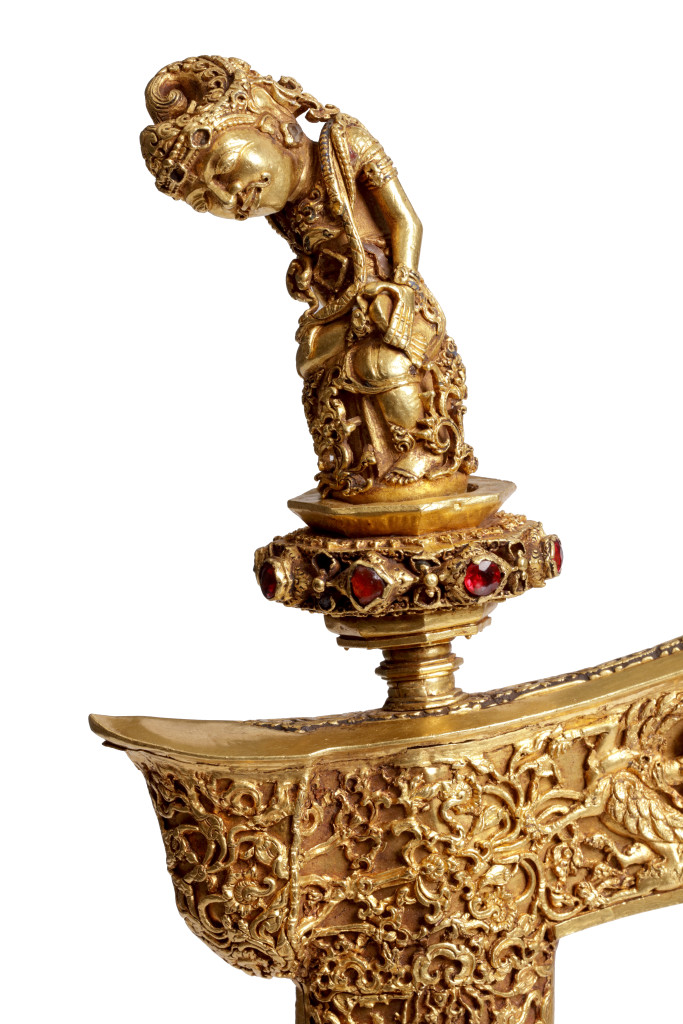
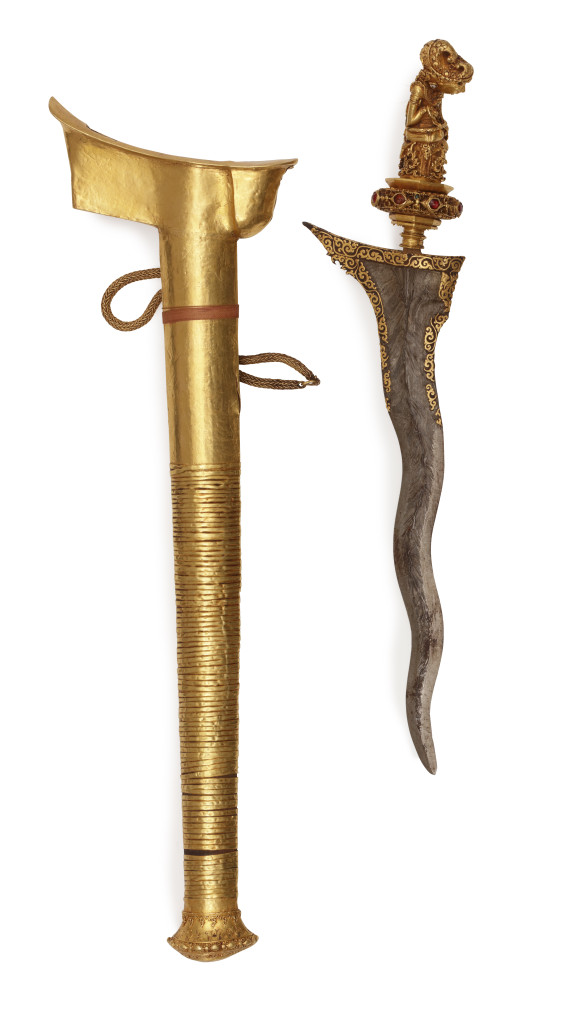
The blade with five luk (curves), with gold decoration at the top. The hilt in the form of a gold figure of Arjuna, the prince of the Pandawa family, inlaid with gemstones. The mendak (decoration below the hilt) is further set with high-grade rubies, and the sheath is intricately decorated with deeply chiselled scrolls and winged lions (Singha). The lower part of the scabbard is in the form of plain wickerwork or rattan, showing the great skill of the craftsman in all simplicity. With a central plaque inscribed DATOE VAN LOEWE.
L. approx. 34 cm
Provenance:
- The Kings of Bone, South-Sulawesi, probably made for La Tenrirawe Bongkange, Matinroe Ri Gucinna (reigned 1560-1564); La Inca, Matinroe Ri Addenenna (reigned 1564-1565); or La Pattawe, Matinroe Ri Bettung (reigned 1565-1602)
- By loot to the Kingdom of Luwu around 1905-06
- Gifted by the Datu of Luwu to Governor-General Jonkheer Mr. A.C.D. de Graeff (1872-1957); thence by descent
- Sale, Glerum Auctioneers, Amsterdam, around 2000 (sold for 50.000+ guilders, a record price at the time)
- Collection Robert Hales, London
- Private collection, United Kingdom
Literature:
Robert Hales, Islamic and Oriental Arms and Armour: A Lifetime’s Passion, 2013, p. 119, no. 286 (ill.)
Compare:
A keris in the Dutch Royal Collections (object no. [MU-13447](https://www.koninklijkeverzamelingen.nl/mediabank/detail/22ab88ce-c47a-5c96-86ad-6c78cb7f7f2f/media/bac36e06-2b17-d930-fa05-8a9a8e033407?mode=detail&view=gallery&rows=1&page=92&sort=random%7B1717243506069%7D%20asc))
Looted regalia
In 1611, during the reign of the tenth ruler of Bone Queen We Tenrituppu Matinroe ri Sidenreng, Bone was invaded by the Sultanate of Gowa and pressured to convert to Islam. It is possible to date this keris to the 16th century (to be safe) and between the early 17th century. The Hinduist motifs would not be used, especially after conversion to Islam. However, apparently, it was important enough to be kept as regalia, even by the Muslim kings.
With the capture or exile of the entire Gowan royal family, the Dutch seized the famous regalia, including the sword named Sundanga and the chain named Tanisamang, and probably the present keris. The banner of the Bate Salapanga council was likewise confiscated. Much of the war booty was donated to the Bataviaasch Genootschap, now the Museum Nasional Indonesia. However, plenty of weaponry and jewellery found their way to the Netherlands to be deposited in the Museum voor Volkenkunde. By a decree of the governor of 17 July 1906, all war booty was the property of the Bataviaasch Genootschap. Some of the booty taken in the campaigns of 1905 was eventually returned to Bone and Gowa, where the royal houses maintain it to this day.
Annexation of Bone and Luwu
The South Sulawesi expeditions of 1905, which included the Third Bone War and the Gowa War, were undertaken by the Royal Netherlands East Indies Army to compel the states of South Sulawesi to sign the Korte Verklaring, a declaration accepting Dutch sovereignty. Dutch historians describe the expeditions as an obligation to maintain law and order, while an Indonesian historian suggests a strategic motive: controlling the Great East. Economic reasons were also at play, particularly the extension of tax-collecting powers. The expeditions, endorsed by Governor Alexander Kroesen, targeted Bone, Luwu, and Wajo kingdoms. Failed negotiations led to Governor- General J.B. van Heutsz's plan to occupy South Sulawesi and force the Short Declaration on the local rulers as part of the "Peace Policy."
The campaign against Bone commenced on 18 July 1905 with Dutch warships off Bajoe. They presented their demands to La Pawawoi Karaeng Segeri, king of Bone. The Dutch requested control over policing duties and taxation rights in Bajoe and Pallima. The king, after refusing the demands and preparing defences, faced Dutch landing forces on 20 July. The Dutch conquered Bajoe by the end of July, and after his son died in battle, La Pawawoi was exiled to Bandung, where he died in 1911, earning the title Matinroe ri Bandung (he who died in Bandung).
The campaign against Gowa began with a letter from the Sulawesi governor to the Sultan of Gowa, I Makkulau Karaeng Lembangaparang, inviting negotiations. Ignoring the ultimatum, the Sultan retreated into the mountains, but Dutch forces engaged in fierce battles, resulting in the royal family's flight. Despite attempts to negotiate, I Makkulau died escaping, and the Dutch buried his remains. His son continued resistance for fifteen months before seeking peace and, after being captured, was exiled to Selayang Island.
Gowa and Bone were annexed to the Government of Sulawesi and Subordinate Areas, in Dutch the Gouvernement Celebes en Onderhoorigheden. In 1911 this was divided into seven sections or afdelingen: Makassar, Bantaeng, Bone, Pare-Pare, Luwu, Mandar and Buton. The east Sulawesi coast was a separate area. Each section was governed through an assistant resident or assistent-resident.
Kingdom of Bone
Bone was an adat-based Bugis kingdom whose origins can be traced back to the early 15th century. Its chronicle (as yet unpublished) provides detailed information on its rulers, starting from La Umasa, who ruled in the early 15th century, through to La Tenrtatta, who died in 1699. Under La Umasa and his nephew La Saliu (Kerrépelua), who succeeded him, Bone expanded from a handful of settlements around the modern capital Watampone to a tiny kingdom roughly one-third the size of Kabupaten Bone. The state later enjoyed a period of prosperity in the middle of the 17th century.
Bone became the most powerful state of South Sulawesi under Arung (ruler of) Palakka, La Tenritatta (1634 or 1635 – 1696), who sided with the Dutch admiral Cornelis Speelman against the Makasar kingdom of Goa-Tallo, which led to the defeat and capture of Makassar in 1669. From this year until 1814, when the British temporarily gained power in the region, Bone was by treaty and in practice the overlord of South Sulawesi, except Dutch-controlled areas on the west and south coast, including the important port city of Makassar. When the Dutch returned to Makassar in 1816, they attempted to reduce Bone's status from equal to vassal, a move strongly resisted by Bone's rulers.
Following the military defeat during the South Sulawesi expeditions of 1905, the Bone State lost its independence to the Dutch. South Sulawesi came under Dutch control, and the Datu of Luwu became its regents as the Bone Kings kept resisting Dutch control.
The blade with five luk (curves), with gold decoration at the top. The hilt in the form of a gold figure of Arjuna, the prince of the Pandawa family, inlaid with gemstones. The mendak (decoration below the hilt) is further set with high-grade rubies, and the sheath is intricately decorated with deeply chiselled scrolls and winged lions (Singha). The lower part of the scabbard is in the form of plain wickerwork or rattan, showing the great skill of the craftsman in all simplicity. With a central plaque inscribed DATOE VAN LOEWE.
L. approx. 34 cm
Provenance:
- The Kings of Bone, South-Sulawesi, probably made for La Tenrirawe Bongkange, Matinroe Ri Gucinna (reigned 1560-1564); La Inca, Matinroe Ri Addenenna (reigned 1564-1565); or La Pattawe, Matinroe Ri Bettung (reigned 1565-1602)
- By loot to the Kingdom of Luwu around 1905-06
- Gifted by the Datu of Luwu to Governor-General Jonkheer Mr. A.C.D. de Graeff (1872-1957); thence by descent
- Sale, Glerum Auctioneers, Amsterdam, around 2000 (sold for 50.000+ guilders, a record price at the time)
- Collection Robert Hales, London
- Private collection, United Kingdom
Literature:
Robert Hales, Islamic and Oriental Arms and Armour: A Lifetime’s Passion, 2013, p. 119, no. 286 (ill.)
Compare:
A keris in the Dutch Royal Collections (object no. [MU-13447](https://www.koninklijkeverzamelingen.nl/mediabank/detail/22ab88ce-c47a-5c96-86ad-6c78cb7f7f2f/media/bac36e06-2b17-d930-fa05-8a9a8e033407?mode=detail&view=gallery&rows=1&page=92&sort=random%7B1717243506069%7D%20asc))
Looted regalia
In 1611, during the reign of the tenth ruler of Bone Queen We Tenrituppu Matinroe ri Sidenreng, Bone was invaded by the Sultanate of Gowa and pressured to convert to Islam. It is possible to date this keris to the 16th century (to be safe) and between the early 17th century. The Hinduist motifs would not be used, especially after conversion to Islam. However, apparently, it was important enough to be kept as regalia, even by the Muslim kings.
With the capture or exile of the entire Gowan royal family, the Dutch seized the famous regalia, including the sword named Sundanga and the chain named Tanisamang, and probably the present keris. The banner of the Bate Salapanga council was likewise confiscated. Much of the war booty was donated to the Bataviaasch Genootschap, now the Museum Nasional Indonesia. However, plenty of weaponry and jewellery found their way to the Netherlands to be deposited in the Museum voor Volkenkunde. By a decree of the governor of 17 July 1906, all war booty was the property of the Bataviaasch Genootschap. Some of the booty taken in the campaigns of 1905 was eventually returned to Bone and Gowa, where the royal houses maintain it to this day.
Annexation of Bone and Luwu
The South Sulawesi expeditions of 1905, which included the Third Bone War and the Gowa War, were undertaken by the Royal Netherlands East Indies Army to compel the states of South Sulawesi to sign the Korte Verklaring, a declaration accepting Dutch sovereignty. Dutch historians describe the expeditions as an obligation to maintain law and order, while an Indonesian historian suggests a strategic motive: controlling the Great East. Economic reasons were also at play, particularly the extension of tax-collecting powers. The expeditions, endorsed by Governor Alexander Kroesen, targeted Bone, Luwu, and Wajo kingdoms. Failed negotiations led to Governor- General J.B. van Heutsz's plan to occupy South Sulawesi and force the Short Declaration on the local rulers as part of the "Peace Policy."
The campaign against Bone commenced on 18 July 1905 with Dutch warships off Bajoe. They presented their demands to La Pawawoi Karaeng Segeri, king of Bone. The Dutch requested control over policing duties and taxation rights in Bajoe and Pallima. The king, after refusing the demands and preparing defences, faced Dutch landing forces on 20 July. The Dutch conquered Bajoe by the end of July, and after his son died in battle, La Pawawoi was exiled to Bandung, where he died in 1911, earning the title Matinroe ri Bandung (he who died in Bandung).
The campaign against Gowa began with a letter from the Sulawesi governor to the Sultan of Gowa, I Makkulau Karaeng Lembangaparang, inviting negotiations. Ignoring the ultimatum, the Sultan retreated into the mountains, but Dutch forces engaged in fierce battles, resulting in the royal family's flight. Despite attempts to negotiate, I Makkulau died escaping, and the Dutch buried his remains. His son continued resistance for fifteen months before seeking peace and, after being captured, was exiled to Selayang Island.
Gowa and Bone were annexed to the Government of Sulawesi and Subordinate Areas, in Dutch the Gouvernement Celebes en Onderhoorigheden. In 1911 this was divided into seven sections or afdelingen: Makassar, Bantaeng, Bone, Pare-Pare, Luwu, Mandar and Buton. The east Sulawesi coast was a separate area. Each section was governed through an assistant resident or assistent-resident.
Kingdom of Bone
Bone was an adat-based Bugis kingdom whose origins can be traced back to the early 15th century. Its chronicle (as yet unpublished) provides detailed information on its rulers, starting from La Umasa, who ruled in the early 15th century, through to La Tenrtatta, who died in 1699. Under La Umasa and his nephew La Saliu (Kerrépelua), who succeeded him, Bone expanded from a handful of settlements around the modern capital Watampone to a tiny kingdom roughly one-third the size of Kabupaten Bone. The state later enjoyed a period of prosperity in the middle of the 17th century.
Bone became the most powerful state of South Sulawesi under Arung (ruler of) Palakka, La Tenritatta (1634 or 1635 – 1696), who sided with the Dutch admiral Cornelis Speelman against the Makasar kingdom of Goa-Tallo, which led to the defeat and capture of Makassar in 1669. From this year until 1814, when the British temporarily gained power in the region, Bone was by treaty and in practice the overlord of South Sulawesi, except Dutch-controlled areas on the west and south coast, including the important port city of Makassar. When the Dutch returned to Makassar in 1816, they attempted to reduce Bone's status from equal to vassal, a move strongly resisted by Bone's rulers.
Following the military defeat during the South Sulawesi expeditions of 1905, the Bone State lost its independence to the Dutch. South Sulawesi came under Dutch control, and the Datu of Luwu became its regents as the Bone Kings kept resisting Dutch control.
Related objects
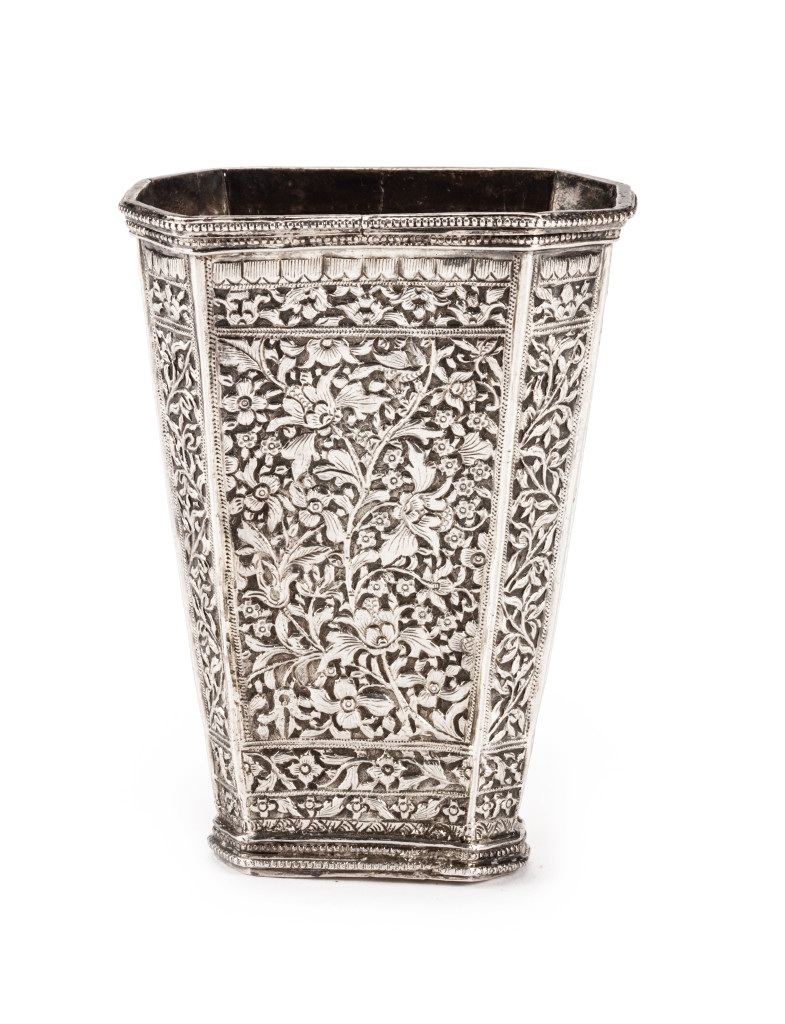
A Fine Sumatran silvere Betel leaf holder
West-Sumatra, Padang, early 19th century, silver unmarked
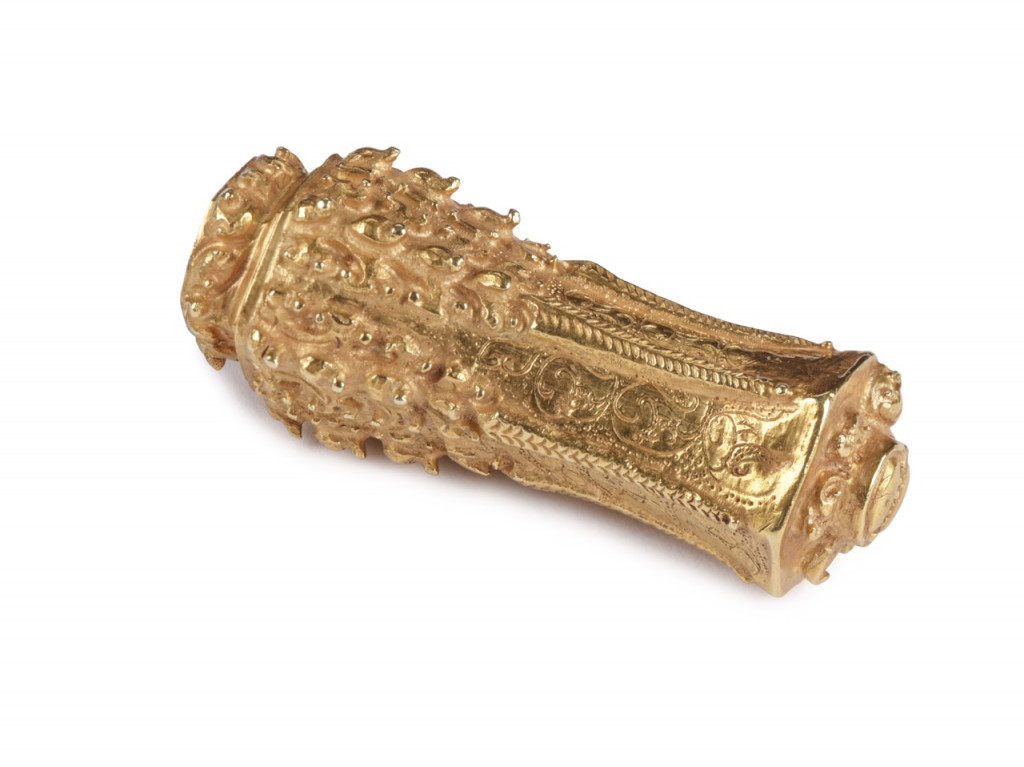
A rare ancient Hindu-Javanese gold fan or fly-whisk finial
Indonesia, Central Java, Central Javanese period, Mataram Kingdom, circa 9th-10th century
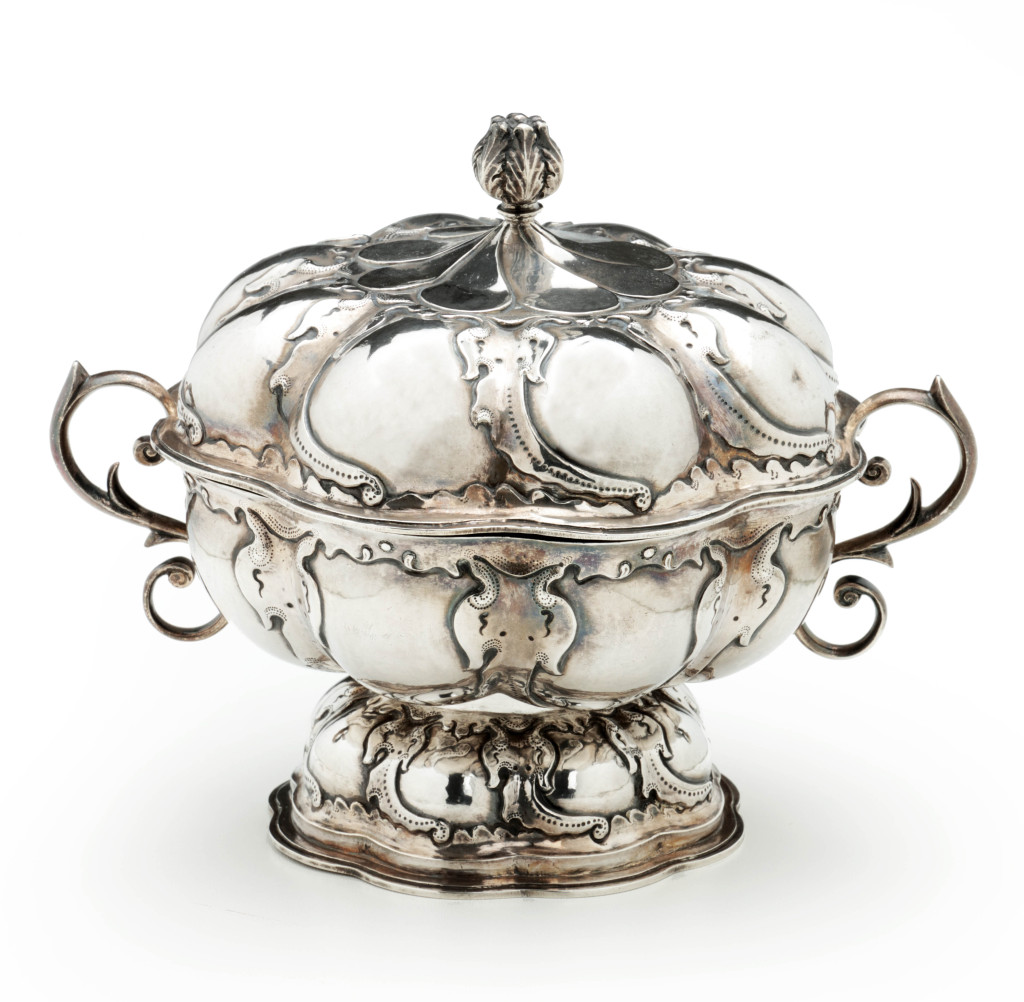
A rare Dutch-colonial silver 'Kwab' bowl and cover
A rare Indonesian silver covered bowl