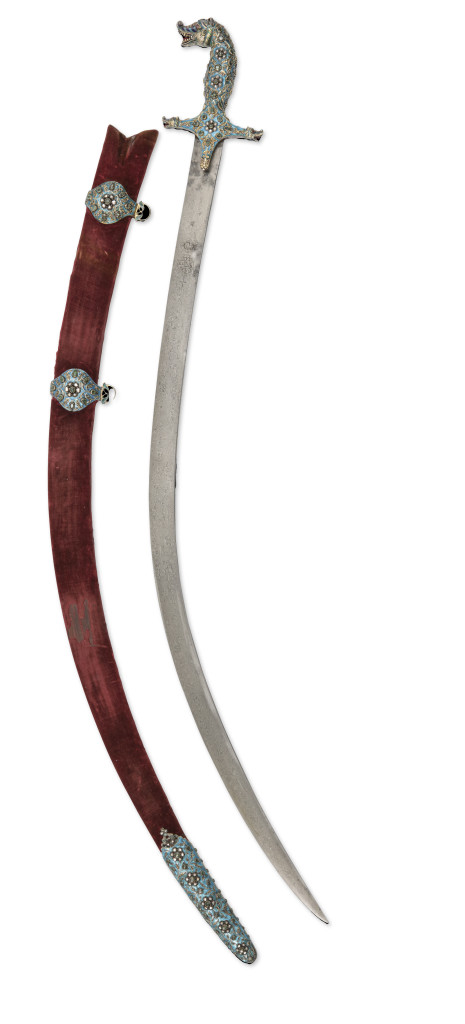
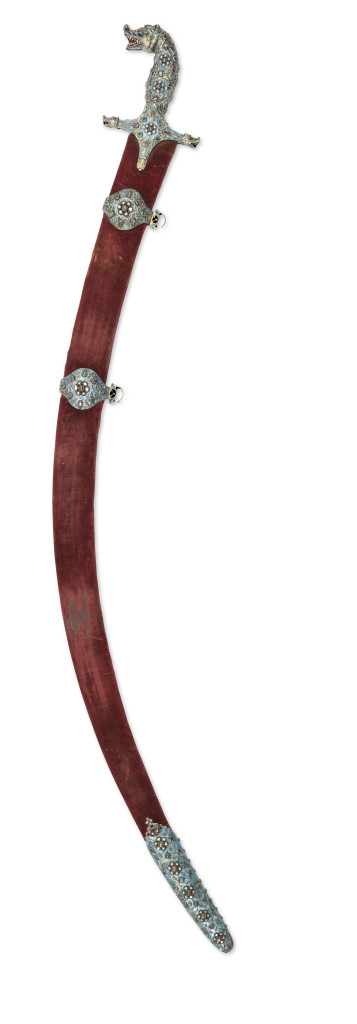
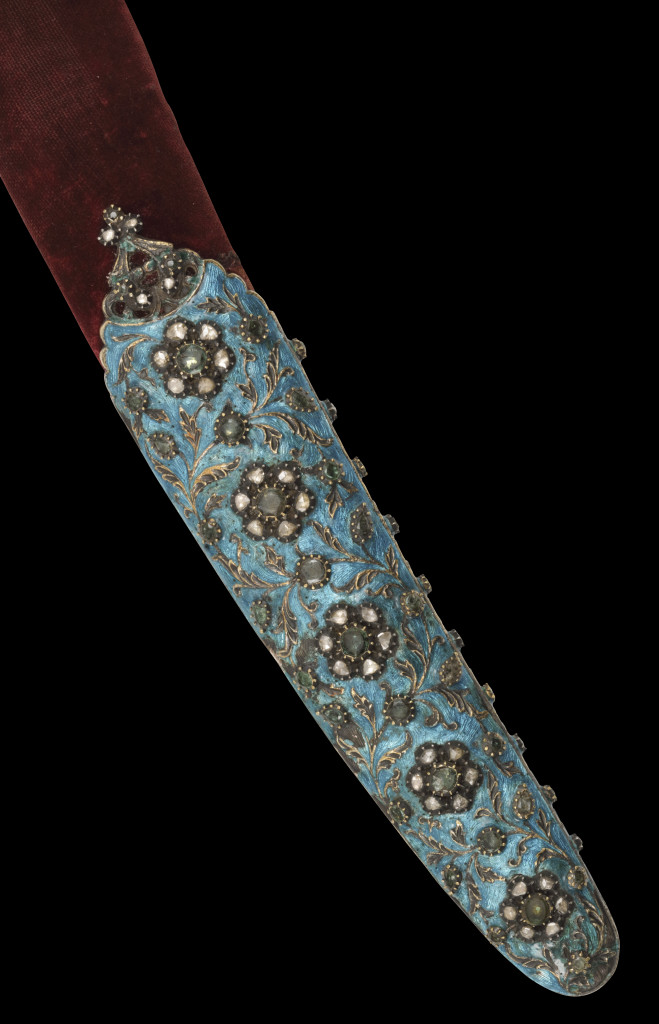
An exceptional Indian diamond, emerald, beryl and ruby inlaid enamelled silver and gold shamshir
L. 104 cm
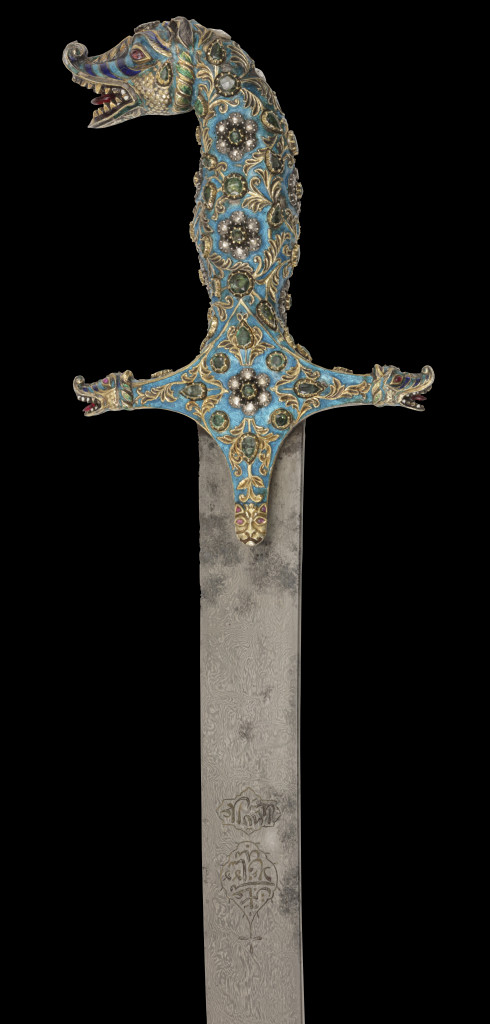
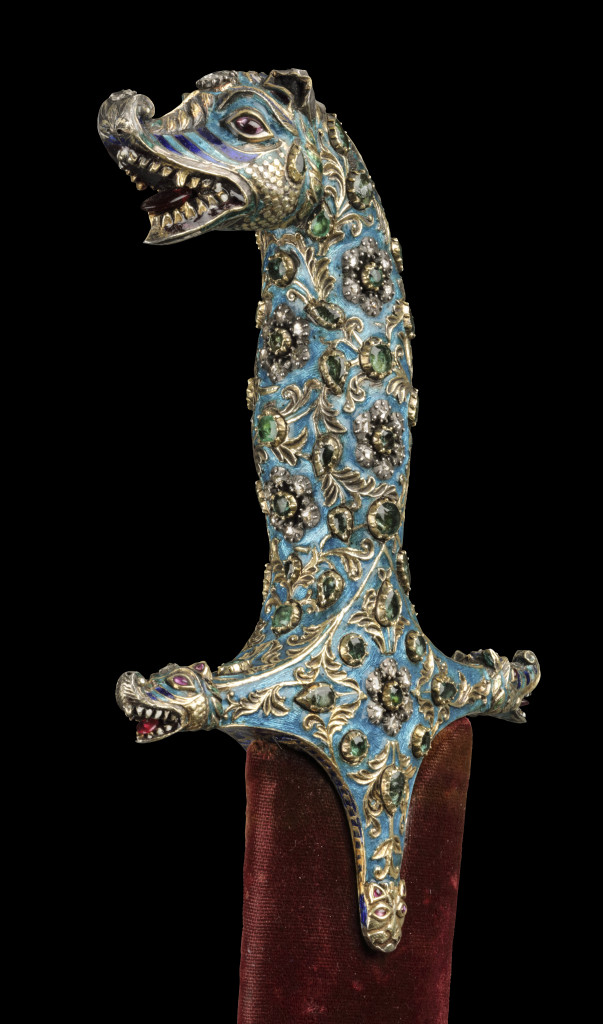
This remarkable shamshir, features an exquisite Iranian watered steel blade and a silver-gilt hilt adorned with predominantly light blue enamel complemented by dark blue and green highlights. The hilt is embellished with clusters of diamonds and pale green emeralds. Originating from Persia (modern-day Iran), the shamshir, a curved sword, gained popularity across the Islamic world and underwent significant development over centuries. Evolving from the straight-bladed Persian scimitar, the shamshir's curved blade and distinctive hilt featuring a cross-guard and pommel emerged by the 12th century, marking its transition from scimitar to shamshir. Its design proved highly advantageous for mounted warriors, enabling powerful strikes from horseback and agile combat. The shamshir's design was influenced by a fusion of cultural influences, drawing inspiration from Central Asian, Turkic, and Arabic swords. Interactions with neighbouring regions, like India's Mughal empire, further enriched its design. Despite declining battlefield utility due to firearms' rise, the shamshir retained ceremonial significance symbolizing authority and prestige.
The hilt of this elaborately adorned sword showcases three makaras, mythical sea creatures blending elements of the crocodile, elephant, boar, fish, and peacock. These creatures frequently appear in Hindu and Buddhist temple iconography, serving as vahana for goddesses and sea god Varuna. Makaras are known as protectors of thresholds and gateways and traditionally guard throne rooms and temple entrances. Crafted from silver and overlaid in gold, the hilt's pommel, and quillon terminals, as well as the langet terminals, take the form of makara and small lion heads. The intricate decoration, following the kundun style, features rosettes with central emeralds surrounded by diamonds. Ruby eyes and ears accentuate the animals on the hilt, while the hinged makara tongues move between sharp gold teeth.
The blade boasts distinctive 'forty step' watered steel, featuring inlaid nasta'liq inscriptions in gold. The inscriptions read 'aml Asad Allah' (made by Asad Allah) and 'bandih-yi vilayet-I Shah ‘Abbas' (‘Abbas, slave of the king of holiness). These inscriptions refer to renowned Persian swordsmith Asad Allah of Isfahan, implying the blade's quality matches that of the master's work.
A comparable but later makara hilt in blued steel resides in the Jodhpur Rathores' armory, sharing similarities with the present sword's blade and inscription.
Provenance:
Robert Hales, London
Literature:
Robert Hales, Islamic and Oriental arms and armour: a lifetime’s passion, London, 1992, p. 169, no. 414
Related objects
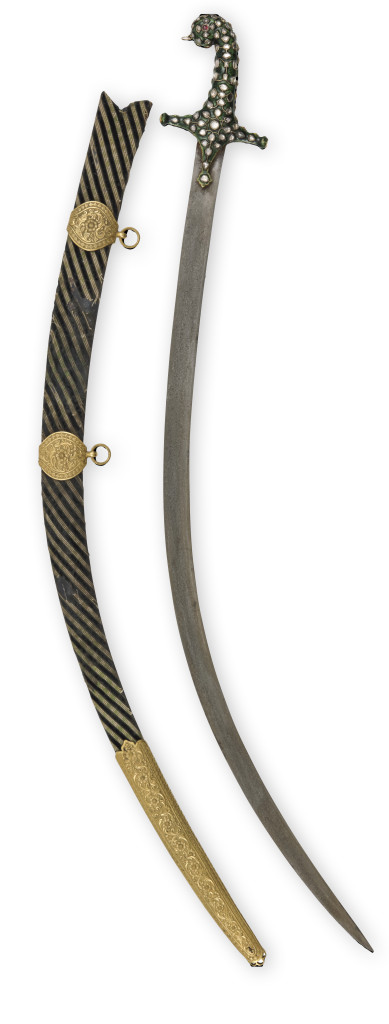
A superb Mughal green diamond-set gold enameled shamshir
The exceptionally fine pistol-grip hilt is decorated in kundan technique with diamonds and rubies set in gold, against a green enameled ground. It has a single-edged curved blade of watered steel. Including an associated striped cloth-covered sheath, two gold sheath mounts and gold chape with very fine scrolling floral repoussé decoration. The term repoussé comes from the French word meaning ‘pushed up’ or ‘raised’. It involves shaping metal from the reverse side to create intricate design and patterns on the front surface. It is achieved by hammering and shaping a sheet of metal, typically brass, gold or silver.
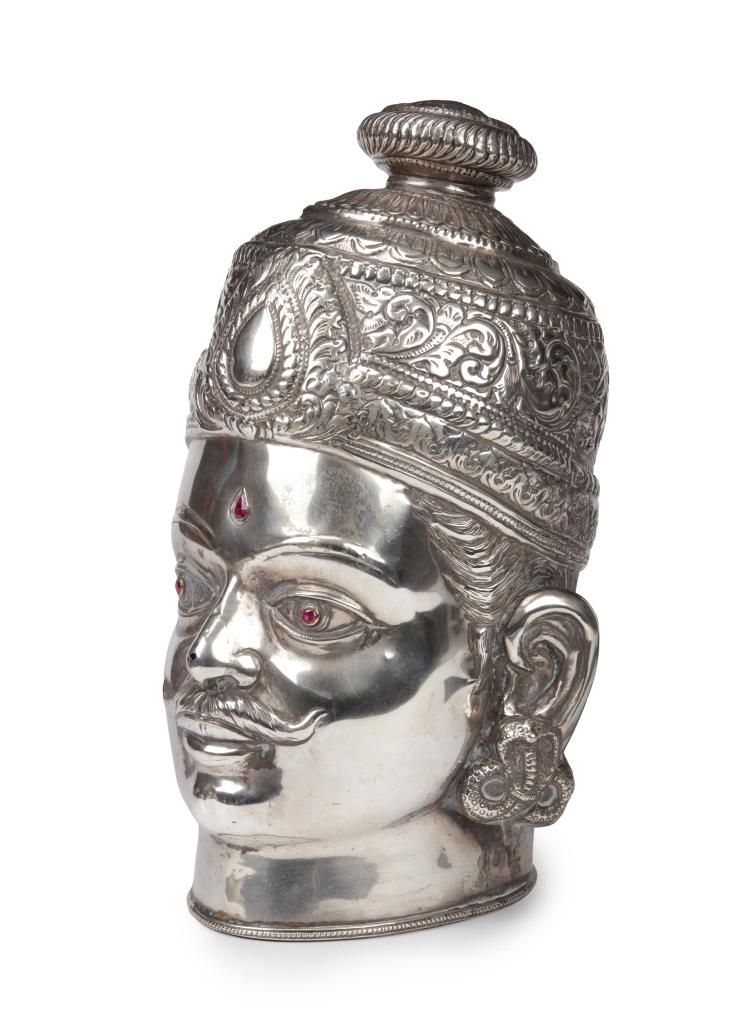
A large silver Shiva head
_India, late 19th century_ _H. 33.5 cm; Weight: 1.34 kg_ At over thirty centimeters high, this example is shrine-scaled, its mirror-bright surface designed to animate offerings, movement, and flame.
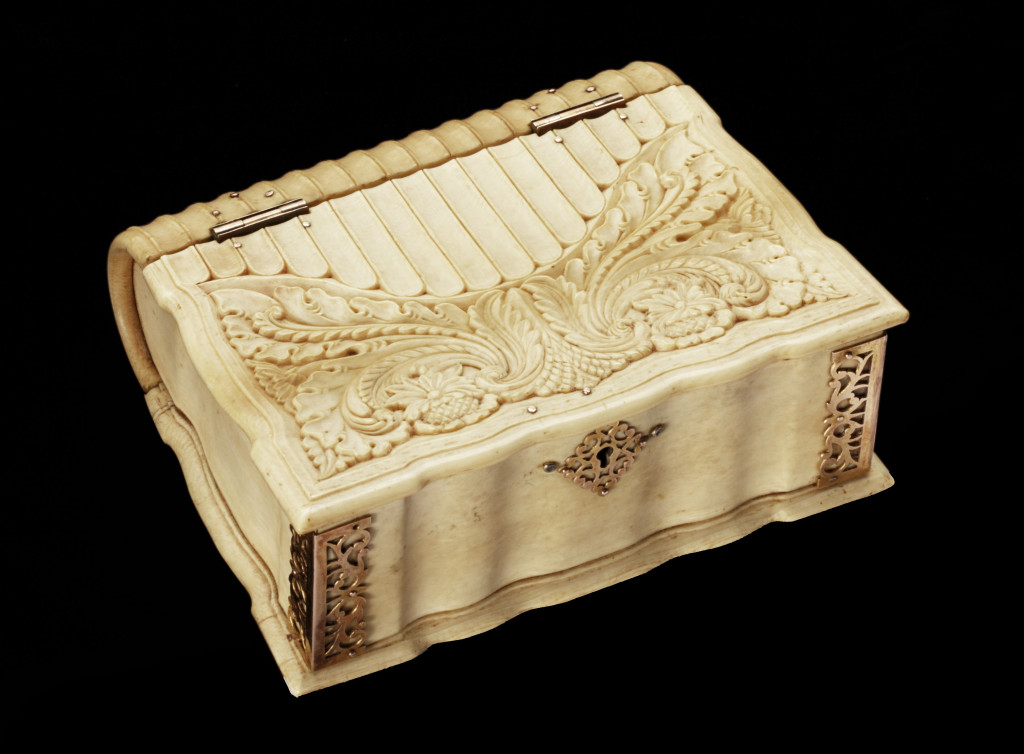
A very fine Sri Lankan ivory and gold bible box
Fine Sri Lankan Ivory and Gold Bible box