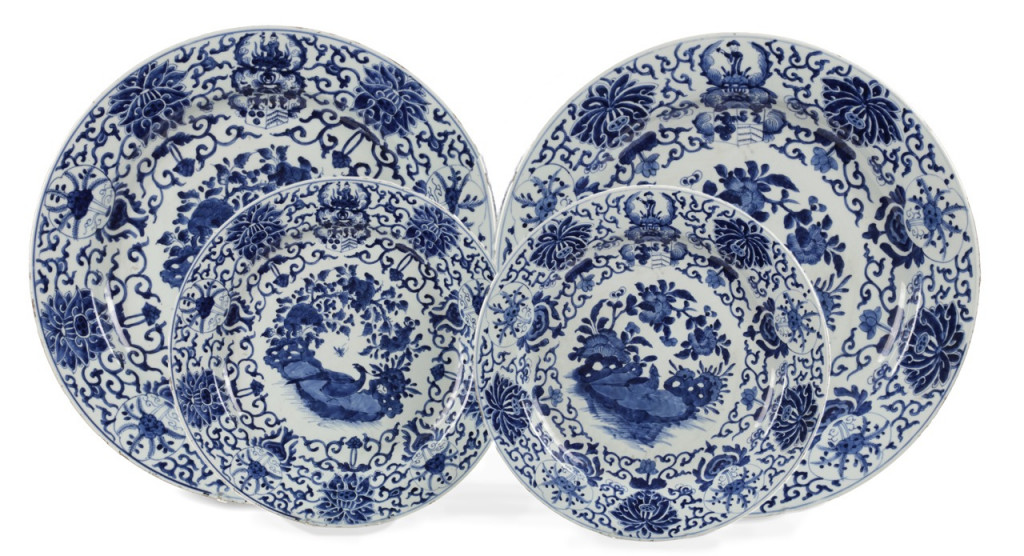
A set of four very large and two smaller Chinese armorial export blue and white porcelain 'Pelgrom' chargers
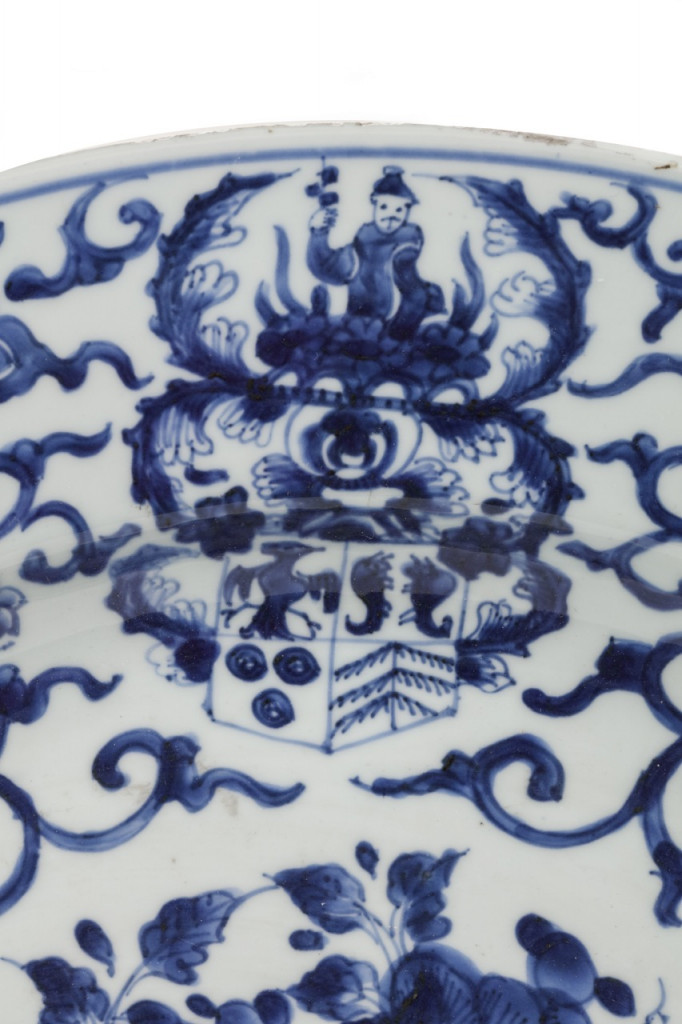
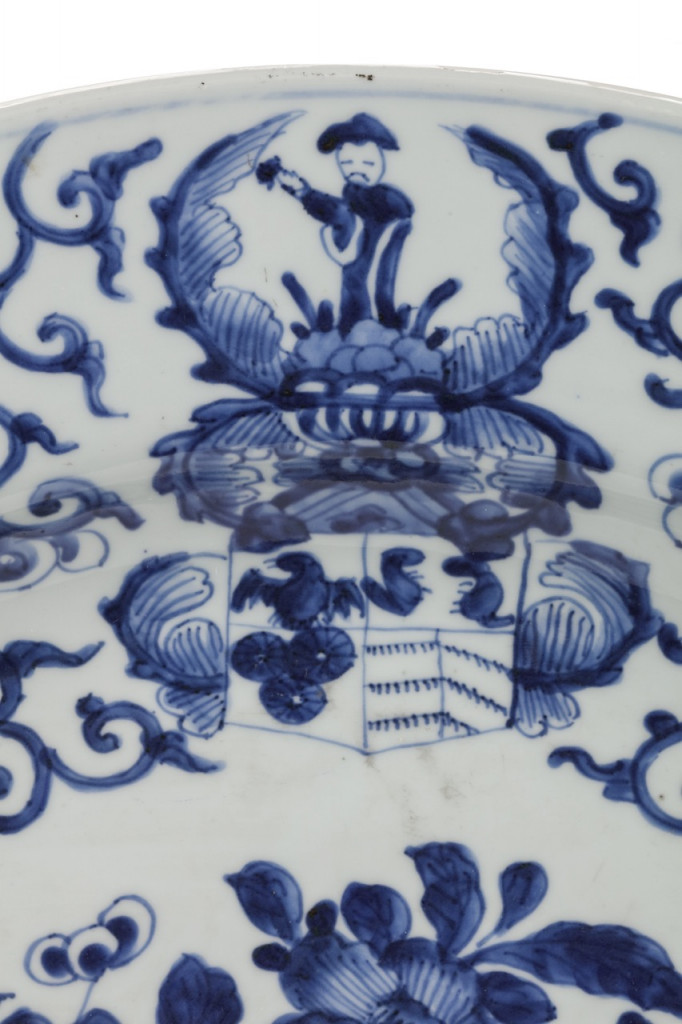
The chargers decorated in the centre in typical Chinese style, with a bird on a rock or with a flying insect, and all with flowering plants. The rim, decorated with large lotus flowers and scrollwork, bears the coat of arms of the Pelgrom family on top, on the reverse three large flower sprays and in the middle within a double circle a conch shell.
Diam. approx. 49.7 & 39 cm
These two huge dishes once belonged to a dinner service which was ordered by Jacob Pelgrom (c. 1655 Rouen – 1713 Batavia). As a Huguenot he had fled France after the freedom of the protestant religion was revoked by Louis XIV in 1685.
Pelgrom arrived in Batavia in 1688 onboard the “Langwijk” of the Amsterdam VOC Chamber. His career in the VOC was mainly in Bengal where he became the first director of the Bengal trading post in Cassimbazar in 1701. From 1708 till his death in 1713 he lived in Batavia where he had several official functions including head of the tax department.
Still in Amsterdam Jacob had married Catharina Pigou (1656-1709), also a Huguenot refugee from France, Amiens. They had at least four children. Their youngest daughter, Johanna Catharina (1686-1734) married Anthonij Huysmans (1688-1729) who succeeded his father-law as director of Bengal. The Huysmans-Pelgrom family became related to several of the principal families of the Dutch East Indies.
For a comparable dish in the permananent exhibition in the Rijksmuseum Amsterdam see accession number [AK-RAK-1994-5](https://www.rijksmuseum.nl/en/collection/AK-RAK-1994-5)
Part of the China collection.
Related objects
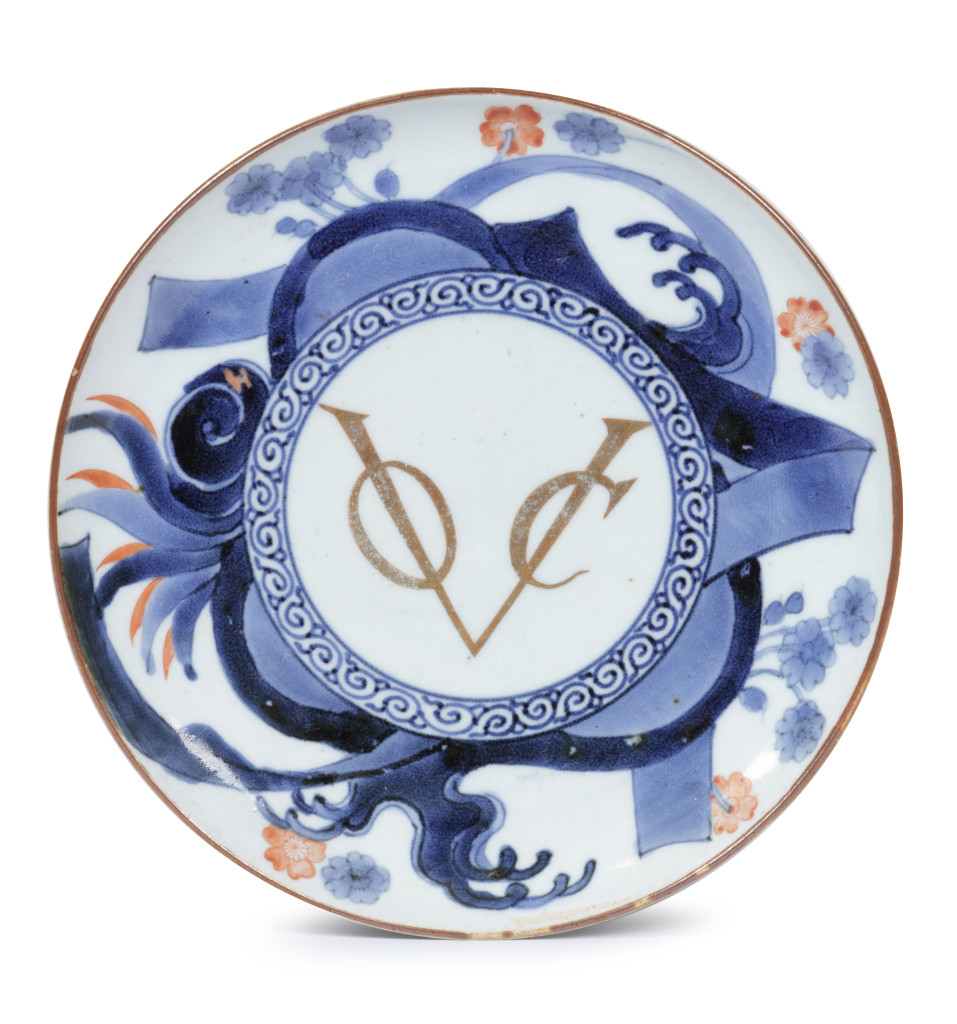
A Japanese Ko-imari porcelain 'VOC' dish
Arita, Edo period, first half 19th century Decorated in blue and iron-red under glaze with in the center the VOC monogram in gold. The bottom with imitation Chinese Ming Dynasty Chenghua marks, 'Great Ming Chenghua period mark'. Diam. 21.2 cm Dishes like the one present were very expensive souvenirs for wealthy Japanese domestic tourists who visited Nagasaki to get a glimpse of the Dutch on Deshima. The design of this particular dish is unknown, and it is possibly unique.
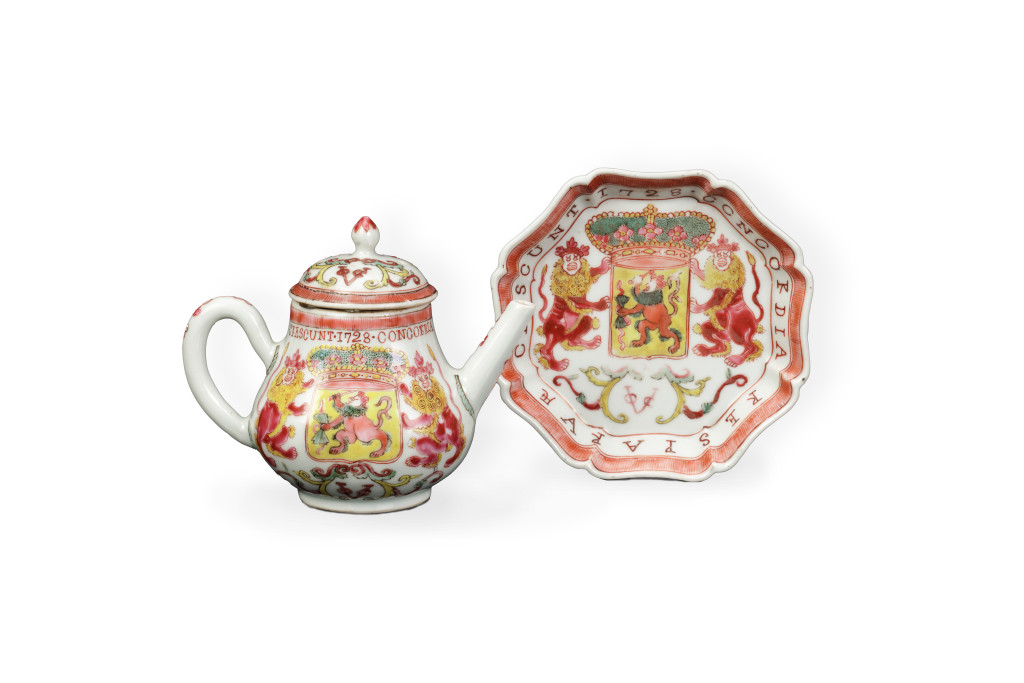
A pink, yellow and green enamelled porcelain VOC teapot and saucer
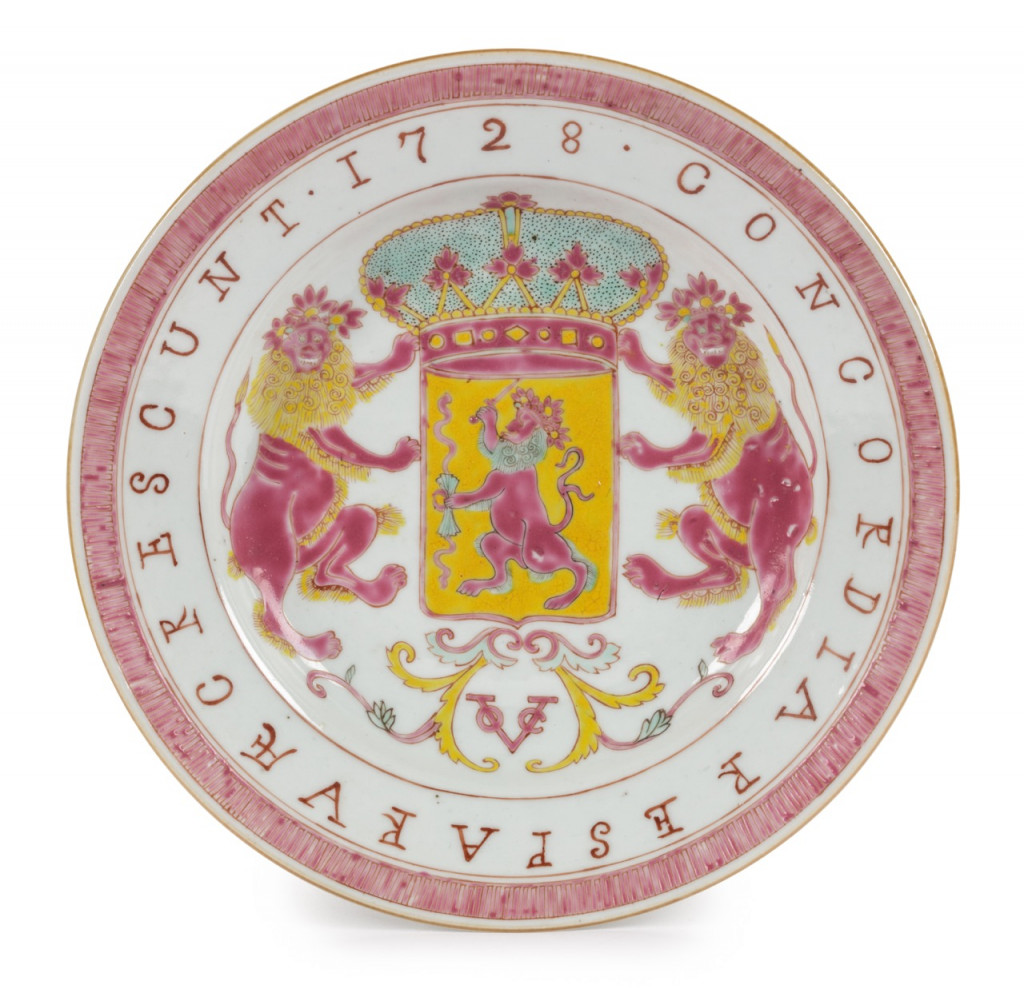
A pink, yellow and green enamelled porcelain VOC plate
Executed in rose-pink, yellow, and soft blue-green enamels, this design follows a silver ducatoon of 1728 in almost every aspect, with even the rim of the plate imitating the ribbed milling of the coin. On a shield is a crowned rampant lion, holding in his left paw a bunch of seven arrows symbolising the seven provinces of the United Netherlands, and in his right paw, a sword is shown supported by two crowned rampant lions. Below the shield is the monogram of the VOC, the Dutch East India Company, above the date 1728, and around it is the heraldic motto of the Dutch Republic CONCORDIA RES PARVAE CRESCUNT (by unity small things grow). The first ducatoon, or zilveren rijder, on which the design of this plate was based, arrived in Canton, China, on the 2nd of August 1729 with the Coxhorn, the first VOC ship to sail straight to Canton and not by way of Batavia. It arrived in Amsterdam in 1730 with the ordered porcelain in this design. This is an early example of the so-called Chine de Commande porcelain. Although the Cantonese artists had a zilveren rijder as an example, they didn’t really understand the design, giving the lions grimacing human faces and cape-like manes. They also didn’t understand the Latin letters, since the R ends truncated, the V is an inverted A, and the E looks more like a Chinese character. The only Chinese porcelain known with this design is a tea set, comprising cup-and-saucers and a theapot. For a cup and saucer, see: Uit Verre Streken, June 2017, no. 49. The Dutch likely took a cup-and-saucer from China to Japan, ordering larger plates like the one present. Until recently, these plates were attributed to Chinese kilns, but they are more likely Japanese. This solves the debate on whether these dishes are modern Chinese forgeries. One has been found in an old Japanese collection and is listed in a catalogue, which makes the latter impossible. The enamel's hues and the porcelain's colour are, indeed, more Japanese than Chinese.