
A Chinese export porcelain armorial 'Van Reverhorst' plate
Decorated in blue, green, black, iron-red and gilt, with the coat-of-arms of Van Reverhorst, with coronet and crest, surrounded by smaller arms of the families Van Reverhorst, De Winter, Vereyck and De Bruijn to the left, and Schrevelius, Van Peenen, Van Groenendijk and Vroede to the right, within a gilt and iron-red shell-scroll border.
Diam. 23 cm
This plate is part of a large dinner and tea service representing the ancestral coat-of-arms of the commissioners of this service, Theodorus and Adriaan van Reverhorst. Family trees are known on armorial charts, hatchments and portraits, but on Chinese export porcelain, this is the first of only four services known, all made for the Dutch market. Of these, the Van Reverhorst service is the largest and most beautiful. In Holland, it was considered a matter of particular pride to be able to claim eight armigerous great-grandparents. The paternal ancestral families of Theodorus and Adriaan came from The Hague (Van Reverhorst, De Winter, Vereijk and De Bruijn), whereas the maternal ancestors, comparatively higher ranking families (Schrevelius, Van Peenen and Van Groenendijk), came from Leiden and (De Vroede) from Amsterdam.
It is likely that Adriaan (The Hague 1720 - Batavia 1751), being a supercargo in Canton from 1743 till 1748, carried out the order for the service, placed by his brother Theodorus (The Hague 1706 - 1758), a member of the Court of Justice in Batavia. Theodorus arrived in Batavia in 1735 where he was installed as a member of the Court of Justice, holding this post until 1752. In 1748 he married Agneta Maria Crielaart (1727-1752), and they lived in a house at the Tijgersgracht, the most fashionable street of Batavia. They had no children and after the death of his wife in 1752, Theodorus returned to The Hague.
Adriaan accompanied his brother in 1735 to Batavia. As a 15-year-old boy, he held the rank of ship's boy, earning HFL. 5 a month. In 1741 he was appointed junior merchant and in 1743 he was sent to Canton as the third supercargo, becoming the second supercargo in 1745, earning HFL. 60 a month. Clearly, Adriaan had ample opportunity to order armorial porcelain, but it is likely his brother Theodorus was involved, because he had a principal position in Batavia as a member of the Court of Justice, earning at least HFL. 200 a month. Adriaan never married and died aged 31 in his brother's house at the Tijgersgracht in 1751. In 1752 Theodorus returned to Holland with this and two other services with the Van Reverhorst coat-of-arms. After his death in 1758, his brothers Cornelis and Hermanus van Reverhorst and their descendants inherited the services.
Literature:
Dr. Jochem Kroes, Chinese Armorial Porcelain for the Dutch Market, Den Haag/Zwolle, 2007)
Related objects
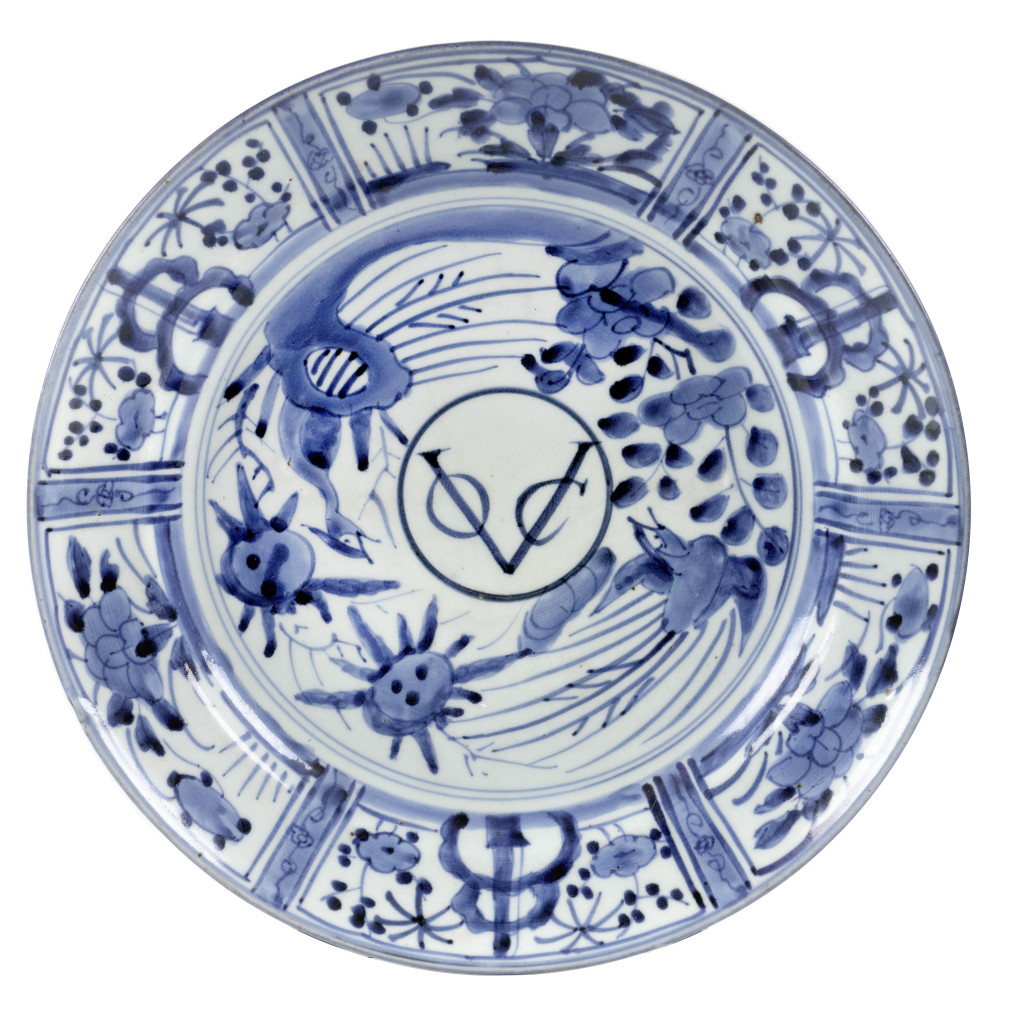
A rare large Japanese Arita blue and white porcelain 'V.O.C' dish
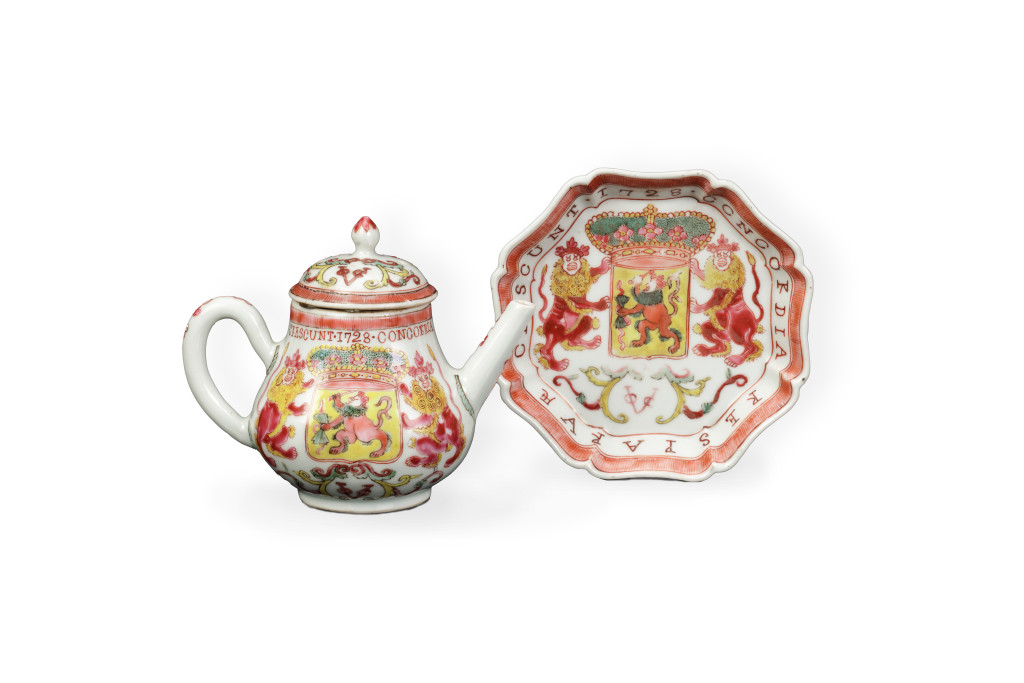
A pink, yellow and green enamelled porcelain VOC teapot and saucer
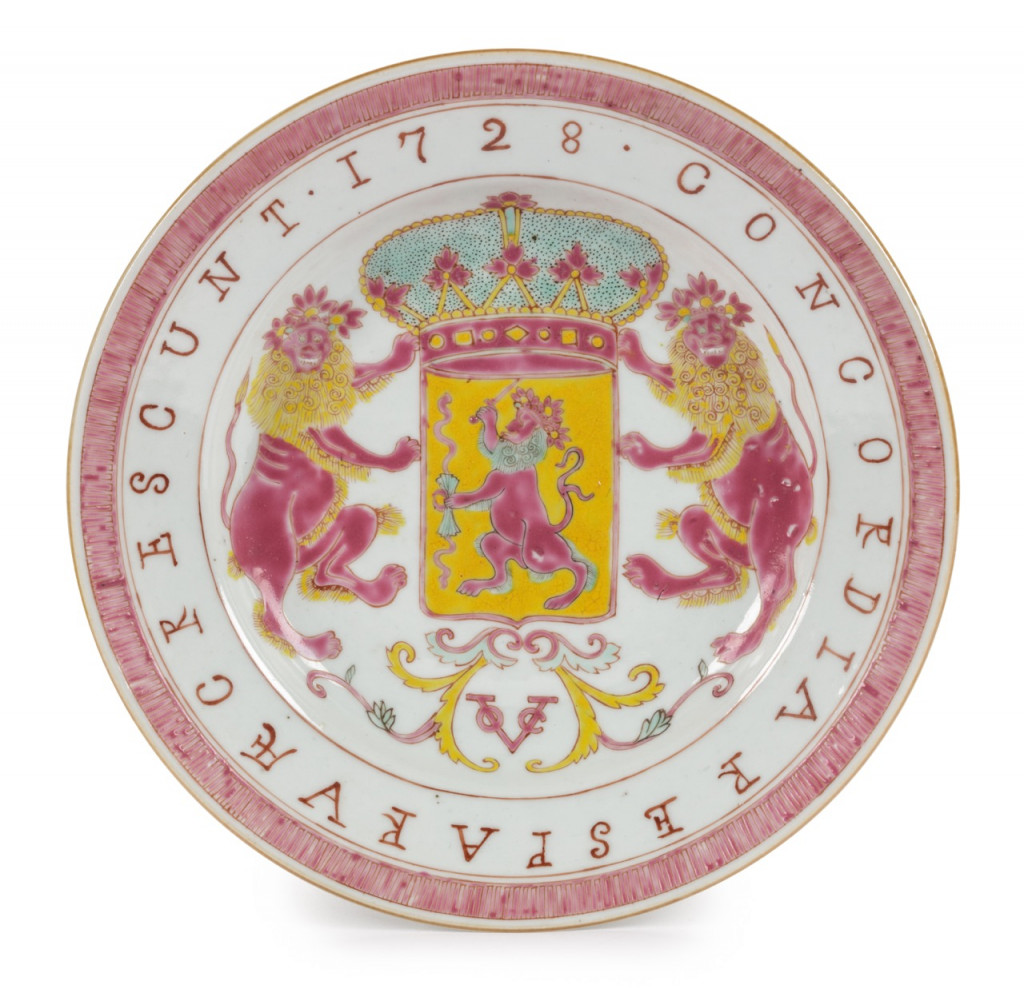
A pink, yellow and green enamelled porcelain VOC plate
Executed in rose-pink, yellow, and soft blue-green enamels, this design follows a silver ducatoon of 1728 in almost every aspect, with even the rim of the plate imitating the ribbed milling of the coin. On a shield is a crowned rampant lion, holding in his left paw a bunch of seven arrows symbolising the seven provinces of the United Netherlands, and in his right paw, a sword is shown supported by two crowned rampant lions. Below the shield is the monogram of the VOC, the Dutch East India Company, above the date 1728, and around it is the heraldic motto of the Dutch Republic CONCORDIA RES PARVAE CRESCUNT (by unity small things grow). The first ducatoon, or zilveren rijder, on which the design of this plate was based, arrived in Canton, China, on the 2nd of August 1729 with the Coxhorn, the first VOC ship to sail straight to Canton and not by way of Batavia. It arrived in Amsterdam in 1730 with the ordered porcelain in this design. This is an early example of the so-called Chine de Commande porcelain. Although the Cantonese artists had a zilveren rijder as an example, they didn’t really understand the design, giving the lions grimacing human faces and cape-like manes. They also didn’t understand the Latin letters, since the R ends truncated, the V is an inverted A, and the E looks more like a Chinese character. The only Chinese porcelain known with this design is a tea set, comprising cup-and-saucers and a theapot. For a cup and saucer, see: Uit Verre Streken, June 2017, no. 49. The Dutch likely took a cup-and-saucer from China to Japan, ordering larger plates like the one present. Until recently, these plates were attributed to Chinese kilns, but they are more likely Japanese. This solves the debate on whether these dishes are modern Chinese forgeries. One has been found in an old Japanese collection and is listed in a catalogue, which makes the latter impossible. The enamel's hues and the porcelain's colour are, indeed, more Japanese than Chinese.