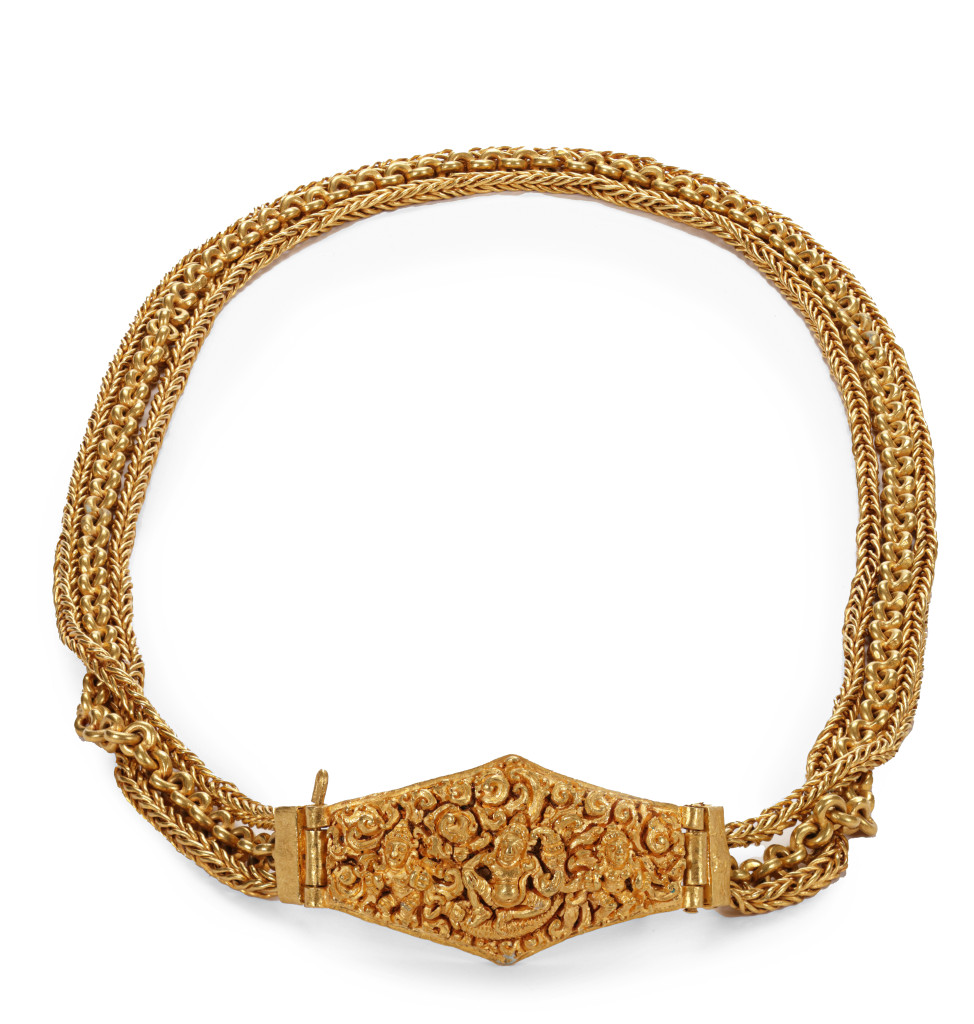
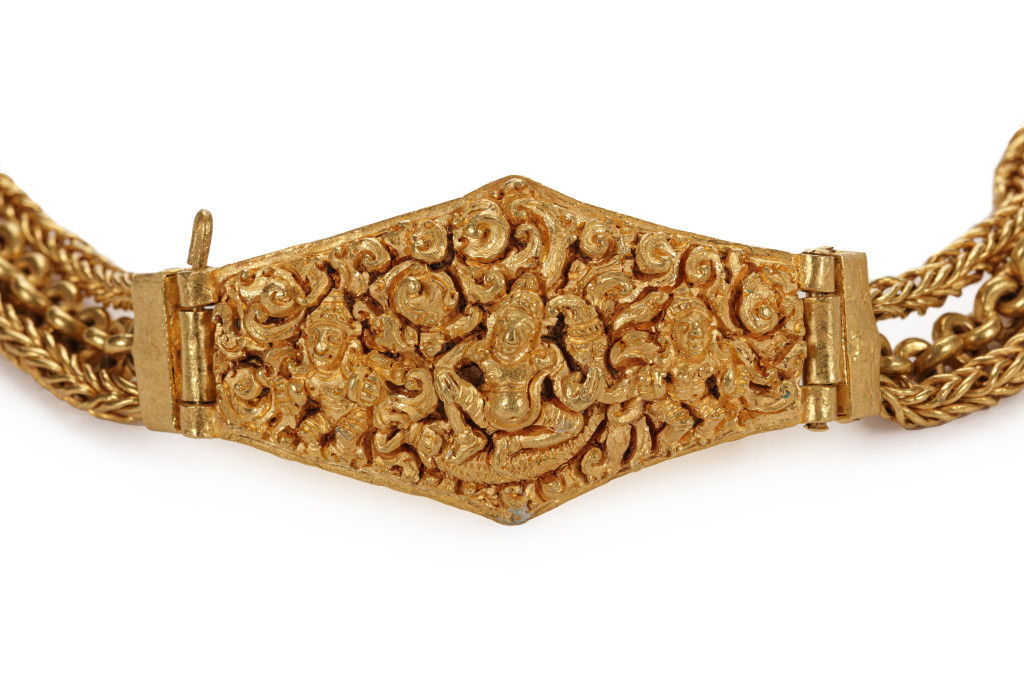
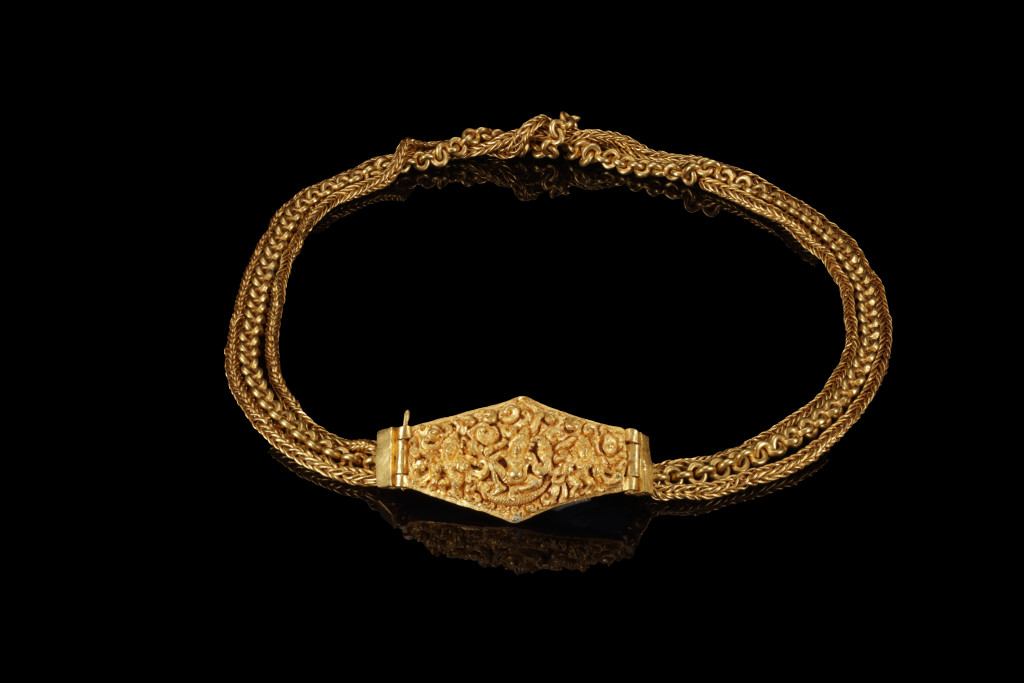
An ancient Javanese solid high-carat near-pure gold pendant on a three-strand chain
Central Java, Central Javanese period, 9th-10th century CE
The heavy gold pendant seems to be cast in cire-perdue and later carved and worked using several techniques. It has a central figure surrounded by curling floral and foliate motifs, possibly depicting a seated guardian deity, or Dvarapala. The pendant is attached to a twisted cord chain flanked by a flat anchor link chain at each side held in place by gold pins.
L. 84 cm (fully extended) / Weight: 744 grams
Provenance:
Collection of a notable from the Hague, who stayed in the former Dutch East Indies around circa 1900; thence by descent
Purchased from the above by a distinguished Dutch collector (name is known to us) between 1970 and 1980
This object is registered at the Documentation Centre for Ancient Indonesian Art in Amsterdam.
We are grateful to the Documentation Centre for Ancient Indonesian Art in Amsterdam and Mr. Jaap Polak for their assistance in determining the specifics and date of this finial above.
In ancient Java, gold chains were crafted for both personal adornment and to decorate religious statues. Dvarapala, a guardian deity, is found at both Hindu and Buddhist temple entrances, either alone or in pairs. Such chains and pendants were used as protective talismans and worn over the shoulders, around the neck, at the waist, or as a sort of sash.
The heavy gold pendant seems to be cast in cire-perdue and later carved and worked using several techniques. It has a central figure surrounded by curling floral and foliate motifs, possibly depicting a seated guardian deity, or Dvarapala. The pendant is attached to a twisted cord chain flanked by a flat anchor link chain at each side held in place by gold pins.
L. 84 cm (fully extended) / Weight: 744 grams
Provenance:
Collection of a notable from the Hague, who stayed in the former Dutch East Indies around circa 1900; thence by descent
Purchased from the above by a distinguished Dutch collector (name is known to us) between 1970 and 1980
This object is registered at the Documentation Centre for Ancient Indonesian Art in Amsterdam.
We are grateful to the Documentation Centre for Ancient Indonesian Art in Amsterdam and Mr. Jaap Polak for their assistance in determining the specifics and date of this finial above.
In ancient Java, gold chains were crafted for both personal adornment and to decorate religious statues. Dvarapala, a guardian deity, is found at both Hindu and Buddhist temple entrances, either alone or in pairs. Such chains and pendants were used as protective talismans and worn over the shoulders, around the neck, at the waist, or as a sort of sash.
Part of the Indonesian Archipelago collection.
Related objects
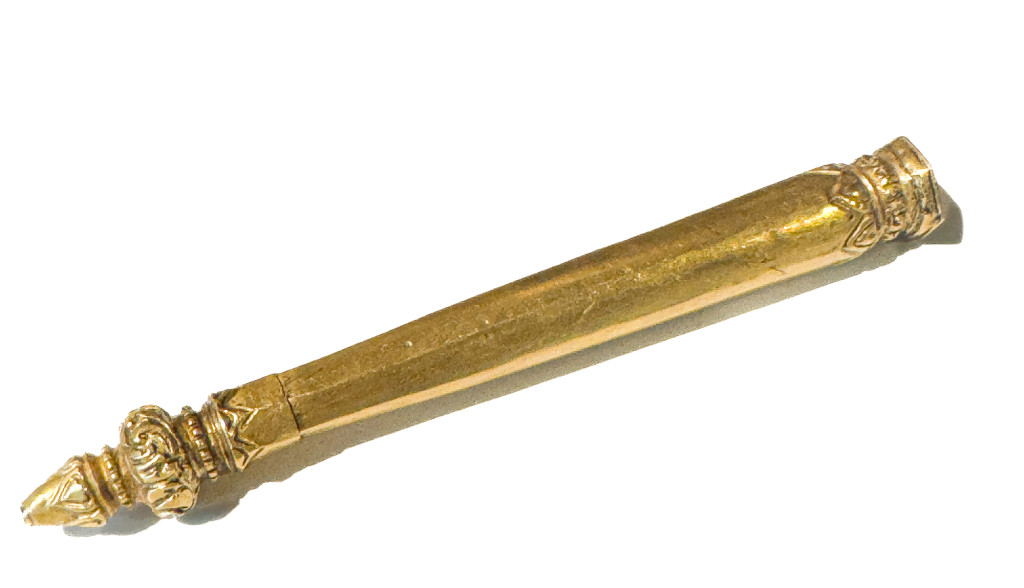
An ancient Hindu-Javanese gold fan or fly-whisk finial
Indonesia, Central Java, Central Javanese period, Mataram Kingdom, circa 9th-10th century
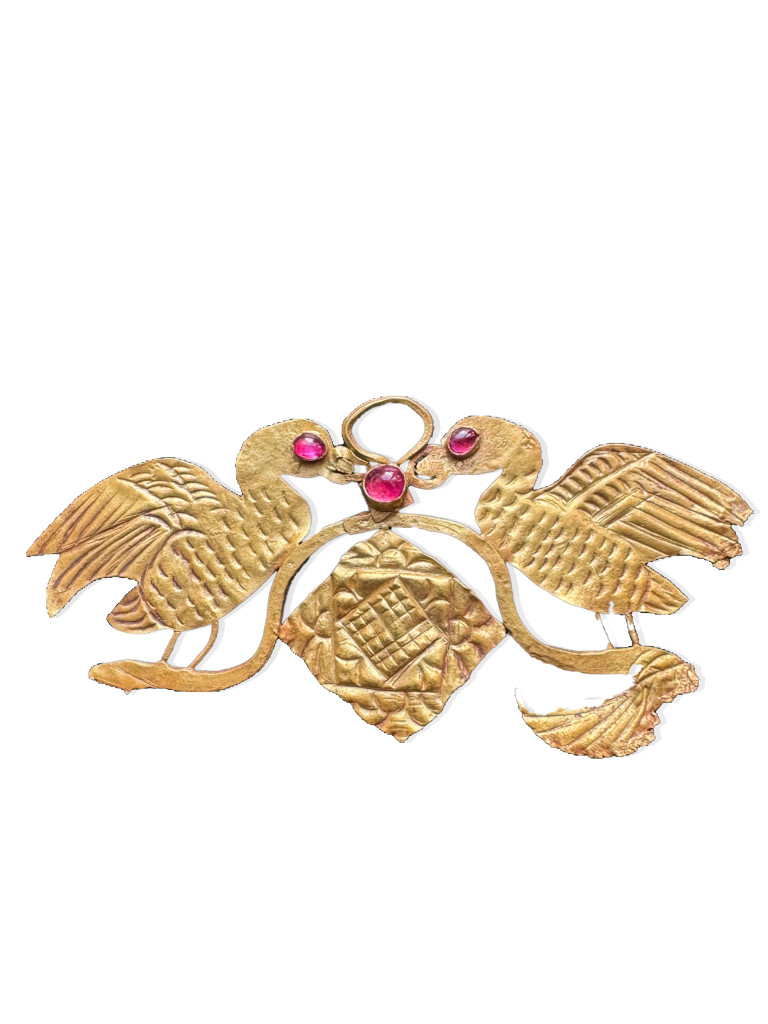
An ancient Hindu-Javanese spinel-set gold pendant
Indonesia, Central Java, Central Javanese period, Mataram Kingdom, circa 9th-10th century
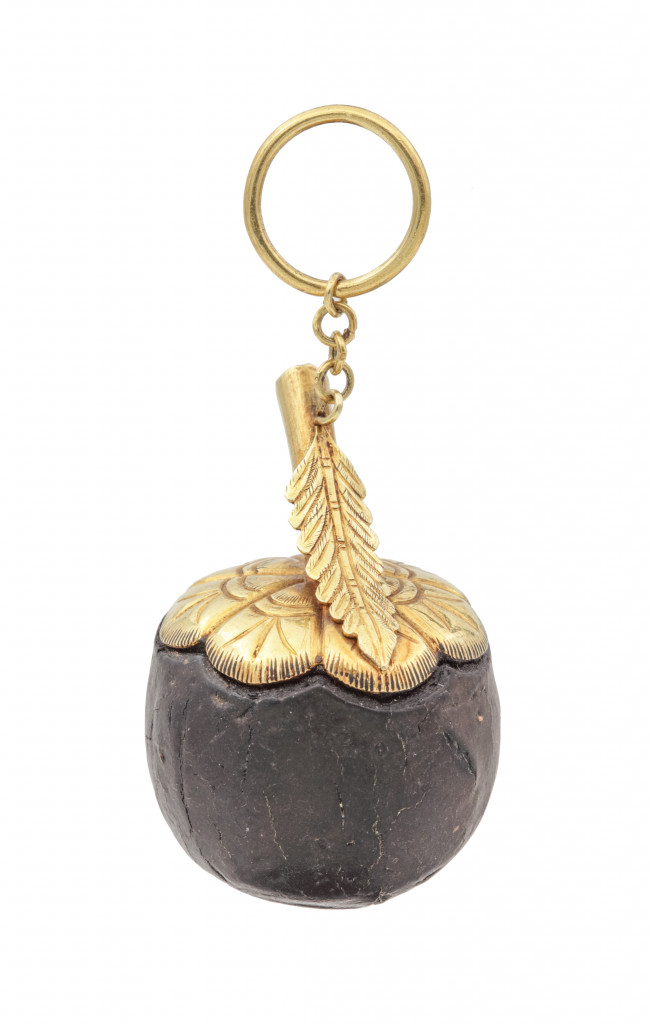
An ambergris and gold Indonesian or Dutch colonial perfume pendant in the form of a mangosteen fruit
Ambergris, or ‘Ambar’ in Indonesian, is often dubbed the ‘gold of the sea’. It is a rare and precious substance with a history as intriguing as its aroma. Originating from the intestines of sperm whales, it forms when the whale's digestive system produces a secretion to envelop and protect its intestines from the sharp beaks of consumed squid. Over time, this substance hardens and is either expelled by the whale or becomes part of its remains when it dies.