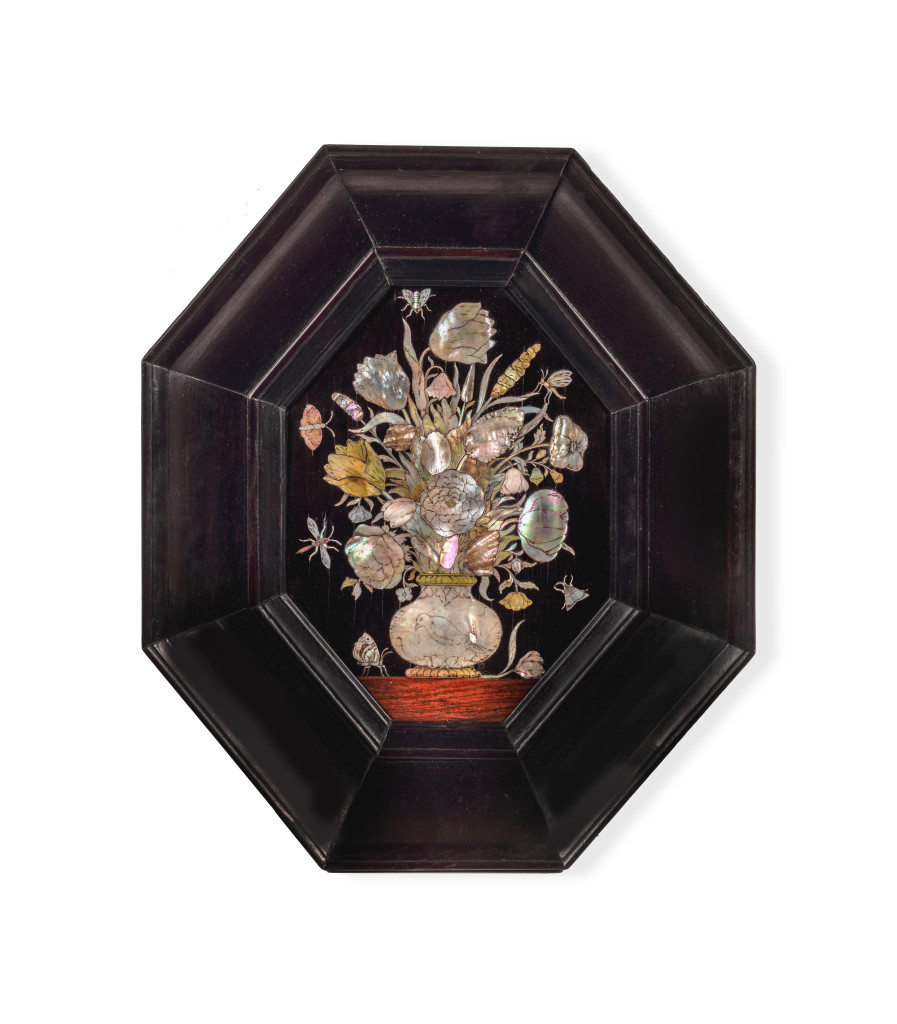
A Dutch mother of pearl inlaid panel depicting a vase of flowers attributed to Anna Maria van Rijswijck (c. 1628 - 1671-1672)
Amsterdam, Holland, circa 1650-1655
Signed with a very small monogram, 'AVR' just above the foot of the vase, most likely an indication that the work is made by Anna van Rijswijck, the daughter of Dirck van Rijswijck (1559-1679).
In the centre of the panel, a round vase bulges with a bouquet consisting of various overlapping flowers: tulips, roses, daffodils, and foxgloves. Two butterflies, a fly, a moth, and two mosquitoes hover near the bouquet, suggesting the freshness of the depicted flowers.
H. 22 x W. 17 cm (panel)
H. 34 x W. 29 x D. 5.5 cm (frame)
Condition: Cleaned and the table wood was heavily discoloured, was replaced based on other works in museums, but kept on the back of the frame.
Provenance:
Private collection, United Kingdom (at least since the early 20th century)
Anna Maria van Rijswijck (c. 1628–1671/1672) was the eldest daughter of the renowned goldsmith and master of mother-of-pearl inlay, Dirck van Rijswijck, and his wife Jaquelyn Rodriges (d. 1669). Baptized in Antwerp, she later moved to Amsterdam, where in 1657, she married Dirck Thymensz. de Jonge, a merchant of the Dutch East India Company (VOC). Following her marriage in 1657, she relocated to Batavia (Jakarta), where she passed away in 1671 or 1672. Given that VOC merchants typically travelled to their overseas postings soon after marriage, she likely departed for Batavia between 1657 and 1658. Anna Maria’s marriage into a VOC-related family highlights the interconnections between Amsterdam’s artistic, mercantile, and colonial circles. These three are embodied in the mother-of-pearl work, which depended on the overseas trade in 'exotic' materials. Anna's brother, Jan Anthony van Rijswijck (1624–before 1661), too is known to have continued the family’s artistic legacy as an engraver and master of mother-of-pearl work. He would likely have signed with monogram JAVR, instead of only AVR.
Dirck van Rijswijck was a respected artist in 17th-century Amsterdam. He was well-known for his mother-of-pearl floral still lifes. Joost van den Vondel, the 17th-century Dutch poet, wrote a poem inspired by a slate tabletop inlaid with mother-of-pearl. His neighbour Dirck made the tabletop and is now in the collection of the Rijksmuseum of Amsterdam. Praising one of the artist’s most accomplished works the poet began with the following lines: 'From now on, one does not have to travel to China, to cross with the Chinese in Bejing's impressive palaces; one does not court of the sun, built by Vulcan, as it shines from Ovid's mind and books with glow and heavenly gold; the art never understood by the Chinese, never invented by Vulcan, can be found in full splendor at Van Rijswijck’s house nearby.’
Throughout his long career, Van Rijswijck was described as a goldsmith, but no pieces of jewellery or precious objects from his atelier have ever been found. The only reference of Van Rijswijck's work as a goldsmith dates from 1626 and pertains to the remounting of agates in rings for Isabella Brant (1591-1626), first wife of Peter Paul Rubens (1577-1640), for which he was paid 76 guilders. In Amsterdam, the artist continued in this profession, but perhaps the business was not successful enough because the artist also started making medals and inlay works of mother-of-pearl.
Around the middle of the century, Van Rijswijck began to inlay ebony or slate panels with mother-of-pearl, marble, coloured bone or ivory, creating mostly still-life ‘pictures’ and tabletops. The artist employed this technique, for which he became famous in his own time, until the end of his life. It is not known how van Rijswijck came to specialize in these inlay techniques, although as a goldsmith, he would have been acquainted with the materials he used. After all, a table of slate was often found in a goldsmith's workshop to test the purity of silver and gold.
More importantly, mother-of-pearl was traditionally found in goldsmith work.
Ebony furniture inlaid with flowers and other mother-of-pearl decorations did not occur frequently either, but examples from the second half of the seventeenth century do exist. These pieces may well be inspired by the tables, cupboards, chests, and cabinets decorated with mother-of-pearl that were imported from the Far East.
Living and working in Amsterdam, Van Rijswijck would have been familiar with the lacquer goods in the East-India shops. In addition, the artist appears to have been well acquainted with high officials of the Dutch East India Company since several of them, including Huft, Nicolaes Verburch (c. 1620-1675), and Nicolaes Witsen (1641-1717), were among his clients or patrons.
Signed with a very small monogram, 'AVR' just above the foot of the vase, most likely an indication that the work is made by Anna van Rijswijck, the daughter of Dirck van Rijswijck (1559-1679).
In the centre of the panel, a round vase bulges with a bouquet consisting of various overlapping flowers: tulips, roses, daffodils, and foxgloves. Two butterflies, a fly, a moth, and two mosquitoes hover near the bouquet, suggesting the freshness of the depicted flowers.
H. 22 x W. 17 cm (panel)
H. 34 x W. 29 x D. 5.5 cm (frame)
Condition: Cleaned and the table wood was heavily discoloured, was replaced based on other works in museums, but kept on the back of the frame.
Provenance:
Private collection, United Kingdom (at least since the early 20th century)
Anna Maria van Rijswijck (c. 1628–1671/1672) was the eldest daughter of the renowned goldsmith and master of mother-of-pearl inlay, Dirck van Rijswijck, and his wife Jaquelyn Rodriges (d. 1669). Baptized in Antwerp, she later moved to Amsterdam, where in 1657, she married Dirck Thymensz. de Jonge, a merchant of the Dutch East India Company (VOC). Following her marriage in 1657, she relocated to Batavia (Jakarta), where she passed away in 1671 or 1672. Given that VOC merchants typically travelled to their overseas postings soon after marriage, she likely departed for Batavia between 1657 and 1658. Anna Maria’s marriage into a VOC-related family highlights the interconnections between Amsterdam’s artistic, mercantile, and colonial circles. These three are embodied in the mother-of-pearl work, which depended on the overseas trade in 'exotic' materials. Anna's brother, Jan Anthony van Rijswijck (1624–before 1661), too is known to have continued the family’s artistic legacy as an engraver and master of mother-of-pearl work. He would likely have signed with monogram JAVR, instead of only AVR.
Dirck van Rijswijck was a respected artist in 17th-century Amsterdam. He was well-known for his mother-of-pearl floral still lifes. Joost van den Vondel, the 17th-century Dutch poet, wrote a poem inspired by a slate tabletop inlaid with mother-of-pearl. His neighbour Dirck made the tabletop and is now in the collection of the Rijksmuseum of Amsterdam. Praising one of the artist’s most accomplished works the poet began with the following lines: 'From now on, one does not have to travel to China, to cross with the Chinese in Bejing's impressive palaces; one does not court of the sun, built by Vulcan, as it shines from Ovid's mind and books with glow and heavenly gold; the art never understood by the Chinese, never invented by Vulcan, can be found in full splendor at Van Rijswijck’s house nearby.’
Throughout his long career, Van Rijswijck was described as a goldsmith, but no pieces of jewellery or precious objects from his atelier have ever been found. The only reference of Van Rijswijck's work as a goldsmith dates from 1626 and pertains to the remounting of agates in rings for Isabella Brant (1591-1626), first wife of Peter Paul Rubens (1577-1640), for which he was paid 76 guilders. In Amsterdam, the artist continued in this profession, but perhaps the business was not successful enough because the artist also started making medals and inlay works of mother-of-pearl.
Around the middle of the century, Van Rijswijck began to inlay ebony or slate panels with mother-of-pearl, marble, coloured bone or ivory, creating mostly still-life ‘pictures’ and tabletops. The artist employed this technique, for which he became famous in his own time, until the end of his life. It is not known how van Rijswijck came to specialize in these inlay techniques, although as a goldsmith, he would have been acquainted with the materials he used. After all, a table of slate was often found in a goldsmith's workshop to test the purity of silver and gold.
More importantly, mother-of-pearl was traditionally found in goldsmith work.
Ebony furniture inlaid with flowers and other mother-of-pearl decorations did not occur frequently either, but examples from the second half of the seventeenth century do exist. These pieces may well be inspired by the tables, cupboards, chests, and cabinets decorated with mother-of-pearl that were imported from the Far East.
Living and working in Amsterdam, Van Rijswijck would have been familiar with the lacquer goods in the East-India shops. In addition, the artist appears to have been well acquainted with high officials of the Dutch East India Company since several of them, including Huft, Nicolaes Verburch (c. 1620-1675), and Nicolaes Witsen (1641-1717), were among his clients or patrons.
Part of the Europe collection.
Related objects
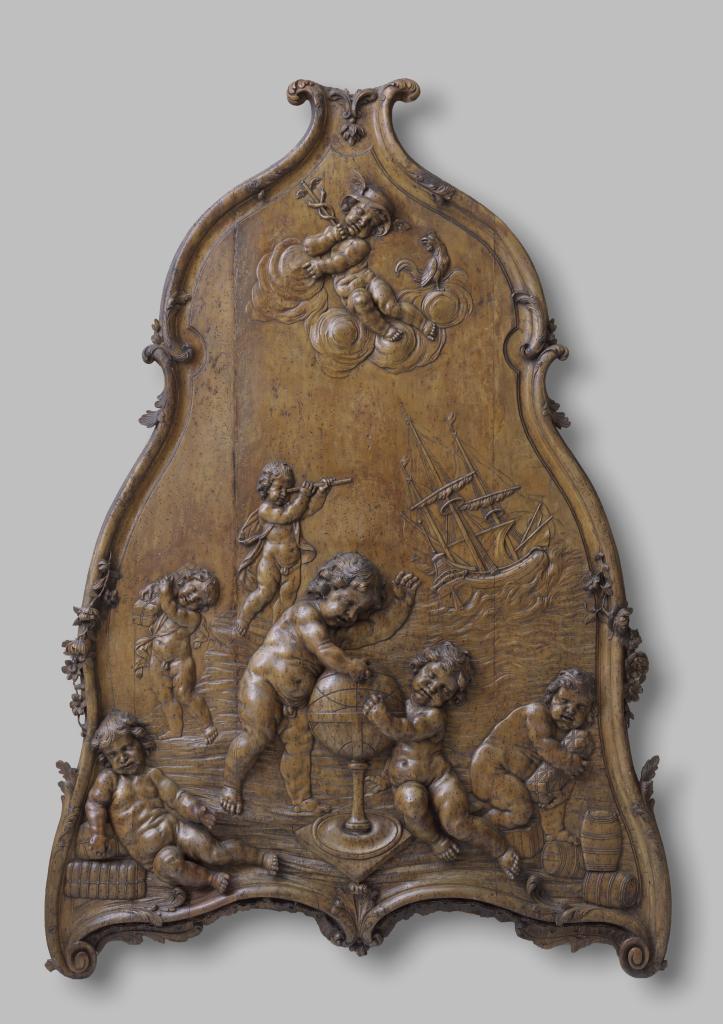
A Dutch limewood relief with the Allegory of Overseas Trade
_Amsterdam or The Hague, circa 1660-1700_ _H. 181 x W. 128.5 cm_
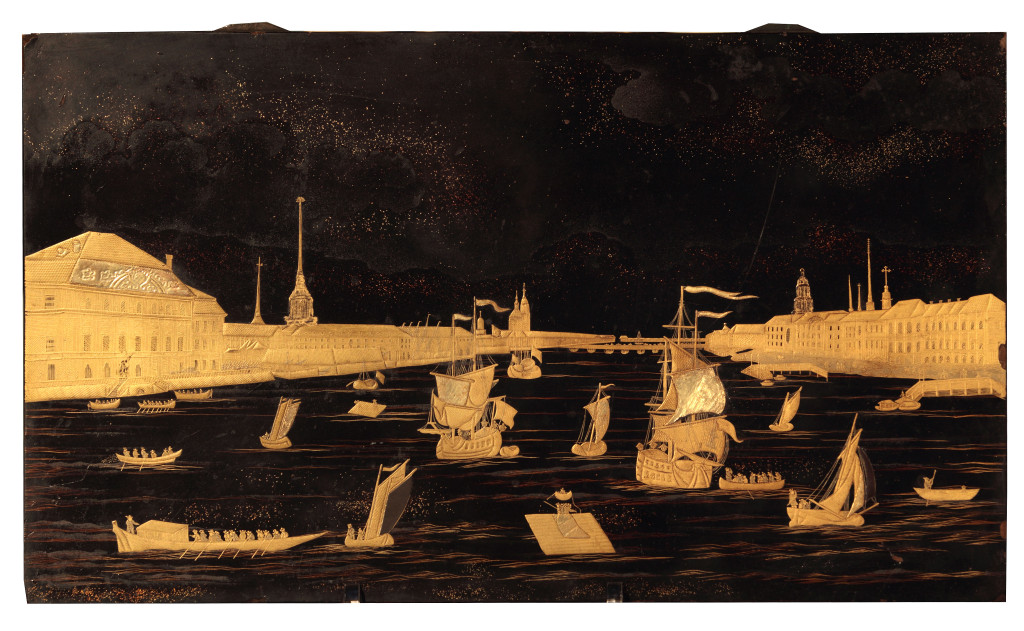
An important Japanese lacquer maki-é panel depicting St. Petersburg on the river Neva with the Winter Palace on the left and the Academy of Science on the right, probably by Lakwerker Sasaya
Nagasaki, 1780-1800
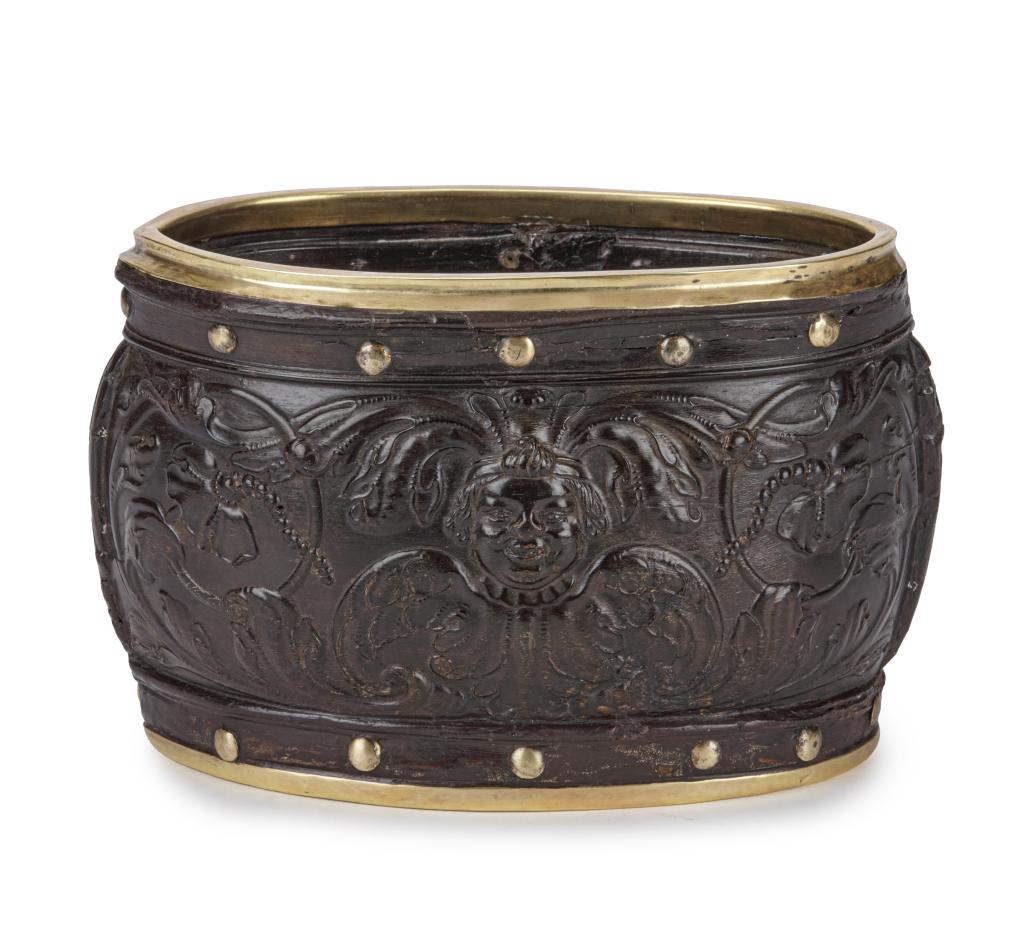
A Dutch brass-mounted pressed baleen casket by Herman Doomer (1595–1650)
_Amsterdam, circa 1640_ _L. 20.7 x W. 13 x H. 14.3 cm_