A pair of Anglo-Indian 'Vizagapatam' pen-engraved bone-inlaid padouk side chairs
India, Visakhapatnam, mid-18th century
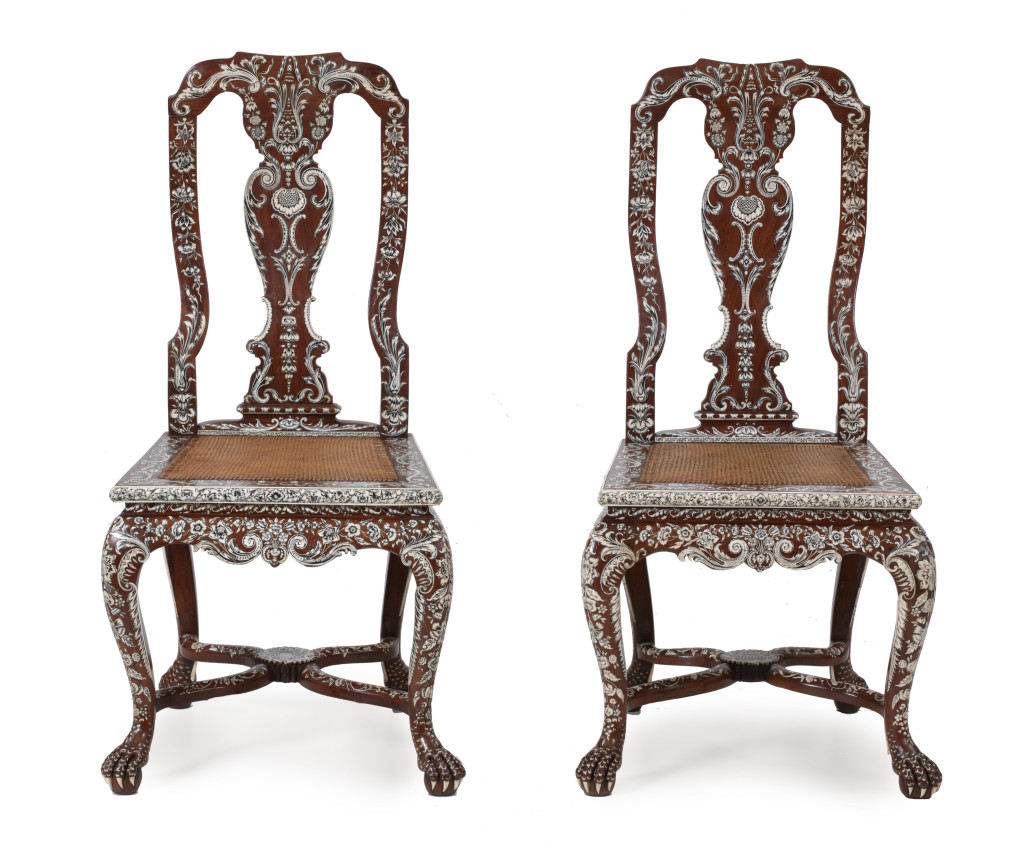
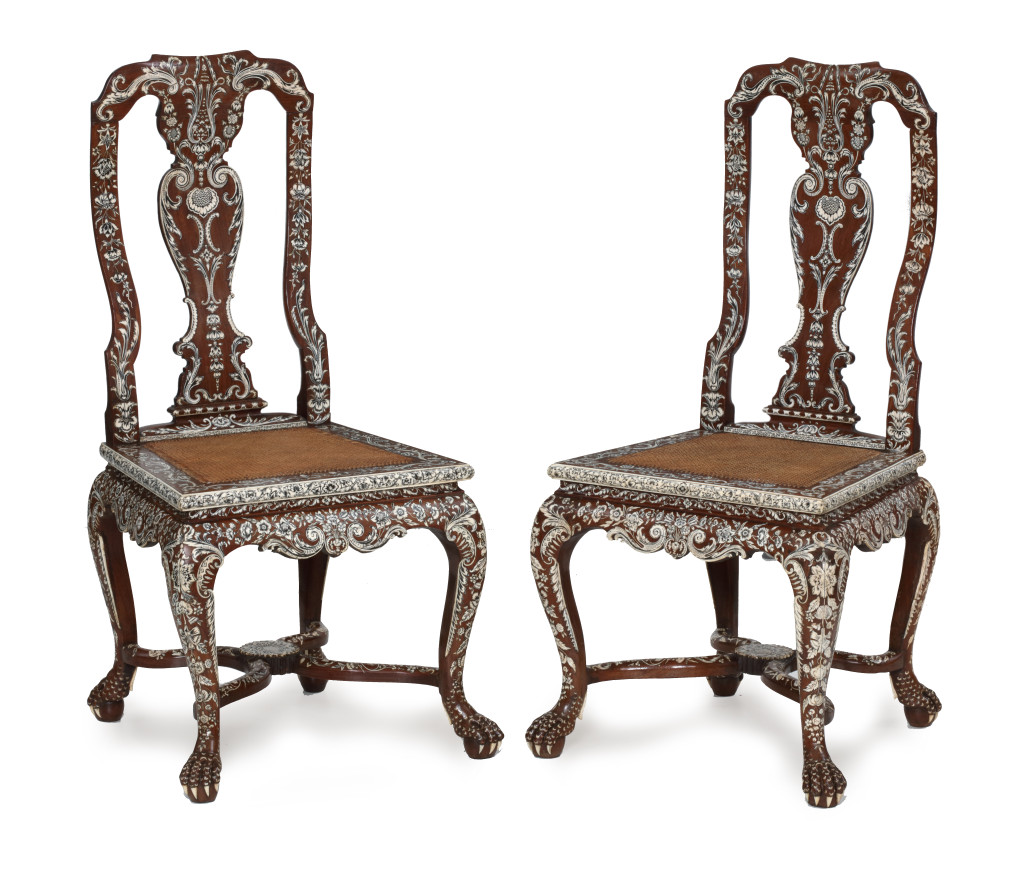
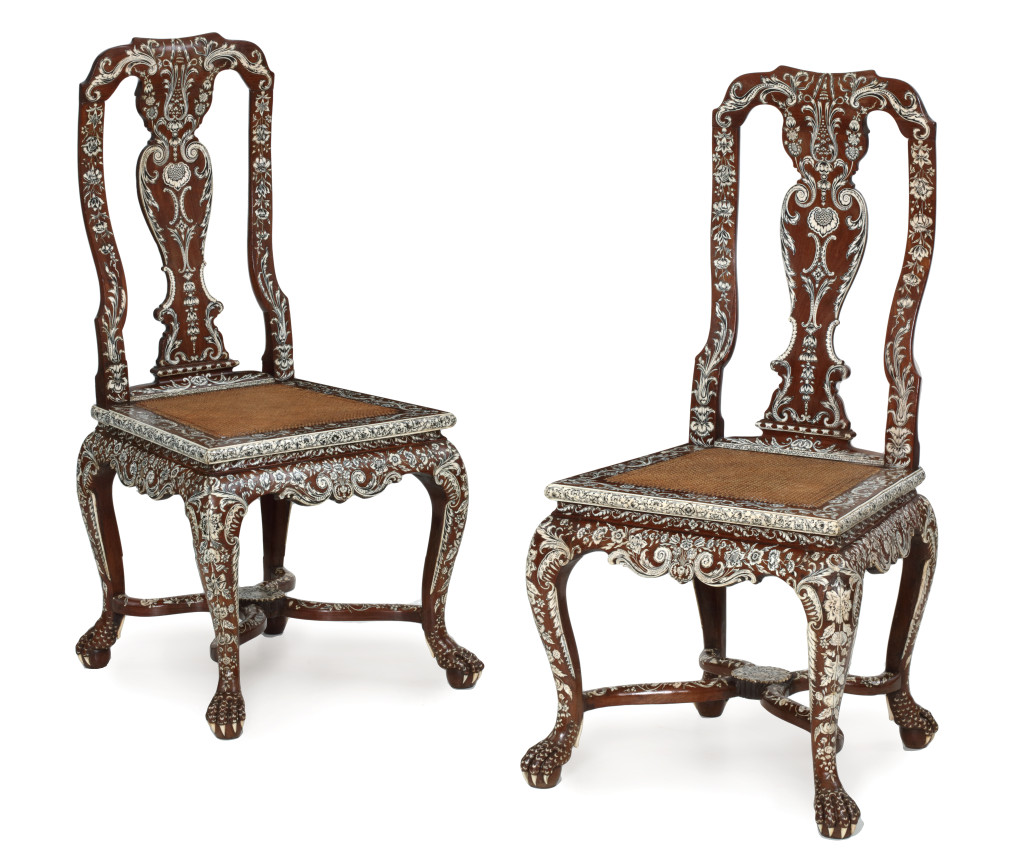
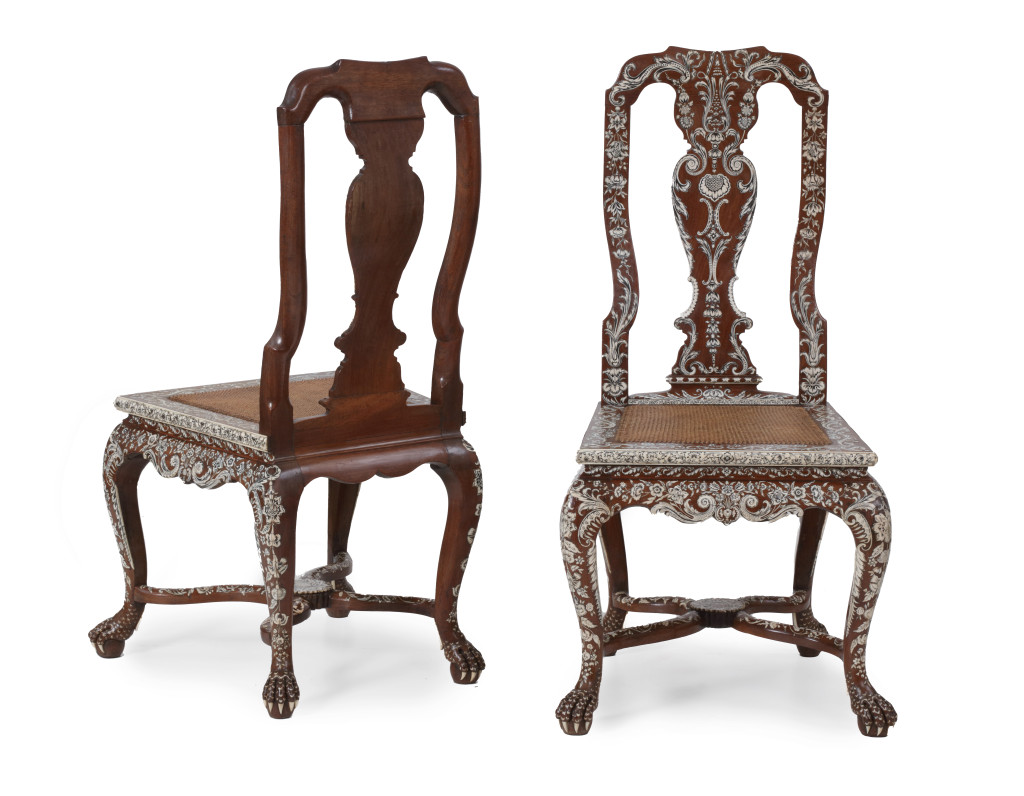
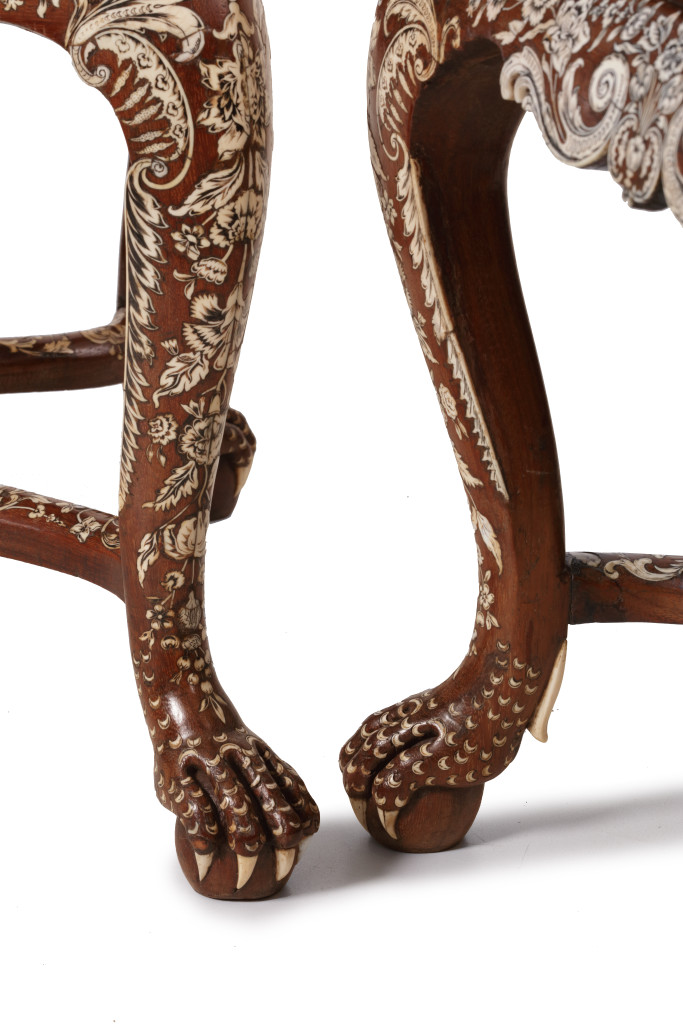
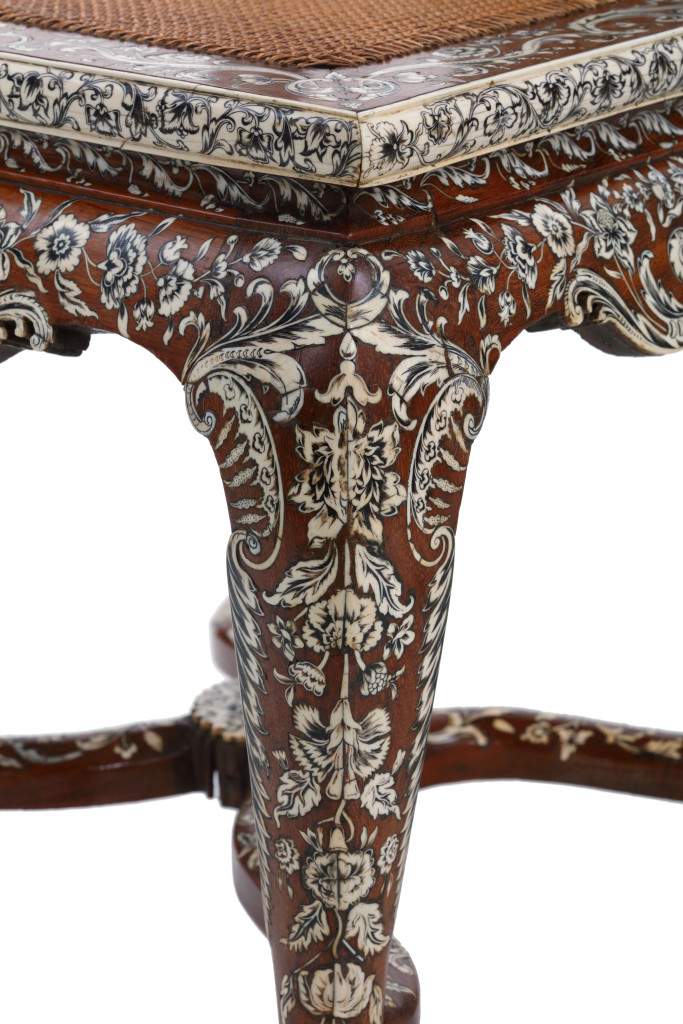
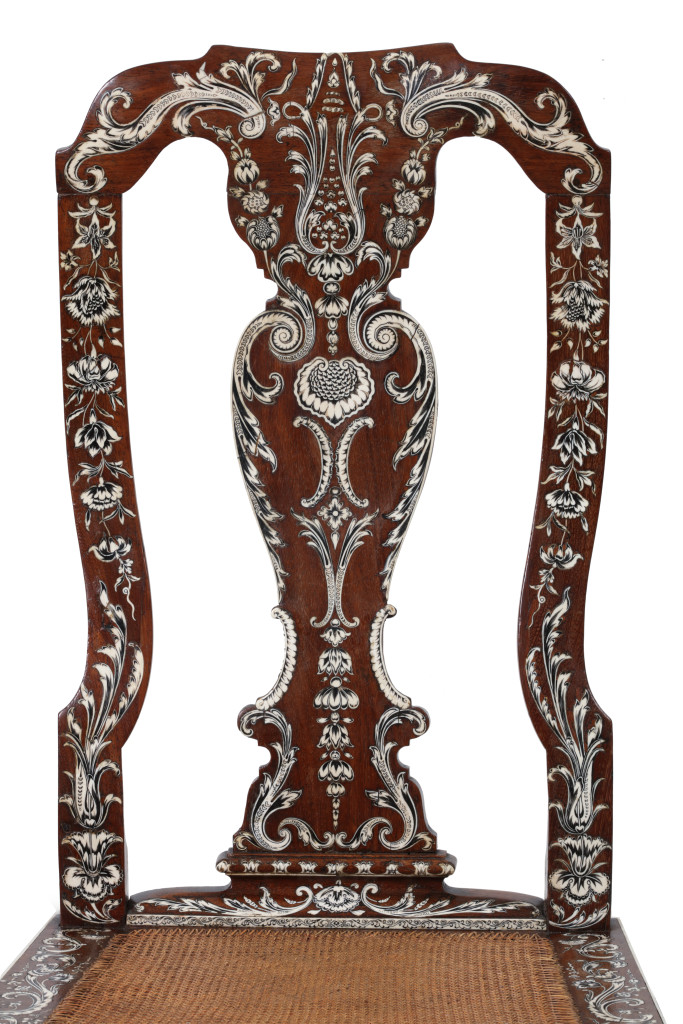
They were crafted from padouk wood and inlaid with delicately engraved bone ornaments. The design of the chairs closely follows European Rococo styles of the period, likely modeled on English prototypes brought to India. Each chair features a curved back with a vase-shaped central splat and serpentine uprights, richly inlaid with scrolling floral and foliate motifs in bone beneath a shaped top rail. The seat is inset with woven cane and bordered by a band of trailing carved leaves and flowers, with the seat frame edged in engraved bone moulding. Below, a concave-molded rail runs around the front and sides of the seat. Above, shaped aprons are also inlaid with scrollwork and floral sprays. The chairs stand on cabriole legs adorned with further foliate carving and trailing bone inlay, terminating in bold claw-and-ball feet with bone claws. An elegant X-shaped stretcher joins the legs with a central lotus-flower medallion, also inlaid in bone.
H. 103.5 x W. 51 x D. 48 cm (each)
Provenance:
By tradition, a gift from the Nawab of Arcot to a British East India Company official
Acquired in Spain by Baron Lionel de Rothschild (1808-79) and subsequently installed at 148, Piccadilly, London
Thence by descent to Victor Rothschild, Esq., 148, Piccadilly, London where the suite was recorded in the library central hall (or entrance hall) and lobby (or west lobby) in 1882, 1904, 1915, 1924 and 1928
Sold from 148 Piccadilly, by order of Victor Rothschild; Sotheby's house sale, 20 April 1937, lot 195 (part), to Partridge
With Lennox Money Antiques, London, December 1973
Acquired circa 1973 and sold Anonymous sale; Christie's, London, 9 July 1998, lot 51
The Collection of Lily & Edmond Safra, sold Sotheby's, New York, 3-4 November 2005, lot 141
Private collection, United Kingdom
These exquisite side chairs are fine examples of mid-18th-century Anglo-Indian furniture made in Vizagapatam, a port city on India’s eastern Coromandel Coast. The base of each chair is particularly striking: the feet are carved as animalistic paws grasping a spherical ball, with small bone segments inlaid to imitate scales or claws. This use of bone accents on the feet—forming the talons and surface ornament—highlights the extraordinary craftsmanship of Vizagapatam artisans. British furniture designs of the Georgian era inspired such claw-and-ball feet. Yet, they are executed with an exotic flair, integrating Indian materials (padouk hardwood and bone) dramatically. This fusion of Western form and Indian workmanship characterizes the unique hybrid aesthetic of Anglo-Indian furniture.
In terms of provenance, by tradition, these chairs were initially presented as a gift from the Nawab of Arcot (a regional Indian ruler) to an official of the British East India Company. The chairs later entered the collection of Baron Lionel de Rothschild (1808–1879), who is said to have acquired a larger suite of such furniture in Spain during the 19th century. Rothschild installed the suite comprising six side chairs, matching armchairs, and a center table in the library of his London residence at 148 Piccadilly. The suite remained at 148 Piccadilly for decades, passing by descent through the Rothschild family, and was documented in several estate inventories of the late 19th and early 20th centuries. In 1937, the contents of the house were sold, and the group of Anglo-Indian chairs was auctioned by Sotheby’s as part of that sale. In the 20th century, pairs from the set surfaced in the art market; for instance, these chairs were owned in the 1970s by Lennox Money Antiques and later formed part of the notable collection of Lily and Edmond J. Safra in the early 2000s.
Scholars consider this Vizagapatam suite among the most magnificent surviving examples of Anglo-Indian furniture from the 18th century. Its overall form and decorative vocabulary were directly influenced by English Rococo designs. Indeed, the patterns correspond to those found in Thomas Chippendale’s Gentleman and Cabinet-Maker’s Director (first published in 1754) and related contemporary furniture. A closely comparable suite, but veneered entirely in ivory, was commissioned for Alexander Wynch, Governor of Fort St. George (Madras) from 1773–1775, and is now in the British Royal Collection. The Wynch suite (which includes chairs of similar profile and inlay) underscores the popularity of these Anglo-Indian interpretations of Chippendale-style designs among high-ranking colonial officials and nobility in the late 18th century. The exceptional quality and lavishness of the Rothschild chairs have been noted since the early 20th century; for example, art historian Dr. Vilhelm Slomann featured them in a 1934 Burlington Magazine article, and R. Edwards and K. de B. Codrington discussed them in Apollo in 1935. Such early documentation indicates that the artistic value of this furniture was recognized well before the current era.
Given their opulence, it has been suggested that furniture of this type was intended not only for private use but also as diplomatic or princely gifts. R. W. Symonds records an illustrative case in The Connoisseur (1934): an armchair closely related to this set (similarly inlaid and with the same claw-and-ball feet) bears an inscription stating it was presented by the Nawab of Arcot to Lady Harland in 1772. (Lady Harland’s husband, Sir Robert Harland, was at that time Commander-in-Chief of the British fleet in India and the King’s plenipotentiary to the Nawab.) This remarkable provenance anecdote demonstrates how Indian rulers like the Nawab of Arcot used luxurious furniture as political gifts to curry favor with British officials. The existence of that inscribed armchair, dated 1772, aligns with the likely timeframe of the Rothschild suite and suggests these chairs, too, may have been originally commissioned as a prestigious gift or to furnish an important colonial residence.
Multiple publications have documented and analyzed these chairs, reflecting their enduring significance. In addition to the 1930s studies mentioned above, Dr. Amin Jaffer examined the set in his article “On the Coast of Coromandel” in Christie’s Magazine, July 1998, situating it within the broader context of the furniture export from India. Jaffer also included the suite in his comprehensive book Furniture from British India and Ceylon (2001), which offers further insight into its manufacture and stylistic origins. More recently, a pair of armchairs from the same Rothschild suite was featured in a 1999 exhibition catalogue by Mallett of London, illustrating another component of this notable group. These chairs and their companion pieces represent a superb intersection of Indian craftsmanship and British design influence, earning a distinguished place in the history of decorative arts.
They were crafted from padouk wood and inlaid with delicately engraved bone ornaments. The design of the chairs closely follows European Rococo styles of the period, likely modeled on English prototypes brought to India. Each chair features a curved back with a vase-shaped central splat and serpentine uprights, richly inlaid with scrolling floral and foliate motifs in bone beneath a shaped top rail. The seat is inset with woven cane and bordered by a band of trailing carved leaves and flowers, with the seat frame edged in engraved bone moulding. Below, a concave-molded rail runs around the front and sides of the seat. Above, shaped aprons are also inlaid with scrollwork and floral sprays. The chairs stand on cabriole legs adorned with further foliate carving and trailing bone inlay, terminating in bold claw-and-ball feet with bone claws. An elegant X-shaped stretcher joins the legs with a central lotus-flower medallion, also inlaid in bone.
H. 103.5 x W. 51 x D. 48 cm (each)
Provenance:
By tradition, a gift from the Nawab of Arcot to a British East India Company official
Acquired in Spain by Baron Lionel de Rothschild (1808-79) and subsequently installed at 148, Piccadilly, London
Thence by descent to Victor Rothschild, Esq., 148, Piccadilly, London where the suite was recorded in the library central hall (or entrance hall) and lobby (or west lobby) in 1882, 1904, 1915, 1924 and 1928
Sold from 148 Piccadilly, by order of Victor Rothschild; Sotheby's house sale, 20 April 1937, lot 195 (part), to Partridge
With Lennox Money Antiques, London, December 1973
Acquired circa 1973 and sold Anonymous sale; Christie's, London, 9 July 1998, lot 51
The Collection of Lily & Edmond Safra, sold Sotheby's, New York, 3-4 November 2005, lot 141
Private collection, United Kingdom
These exquisite side chairs are fine examples of mid-18th-century Anglo-Indian furniture made in Vizagapatam, a port city on India’s eastern Coromandel Coast. The base of each chair is particularly striking: the feet are carved as animalistic paws grasping a spherical ball, with small bone segments inlaid to imitate scales or claws. This use of bone accents on the feet—forming the talons and surface ornament—highlights the extraordinary craftsmanship of Vizagapatam artisans. British furniture designs of the Georgian era inspired such claw-and-ball feet. Yet, they are executed with an exotic flair, integrating Indian materials (padouk hardwood and bone) dramatically. This fusion of Western form and Indian workmanship characterizes the unique hybrid aesthetic of Anglo-Indian furniture.
In terms of provenance, by tradition, these chairs were initially presented as a gift from the Nawab of Arcot (a regional Indian ruler) to an official of the British East India Company. The chairs later entered the collection of Baron Lionel de Rothschild (1808–1879), who is said to have acquired a larger suite of such furniture in Spain during the 19th century. Rothschild installed the suite comprising six side chairs, matching armchairs, and a center table in the library of his London residence at 148 Piccadilly. The suite remained at 148 Piccadilly for decades, passing by descent through the Rothschild family, and was documented in several estate inventories of the late 19th and early 20th centuries. In 1937, the contents of the house were sold, and the group of Anglo-Indian chairs was auctioned by Sotheby’s as part of that sale. In the 20th century, pairs from the set surfaced in the art market; for instance, these chairs were owned in the 1970s by Lennox Money Antiques and later formed part of the notable collection of Lily and Edmond J. Safra in the early 2000s.
Scholars consider this Vizagapatam suite among the most magnificent surviving examples of Anglo-Indian furniture from the 18th century. Its overall form and decorative vocabulary were directly influenced by English Rococo designs. Indeed, the patterns correspond to those found in Thomas Chippendale’s Gentleman and Cabinet-Maker’s Director (first published in 1754) and related contemporary furniture. A closely comparable suite, but veneered entirely in ivory, was commissioned for Alexander Wynch, Governor of Fort St. George (Madras) from 1773–1775, and is now in the British Royal Collection. The Wynch suite (which includes chairs of similar profile and inlay) underscores the popularity of these Anglo-Indian interpretations of Chippendale-style designs among high-ranking colonial officials and nobility in the late 18th century. The exceptional quality and lavishness of the Rothschild chairs have been noted since the early 20th century; for example, art historian Dr. Vilhelm Slomann featured them in a 1934 Burlington Magazine article, and R. Edwards and K. de B. Codrington discussed them in Apollo in 1935. Such early documentation indicates that the artistic value of this furniture was recognized well before the current era.
Given their opulence, it has been suggested that furniture of this type was intended not only for private use but also as diplomatic or princely gifts. R. W. Symonds records an illustrative case in The Connoisseur (1934): an armchair closely related to this set (similarly inlaid and with the same claw-and-ball feet) bears an inscription stating it was presented by the Nawab of Arcot to Lady Harland in 1772. (Lady Harland’s husband, Sir Robert Harland, was at that time Commander-in-Chief of the British fleet in India and the King’s plenipotentiary to the Nawab.) This remarkable provenance anecdote demonstrates how Indian rulers like the Nawab of Arcot used luxurious furniture as political gifts to curry favor with British officials. The existence of that inscribed armchair, dated 1772, aligns with the likely timeframe of the Rothschild suite and suggests these chairs, too, may have been originally commissioned as a prestigious gift or to furnish an important colonial residence.
Multiple publications have documented and analyzed these chairs, reflecting their enduring significance. In addition to the 1930s studies mentioned above, Dr. Amin Jaffer examined the set in his article “On the Coast of Coromandel” in Christie’s Magazine, July 1998, situating it within the broader context of the furniture export from India. Jaffer also included the suite in his comprehensive book Furniture from British India and Ceylon (2001), which offers further insight into its manufacture and stylistic origins. More recently, a pair of armchairs from the same Rothschild suite was featured in a 1999 exhibition catalogue by Mallett of London, illustrating another component of this notable group. These chairs and their companion pieces represent a superb intersection of Indian craftsmanship and British design influence, earning a distinguished place in the history of decorative arts.
Part of the Indian Ocean collection.
Related objects
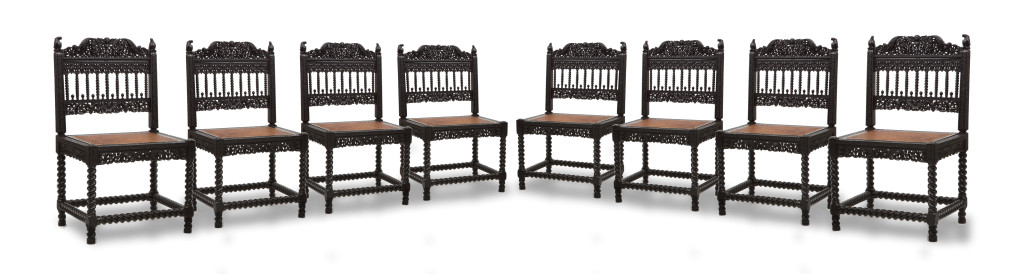
A large set of sixteen fine colonial ebony side chairs and an armchair
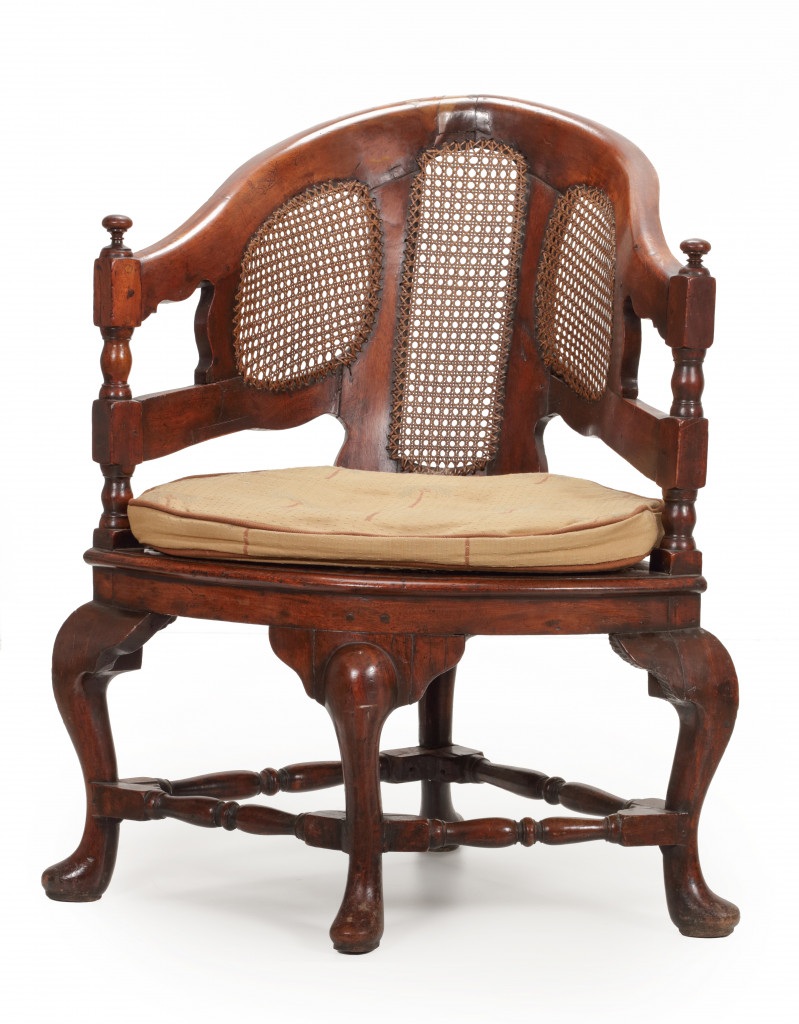
An Indonesian padouk (Pterocarpus dalbergioïdes), djati and rattan corner chair
Dutch Colonial Indonesian padouk, djati corner chairDutch Colonial Indonesian padouk, djati corner chair side twoDutch Colonial Indonesian padouk, djati corner chair with pillowDutch Colonial Indonesian padouk, djati corner chair1/4An Indonesian padouk (Pterocarpus dalbergioïdes), djati and rattan corner chair
No image
Two Sri Lankan satinwood and cane high-back chairs
Sri Lanka High Back Chairs Colonial