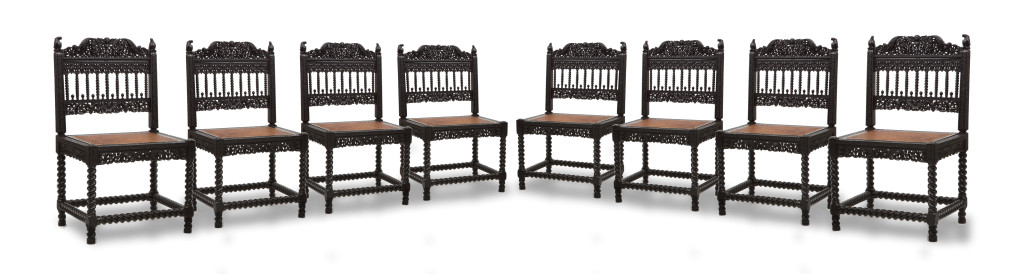
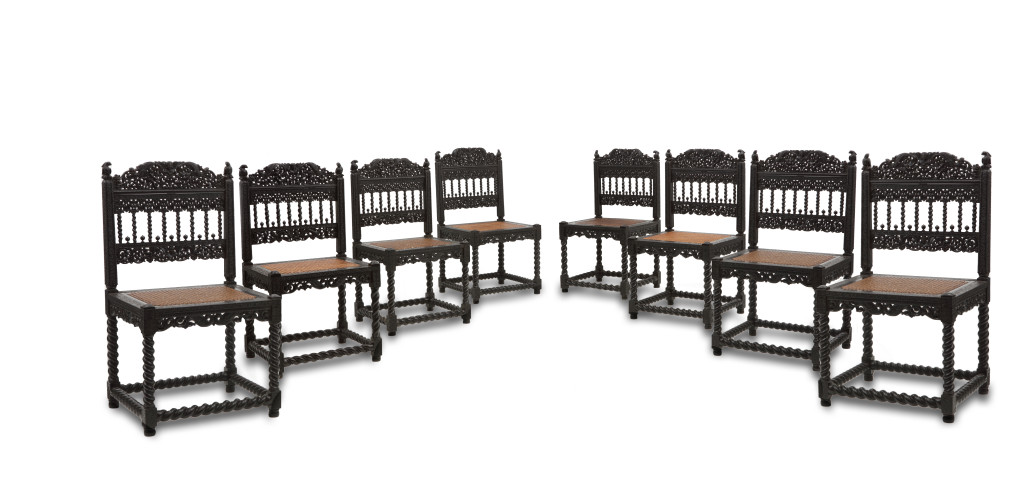
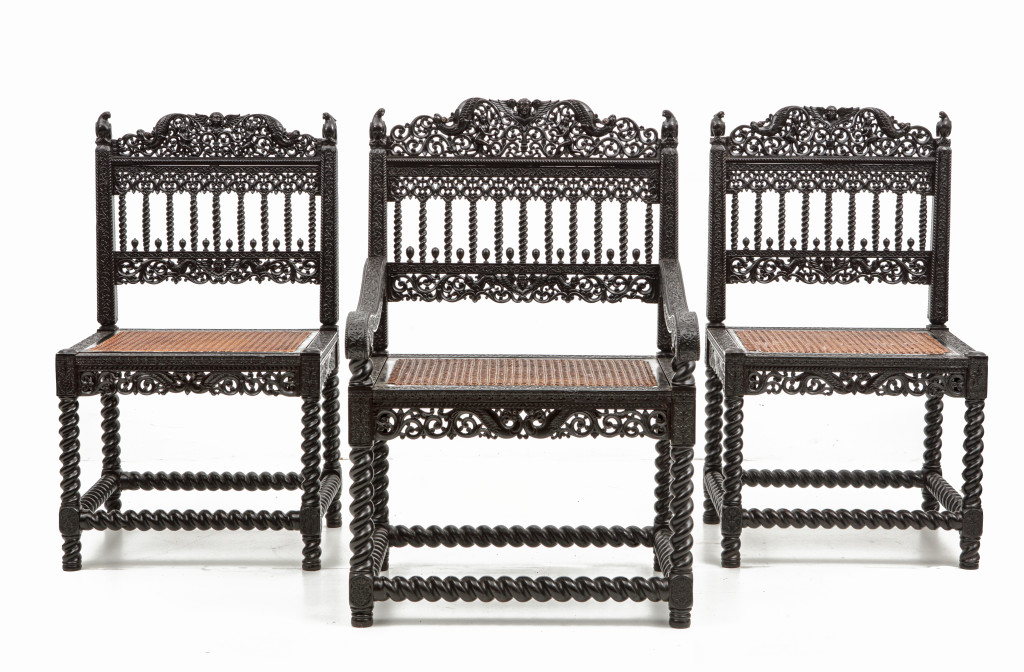
A large set of sixteen fine colonial ebony side chairs and an armchair
Coromandel coast, probably Masulipatnam, circa 1650- 1680
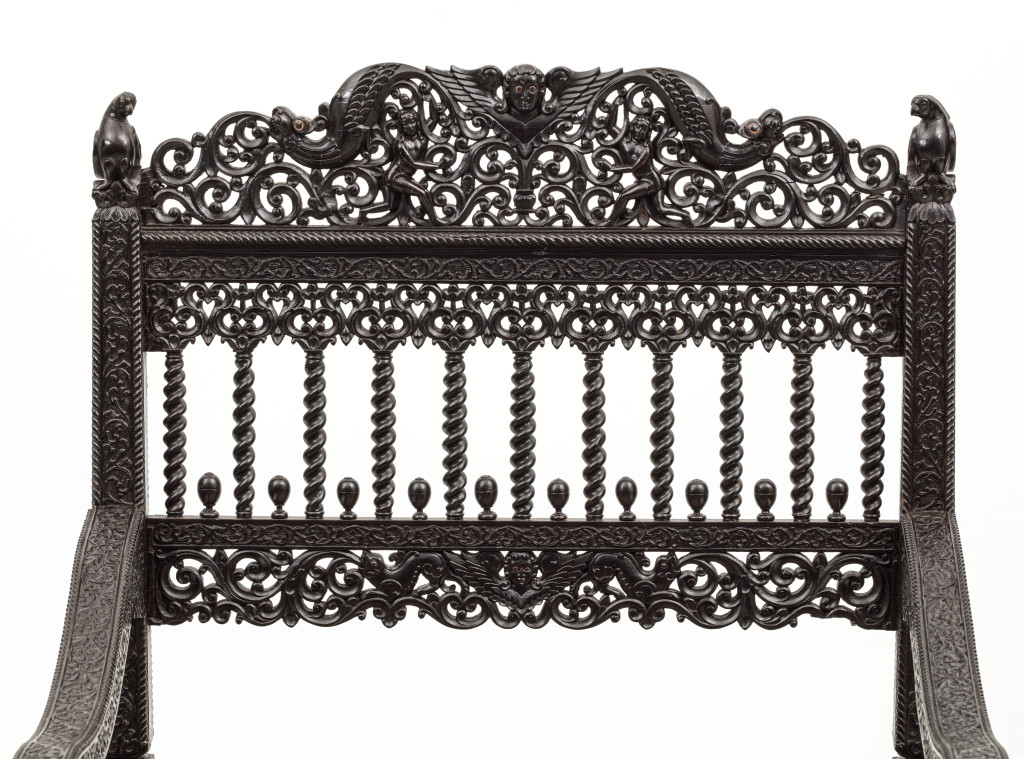
Each chair has an open back with superb pierced and carved decoration, the crest rail with a central winged female head flanked on either side with a nude female figure or absara and a mythical sea creature or makara on the upper edge. Between the crest rail and the lower back rail is a row of eight twist-turned balusters with scrolling foliate capitals, the balusters alternating with seven turned knobs, a winged female head flanked by a pair of makaras at the centre of the lower back rail. The tapering uprights are decorated with scrolling vines, the uprights support finials in the form of birds. The drop-in rectangular seats are re-caned, and the seat rails are carved and pierced with a pair of confronting birds at the centre, with twist-turned legs and a box stretcher.
Several chairs bear the (remains of) a label which reads ‘The Property of the Trustees of the Will of ARTHUR GEORGE EARL OF ONSLOW’, and numbered ‘28’ confirming that they were previously part of the furnishings of Clandon Park House, a famous listed Palladian mansion in Surrey and seat of the Earls of Onslow.
H. 97 x W. 54-55 x D. 47 cm (side chairs)
H. 100 x W. 65.5 x D. 61 cm (armchair)
Provenance:
- Clandon Park House, Surrey
- Rainer Zietz Ltd., London, (1994)
- Private collection, Germany
- Earl’s Court Road Antiques dealer, London (circa 1960)
- Cary Welch, London
- Private collection, Belgium
This type of chair usually turns up in England and seldom in Holland, although they were probably ordered by the Dutch on the Coromandel Coast of India. Possibly the Hindu motifs of animals and humans in the carvings of these so-called “Kust stoelen” were eventually not greatly appreciated in Muslim/Calvinist Java/Batavia. These high points in ebony furniture making were made by Hindu craftsmen in South India converted to Roman Catholicism by the Portuguese in the 16th and 17th centuries. They combined Hindu and Christian motives in a manner not seen again in furniture from India after the 17th century. As in other known examples, the carving is in the round. The carvings on these two chairs bear a close resemblance to the carving of the head- and foot-boards of the ebony rocking cradle in the Rijksmuseum Amsterdam (inv. no. BK-1966-48, illustrated in Asia in Amsterdam, 2015, cat. 26, p.108).
No other group of Indo-European furniture has been as misunderstood as carved ebony furniture made in India, Sri Lanka and the former Dutch East Indies in the second half of the seventeenth century. The furniture itself is of solid ebony, pierced or carved in various degrees of relief, with twist-turned components. Among the forms made were large suites of chairs and settees; and, less commonly, tables, cradles, beds, cabinets and boxes. The production of solid ebony furniture of this type seems to have first began along the Coromandel coast, a textile-producing region settled with European trading factories. Dutch traveller Georg Rumphius (1627-1702) recorded that the coast ‘is exceptionally richly provided of this ebony as the natives make from it all kinds of curious work, as chairs, benches and small tables, carving them out with foliage, and sculpture’.
Carved ebony chairs of this type have been recorded in English collections from as early as the mid-eighteenth century, and much of the confusion about their origin is due to the belief, current in the second half of the eighteenth and most of the nineteenth century, that they were surviving examples of early English furniture. This idea was supported by the rigid, rectilinear forms of the furniture, which looked antiquated to eighteenth-century eyes; the use of twist-turning, which was believed to be typical of Elizabethan furniture; the bizarre, intricate carving, which often included mythic beasts and figures that seemed to have been conceived before the vocabulary of classical ornament began to influence English design; and the colour, black, which was commonly associated with furniture of great antiquity. For Horace Walpole (1717-97), who appears to have been responsible for this attribution, notions about the age of such furniture based on its physical attributes were confirmed by the existence of examples in houses with Tudor associations. In 1748 he saw carved ebony chairs at Esher Place, Surrey, and believed them to be the property of Cardinal Wolsey, who had lived there after 1519. Buying chiefly at auction, Walpole acquired pieces of carved ebony furniture for his Gothic Revival house, Strawberry Hill. By 1759 he had furnished what was to become the Holbein Chamber with ‘chairs & dressing table’ of ‘real carved ebony’. The decoration of Strawberry Hill was widely publicised, both by the numerous visitors to the house and through well-circulated published descriptions (1774; 1784).
By the early 19th century, Walpole’s view that carved ebony furniture of this type was both English and of early date had become firmly established. In his drawings of ‘Ancient Furniture’ (1834), A.W.N. Pugin featured a carved ebony chair of the type at Strawberry Hill depicted beneath a portrait of Henry VIII. In Specimens of Ancient Furniture (published monthly from 1832 to 1836 and then in a single volume in 1836), Henry Shaw included a carved ebony chair of the same type formerly in Walpole’s collection. Works such as these, which were used by antiquaries as reference texts, established the significance of carved ebony in houses with Gothic and Tudor-style interiors, whether old or newly created.
Source:
Amin Jaffer, Luxury Goods From India: the art of the Indian Cabinet- Maker, London, V&A, 2002, pp. 46-47
Each chair has an open back with superb pierced and carved decoration, the crest rail with a central winged female head flanked on either side with a nude female figure or absara and a mythical sea creature or makara on the upper edge. Between the crest rail and the lower back rail is a row of eight twist-turned balusters with scrolling foliate capitals, the balusters alternating with seven turned knobs, a winged female head flanked by a pair of makaras at the centre of the lower back rail. The tapering uprights are decorated with scrolling vines, the uprights support finials in the form of birds. The drop-in rectangular seats are re-caned, and the seat rails are carved and pierced with a pair of confronting birds at the centre, with twist-turned legs and a box stretcher.
Several chairs bear the (remains of) a label which reads ‘The Property of the Trustees of the Will of ARTHUR GEORGE EARL OF ONSLOW’, and numbered ‘28’ confirming that they were previously part of the furnishings of Clandon Park House, a famous listed Palladian mansion in Surrey and seat of the Earls of Onslow.
H. 97 x W. 54-55 x D. 47 cm (side chairs)
H. 100 x W. 65.5 x D. 61 cm (armchair)
Provenance:
- Clandon Park House, Surrey
- Rainer Zietz Ltd., London, (1994)
- Private collection, Germany
- Earl’s Court Road Antiques dealer, London (circa 1960)
- Cary Welch, London
- Private collection, Belgium
This type of chair usually turns up in England and seldom in Holland, although they were probably ordered by the Dutch on the Coromandel Coast of India. Possibly the Hindu motifs of animals and humans in the carvings of these so-called “Kust stoelen” were eventually not greatly appreciated in Muslim/Calvinist Java/Batavia. These high points in ebony furniture making were made by Hindu craftsmen in South India converted to Roman Catholicism by the Portuguese in the 16th and 17th centuries. They combined Hindu and Christian motives in a manner not seen again in furniture from India after the 17th century. As in other known examples, the carving is in the round. The carvings on these two chairs bear a close resemblance to the carving of the head- and foot-boards of the ebony rocking cradle in the Rijksmuseum Amsterdam (inv. no. BK-1966-48, illustrated in Asia in Amsterdam, 2015, cat. 26, p.108).
No other group of Indo-European furniture has been as misunderstood as carved ebony furniture made in India, Sri Lanka and the former Dutch East Indies in the second half of the seventeenth century. The furniture itself is of solid ebony, pierced or carved in various degrees of relief, with twist-turned components. Among the forms made were large suites of chairs and settees; and, less commonly, tables, cradles, beds, cabinets and boxes. The production of solid ebony furniture of this type seems to have first began along the Coromandel coast, a textile-producing region settled with European trading factories. Dutch traveller Georg Rumphius (1627-1702) recorded that the coast ‘is exceptionally richly provided of this ebony as the natives make from it all kinds of curious work, as chairs, benches and small tables, carving them out with foliage, and sculpture’.
Carved ebony chairs of this type have been recorded in English collections from as early as the mid-eighteenth century, and much of the confusion about their origin is due to the belief, current in the second half of the eighteenth and most of the nineteenth century, that they were surviving examples of early English furniture. This idea was supported by the rigid, rectilinear forms of the furniture, which looked antiquated to eighteenth-century eyes; the use of twist-turning, which was believed to be typical of Elizabethan furniture; the bizarre, intricate carving, which often included mythic beasts and figures that seemed to have been conceived before the vocabulary of classical ornament began to influence English design; and the colour, black, which was commonly associated with furniture of great antiquity. For Horace Walpole (1717-97), who appears to have been responsible for this attribution, notions about the age of such furniture based on its physical attributes were confirmed by the existence of examples in houses with Tudor associations. In 1748 he saw carved ebony chairs at Esher Place, Surrey, and believed them to be the property of Cardinal Wolsey, who had lived there after 1519. Buying chiefly at auction, Walpole acquired pieces of carved ebony furniture for his Gothic Revival house, Strawberry Hill. By 1759 he had furnished what was to become the Holbein Chamber with ‘chairs & dressing table’ of ‘real carved ebony’. The decoration of Strawberry Hill was widely publicised, both by the numerous visitors to the house and through well-circulated published descriptions (1774; 1784).
By the early 19th century, Walpole’s view that carved ebony furniture of this type was both English and of early date had become firmly established. In his drawings of ‘Ancient Furniture’ (1834), A.W.N. Pugin featured a carved ebony chair of the type at Strawberry Hill depicted beneath a portrait of Henry VIII. In Specimens of Ancient Furniture (published monthly from 1832 to 1836 and then in a single volume in 1836), Henry Shaw included a carved ebony chair of the same type formerly in Walpole’s collection. Works such as these, which were used by antiquaries as reference texts, established the significance of carved ebony in houses with Gothic and Tudor-style interiors, whether old or newly created.
Source:
Amin Jaffer, Luxury Goods From India: the art of the Indian Cabinet- Maker, London, V&A, 2002, pp. 46-47
Part of the Indian Ocean collection.
Related objects
No image
Two Sri Lankan satinwood and cane high-back chairs
Sri Lanka High Back Chairs Colonial
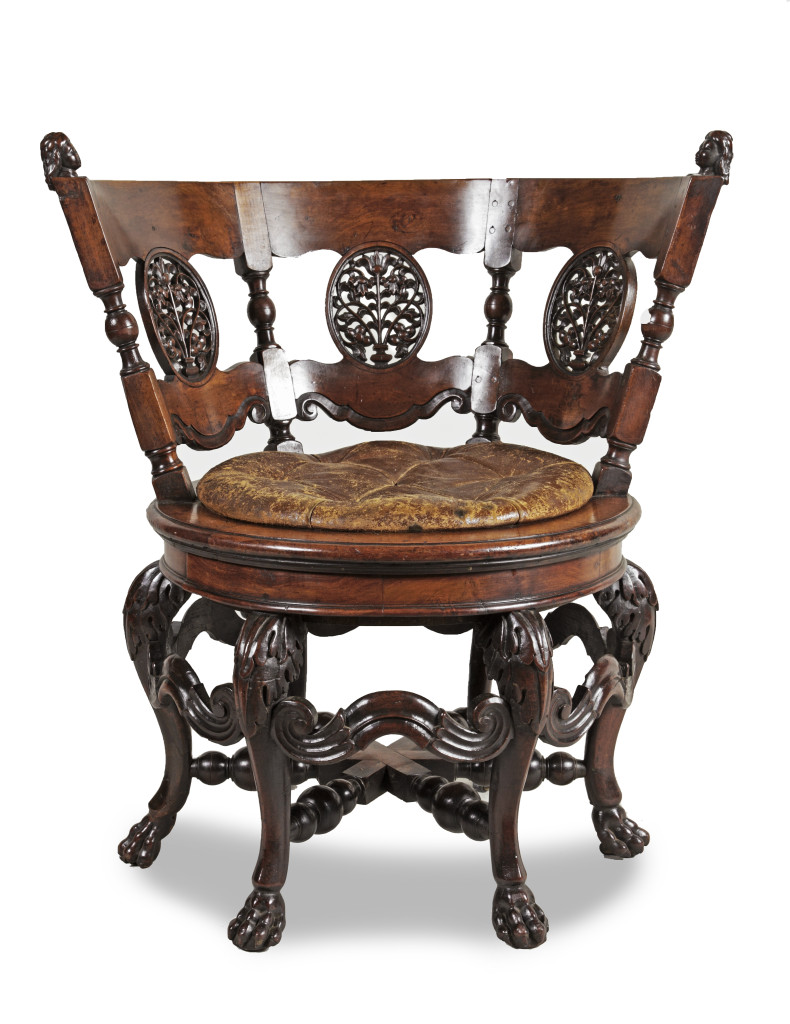
A fine Sri Lankan satinwood and leather 'burgomaster' chair
Sri Lanka Burgomaster Chair leather seat
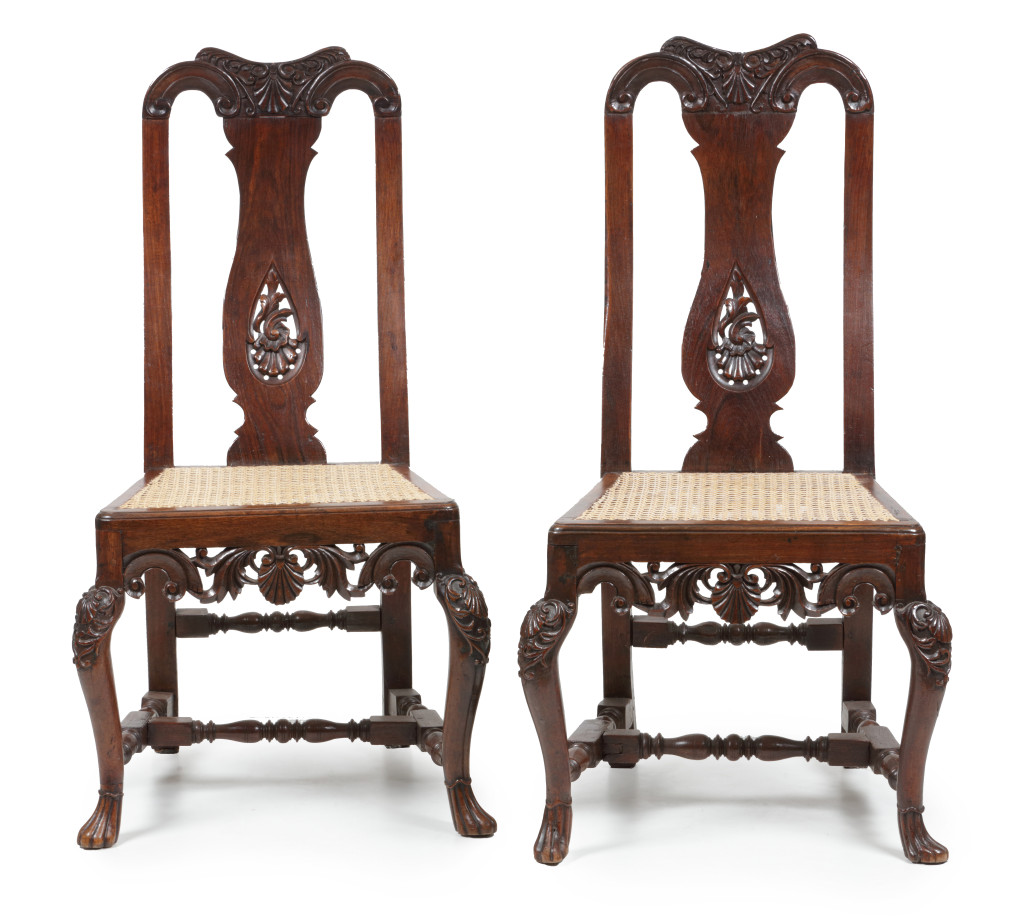
Pair of Sri Lankan East-Indian walnut, or mãrã, high-back side chairs
Sri Lanka, Dutch colonial, mid 18th century