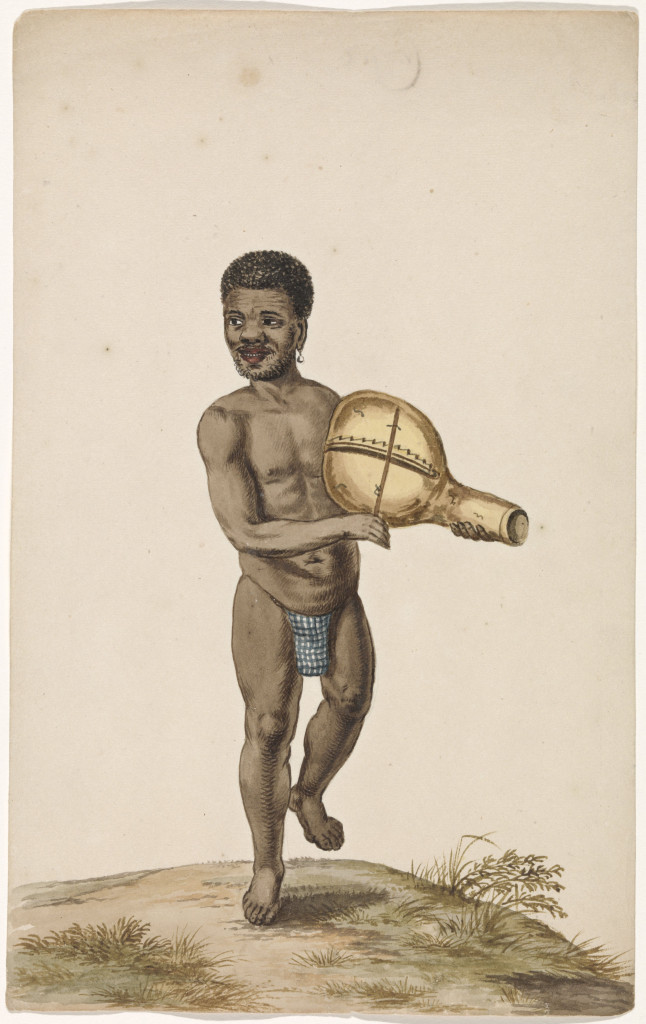
Follower of Andries Beeckman (1628-1664)
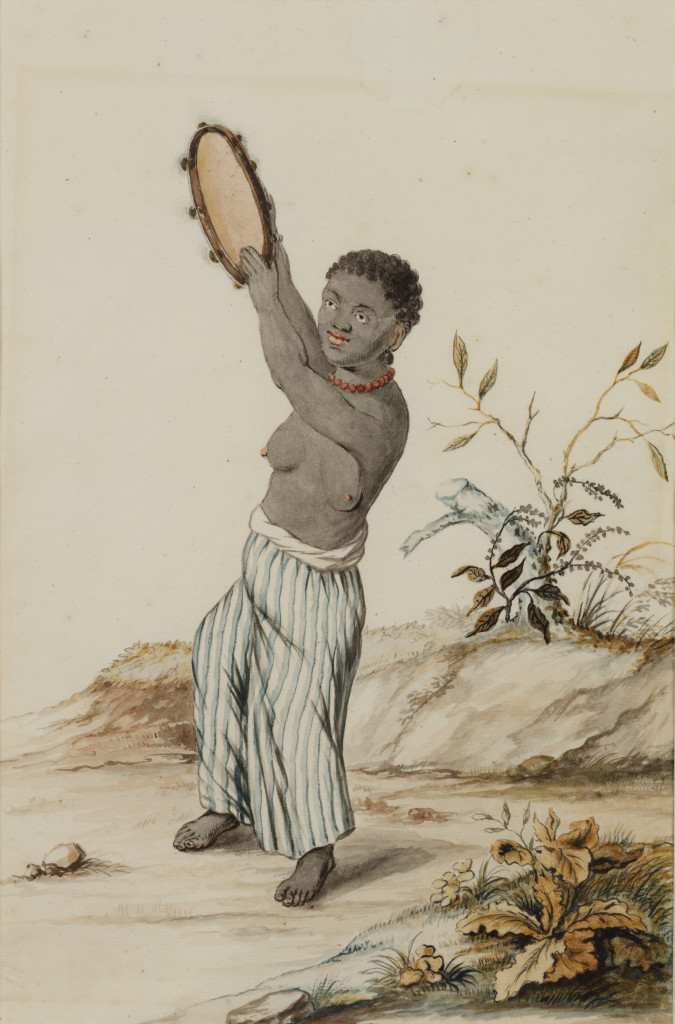
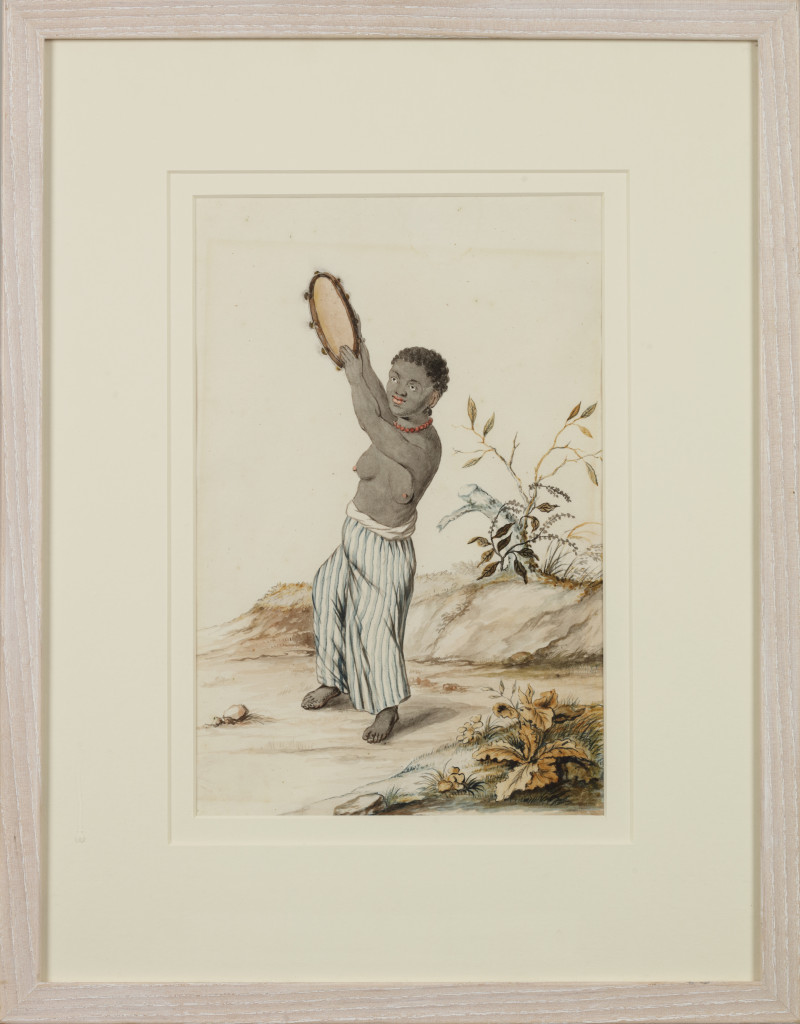
African Woman with Tambourine (c. 1685-1725)
Watercolour on paper, H. 31 x W. 20.5 cm
The paper has an Amsterdam coat-of-arms watermark used between 1685 and 1700. Since paper could have been stored, this drawing might have been made slightly later, but probably in the last quarter of the 17th century.
Provenance:
- Private collection, United Kingdom
- With Finch & Co, London
Andries Beeckman travelled to the Cape and Batavia (Jakarta) as one of the few artists early in the 17th century. Beeckman’s work provides valuable visual accounts of 17th-century life in the Dutch colonies. His works are characterized by intricate details and a keen observation of daily life, trade activities, and the diverse peoples of the former Dutch East Indies and the Cape.
The African woman in this watercolour can be seen wearing ‘slave beads’. These had the symbolic function of reinforcing a woman’s social identity and, simultaneously to ward off evil (or potentially dangerous spirits). The beads were silent witnesses in one sense, and they were also exquisitely revealing in others. They spoke loudly
to individuals familiar with their cultural framework. Ironically, one reason owners of enslaved Africans let women wear beads and other similar objects that expressed a woman’s African cultural identity was that the potent symbolism escaped ‘Western’ eyes. European or Euro-American men saw beads as simply decorative trifles: women’s things not worthy of much heed; thus, they survived. By diminishing the importance of jewellery, members of the dominant culture unknowingly permitted its use and, hence, its African symbolism to persist unchecked.
According to the other copy in the Rijksmuseum, the original title of this drawing is ‘Een Kafferin’. The term Kaffer or Kaffir, is an exonym and an ethnic slur – the use of it for black people being particularly common in South Africa. In Arabic, the word kāfir (“unbeliever”) was originally applied to non-Muslims. During the Age of Exploration in early modern Europe, variants of the Latin term cafer (cafri) were adopted in reference to non-Muslim Bantu peoples even when they were monotheistic. It was eventually used, particularly in Afrikaans, for any black person during the Apartheid and Post-Apartheid eras, closely associated with South African racism. It became a pejorative by the mid-20th century and is now considered extremely offensive hate speech.
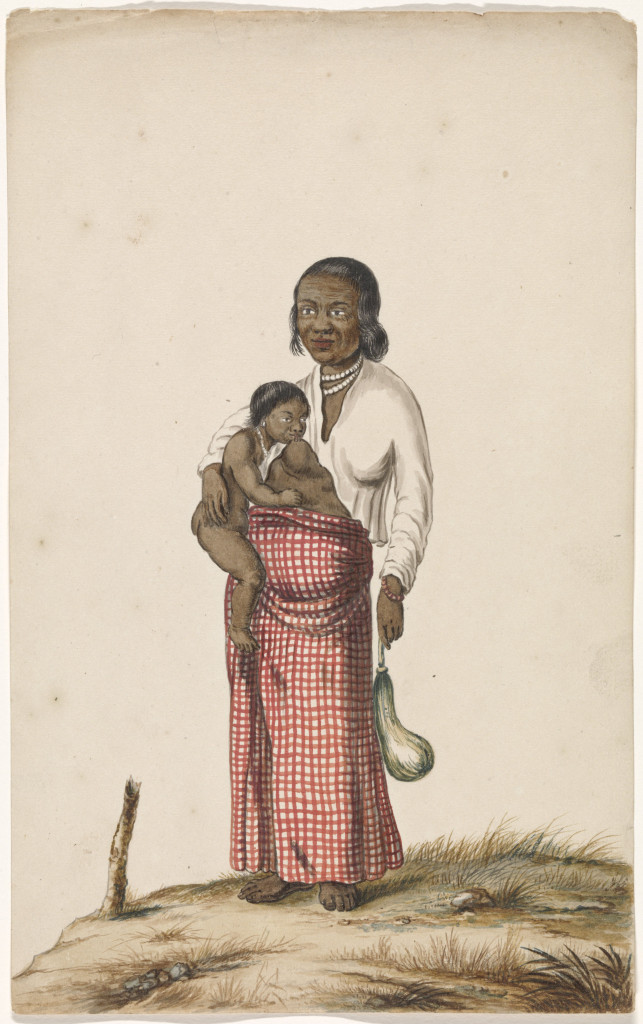
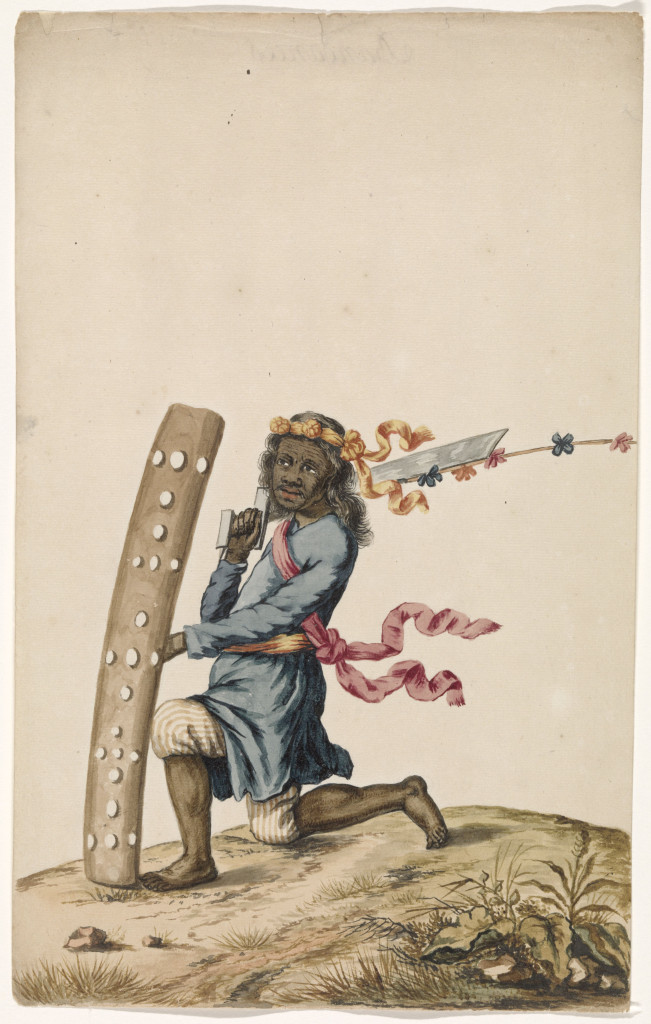
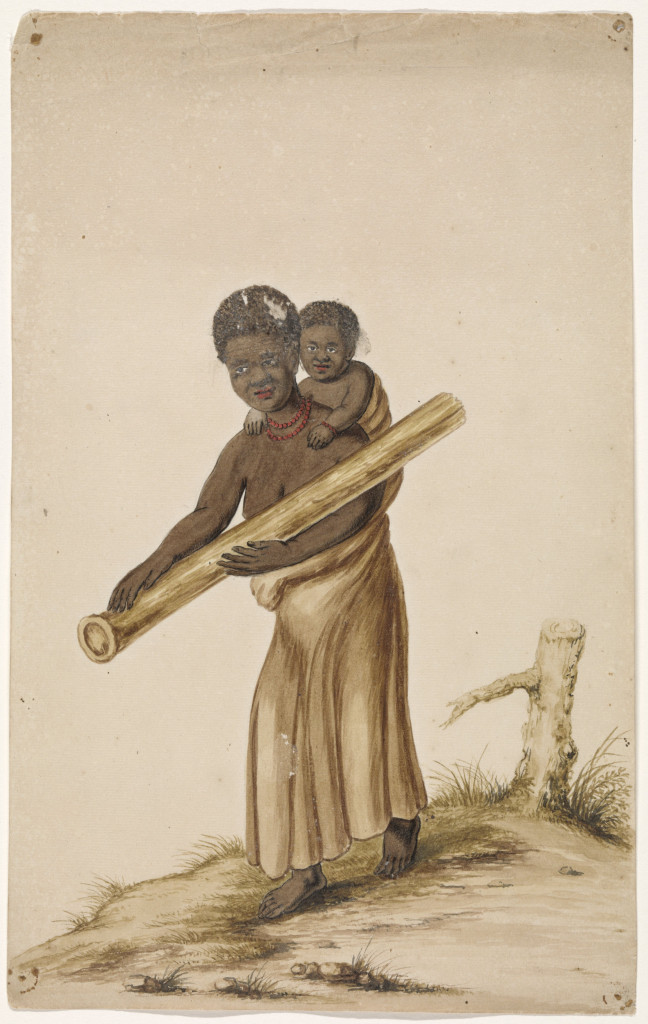
This drawing is one of a series of illustrations depicting non-Europeans, often presented in an album. Andries Beeckman probably made several similar series that found a ready market among European collectors and owners of cabinets of curiosities. The Album de Paulmy in the Bibliothèque de l’Arsenal in Paris contains fifty-five sheets of people and animals, of which two are signed by Beeckman. This series includes inhabitants and animals from Asia, Africa, and South America. Beeckman would have been able to see the Asian and African subjects on his journey to Indonesia, so most of them were probably drawn from his own observation. This is not the case for the South American animals because, as far as we know, Beeckman never visited that continent. Beeckman’s watercolour series were so popular that they were still being copied well into the 18th century. Fragments of at least three other series are known.
The Rijksmuseum acquired sixteen sheets, which are early copies after Beeckman too like the present drawing (see extra images). To judge by the watermark and the style, they date from the last quarter of the seventeenth century or the beginning of the eighteenth. They may have been made after an original series by Beeckman that has not survived because several drawings in this series, like The Ternatan, The Persian and The Mestiza, are not in the Paulmy Album or other series. Research has revealed that eighteen sheets from the same series are still in private collections. This means that we know of thirty-four watercolour drawings in this series, sixteen of which are in the Rijksmuseum. The present drawing is part of another series of drawings - since the Rijksmuseum already holds a copy of the woman with a tambourine. Due to the comparable watermark in both drawings, they were made at almost the same time and perhaps by the same hand.
Sources:
– Onishi, Norimitsu, “Jail Time for Using South Africa’s Worst Racial Slur?”,in: The New York Times, 27 October 2016
– Menno Jonker, Erlend de Groot, Caroline de Hart, Niels Bergervoet , Van velerlei pluimage : zeventiende-eeuwse waterverftekeningen van Andries Beeckman, Nijmegen, Uitgeverij Vantilt, 2014, p. 164, 167, no. 39
– Malika M’rani Alaoui, Jonathan Bikker, Jan de Hond, Frits Scholten, Eveline Sint Nicolaas, Matthias Ubl & Jeroen van Vliet, “Recent acquisitions” in: Rijksmuseum Bulletin, 2017, pp. 209-239, no. 9
Watercolour on paper, H. 31 x W. 20.5 cm
The paper has an Amsterdam coat-of-arms watermark used between 1685 and 1700. Since paper could have been stored, this drawing might have been made slightly later, but probably in the last quarter of the 17th century.
Provenance:
- Private collection, United Kingdom
- With Finch & Co, London
Andries Beeckman travelled to the Cape and Batavia (Jakarta) as one of the few artists early in the 17th century. Beeckman’s work provides valuable visual accounts of 17th-century life in the Dutch colonies. His works are characterized by intricate details and a keen observation of daily life, trade activities, and the diverse peoples of the former Dutch East Indies and the Cape.
The African woman in this watercolour can be seen wearing ‘slave beads’. These had the symbolic function of reinforcing a woman’s social identity and, simultaneously to ward off evil (or potentially dangerous spirits). The beads were silent witnesses in one sense, and they were also exquisitely revealing in others. They spoke loudly
to individuals familiar with their cultural framework. Ironically, one reason owners of enslaved Africans let women wear beads and other similar objects that expressed a woman’s African cultural identity was that the potent symbolism escaped ‘Western’ eyes. European or Euro-American men saw beads as simply decorative trifles: women’s things not worthy of much heed; thus, they survived. By diminishing the importance of jewellery, members of the dominant culture unknowingly permitted its use and, hence, its African symbolism to persist unchecked.
According to the other copy in the Rijksmuseum, the original title of this drawing is ‘Een Kafferin’. The term Kaffer or Kaffir, is an exonym and an ethnic slur – the use of it for black people being particularly common in South Africa. In Arabic, the word kāfir (“unbeliever”) was originally applied to non-Muslims. During the Age of Exploration in early modern Europe, variants of the Latin term cafer (cafri) were adopted in reference to non-Muslim Bantu peoples even when they were monotheistic. It was eventually used, particularly in Afrikaans, for any black person during the Apartheid and Post-Apartheid eras, closely associated with South African racism. It became a pejorative by the mid-20th century and is now considered extremely offensive hate speech.
This drawing is one of a series of illustrations depicting non-Europeans, often presented in an album. Andries Beeckman probably made several similar series that found a ready market among European collectors and owners of cabinets of curiosities. The Album de Paulmy in the Bibliothèque de l’Arsenal in Paris contains fifty-five sheets of people and animals, of which two are signed by Beeckman. This series includes inhabitants and animals from Asia, Africa, and South America. Beeckman would have been able to see the Asian and African subjects on his journey to Indonesia, so most of them were probably drawn from his own observation. This is not the case for the South American animals because, as far as we know, Beeckman never visited that continent. Beeckman’s watercolour series were so popular that they were still being copied well into the 18th century. Fragments of at least three other series are known.
The Rijksmuseum acquired sixteen sheets, which are early copies after Beeckman too like the present drawing (see extra images). To judge by the watermark and the style, they date from the last quarter of the seventeenth century or the beginning of the eighteenth. They may have been made after an original series by Beeckman that has not survived because several drawings in this series, like The Ternatan, The Persian and The Mestiza, are not in the Paulmy Album or other series. Research has revealed that eighteen sheets from the same series are still in private collections. This means that we know of thirty-four watercolour drawings in this series, sixteen of which are in the Rijksmuseum. The present drawing is part of another series of drawings - since the Rijksmuseum already holds a copy of the woman with a tambourine. Due to the comparable watermark in both drawings, they were made at almost the same time and perhaps by the same hand.
Sources:
– Onishi, Norimitsu, “Jail Time for Using South Africa’s Worst Racial Slur?”,in: The New York Times, 27 October 2016
– Menno Jonker, Erlend de Groot, Caroline de Hart, Niels Bergervoet , Van velerlei pluimage : zeventiende-eeuwse waterverftekeningen van Andries Beeckman, Nijmegen, Uitgeverij Vantilt, 2014, p. 164, 167, no. 39
– Malika M’rani Alaoui, Jonathan Bikker, Jan de Hond, Frits Scholten, Eveline Sint Nicolaas, Matthias Ubl & Jeroen van Vliet, “Recent acquisitions” in: Rijksmuseum Bulletin, 2017, pp. 209-239, no. 9