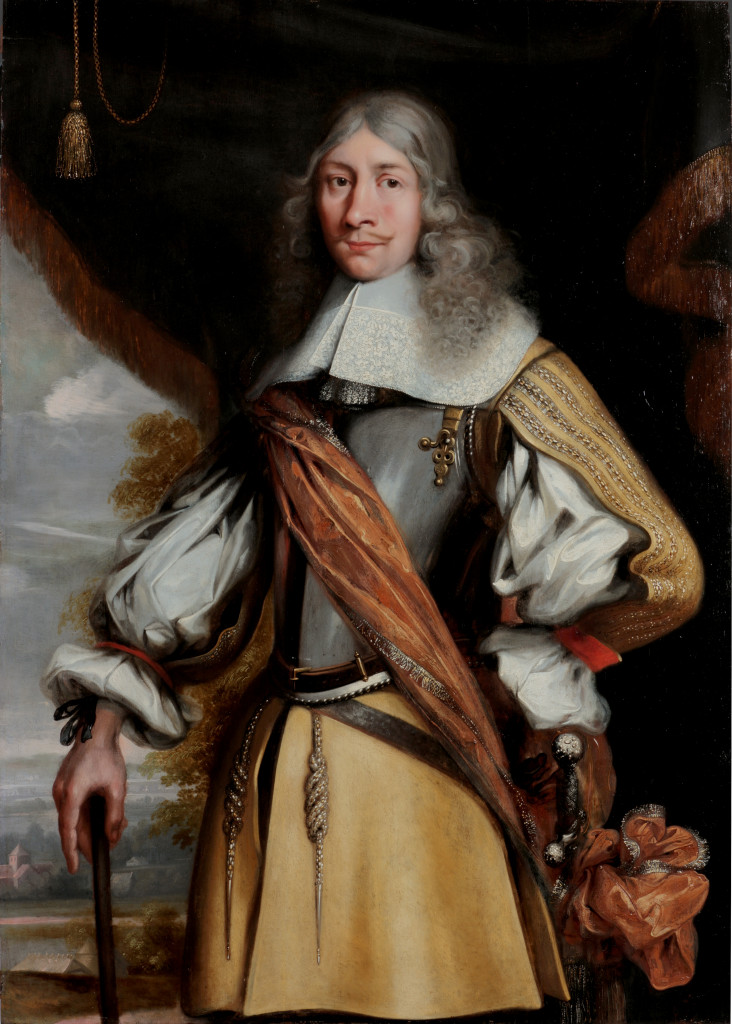
Attributed to or follower of Jürgen Ovens (1623-1678)
Oil on parqueted panel, 115 x 80 cm
Rijcklof was born in 1619 in Rees, near Cleves in present-day North Rhine-Westphalia. In 1628 his father Volckert Boyckes van Goens with his wife and son sailed on the VOC ship “Bueren” to Batavia to become the new commander of the VOC troops in Batavia. Rijcklof was just 10 years when he left Amsterdam with his parents. Within a month after arriving in Batavia in 1629 his father died and soon his mother followed, leaving Rijcklof an orphan in Batavia without money. Thanks to the intercession of his uncle Boycke who was an employee of the VOC, Rijcklof was taken into the employment of the VOC and was sent to the Coromandel Coast where his career in the VOC started. In 1734 he returned to Batavia where within fifteen years he became a member of the “Raad van Indië”. Rijcklof played a leading rôle in the conquest of important bases on the coasts of India and Ceylon in 1653 and 1654. It was his intention to make Ceylon the centre of the VOC power in Asia but “de Heeren XVII” in Amsterdam decided that Batavia should remain the VOC headquarter. Between 1655 and 1657 Rijckloff was back in Holland and as a very successful VOC employee, it was only natural that he then had his portrait(s) painted. In 1657 he was back in Asia where he became admiral of the fleet and conquered Tutucorijn, Manaar, Jaffnapatam and Negapatnam on Ceylon and later Cranganoor, Cochin and Cannanoor on the Malabar coast from the Portuguese. From 1665 till 1675 Rijcklof was Governor General of Ceylon where he was succeeded by his son of the same name. From 1676 till 1680 he succeeded Joan Maetsuyker as Governor-General in Batavia. During this period his portrait as Governor-General was painted in Batavia possibly by Marten Palin who also painted the portrait of van Goens successor Cornelis Speelman. That portrait of van Goens now is one of the VOC Governor General portraits in the collection of the Rijksmuseum Amsterdam. In 1682 van Goens returned to Holland where he died within three months after his return, in Amsterdam the 14th of November 1682. He was buried in the Kloosterkerk in The Hague where his tomb is still present today with a poem proclaiming his heroic deeds as an epitaph. Rijcklof van Goens was one of the truly great leaders in the history of the VOC. Jürgen or Jurriaen Ovens as he was known in the Netherlands, was born in Tönning (Holstein) and arrived for the first time in Amsterdam in 1640, 17 years old. He apparently became a pupil of Rembrandt but the paintings by Anthony van Dyck seem to have had a greater influence on his works, mainly portraits. He became a close friend and collaborator of Govaert Flinck and when Flinck died he was asked to finish a painting by Flinck to be placed in the town hall when Rembrandt’s “The Conspiracy of Claudius Civilis” was rejected. In 1650 he became the court painter for the Dukes of Holstein-Gottorp where he spent most of his time but he was in Stockholm in 1654 and in Amsterdam in 1656. In his days his fame as a portrait painter even exceeded that of Rembrandt. He painted portraits of Charles II of England, Queen Christina of Sweden, Queen Sophie Amalia of Denmark, admiral Maarten Tromp, Godert de Ginkell 1st Earl of Athlone, Colonel John Hutchinson and many others. Another version of the present portrait of Rijcklof van Goens dated 1656 and also attributed to Jürgen Ovens is in a private collection in Stockholm. In 1656, before returning to Indonesia van Goens wrote a summary of his expenses: “for carving of one large picture frame fl.200, 6 smaller ones fl. 150, the wood and preparations fl.48, gilding fl.117, for 4 portraits of myself, my wife, my father and uncle to Flinck fl.800, for 2 portraits of my children to Lutkenhuysen fl.200, 4 more portraits fl.200 and 2 paintings by Lutkenhuysen fl.200, 3 paintings by van de Velde de Oude fl.1770, 3 paintings by van de Velde de Jonge fl.480, 5 portraits by van der Helst fl.1400 and 2 more portraits by Flinck fl.400” (Berigten van het Historisch Genootschap, deel V, page 46-48). All these paintings van Goens left behind with family and caretakers in Amsterdam when he returned to Indonesia again on September 26, 1656. The present portrait is not in the style of Govaert Flinck and much more in the style of Ovens. Unfortunately, all four portraits by Flinck appear to be lost. So two very similar copies of a portrait of van Goens, painted in 1656, still exist, both unsigned, one in Stockholm and the present, until recently unknown, copy.
These two portraits could be contemporary copies after a lost(?) original portrait of Rijcklof van Goens, possibly by Jürgen Ovens. There are some striking similarities in the depiction of material, the stance of the sitter and style in the portrait of Jan Barend Schaep (ca. 1659) in the Amsterdam Museum, and of Friedrich von Günteroth (1671) in the Sleeswijk Museum, both unsigned and both attributed to Jürgen Ovens. However, whether the present portrait was painted by Ovens himself or by a pupil or follower remains difficult to establish. The background of both the present portrait and the one in Stockholm is a Dutch river landscape, possibly the Rhine near Rees where Rijcklof was born. In 1656 when this portrait was painted van Goens still was without territorial authority so was not yet allowed to carry a baton and instead, he is holding just a walking stick.
According to a sticker on the reverse of the present portrait, it was owned by Jhr. Evert Rein van der Wyck (1876-1934) and his wife Frederica Sophia Carolina Speelman (1883-1975) who had it restored in 1925. There appears to be no direct family connection between them and van Goens but interesting enough Cornelis Speelman (1628-1684) who succeeded Rijcklof van Goens as Governor-General of the Dutch East Indies in 1681, is the great-great-great-great-great-grandfather of Frederica Speelman and also Gustaaf Willem baron van Imhoff (1705-1750) who was Governor General in Batavia from 1743 till 1750, is the great-great-great-great-grandfather of Frederica.
Related objects
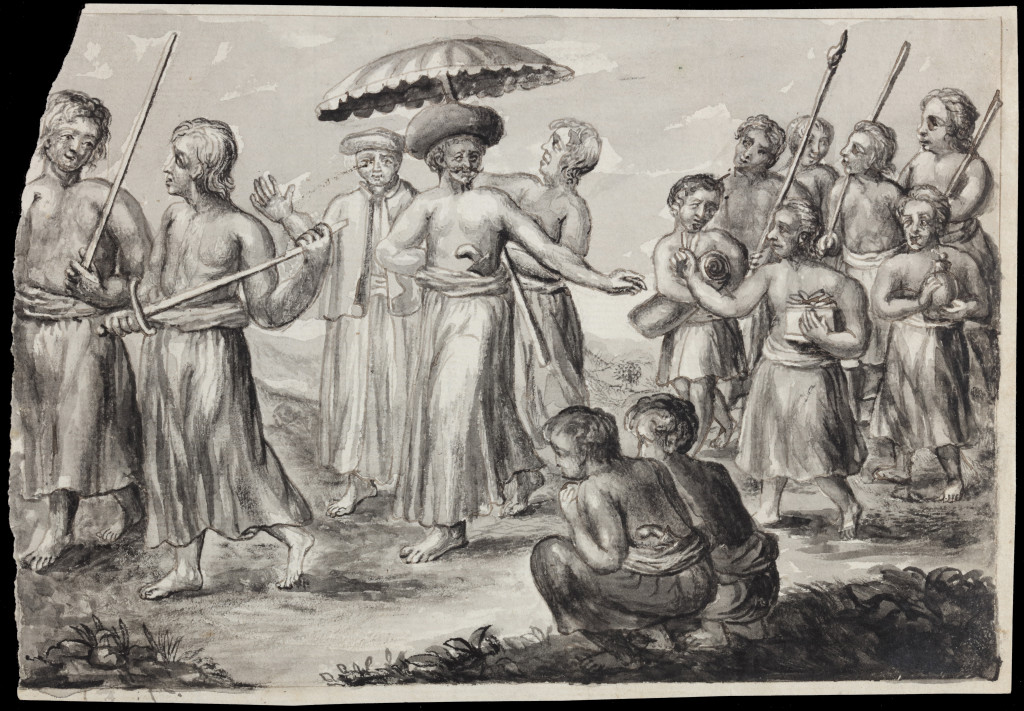
Attributed to Willem Lodewijksz
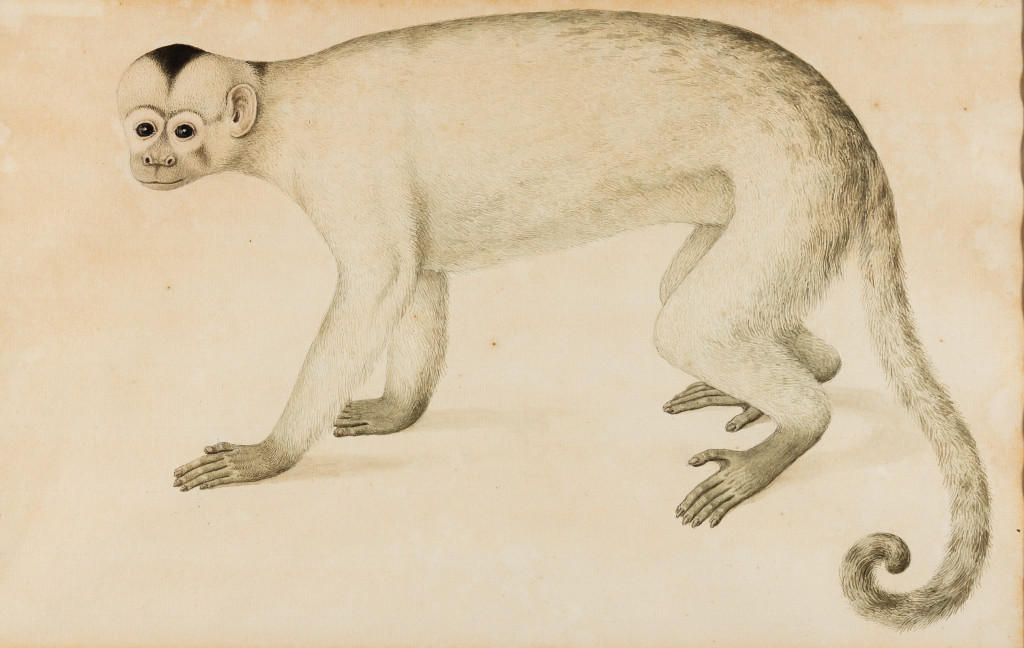
Attributed to Aloys Zötl (1803-1887)
Aloys Zötl is notable for his paintings and drawings of fantastical animals and other natural history subjects. Depicted here is quite possibly a White Gibbon, but in a fantastic way. Decades after his death in 1887, Zötl’s work was re-discovered by surrealist André Breton, who recognized a surrealist aesthetic in it. Breton wrote: "Lacking any biographical details about the artist, one can only indulge one’s fantasies in imagining the reason which might have induced this workman from Upper Austria, a dyer by profession, to undertake so zealously between 1832 and 1887 the elaboration of the most sumptuous bestiary ever seen."
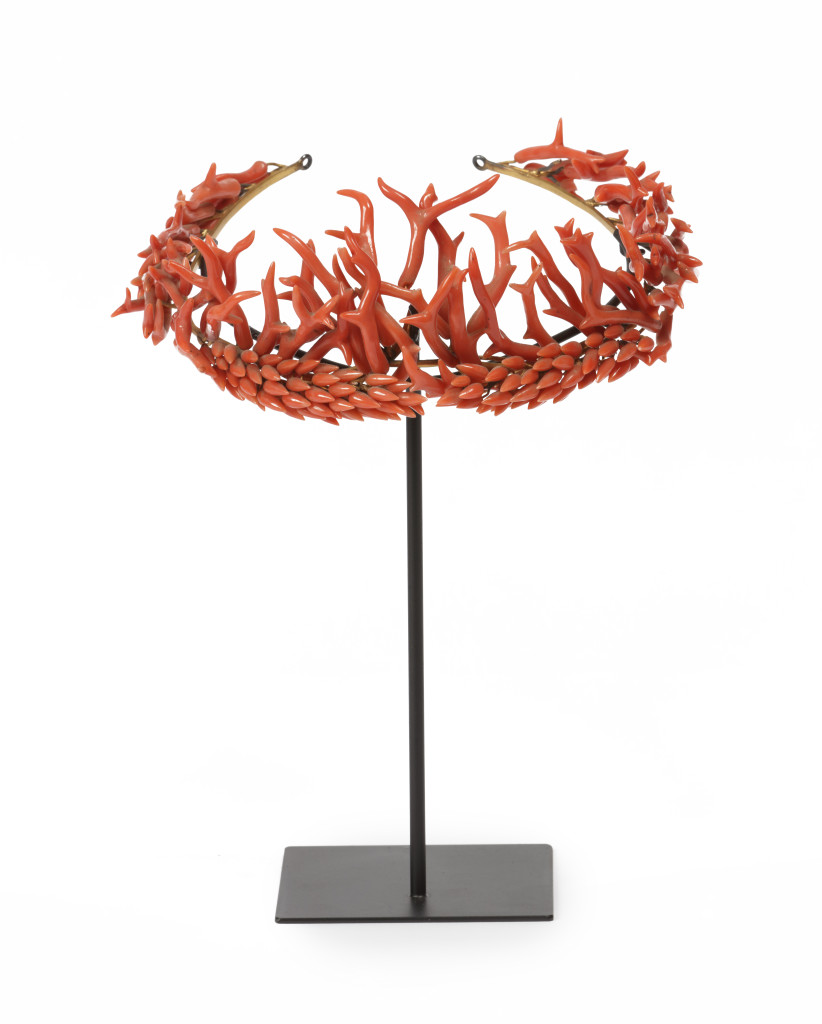
A Red Coral (Corallium rubrum) crown or tiara attributed to the Phillips Brothers of London
Although the present piece bears no signature, it is closely related to the work of the Phillips Brothers, for whom Robert Phillips was the leading supplier of coral objects in London. As early as 1870, the company was able to title itself “The most complete collection of fine coral work in the world". Coral jewellery, from elaborate tiaras like the one presented to simple strings of beads, was one of the most characteristic forms of personal jewellery in the Victorian era. The origins of the fashion have been variously traced to Napoleon’s Italian campaigns; to the coral jewellery of a royal bride (the Duchess d’Aumale in Naples in 1845); or (more circularly) to the era’s general interest in decorative naturalism. The European centre for coral design was Naples, with easy access to beds of red coral in the Mediterranean, which were indeed largely destroyed by the popularity during this period. The most prominent designer Robert Phillips directed the fashion from his studio on Cockspur Street. Its heyday in Britain - particularly of the naturalistic strain, which preserved the spiky natural shapes of the coral forms - were the 1850s. Later the fashion collapsed, perhaps under its own weight. (Anderson, 2008)