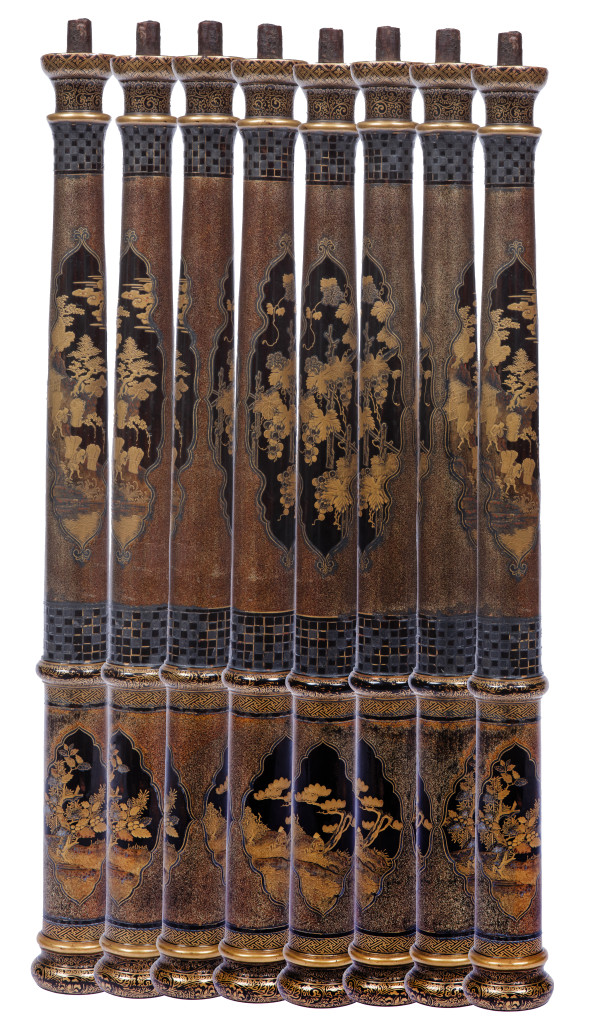
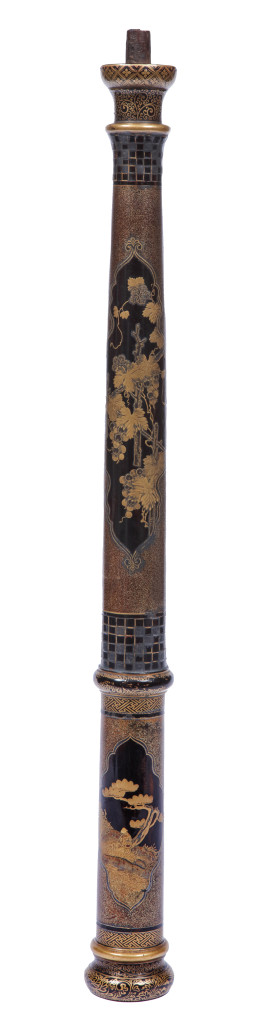
An extremely fine lacquered and unique intact Japanese export lacquer baluster made on order by the VOC for Amalia van Solms
The European cherry wood (Prunus avium), tall and thin baluster of slightly tapered cylindrical shape covered in a black lacquer ground with gold lacquer decoration, is divided into two sections of decoration by a raised circumferential ring, approximately at one third from the lower end. Further rings and geometric borders with inlays of tin are at the top and bottom end of the upper section of the baluster. The gold-lacquer decoration of trees, foliage and vines, and farmers carrying bundles of hay in landscapes inside cartouches against a nashiji-ground is magnificent and might represent the harvest season.
L. 52.8 cm
Oliver Impey and Christiaan Jörg in Japanese Export Lacquer 1580-1850, describe and illustrate some identical balusters incorporated in a French, early 19th-century secrétaire (p. 44 and ill. 34, 141, 154 a, b, c, 586 a, b.), a mid-19th-century French side cabinet (ill. 142, 155, 585), and a Broadwood & Sons piano supplied in 1829 to Lady Hertford for her Temple Newsam House, Leeds (ill. 143, 156 a, b, c). In the secrétaire and the piano, the incorporated balusters have been cut length-wise and lengthened by adding an extra segment. Only in the side cabinet, five intact balusters have been used.
Impey & Jörg assume that these balusters once were part of a lacquered balustrade belonging to Amalia van Solms (1602-1675), wife of Stadholder Frederik Hendrik (1584-1647).
In about 1638, Amalia van Solms, who was very influential in promoting oriental crafts in the Netherlands, expressed her wish to the VOC for a Japanese lacquered balustrade she intended to replace the existing gilded balustrade in her bedroom in her residence in Het Stadhouderlijk Kwartier in Het Binnenhof in The Hague. The Amsterdam Chamber of the VOC duly ordered in Japan an exorbitant black-and-gold-lacquered balustrade and presented it to Amalia van Solms in 1641. Instead of in Het Stadhouderlijk Kwartier, the balustrade was eventually installed in Amalia’s bedroom in the recently finished palace Huis ten Bosch in 1647, the year Frederik Hendrik died.
Such a balustrade was placed between the bed of state and the area before it where the royal host could receive important visitors, as was customary at European courts at the time. It is likely that Amalia had the plain wooden balusters and railing made in Holland and asked the VOC to have it lacquered in Japan. The VOC sent it to Japan, and in August 1641, it arrived back in Amsterdam and was presented to Amalia by the Amsterdam Chamber of the VOC. It fitted perfectly in Amalia’s bedroom, which was furnished with liberal use of black to emphasise her mourning over her husband’s recent death. According to the description in the inventory of 1654, the balustrade, including five balusters in storage, consisted of about sixty balusters.
The balustrade was admired and described by several visitors to Huis ten Bosch. Nicolas Tessin, for instance, wrote in 1687 that it was “a very finely worked piece of Chinese (sic) woodwork”, and Thomas Bowrey in 1698 records “true Japan lacquered bed, enclosed with rails and bannisters of the same work.”
It remained in the bedroom in Huis ten Bosch until the end of the 18th-century when the French-orientated Batavian Republic overthrew the old regime. The Stadholder and his family fled to England, and in 1797 the whole interior of Huis ten Bosch was auctioned. The priceless but 'out of fashion' balustrade remained unsold, was taken apart, shipped to Paris, and since then, all traces of this extraordinary balustrade disappeared.
No illustrations of the balustrade survived, and only single balusters, some cut length-wise, reappeared incorporated in a secrétaire, a side cabinet and a piano. Most likely, the parts were spread and sold within furniture-makers and restorers circles in France, used, taken apart or even polished, and all are lost in time.
However, with great pride, we present you the last intact baluster of Amalia van Solms' famous Bed of State fence.
Related objects
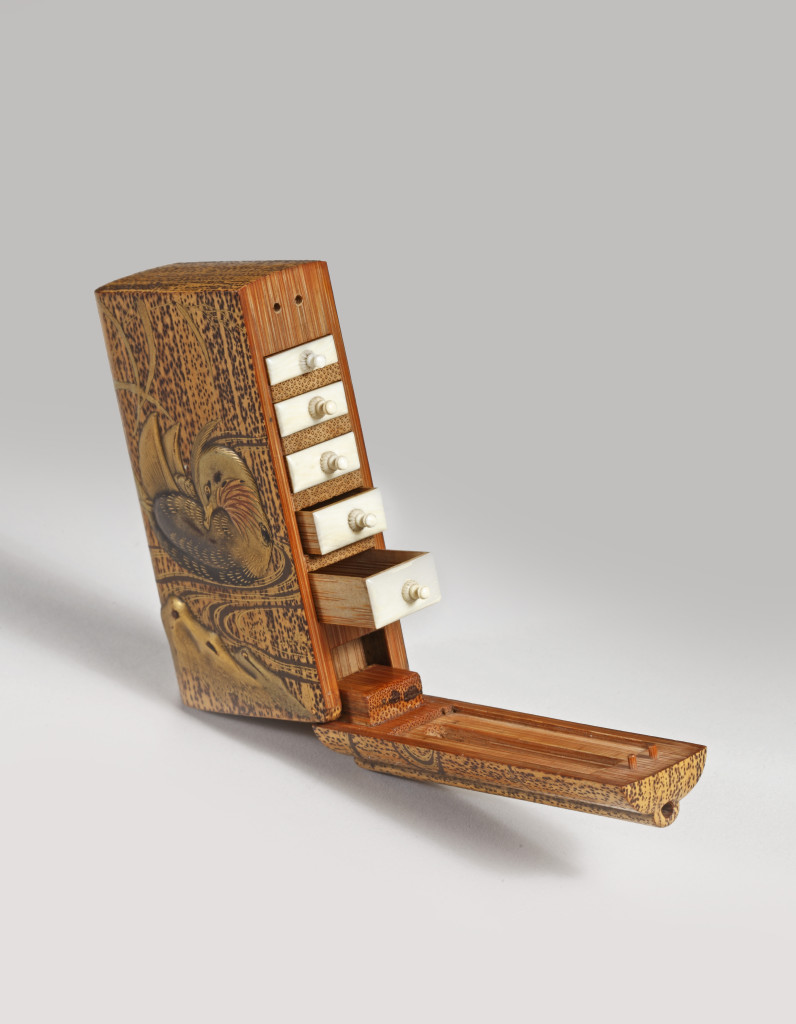
Fine Inro in the form of Drawers
A FINE JAPANESE LACQUERED BAMBOO INRO IN THE FORM OF DRAWERS
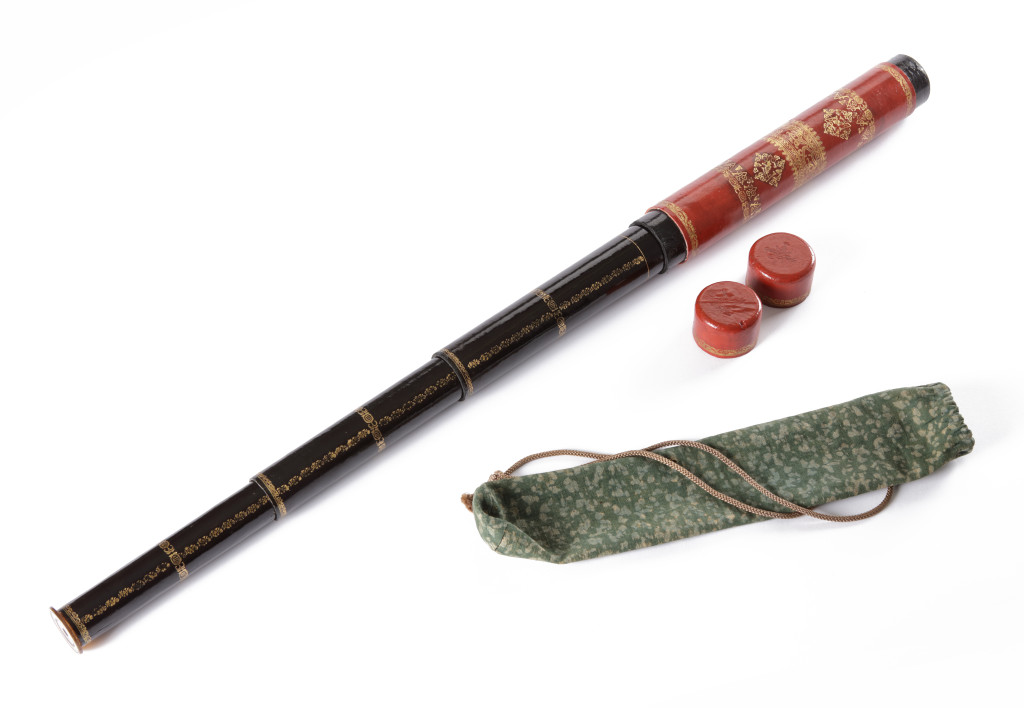
A lacquered half-inch refracting pasteboard telescope decorated with VOC monograms
Japan, Edo Period, late 18th century
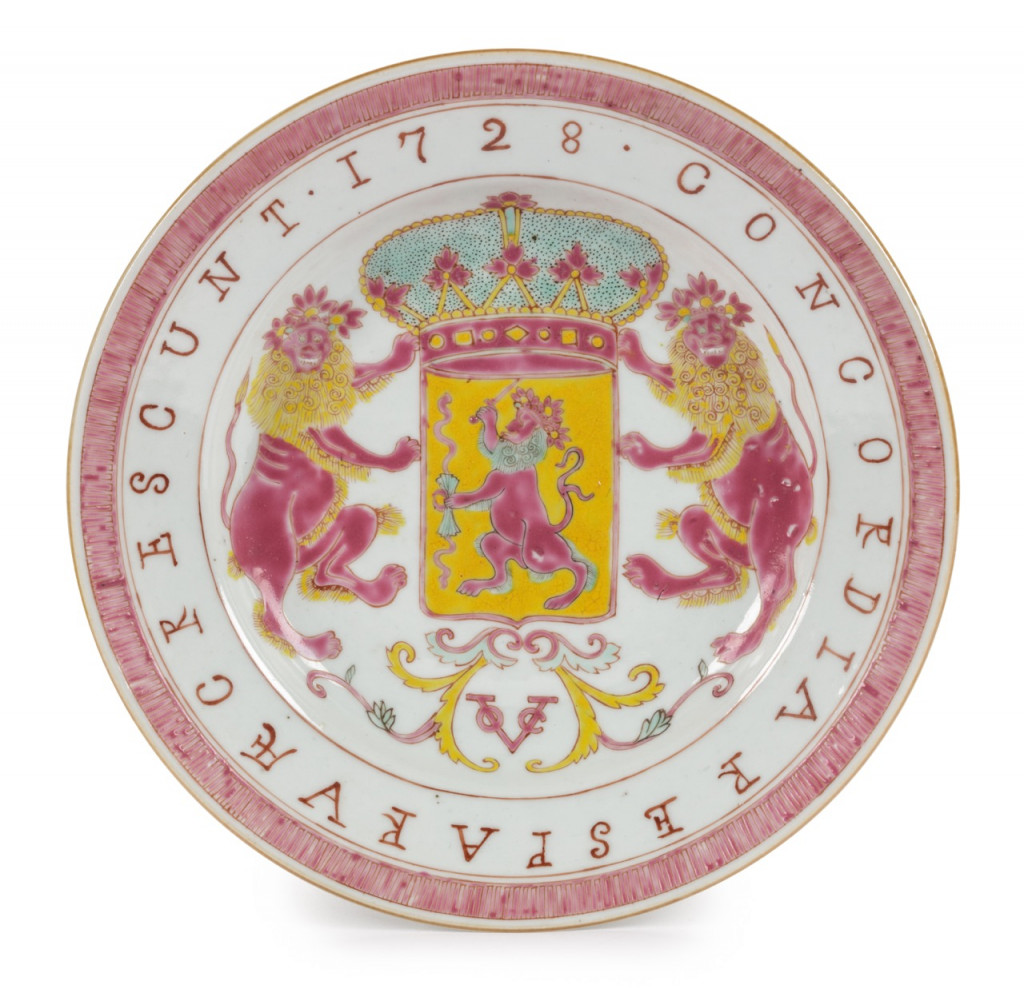
A pink, yellow and green enamelled porcelain VOC plate
Executed in rose-pink, yellow, and soft blue-green enamels, this design follows a silver ducatoon of 1728 in almost every aspect, with even the rim of the plate imitating the ribbed milling of the coin. On a shield is a crowned rampant lion, holding in his left paw a bunch of seven arrows symbolising the seven provinces of the United Netherlands, and in his right paw, a sword is shown supported by two crowned rampant lions. Below the shield is the monogram of the VOC, the Dutch East India Company, above the date 1728, and around it is the heraldic motto of the Dutch Republic CONCORDIA RES PARVAE CRESCUNT (by unity small things grow). The first ducatoon, or zilveren rijder, on which the design of this plate was based, arrived in Canton, China, on the 2nd of August 1729 with the Coxhorn, the first VOC ship to sail straight to Canton and not by way of Batavia. It arrived in Amsterdam in 1730 with the ordered porcelain in this design. This is an early example of the so-called Chine de Commande porcelain. Although the Cantonese artists had a zilveren rijder as an example, they didn’t really understand the design, giving the lions grimacing human faces and cape-like manes. They also didn’t understand the Latin letters, since the R ends truncated, the V is an inverted A, and the E looks more like a Chinese character. The only Chinese porcelain known with this design is a tea set, comprising cup-and-saucers and a theapot. For a cup and saucer, see: Uit Verre Streken, June 2017, no. 49. The Dutch likely took a cup-and-saucer from China to Japan, ordering larger plates like the one present. Until recently, these plates were attributed to Chinese kilns, but they are more likely Japanese. This solves the debate on whether these dishes are modern Chinese forgeries. One has been found in an old Japanese collection and is listed in a catalogue, which makes the latter impossible. The enamel's hues and the porcelain's colour are, indeed, more Japanese than Chinese.