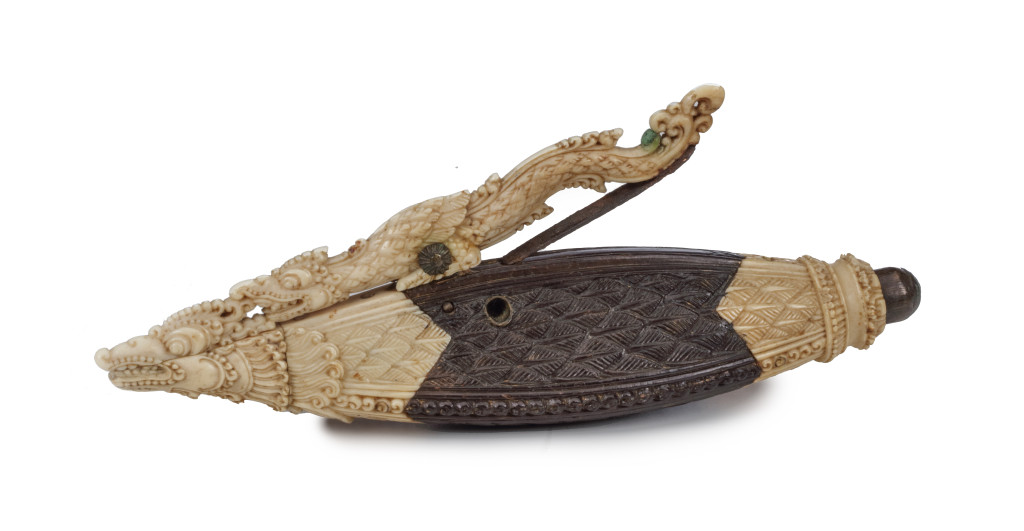
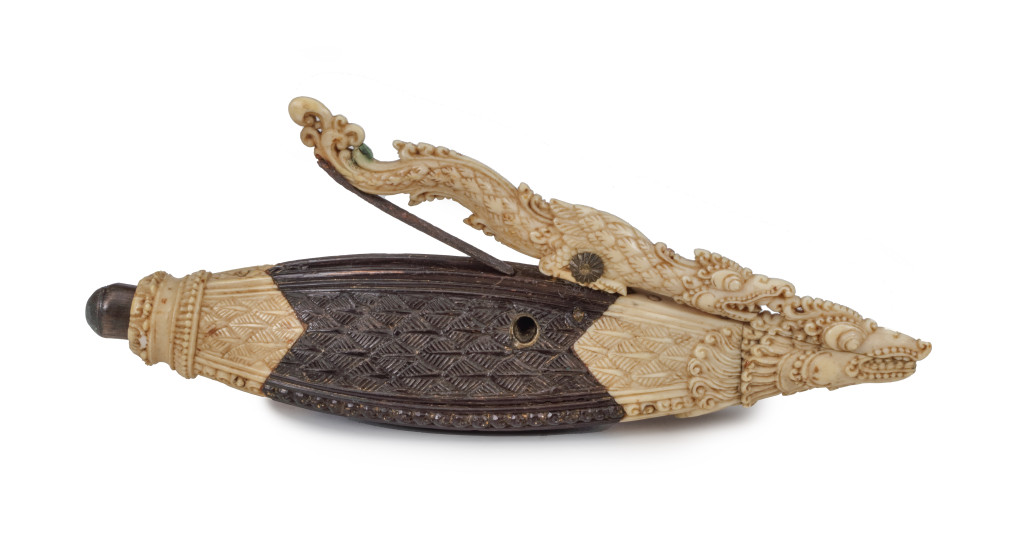
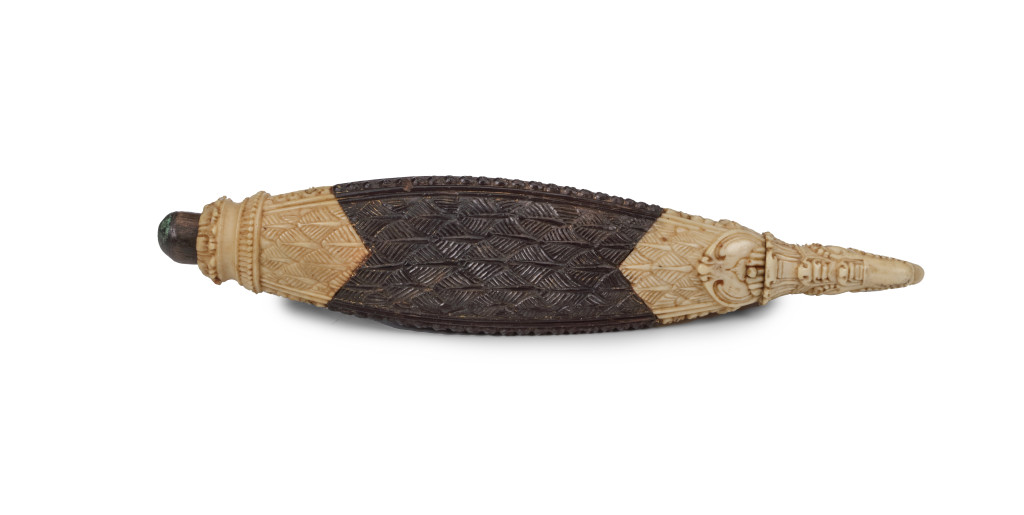
A possibly unique Sinhalese priming flask
Sri Lanka, probably Kingdom of Kandy, 17th century
L. 16.8 cm
A priming flask is a small container, traditionally made of metal, used to carry fine gunpowder. In the days of muzzle-loading firearms, after a bullet was seated, a small amount of this fine powder was poured from the flask into the pan of a flintlock or matchlock mechanism. The purpose was to ignite the main charge of the gun. Ensuring a consistent and controlled amount of powder was crucial for reliable ignition. The priming flask, with its regulated dispensing spout, provided shooters with a convenient and safe means to prime their firearms, making it an indispensable tool for gunners throughout history until the advent of more modern ignition systems.
This flask surfaced in the Netherlands with other Sinhalese artefacts, that seemed stripped of their silver or gold. It might, therefore, be well possible that this flask was looted during the attack on Kandy by the Dutch in 1765. In the second half of the 18th century, persistent drought caused the harvests to fail in Sri Lanka, and the population revolted against the high tax burden of the VOC and the tyranny of the native chiefs. Riots broke out in several places. At the same time, the Dutch came into conflict with the King of Kandy, who blocked the transport of cinnamon across his territory. The war was over when the King openly sided with the rebels in 1761. A new, bold governor was appointed, Lubbert Jan Baron van Eck. He first demanded reinforcements but made a failed attack in 1764, only to penetrate the King's centre of power the following year.
In February 1765, the VOC took the capital of Kandy, but the Dutch soon had to withdraw. This did not stop them from looting the temple and palace, slaughtering sacred cows, and destroying Buddha statues. The temple would have been desecrated for years. Governor Van Eck and his men took religious objects and richly decorated weapons to Colombo, where the VOC administration was located. Among the 'loot' were also some exceptional precious items such as jewels, two portable 1.5 meter-long cannons (jingals) used against the Dutch in battle, two gem-encrusted khastane, a dagger and the famous Cannon of Kandy. Arguably, many other objects were looted by Dutch soldiers, like this flask.
L. 16.8 cm
A priming flask is a small container, traditionally made of metal, used to carry fine gunpowder. In the days of muzzle-loading firearms, after a bullet was seated, a small amount of this fine powder was poured from the flask into the pan of a flintlock or matchlock mechanism. The purpose was to ignite the main charge of the gun. Ensuring a consistent and controlled amount of powder was crucial for reliable ignition. The priming flask, with its regulated dispensing spout, provided shooters with a convenient and safe means to prime their firearms, making it an indispensable tool for gunners throughout history until the advent of more modern ignition systems.
This flask surfaced in the Netherlands with other Sinhalese artefacts, that seemed stripped of their silver or gold. It might, therefore, be well possible that this flask was looted during the attack on Kandy by the Dutch in 1765. In the second half of the 18th century, persistent drought caused the harvests to fail in Sri Lanka, and the population revolted against the high tax burden of the VOC and the tyranny of the native chiefs. Riots broke out in several places. At the same time, the Dutch came into conflict with the King of Kandy, who blocked the transport of cinnamon across his territory. The war was over when the King openly sided with the rebels in 1761. A new, bold governor was appointed, Lubbert Jan Baron van Eck. He first demanded reinforcements but made a failed attack in 1764, only to penetrate the King's centre of power the following year.
In February 1765, the VOC took the capital of Kandy, but the Dutch soon had to withdraw. This did not stop them from looting the temple and palace, slaughtering sacred cows, and destroying Buddha statues. The temple would have been desecrated for years. Governor Van Eck and his men took religious objects and richly decorated weapons to Colombo, where the VOC administration was located. Among the 'loot' were also some exceptional precious items such as jewels, two portable 1.5 meter-long cannons (jingals) used against the Dutch in battle, two gem-encrusted khastane, a dagger and the famous Cannon of Kandy. Arguably, many other objects were looted by Dutch soldiers, like this flask.