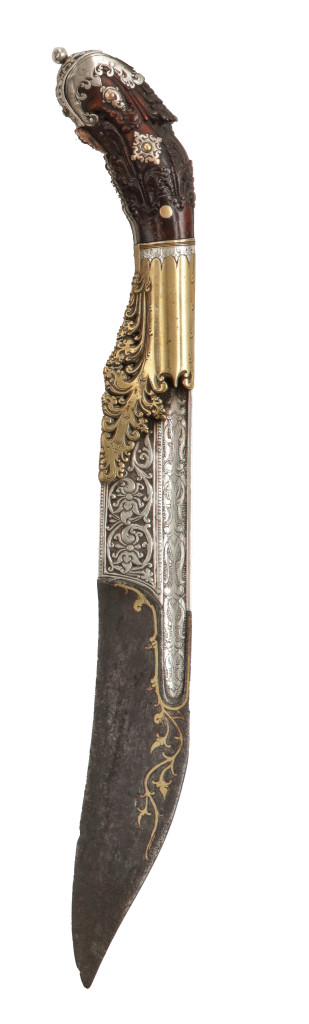
A black coral, silver and gold Sinhalese piha-kaetta dagger
Sri Lanka (Ceylon), Kingdom of Kandy, mid-18th century
L. 27 cm
The kasthāné is the national sword of Sri Lanka. It seems to have emerged in the 16th century following the first contact with Europeans. The general design shows influences from various cultures, but their execution is wholly Sinhalese, exhibiting classic Sinhalese motifs and lion head pommels after the royal emblem.
Silver-mounted kasthane, like this example, were made in the royal workshops of the King, who bestowed them upon noblemen and local chieftains as symbols of rank and office or as gifts to diplomats. Gold was reserved for the king himself and silver for his highest officials, Adigar, who were feudal lords that also acted as ministers and governors. The piha-ketta is often called 'the Kandyan-knife’, but some suggest it was intended as a page-turner, not a knife. In the collection of the Rijksmuseum, two similar kasthane, one gold and one silver, and a piha-kaetta in gold can be found, together with the famous Lewuke’s Cannon, as a result of the looting of the VOC after subduing the Kingdom of Kandy.
L. 27 cm
The kasthāné is the national sword of Sri Lanka. It seems to have emerged in the 16th century following the first contact with Europeans. The general design shows influences from various cultures, but their execution is wholly Sinhalese, exhibiting classic Sinhalese motifs and lion head pommels after the royal emblem.
Silver-mounted kasthane, like this example, were made in the royal workshops of the King, who bestowed them upon noblemen and local chieftains as symbols of rank and office or as gifts to diplomats. Gold was reserved for the king himself and silver for his highest officials, Adigar, who were feudal lords that also acted as ministers and governors. The piha-ketta is often called 'the Kandyan-knife’, but some suggest it was intended as a page-turner, not a knife. In the collection of the Rijksmuseum, two similar kasthane, one gold and one silver, and a piha-kaetta in gold can be found, together with the famous Lewuke’s Cannon, as a result of the looting of the VOC after subduing the Kingdom of Kandy.
Related objects

A banded agate Indian Pesh Kabz dagger
Banded Agate Indian Pesh Kabz
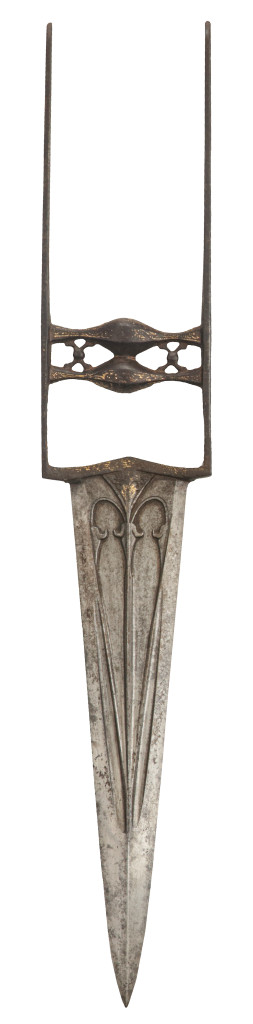
An Indian boy's 'katar', a punch dagger or tiger knife
Indian Boy's Katar Punch Dagger
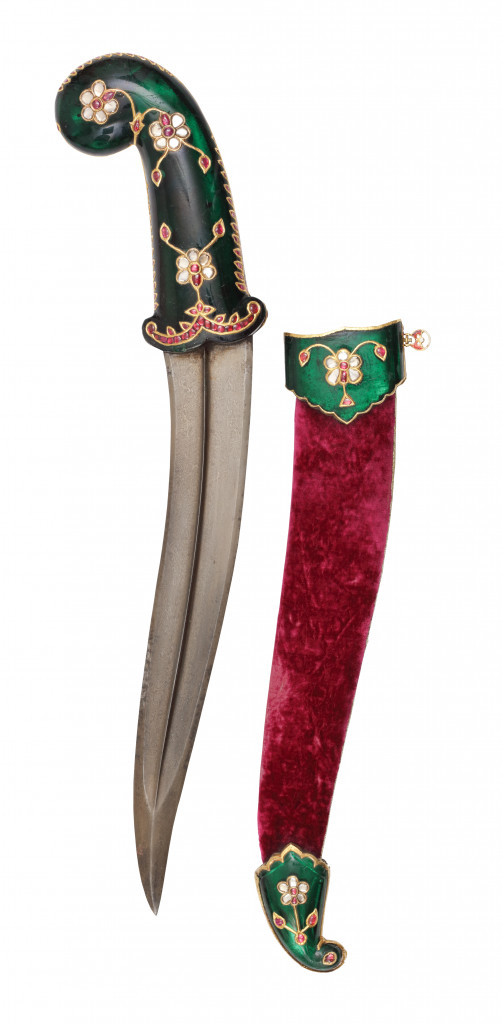
An superb gem-set Mughal glass dagger
An exquisite gem-set Mughal glass dagger formerly in the famous Al-Thani collection, India, Deccan, 18th century. The Al-Thani Collection in one of the most renowned and extensive private collections of art and artefacts in the world, including an exceptional array of weaponry.