
A splendid Mughal talwar with blade dated 1693
North-India, Gujarat, circa 1683 for the blade, the hilt 19th century
L. 90.5 cm (overall length)
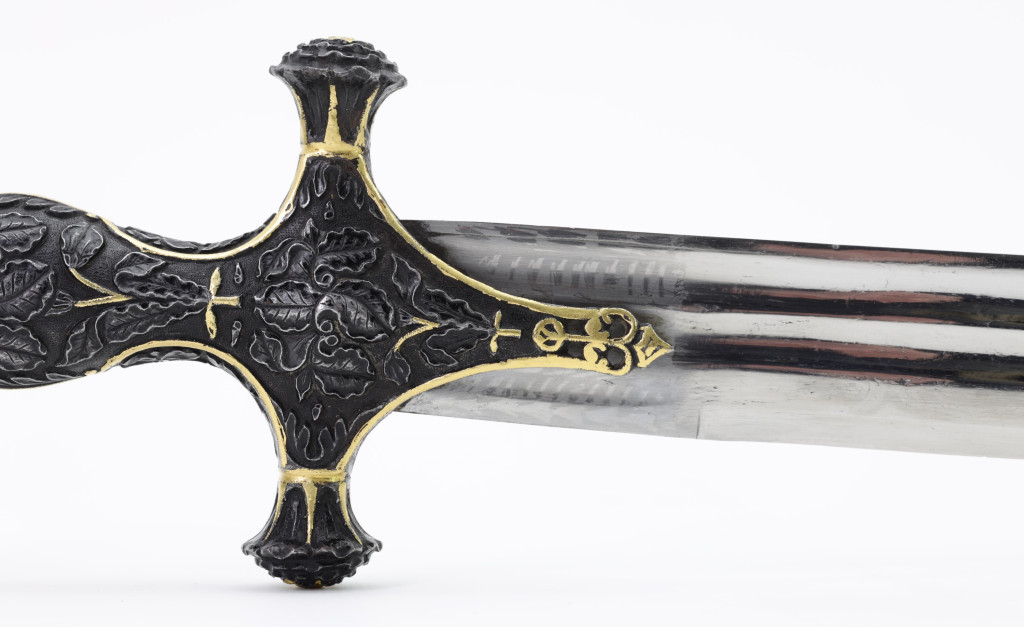
A fine talwar blade with a shape that gently widens from base to tip. It has two prominent grooves that meet in the tip section. The upper groove starts wide and gracefully narrows to accommodate a sharp back edge, with the edge itself slightly hollow-ground due to sharpening techniques involving emery-covered wheels in India.
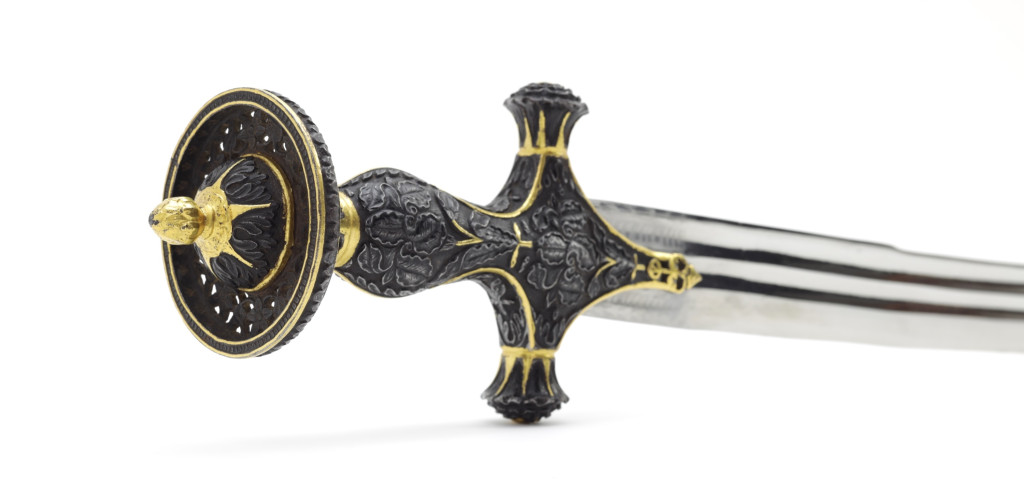
The blade comes with a fine but later hilt, crafted from chiseled iron darkened by deliberate patination. The hilt's decoration includes leaves and flowers in the typical Mughal style, set over a lowered dotted background. The pommel plate is intricately carved with floral designs and is pierced, while the back has a dome adorned with acanthus leaves. The carving exhibits meticulous craftsmanship, with gold overlaid accents providing a striking contrast against the darker metal.
Carved floral elements in relief are typical traits of 17th to early 18th-century work, and this hilt design aims to emulate that style. However, the dark designs with golden highlights reveal a later aesthetic. Such re-hilting was a common practice in India, and many other cultures, where old blades were treasured but the hilts were adapted to suit the prevailing fashion of the day.
The blade's surface displays a burnished finish, with the original burnisher's marks still evident at the base, a rarity among talwar swords. This indicates that the blade retains its original period finish, which is uncommon due to many being sanded down and etched by collectors seeking forging patterns.
In the Indian warrior's world, shiny, chrome-like finishes were infrequently encountered, as mirrors were expensive luxuries. A completely burnished, mirror- finished blade would have been an exciting sight for the viewer, representing an original and prized finish.
There are markings carved in the spine of the blade that appear to have been done by three different
hands. First, closest to the hilt is a number dot-punch mark in a style that reminds of those found on items from the Bikaner armory: ૪૧૪૩ (4143). Next are a place and date that are inscribed: वाकी कोट संवत् ૧૭૪૯ श्री (Vaakee kōṭa samvat1749śri:̄ VaakeePalace1749samvat1693A.D.).Lastly,another dot-punch mark: ૨૯ गुजरात (29 Gujarat). Vaakee Kota or Vaakee Palace, where palace can also be read as ‘city wall’, is probably a place in Gujarat. The 4143 and 29 are most likely collection or armory serial numbers.
Gujarat was a part of the Mughal empire. Mughal emperor Aurangzeb, who held power during the blade's dated period, was born in Gujarat and served as its governor from 1645-1647. Ties between Gujarat officials and the central Mughal authority remained strong.
Talwar blades of this age and in this condition are rarely found on the market. Especially in period finish, still carrying the burnisher's personal mark at the base. The later hilt is beautifully carved, representing 17th-century Mughal art motifs but in a later color scheme to suit the fashions of a later periods.
Source:
S. Kaoukji, Precious Indian Weapons: and other pricely accoutrements, p. 284
L. 90.5 cm (overall length)
A fine talwar blade with a shape that gently widens from base to tip. It has two prominent grooves that meet in the tip section. The upper groove starts wide and gracefully narrows to accommodate a sharp back edge, with the edge itself slightly hollow-ground due to sharpening techniques involving emery-covered wheels in India.
The blade comes with a fine but later hilt, crafted from chiseled iron darkened by deliberate patination. The hilt's decoration includes leaves and flowers in the typical Mughal style, set over a lowered dotted background. The pommel plate is intricately carved with floral designs and is pierced, while the back has a dome adorned with acanthus leaves. The carving exhibits meticulous craftsmanship, with gold overlaid accents providing a striking contrast against the darker metal.
Carved floral elements in relief are typical traits of 17th to early 18th-century work, and this hilt design aims to emulate that style. However, the dark designs with golden highlights reveal a later aesthetic. Such re-hilting was a common practice in India, and many other cultures, where old blades were treasured but the hilts were adapted to suit the prevailing fashion of the day.
The blade's surface displays a burnished finish, with the original burnisher's marks still evident at the base, a rarity among talwar swords. This indicates that the blade retains its original period finish, which is uncommon due to many being sanded down and etched by collectors seeking forging patterns.
In the Indian warrior's world, shiny, chrome-like finishes were infrequently encountered, as mirrors were expensive luxuries. A completely burnished, mirror- finished blade would have been an exciting sight for the viewer, representing an original and prized finish.
There are markings carved in the spine of the blade that appear to have been done by three different
hands. First, closest to the hilt is a number dot-punch mark in a style that reminds of those found on items from the Bikaner armory: ૪૧૪૩ (4143). Next are a place and date that are inscribed: वाकी कोट संवत् ૧૭૪૯ श्री (Vaakee kōṭa samvat1749śri:̄ VaakeePalace1749samvat1693A.D.).Lastly,another dot-punch mark: ૨૯ गुजरात (29 Gujarat). Vaakee Kota or Vaakee Palace, where palace can also be read as ‘city wall’, is probably a place in Gujarat. The 4143 and 29 are most likely collection or armory serial numbers.
Gujarat was a part of the Mughal empire. Mughal emperor Aurangzeb, who held power during the blade's dated period, was born in Gujarat and served as its governor from 1645-1647. Ties between Gujarat officials and the central Mughal authority remained strong.
Talwar blades of this age and in this condition are rarely found on the market. Especially in period finish, still carrying the burnisher's personal mark at the base. The later hilt is beautifully carved, representing 17th-century Mughal art motifs but in a later color scheme to suit the fashions of a later periods.
Source:
S. Kaoukji, Precious Indian Weapons: and other pricely accoutrements, p. 284
Related objects
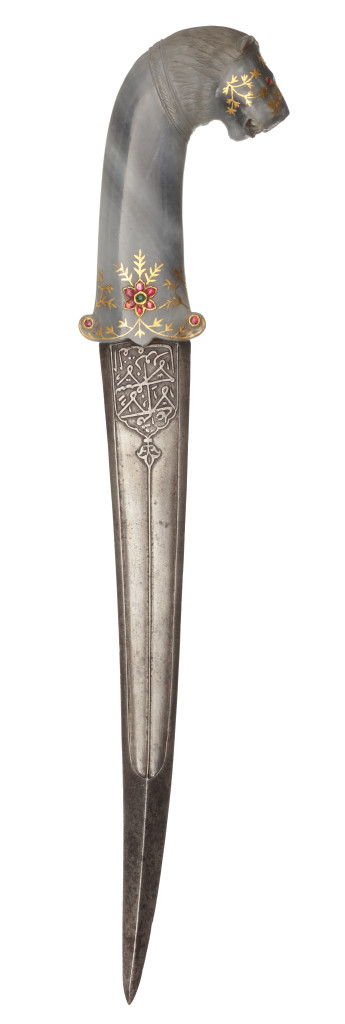
A Mughal gem-set jade-hilted dagger with a lion head pommel
The blue-grey jade is inlaid with gold floral spray. It has ruby eyes and rubies also decorate the base of the hilt. The watered steel blade is chiselled with Islamic inscriptions.
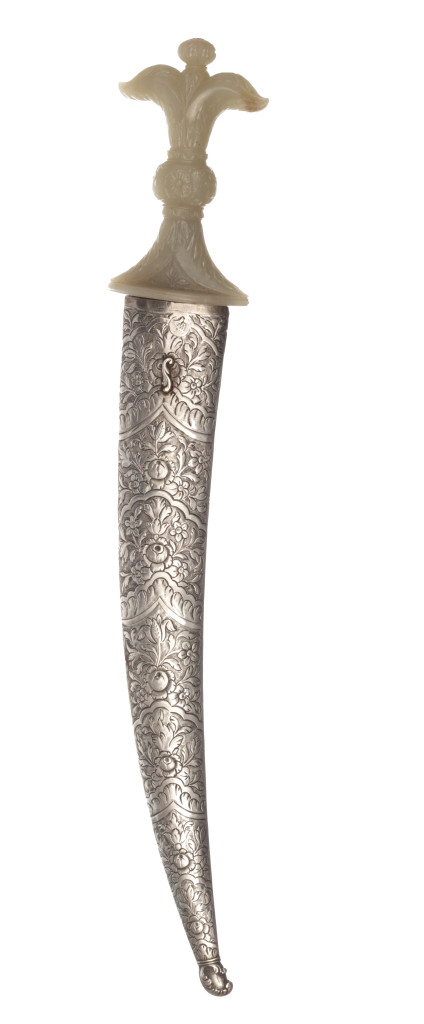
An unusual Mughal jade-hilted dagger
The hilt is carved overall with foliate decoration and it has a plain curved watered steel blade. With an intricately repoussé silver scabbard.
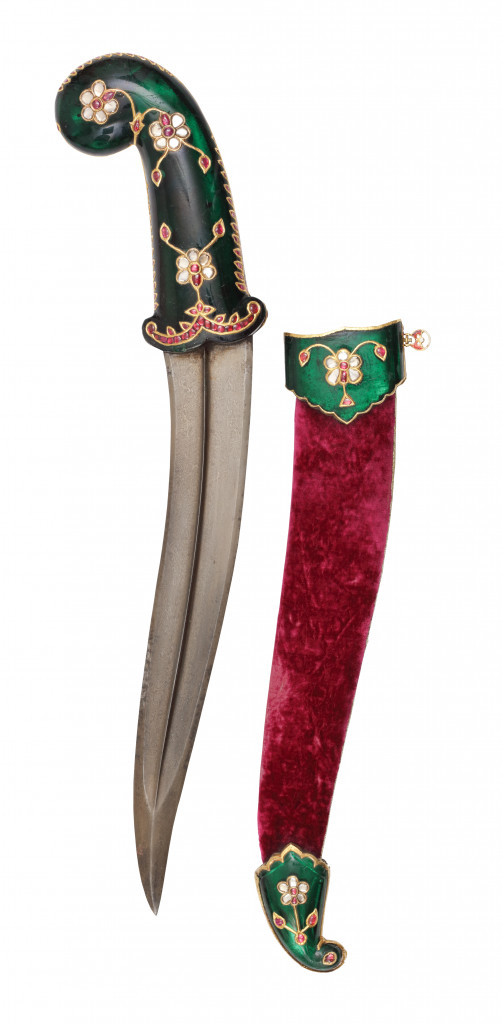
An superb gem-set Mughal glass dagger
An exquisite gem-set Mughal glass dagger formerly in the famous Al-Thani collection, India, Deccan, 18th century. The Al-Thani Collection in one of the most renowned and extensive private collections of art and artefacts in the world, including an exceptional array of weaponry.