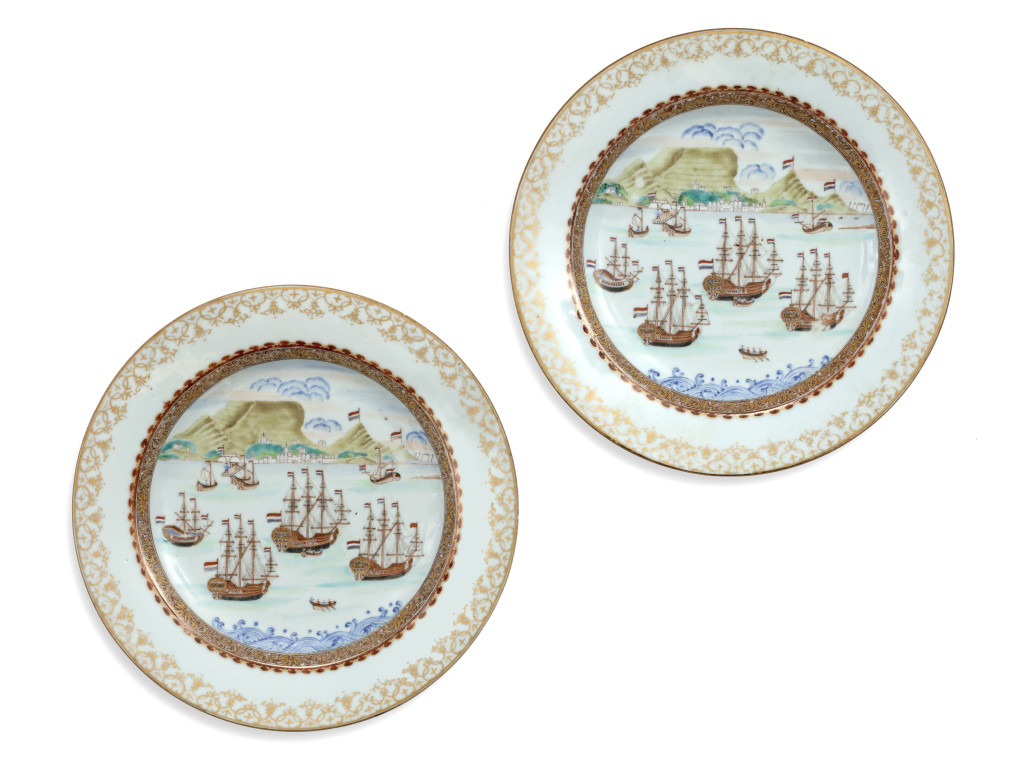
A pair of Chinese export porcelain 'Table Bay’ dishes
Diam. 23.6 cm
Few bays are so easily recognisable as Table Bay with the flat expance of Table Mountain, and Devil’s Peak and Lion’s Head on either side together with signal Hill to the far right, the last two mountains with a Dutch flags on top. At the foot of Table Mountain lies Cape Town, to the left the Castle of Good Hope with the Dutch flag and to the far right the gallows. In the forground four large ships lie for anchor with furled sails and an array of Dutch flags, with two rowing boats, and closer to the shore four more smaller boats. Three different versions of the Table Bay dish are known, two slightly differnet depictions in enamel colours and one in encre de Chine. Dishes decorated in the well with scenes of Dutch ships at anchor in Table Bay are rare nevertheless.
Source:
- C.S. Woodward, Oriental Ceramics at the Cape of Good Hope 1652-1795: An account of the porcelain trade of the Dutch East India Company with particular reference to ceramics with the V.O.C. monogram, the Cape market, and South African collections, A.A. Balkema, Cape Town & Rotterdam, 1974, pp. 131-140
Related objects
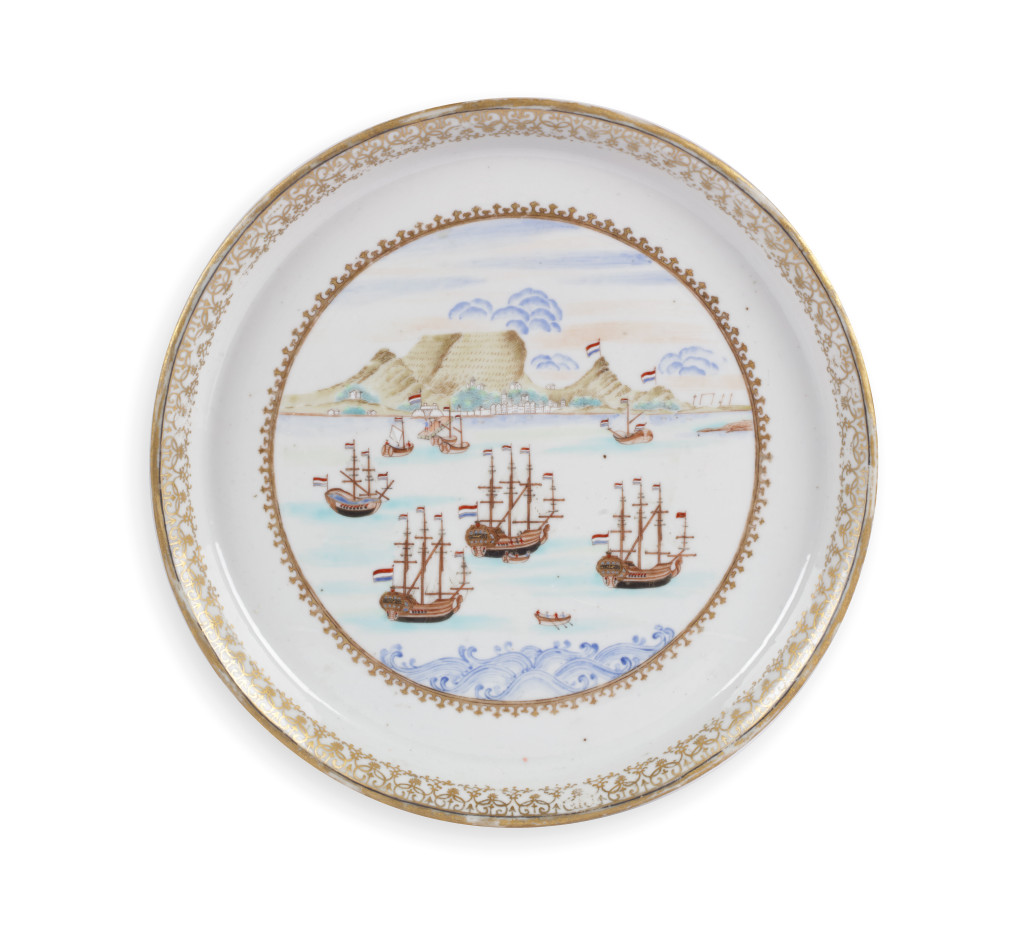
A large Chinese export porcelain 'Table Bay' or 'Cape of Good Hope' dish
Few bays are so easily recognisable as Table Bay with the flat expance of Table Mountain, and Devil’s Peak and Lion’s Head on either side together with signal Hill to the far right, the last two mountains with a Dutch flags on top. At the foot of Table Mountain lies Cape Town, to the left the Castle of Good Hope with the Dutch flag and to the far right the gallows. In the foreground four large ships lie for anchor with furled sails and an array of Dutch flags, with two rowing boats, and closer to the shore four more smaller boats. Three different versions of the Table Bay dish are known, two slightly different depictions in enamel colours and one in encre de Chine. Dishes decorated in the well with scenes of Dutch ships at anchor in Table Bay are rare nevertheless.
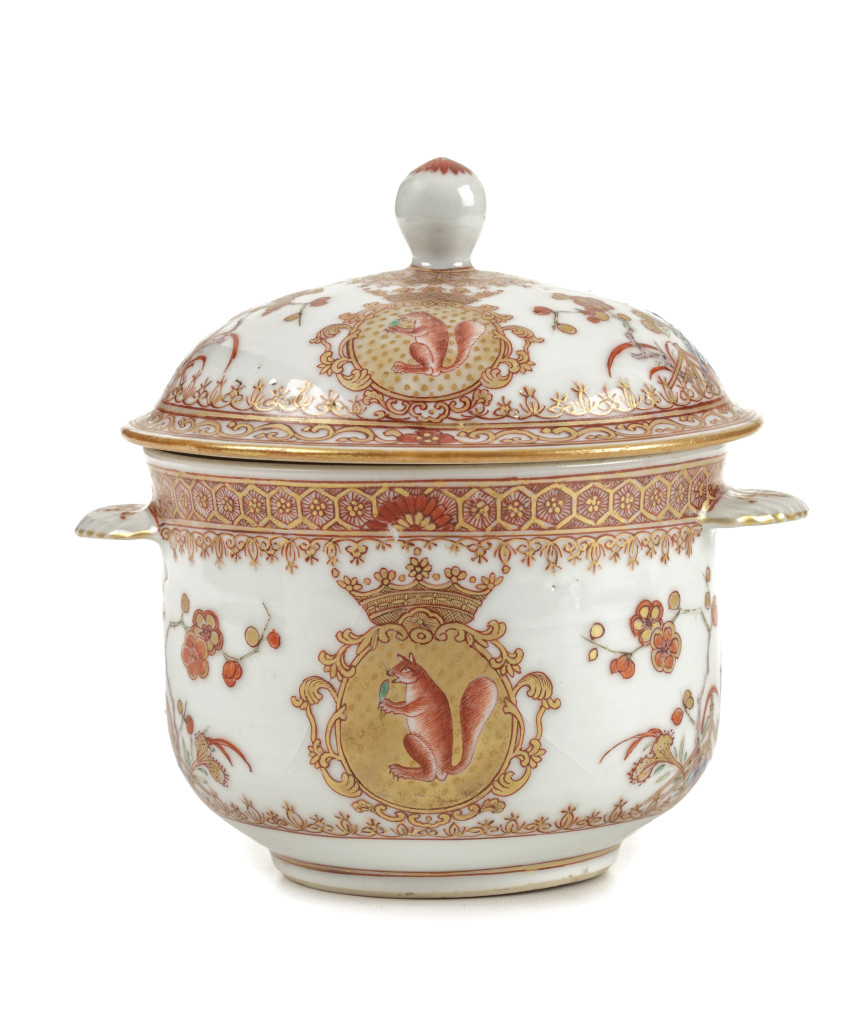
A Chinese export porcelain 'Sichterman' sugar bowl and cover or 'Kandijpot'
Both the bowl and the lid decorated in iron-red, blue, yellow and green enamels and gold, showing a squirrel in profile eating a nut, surrounded by bamboo and floral sprays, the bowl restored.
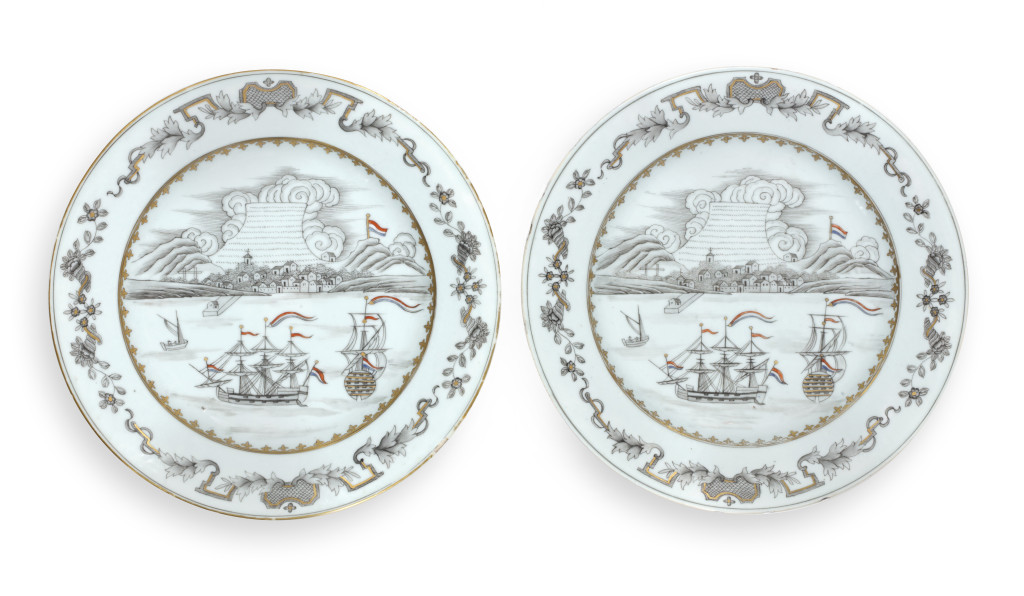
A rare pair of Chinese export porcelain ‘Table Bay’ dishes
Qianlong period, mid-18th century, circa 1740