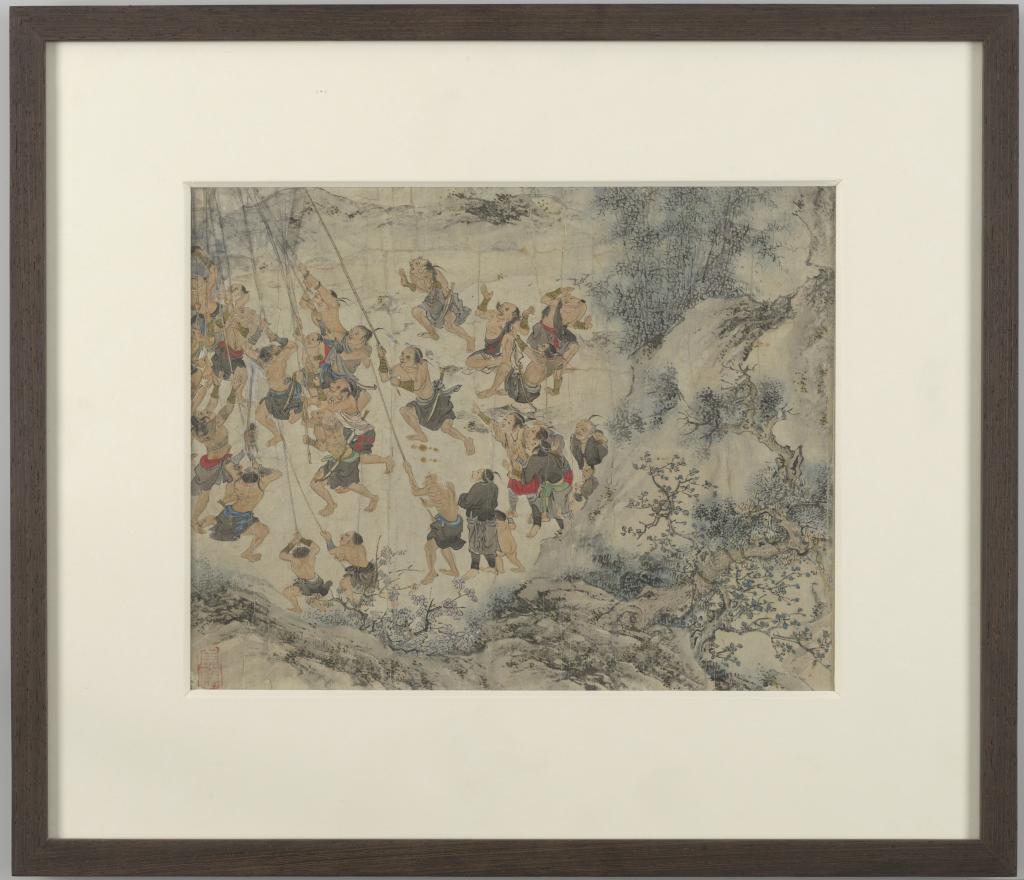
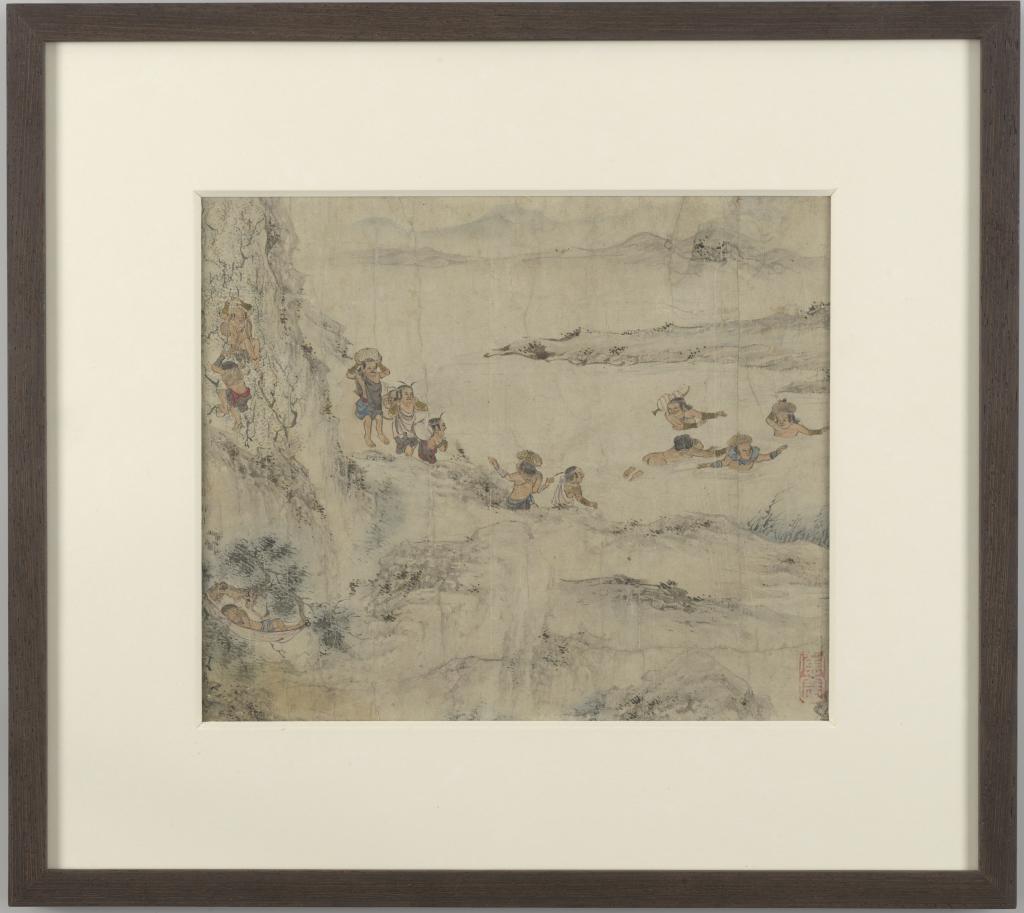
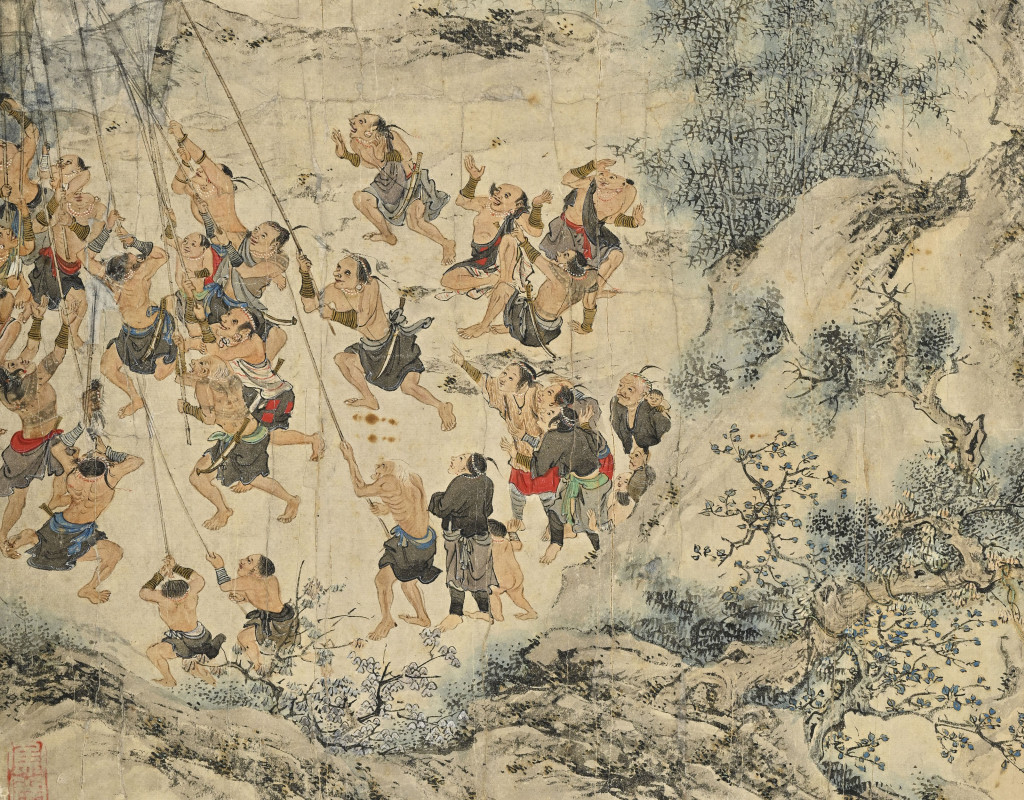
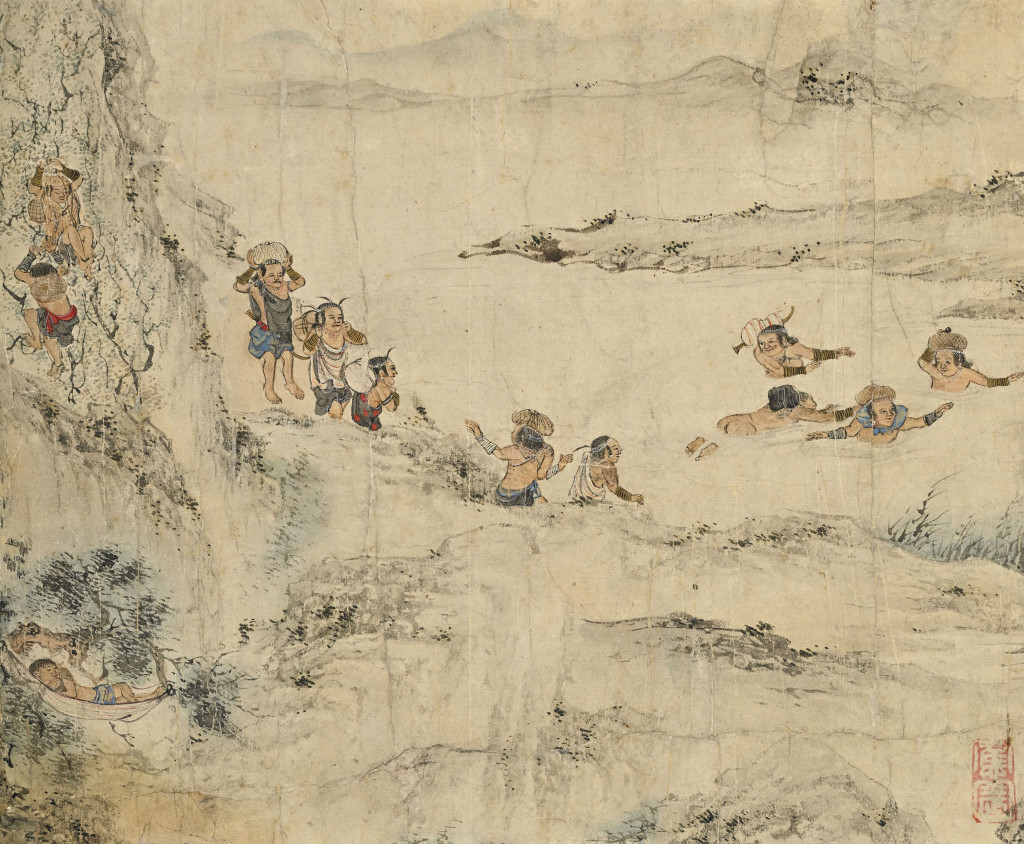
A pair of extremely rare drawings depicting Taiwanese Aborigines
Each drawing marked with a seal
Ink and colour on paper, H. 22.5 x W. 26 cm (each)
These are extremely rare depictions of 'Formosan' or Taiwanese Aborigines, the original inhabitants of the island. Typically, as seen on the present works, they can be seen wearing the feather headdresses and white and red coral beaded necklaces. Possibly these paintings are part from the series now found in the Museum of the Institute of History and Philology in Taipei, see: [object.no. 85361](https://museum.sinica.edu.tw/en/exhibition/15/item/290/)
Provenance:
Collection Li Ai Vee (1932-2021), Switserland
Ms. Li Ai Vee (李爱维, born Eva Anita Li, 1932-2021), was a Sino-German painter who settled in Switzerland and was an avid collector of Asian art, mainly Chinese and Japanese. Born in Shanghai, Li Ai Vee was introduced to painting by her mother, an artist herself. In the 1950s, she studied under prestigious painters, including Lin Fengmian (1900-1991) and Lu Yifei (1908-1997). She then spent a few years in Japan, where she became a disciple of the Zen master Rinzai Yamada Mumon Rōshi (1900-1988). In 1954, she was selected to paint bamboo scenes on the sliding doors of the Hiroshima Memorial. In 1958, Li Ai Vee left China and settled in Zurich, Switzerland. In 1965, she met the internationally renowned painter Zhang Daqian (Chang Dai-Chien, 1899-1983) and became his student. That same year, she received the Medal of the City of Paris in recognition of her art.
Part of the China collection.
Related objects
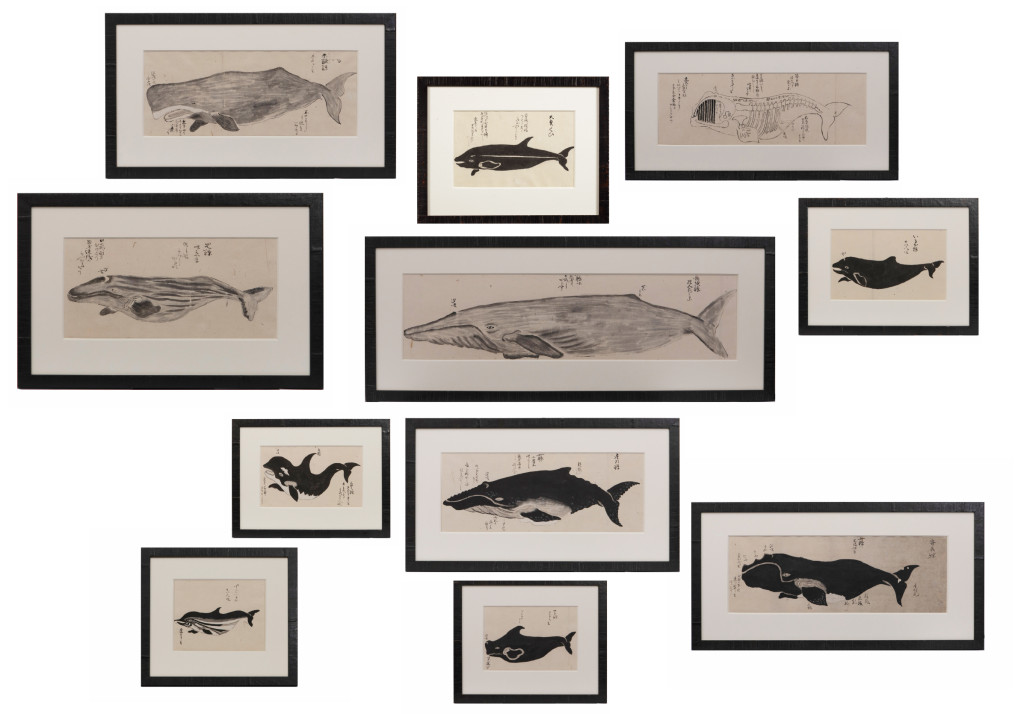
A series of eleven Japanese whale drawings in ink on paper
Anatomical details are written on the drawings in old Kana script. Kana was developed from the logographic characters of Chinese origin, known in Japan as Kanji (Chinese pronunciation: hànzì). The handwriting does not seem to have been intended for legibility.
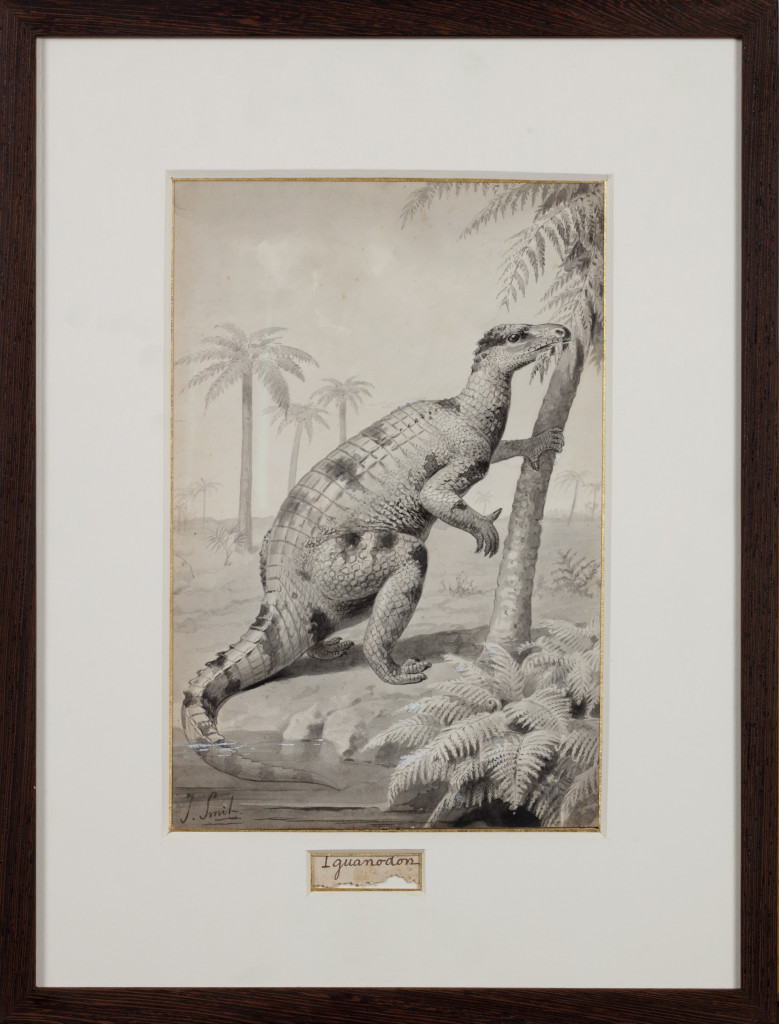
Two original late 19th century drawings, commissioned by Henry R. Knipe for his famous book Nebula to Man, published by J.M. Dent & Co., London, 1905
Henry R. Knipe (1854-1918), a geologist from Tunbridge Wells in Sussex, was a member of the Linnean and Geological Societies. He wrote two works on palaeontology, Nebula to Man (1905), which was written in rhyming verse, and Evolution in the Past (1912). His obituary in Geological Magazine recorded that he devoted “much time and labour to the popularization of the study of extinct animals in this country. With the aid especially of the Staff of the British Museum... he attempted to portray the animals of the past as they appeared when living, and sparing no expense, he employed the most skilled artists to carry out his plans”. The impressions of the discovered fossils rocked the world, and nowadays seem quite accurate as well
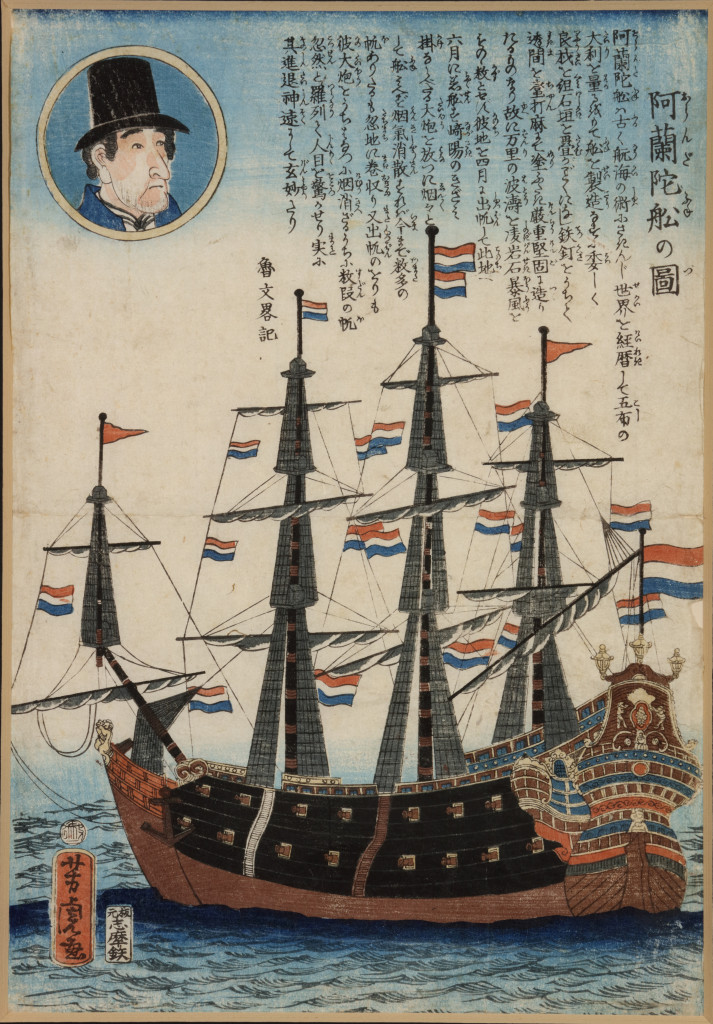
A Yokohama-e woodblock print depicting a Dutch ship by Utagawa Yoshitora (act. 1846-1880)
Yoshitora was active from about 1850 till about 1880. In 1849 he produced a print the censors interpreted as criticism of the Shogunate and Yoshitora was manacled for fifty days and afterwards moved from Edo to Yokohama where he continued to produce illustrations prolifically, particularly of foreigners who arrived in Yokohama after Japan had been forced to open its ports to foreign trade in 1868.