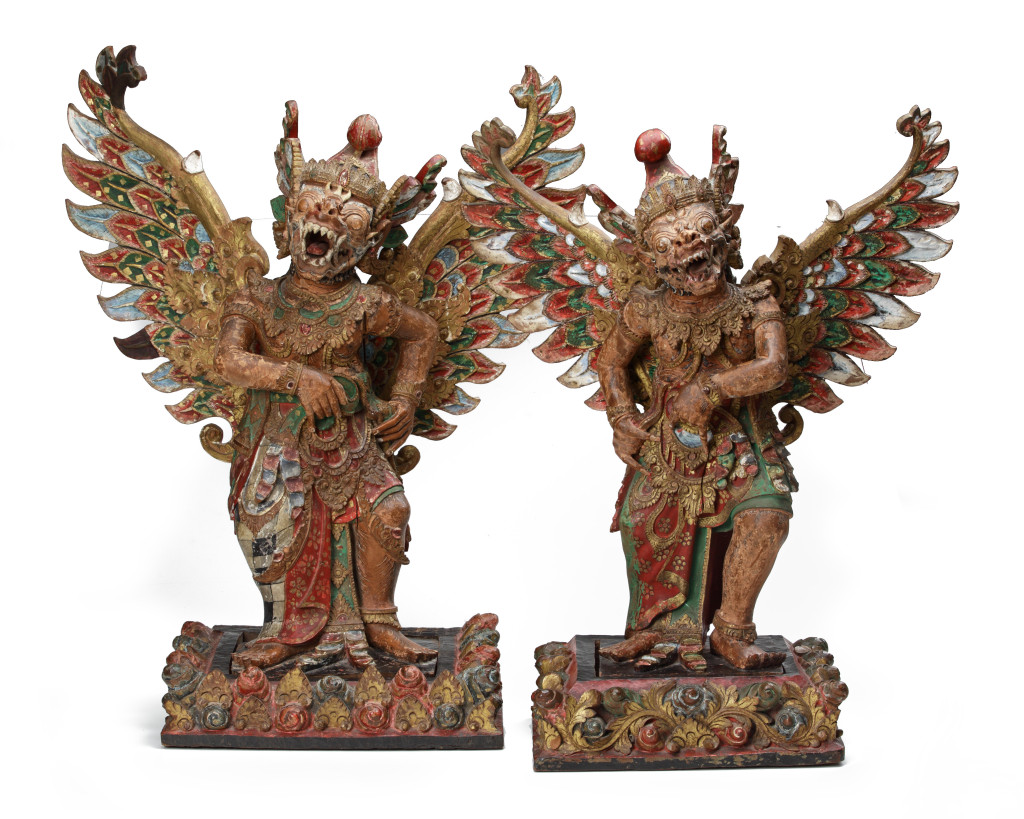
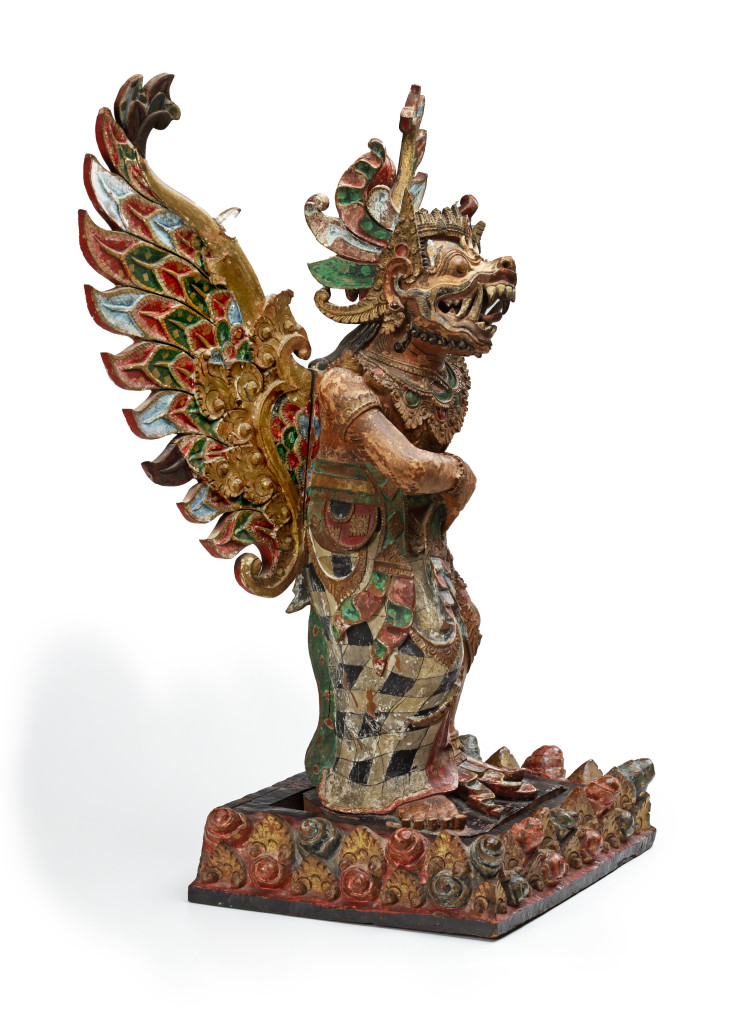
Two Balinese polychrome nangka wood sculptures depicting Sugriwa and Subali, the red monkey twins
Northern Bali, Singaraja, Buleleng Regency, late 19th century
H. 78 & 70 cm
These two winged sculptures represent the red monkey twins Sugriwa and Subali as they are called in Bali. Sugriwa and Subali are central characters in the Hindu epic ‘Ramayana’, particularly in the versions prevalent in Indonesian culture, such as in Balinese Hinduism. They are twin monkey kings of Kishkindha and brothers who become rivals. However, despite being identical twins, they had different fathers; Sugriwa’s father was Surya, the sun god, and Subali’s father was Indra, the king of gods.
The story goes that both brothers were initially allies and ruled the monkey kingdom together. However, a misunderstanding caused by the demon king Ravana led to a rift between them. Ravana disguises himself and challenges each brother to lift a heavy boulder. Subali manages to lift it, finding a trapped Ravana underneath, who then grants him a boon. Subali wishes for half of Ravana's strength, making him very powerful.
Later, Subali and Sugriwa fight for the throne of Kishkindha. During a duel, Subali is presumed dead, and Sugriwa becomes the king. However, Subali returns and overthrows Sugriwa with his newfound strength, assuming the throne and exiling his brother.
In some versions of the Ramayana, Sugriwa becomes an ally of Lord Rama, offering his assistance to rescue Sita from Ravana. In return, Rama helps Sugriwa defeat Subali and regain his kingdom. The tale of Sugriwa and Subali is an integral part of Balinese Kecak dance performances, which depict scenes from the Ramayana.
These two sculptures belong to a class made in the vicinity of Singaraja from about 1890 until 1920 when they were popular among many European tourists in north Bali. There are early 20th-century photos of this type of statue being sold in Surabaya and colonial fairs. The pair of sculptures present belongs to the earliest type in this class, whereas many Balinese sculptures in Dutch museums belong to the later type.
H. 78 & 70 cm
These two winged sculptures represent the red monkey twins Sugriwa and Subali as they are called in Bali. Sugriwa and Subali are central characters in the Hindu epic ‘Ramayana’, particularly in the versions prevalent in Indonesian culture, such as in Balinese Hinduism. They are twin monkey kings of Kishkindha and brothers who become rivals. However, despite being identical twins, they had different fathers; Sugriwa’s father was Surya, the sun god, and Subali’s father was Indra, the king of gods.
The story goes that both brothers were initially allies and ruled the monkey kingdom together. However, a misunderstanding caused by the demon king Ravana led to a rift between them. Ravana disguises himself and challenges each brother to lift a heavy boulder. Subali manages to lift it, finding a trapped Ravana underneath, who then grants him a boon. Subali wishes for half of Ravana's strength, making him very powerful.
Later, Subali and Sugriwa fight for the throne of Kishkindha. During a duel, Subali is presumed dead, and Sugriwa becomes the king. However, Subali returns and overthrows Sugriwa with his newfound strength, assuming the throne and exiling his brother.
In some versions of the Ramayana, Sugriwa becomes an ally of Lord Rama, offering his assistance to rescue Sita from Ravana. In return, Rama helps Sugriwa defeat Subali and regain his kingdom. The tale of Sugriwa and Subali is an integral part of Balinese Kecak dance performances, which depict scenes from the Ramayana.
These two sculptures belong to a class made in the vicinity of Singaraja from about 1890 until 1920 when they were popular among many European tourists in north Bali. There are early 20th-century photos of this type of statue being sold in Surabaya and colonial fairs. The pair of sculptures present belongs to the earliest type in this class, whereas many Balinese sculptures in Dutch museums belong to the later type.
Related objects
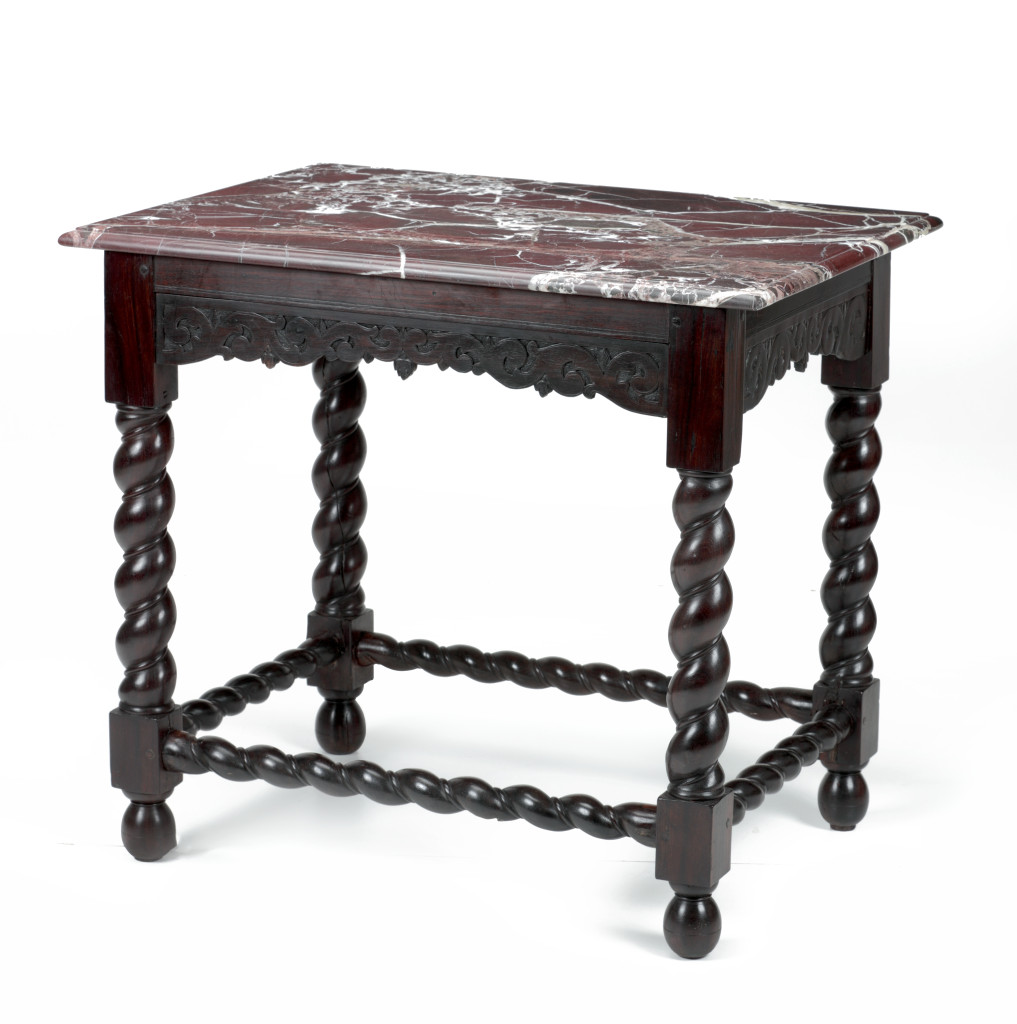
A Moluccan red ebony centre table with marble top
The Moluccas/Ambon, third quarter 17th century
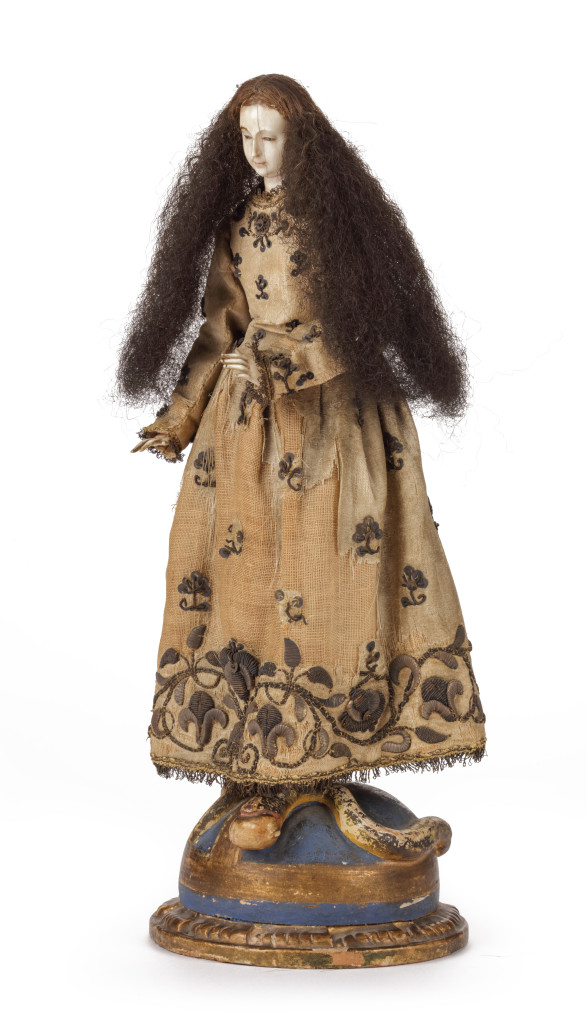
A Spanish-colonial Filipino wood, ivory, human hair and textile sculpture of the Virgin trampling the snake
The face and hands of the Virgin are carved ivory, the body consists of a simple wooden frame dressed in textile and on her head, she has real hair. She is standing on a blue and gilt base with a snake holding an apple in its mouth. In Christianity, this statue symbolises the victory of the Virgin, the chaste mother of Jesus, over sin and death brought into the world by Eva, who fell for the devilish temptations of sex and knowledge.