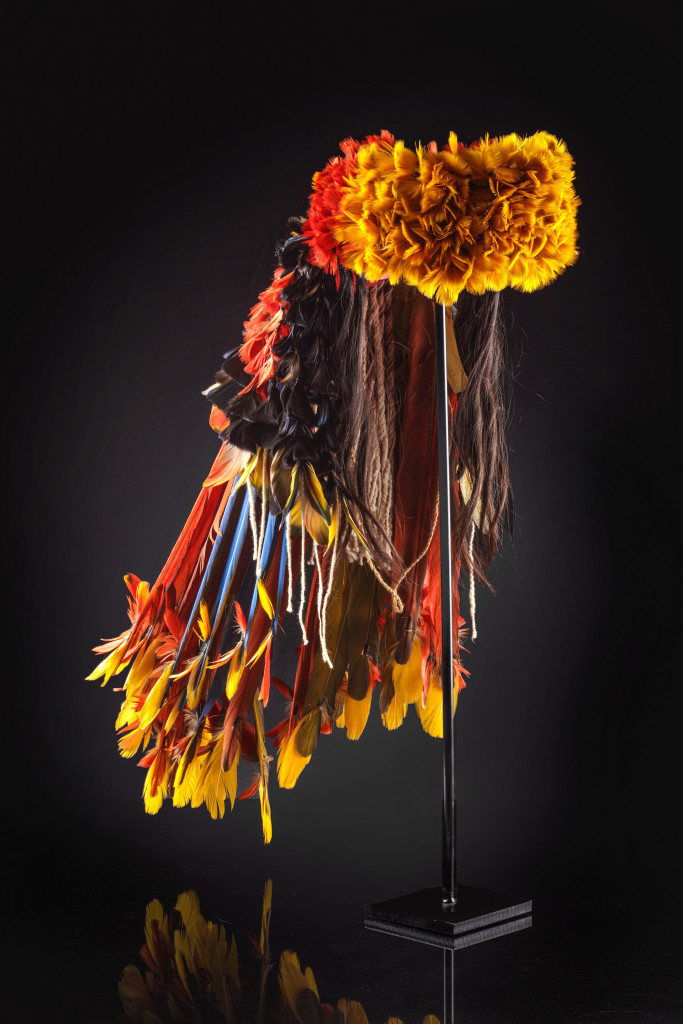
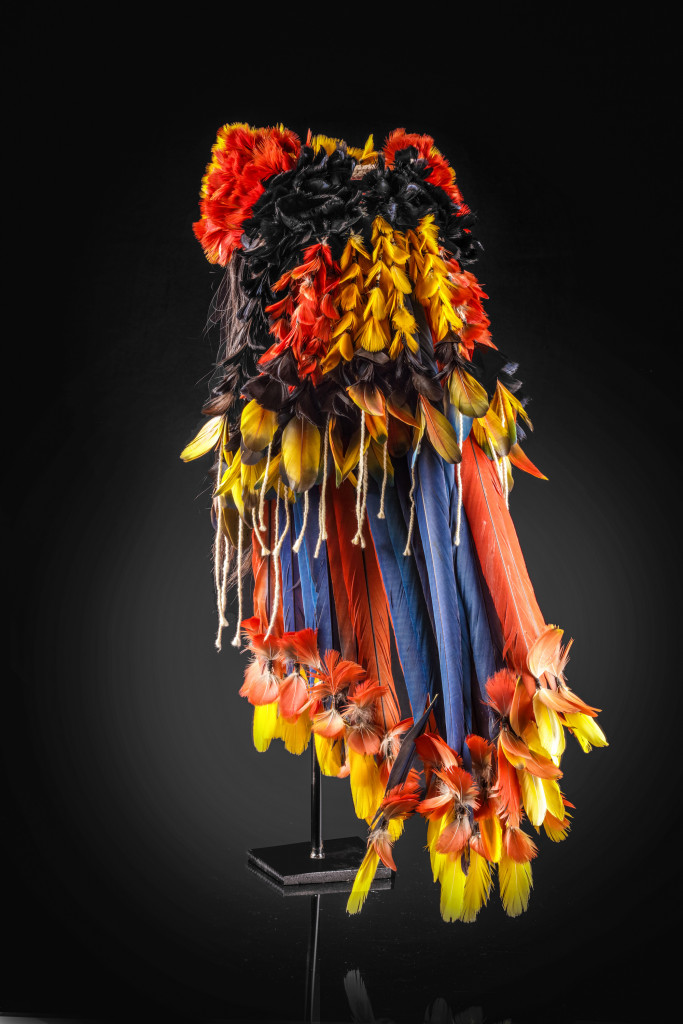
A Rikbaktsa Amazon indigenous feather and hair headdress
Brazil, Mato Grosso, Rio Juruena & Rio Sangue, collected in the 1950s-1960s
H. 65 cm (incl. stand)
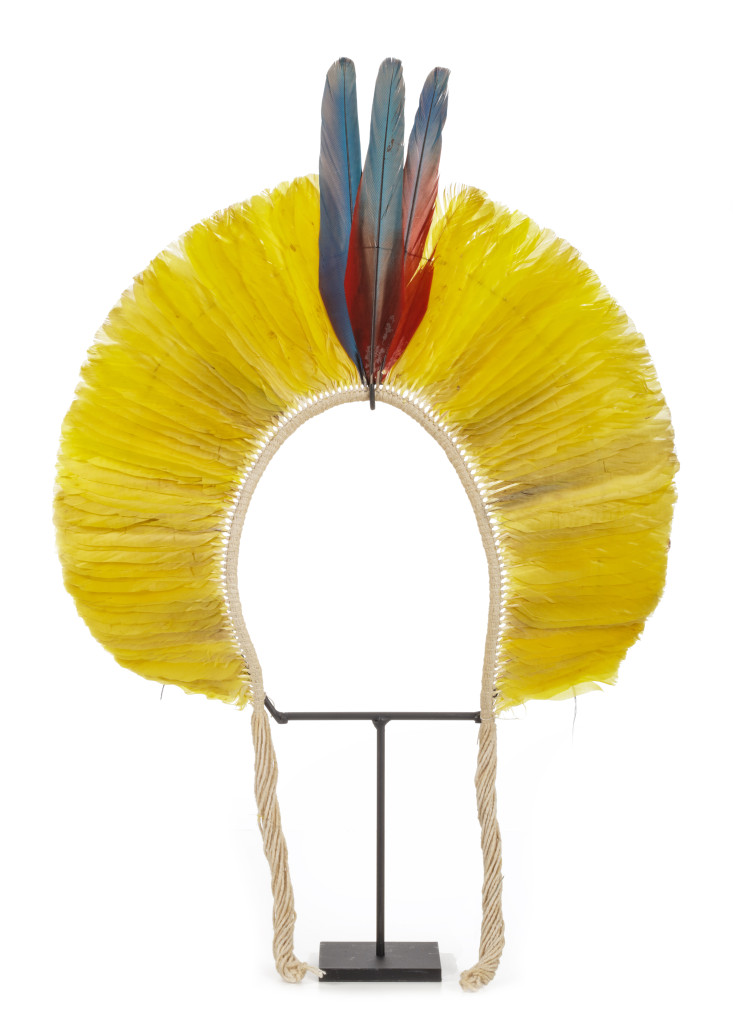
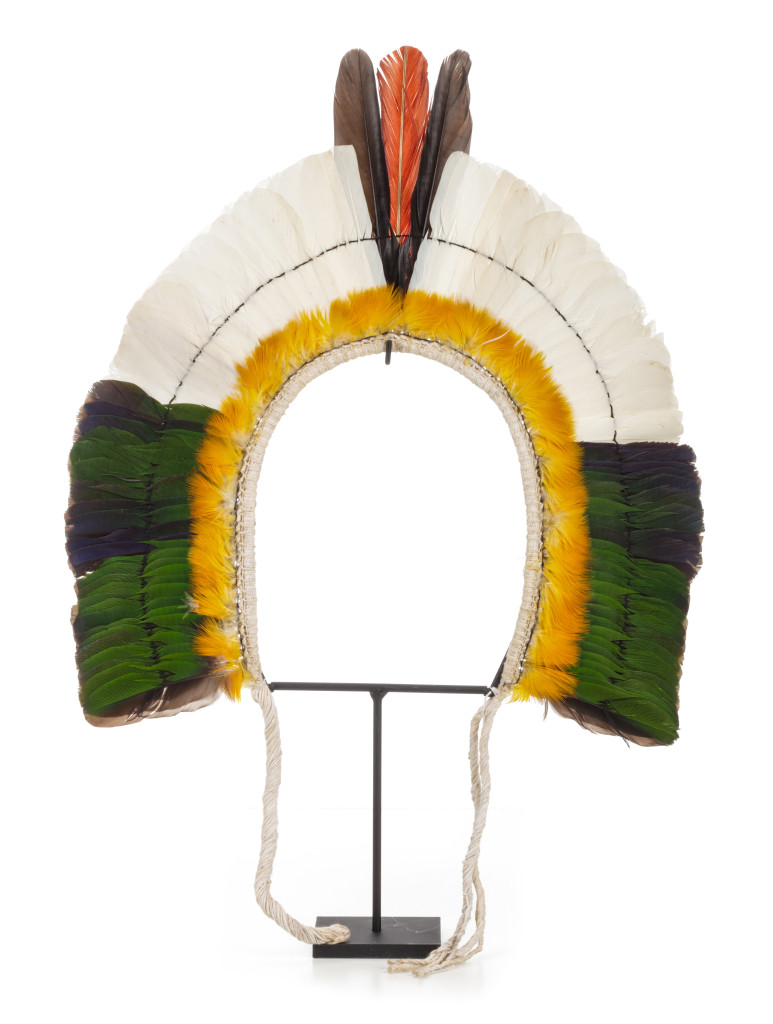
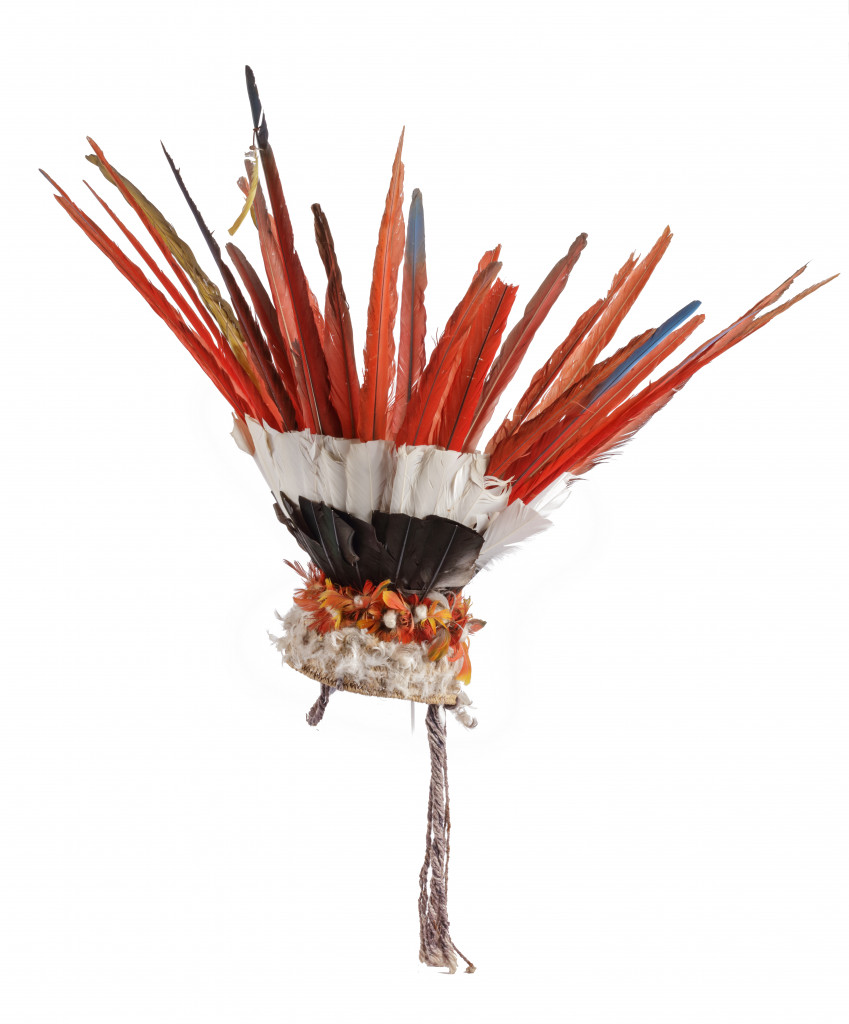
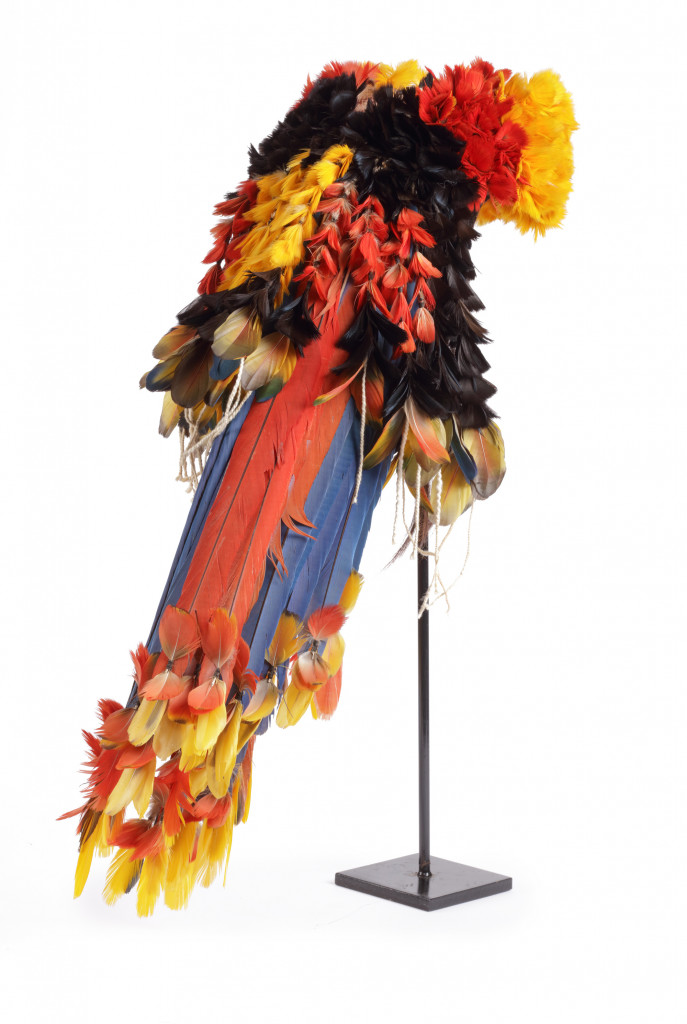
The headband is made of cotton fabric, densely covered with small tufts of feathers that were incorporated during weaving, with 21 long threads with continuing tufts and feather bundles at the ends. On the band, the tufts of feathers are placed in a banded arrangement, with black Hokko bird or Great curassow (Crax rubra) feathers alternated with feathers of the Scarlet macaw (Ara macao) and the Ariel toucan (Ramphastos ariel). Placed below the 21 threads are 29 long Scarlet macaw and Yellow-breasted blue macaw (Ara ararauna) tail feathers, each with a bunch of colourful feathers tied to the tips. Locks of black human hair are suspended from the band's sides at the wearer's ears.
The Rikbaktsa people live in the continuous Indigenous Lands Erikbaktsa (1968), Japuíra (1986) and Do Escondido (1998), in the Amazon rainforest in Brazil, Mato Grosso, and around Rio Juruena & Rio Sangue. This group’s self-denomination – Rikbaktsa – means 'the human beings’. Rik means person, human being; bak reinforces the meaning, and tsa is the suffix for the plural form. In the region they are called Canoeiros (Canoe People), in reference to their ability in the use of canoes, or, less commonly, Orelhas de Pau (Wooden Ears), due to the use of large plugs made of wood to decorate their stretched earlobes.
Since the 17th century Rikbaktsa lands have been visited by Europeans, and both have always been hostile towards each other. By repute, the Rikbaktsa always were at war with the neighbouring tribes, being known as fierce warriors. Ages of European oppression and exploitation diminished the population numbers, but in the 1970s there was a change in the approach of the missionaries towards the Indigenous, recognizing their right to their own culture. Since the end of the 1970s the Rikbaktsa have struggled to regain control over part of their traditional lands. In 1985 they managed to recover the area known as Japuíra and continued their effort to get back the Escondido region, which was finally demarcated in 1998. However, it is still occupied by miners, timber companies and colonization companies.
Provenance:
Collection of an anthropologist, Ireland (collected in the 1950s-1960s)
Literature:
- Gisela Völger & Ursula Dyckerhoff et al., Federarbeiten der Indianer Südamerikas aus der Studiensammlung
- Horst Antes, Oktagon Verlag, Stuttgart, 1995, no. 223
- Real Jardín Botánico, Arte Plumario de Brasil, Instituto de Cooperación Iberoamericana, Comisión Quinto Centenario, 1988, p. 10, fig. 215
H. 65 cm (incl. stand)
The headband is made of cotton fabric, densely covered with small tufts of feathers that were incorporated during weaving, with 21 long threads with continuing tufts and feather bundles at the ends. On the band, the tufts of feathers are placed in a banded arrangement, with black Hokko bird or Great curassow (Crax rubra) feathers alternated with feathers of the Scarlet macaw (Ara macao) and the Ariel toucan (Ramphastos ariel). Placed below the 21 threads are 29 long Scarlet macaw and Yellow-breasted blue macaw (Ara ararauna) tail feathers, each with a bunch of colourful feathers tied to the tips. Locks of black human hair are suspended from the band's sides at the wearer's ears.
The Rikbaktsa people live in the continuous Indigenous Lands Erikbaktsa (1968), Japuíra (1986) and Do Escondido (1998), in the Amazon rainforest in Brazil, Mato Grosso, and around Rio Juruena & Rio Sangue. This group’s self-denomination – Rikbaktsa – means 'the human beings’. Rik means person, human being; bak reinforces the meaning, and tsa is the suffix for the plural form. In the region they are called Canoeiros (Canoe People), in reference to their ability in the use of canoes, or, less commonly, Orelhas de Pau (Wooden Ears), due to the use of large plugs made of wood to decorate their stretched earlobes.
Since the 17th century Rikbaktsa lands have been visited by Europeans, and both have always been hostile towards each other. By repute, the Rikbaktsa always were at war with the neighbouring tribes, being known as fierce warriors. Ages of European oppression and exploitation diminished the population numbers, but in the 1970s there was a change in the approach of the missionaries towards the Indigenous, recognizing their right to their own culture. Since the end of the 1970s the Rikbaktsa have struggled to regain control over part of their traditional lands. In 1985 they managed to recover the area known as Japuíra and continued their effort to get back the Escondido region, which was finally demarcated in 1998. However, it is still occupied by miners, timber companies and colonization companies.
Provenance:
Collection of an anthropologist, Ireland (collected in the 1950s-1960s)
Literature:
- Gisela Völger & Ursula Dyckerhoff et al., Federarbeiten der Indianer Südamerikas aus der Studiensammlung
- Horst Antes, Oktagon Verlag, Stuttgart, 1995, no. 223
- Real Jardín Botánico, Arte Plumario de Brasil, Instituto de Cooperación Iberoamericana, Comisión Quinto Centenario, 1988, p. 10, fig. 215
Part of the The Americas collection.