Wolfgang Hugo Rheinhold (1853-1900)
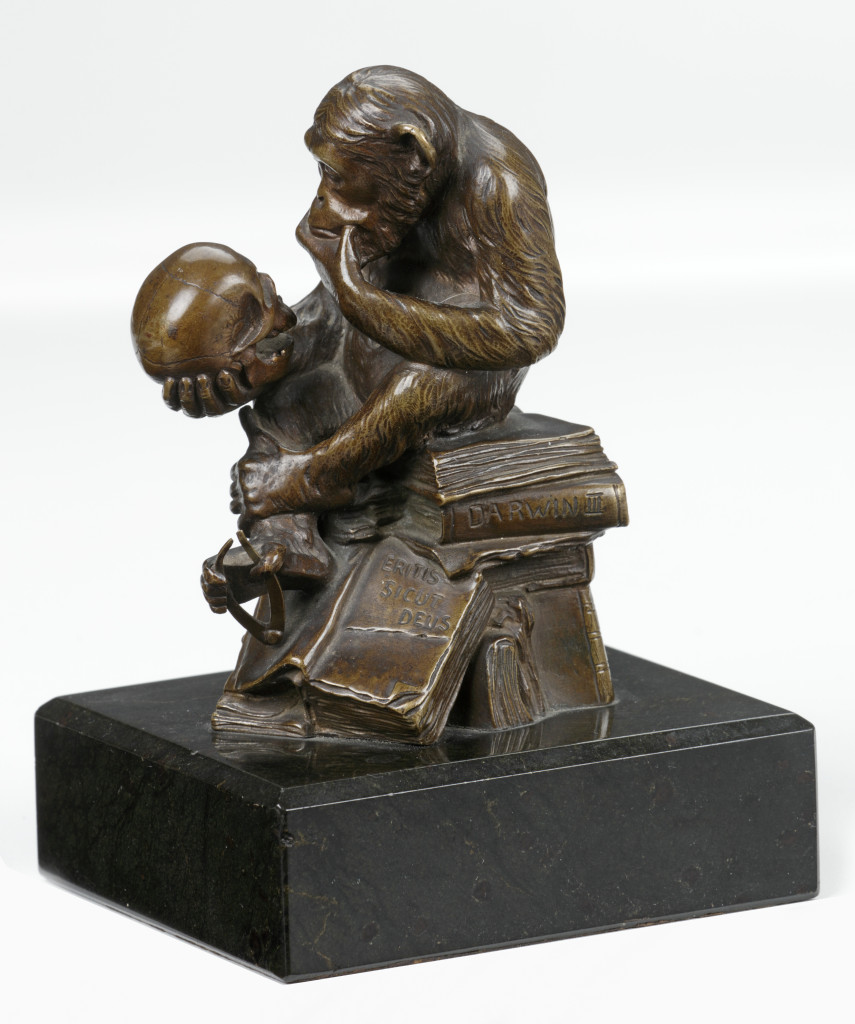
“Eritis sicut Deus” (1st half 20th century)
Bronze on a black stone plinth, H. 33.5 cm
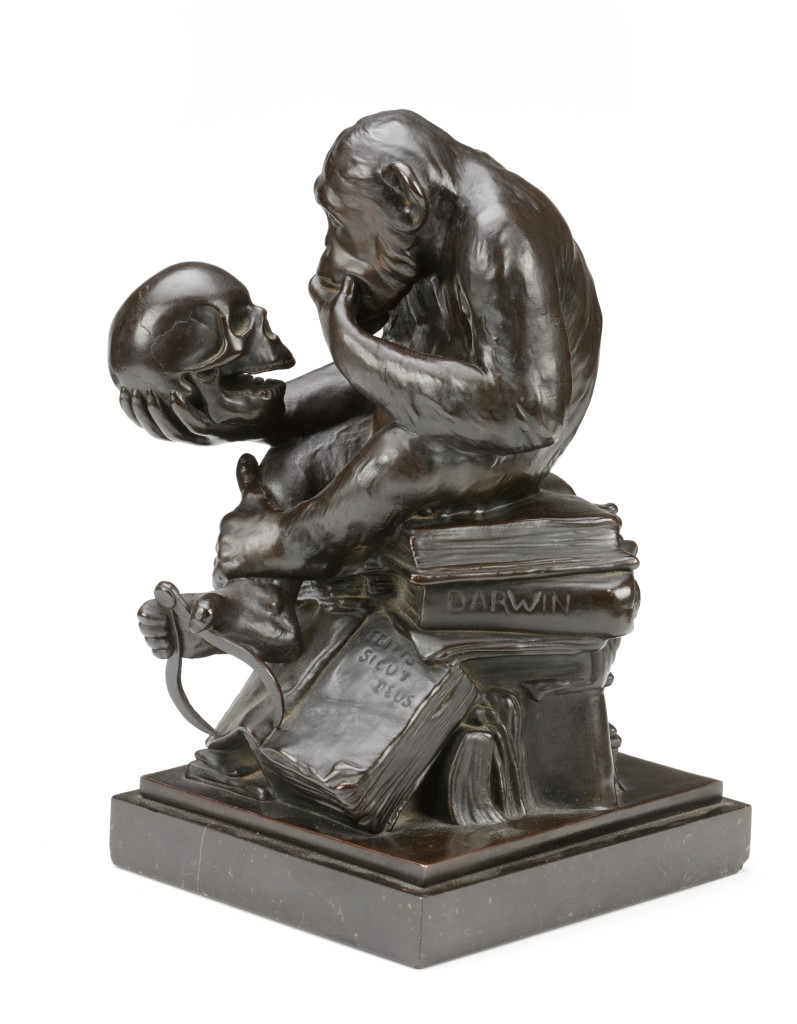
Hugo Rheinhold pursued a career in sculpture later in life. He commenced his career as a prosperous entrepreneur in Hamburg, engaging in trade between Germany and the United States. In 1879, he married; however, his wife soon passed away. He subsequently liquidated his business and relocated to Berlin, where he pursued studies in philosophy and sculpting. His most renowned sculpture is "The Ape with the Skull," created in 1892. The title “Eritus sicut Deus,” meaning "You will be like God, knowing Good and Evil," alludes to the words spoken by the serpent to Eve in Paradise. The book associated with Darwin, upon which the ape is perched, relates to On the Origin of Species, published in 1857. Despite Rheinhold's disagreement with the theory of evolution as a devout Jew, his sculpture attained significant prominence in numerous zoological and medical institutions globally, including the Department of Zoology at the University of Edinburgh, the Royal College of Surgeons in London, the Boston Medical Library, and even on Lenin's desk in the Kremlin.
In 1893, the Gladenbeck foundry in Berlin acquired the rights to cast the sculpture, a privilege they maintained until 1950.
Bronze on a black stone plinth, H. 33.5 cm
Hugo Rheinhold pursued a career in sculpture later in life. He commenced his career as a prosperous entrepreneur in Hamburg, engaging in trade between Germany and the United States. In 1879, he married; however, his wife soon passed away. He subsequently liquidated his business and relocated to Berlin, where he pursued studies in philosophy and sculpting. His most renowned sculpture is "The Ape with the Skull," created in 1892. The title “Eritus sicut Deus,” meaning "You will be like God, knowing Good and Evil," alludes to the words spoken by the serpent to Eve in Paradise. The book associated with Darwin, upon which the ape is perched, relates to On the Origin of Species, published in 1857. Despite Rheinhold's disagreement with the theory of evolution as a devout Jew, his sculpture attained significant prominence in numerous zoological and medical institutions globally, including the Department of Zoology at the University of Edinburgh, the Royal College of Surgeons in London, the Boston Medical Library, and even on Lenin's desk in the Kremlin.
In 1893, the Gladenbeck foundry in Berlin acquired the rights to cast the sculpture, a privilege they maintained until 1950.
Part of the Europe collection.