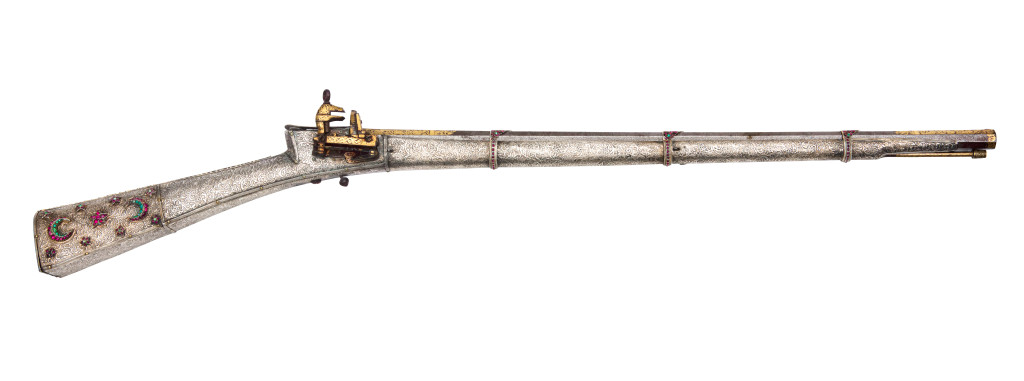
A superb bejewelled gem-set repoussé silver Ottoman miquelet flintlock rifle
L. 107.5 cm / L. 72.3 cm (barrel)
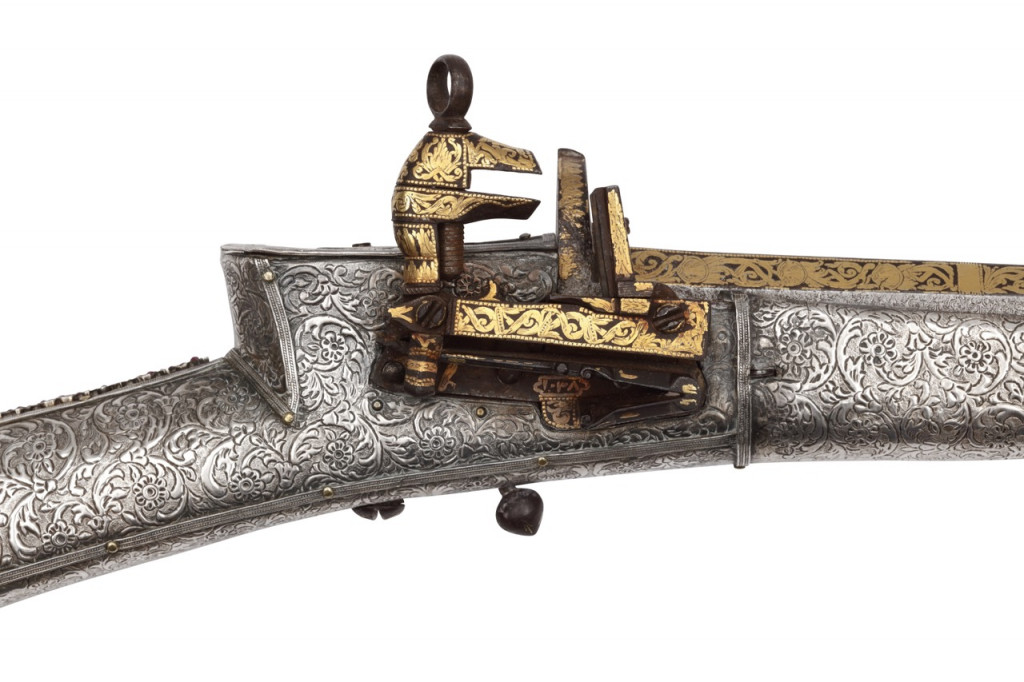
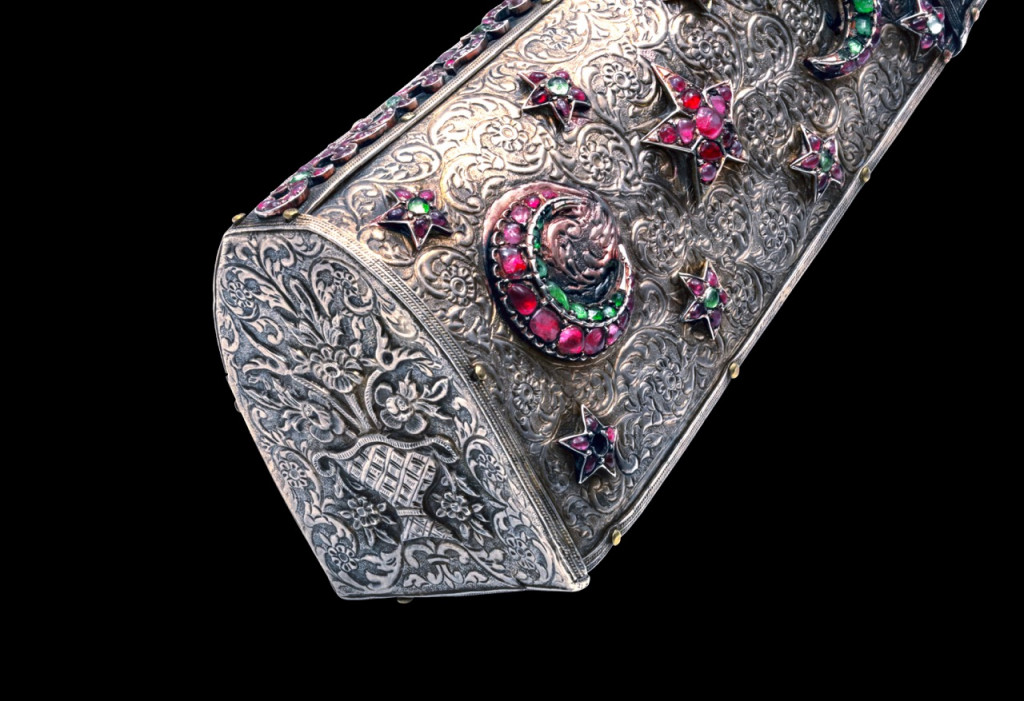
The octagonal watered steel 8-faceted barrel is damascened at the muzzle and breech with gold arabesques, with a lock with similar gold decoration dated 1038AH (1628 CE). The full stock is entirely covered in silver repoussé with floral scrolls, showing traces of gilding, decorated with two crescent moon appliques and centrally a star applique inset with cabochon-cut rubies, spinels, beryls, and emeralds.
A famous related example is the bejewelled gun, wrongly attributed as being made for Ottoman sultan Mahmud I (r. 1730- 1754) in the collection of The Walters Art Museum in Baltimore (access. no. 51.84). The Baltimore gun, however, conceals compartments for a dazzlingly adorned dagger like the one included with this gun - and a set of writing instruments. However, to get to these, one has to open the hinged door bearing the diamond- encrusted insignia or tughra of Mahmud I and the date AH 1145 (1732/33 CE). This date and the date on the gun present should not be read as the year when it was made but rather as a tribute to the past, a mistake often made by European scholars. Though in other cultures, honouring previous rulers or periods by using their name or insignia on art is very typical. The Ottoman empire evolved around the capital and only provided for its royal court. In their turn, the Sultans could gift these exuberant gifts to local rulers, such as the Khedive of Egypt, a local Shah, the Dey of Algiers or Tunis. Unfortunately, only some have survived the test of time since (probably when the Ottoman empire fell). Choosing a silver or gold coin over a silver or gold gun is more attractive, and most were melted down. Another closely related gun, a miquelet pistol, can be found in the collection of The Metropolitan Museum in New York (access no. 23.232.9), and another comparable 18th century one can be found in Robert Elgoods The Arms of Greece and Her Balkan Neighbours in the Ottoman Period, p. 34.
Provenance:
- Collection William Randolph Hearst, New York
- Private collection, New York
- Auction Parke-Bernet Galleries Inc., New York, 25 November 1953, lot 27 (ill.)
- Private collection, United States
Related objects
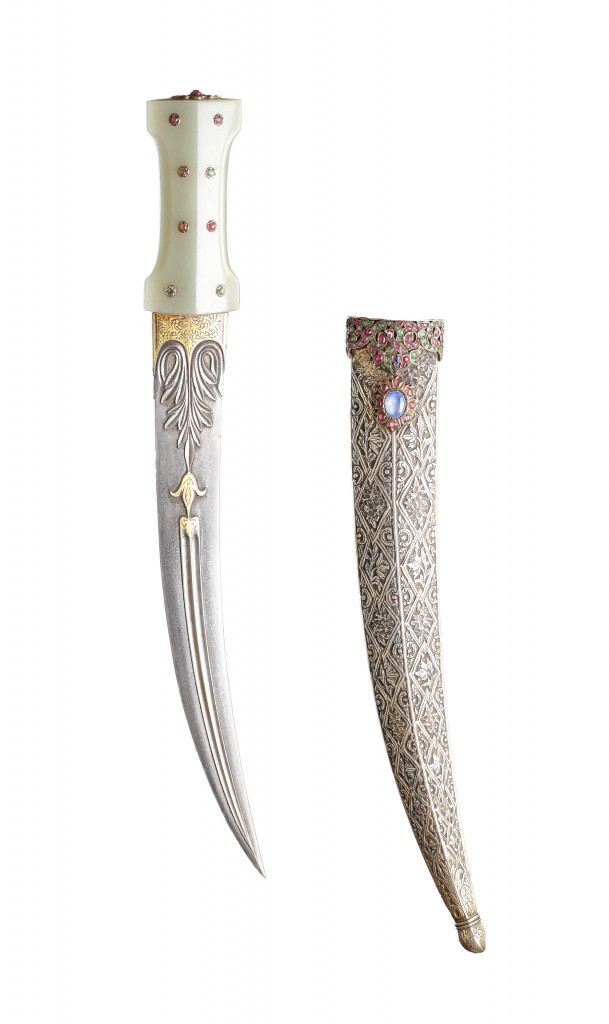
An Ottoman nephrite hilted bejewelled Ottoman hançer
The dagger’s hilt is carved from a single block of pale nephrite jade with an ethereal, luminescent glow. Eye-shaped garnets and emeralds are inset over the grip in a symmetrical arrangement using the kundan technique and evoking tiny blossoms, with a vibrant, fully open matching floral design at the top. The Damascus steel blade is slightly curved in an elegant line and of superior quality. The robust, engraved, fuller, reinforced by double grooves, rises boldly from a central, leafy design in gold on both sides of the blade. The scabbard has, just beneath the locket, a natural bright blue star sapphire (confirmed by using a digital microscope). The silver shows traces of gold inlay and has mounts exuberantly decorated with roses of numerous sparkling rubies, emeralds, spinels, and beryls.
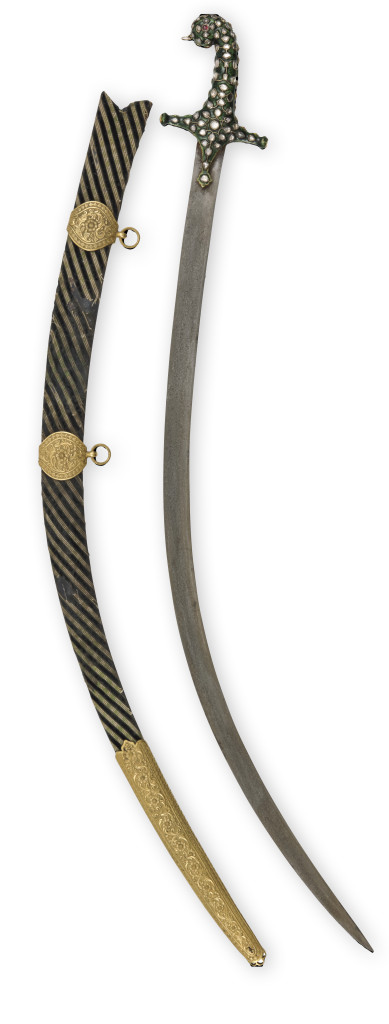
A superb Mughal green diamond-set gold enameled shamshir
The exceptionally fine pistol-grip hilt is decorated in kundan technique with diamonds and rubies set in gold, against a green enameled ground. It has a single-edged curved blade of watered steel. Including an associated striped cloth-covered sheath, two gold sheath mounts and gold chape with very fine scrolling floral repoussé decoration. The term repoussé comes from the French word meaning ‘pushed up’ or ‘raised’. It involves shaping metal from the reverse side to create intricate design and patterns on the front surface. It is achieved by hammering and shaping a sheet of metal, typically brass, gold or silver.
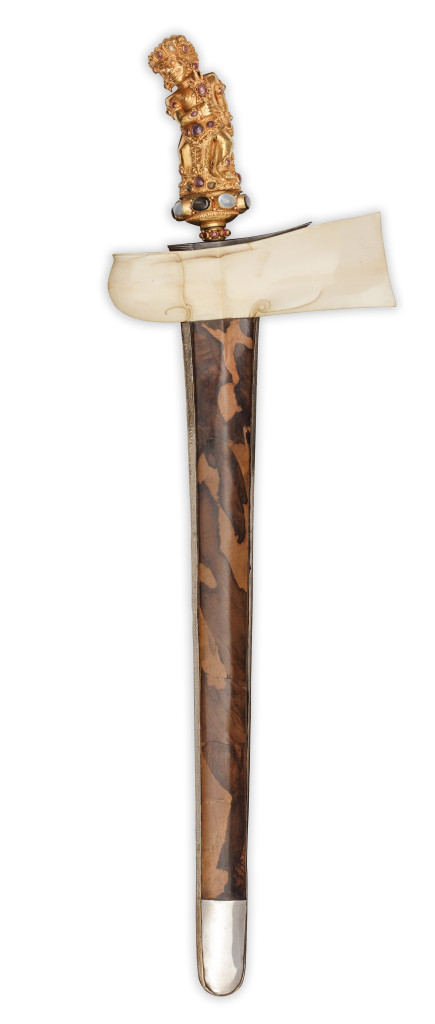
A Balinese gem-set kayu pelet and gold keris
With a dapur sempana beber, the pamor wahyu tumurun and an ivory wrangka of kekandikan form. The gandar is in penjeyer with kayu pelet holy wood with nyamel forms in the grain. The pendok in sili asih with a Bonaspati mask and floral motif, also known as lung worawari or hibiscus. The hilt in the form of Bayu in 22 carat gold, encrusted with gems, with in its arms an amrita vase for good luck.